



Agriculture and Forestry University (AFU) is a state-owned technical university of Nepal with its central office at Rampur, Chitwan. Established in 2010 under the Agriculture and Forestry University Act, 2067, the university brings agriculture, animal and veterinary sciences, fisheries, forestry, research, and extension within one university system.
Its academic structure is organized through three faculties: the Faculty of Agriculture, the Faculty of Animal Science, Veterinary Science and Fisheries, and the Faculty of Forestry. Bachelor, postgraduate, and doctoral study is available across selected disciplines under these faculties.
AFU developed from established agriculture and forestry academic units that had operated under Tribhuvan University. The agriculture unit and Dean's Office at Rampur and the forestry campus at Hetauda became part of the new university structure. Rampur remains the location of the central office and the Faculty of Agriculture, while Hetauda is the main location of the Faculty of Forestry.
The university follows a land-grant model built around teaching, research, and extension. Its academic work is supported by research programs, farms, curriculum services, student-welfare functions, a Veterinary Teaching Hospital, and extension activities related to agriculture and allied disciplines.
| Field | Details |
|---|---|
| University name | Agriculture and Forestry University |
| Abbreviation | AFU |
| University type | State-owned technical university |
| Established | 2010 (2067 BS) |
| Legal basis | Agriculture and Forestry University Act, 2067 |
| Central office | Rampur, Chitwan, Nepal |
| Main academic faculties | 3 |
| Main academic areas | Agriculture; animal and veterinary sciences; fisheries; forestry and natural resources |
| Bachelor-level programs | B.Sc. Agriculture; B.V.Sc. & A.H.; B.Sc. Fisheries; B.Sc. Forestry |
| Official website | https://www.afu.edu.np/ |
| Admission portal | https://admission.afu.edu.np/ |
AFU was established as a separate university system for higher education, research, and extension in agriculture, livestock, veterinary science, fisheries, forestry, and related disciplines.
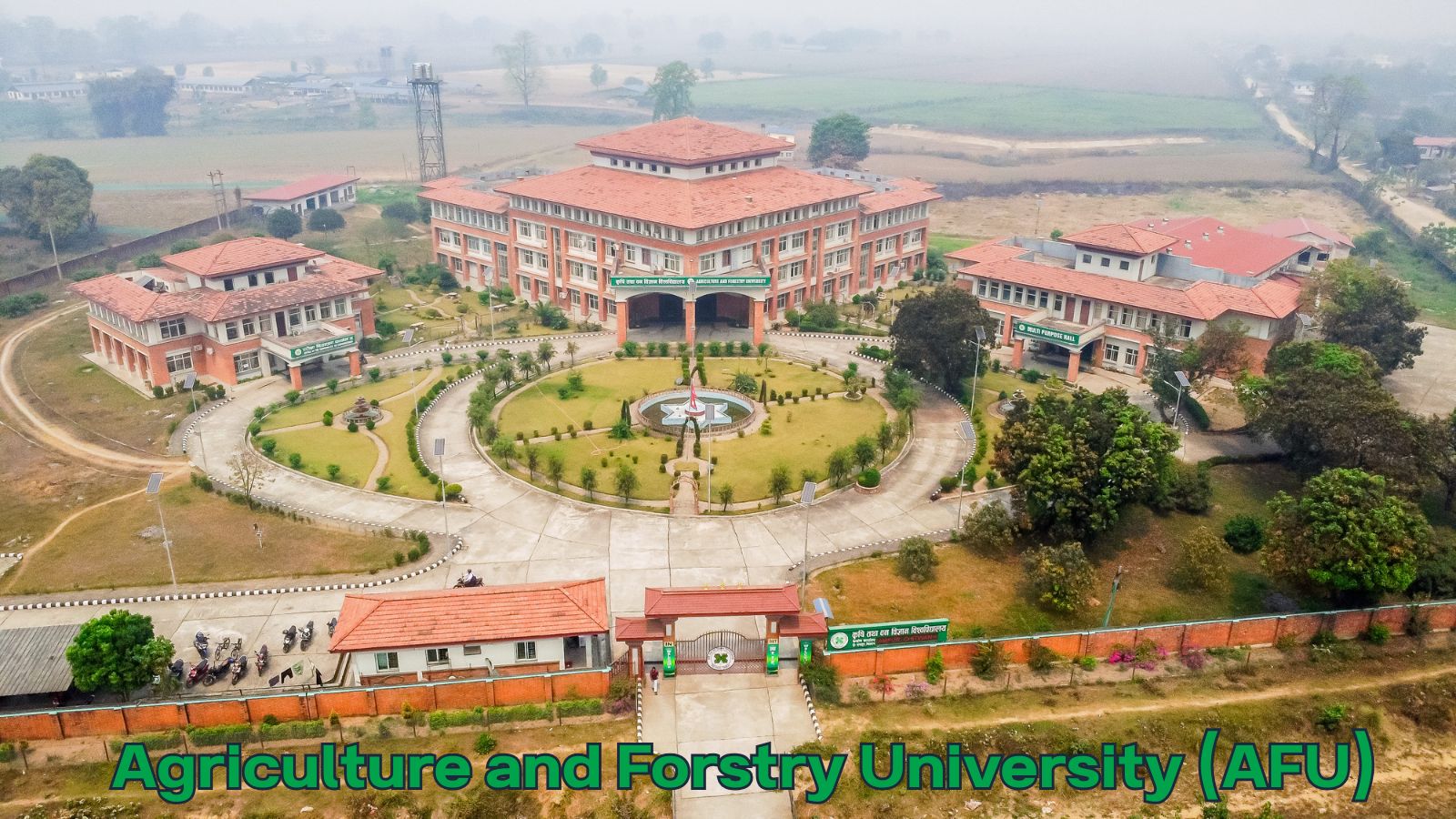
Its academic responsibilities extend beyond degree teaching. Faculty members participate in research and development activities, while postgraduate students contribute through thesis and dissertation research in areas connected with agriculture, livestock, fisheries, forestry, and other subjects within the university's academic scope.
The land-grant model gives AFU a three-part institutional structure. Teaching provides the academic foundation, research develops knowledge and technical understanding, and extension connects university activities with farmers, rural communities, sector stakeholders, and other groups outside the classroom.
Practical academic activity is also part of this structure. Farms, fieldwork, internships, experience-based learning, veterinary clinical work, and research activities support different programs according to their subject requirements.
AFU's academic areas place crop science, animal production, veterinary medicine, fisheries, forestry, natural resources, rural development, and associated technical fields within the same university framework. This gives the institution a specialized academic focus centered on agriculture and natural-resource education.
Agriculture and Forestry University was established in 2010 under the Agriculture and Forestry University Act, 2067. The legislation is recorded as Act No. 3 of 2067.
Before the creation of AFU, the academic units that formed its institutional base operated under Tribhuvan University. The Institute of Agriculture and Animal Sciences at Rampur, the forestry campus at Hetauda, and the Dean's Office of IAAS at Rampur were incorporated into the new university arrangement.
That history continues to shape the university's main academic locations. Rampur in Chitwan houses the central office and Faculty of Agriculture. Hetauda in Makawanpur is the location of the Faculty of Forestry.
AFU later expanded teaching through constituent Colleges of Natural Resource Management in several districts. Agriculture education now extends beyond Rampur, and forestry study is also offered through a constituent college in Udayapur.
The university's first strategic planning period covered 2013–2023. Its second strategic plan covers 2023–2032 and includes teaching, research, extension, support activities, welfare services, digitalization, sustainability, and institutional management.
AFU's vision places the university within a land-grant model concerned with food and nutrition security, climate resilience, economic activity, and social equity in Nepal.
Its mission centers on teaching, research, and extension in agriculture, livestock, fisheries, and forestry, with the wider purpose of contributing to the quality of life of people in Nepal.
The university's academic objectives include education, practical skill development, research, industry and stakeholder connection, sustainable agricultural and natural-resource practices, and community engagement.
Within this framework, AFU works toward:
Providing academic education in agriculture and related disciplines.
Developing practical knowledge and skills through fieldwork and experience-based study.
Conducting research in agriculture, animal sciences, fisheries, forestry, and associated subjects.
Connecting academic programs with farmers, industry stakeholders, rural communities, and relevant organizations.
Addressing environmental conservation and resource use within agriculture and allied disciplines.
Sharing technical knowledge through extension and outreach activities.
Supporting student participation in research, internships, field learning, and practical academic work.
These areas operate within the same institutional model rather than as separate university functions.
AFU organizes its principal academic programs through three faculties, each responsible for a major area of study.
The Faculty of Agriculture is based at Rampur, Chitwan. It provides undergraduate, postgraduate, and doctoral study in agricultural sciences.
B.Sc. Agriculture is the main bachelor-level program under the faculty. Its academic coverage includes crop science, horticulture, agricultural economics, soil science, livestock-related study, aquaculture, rural sociology, and other agricultural subjects.
The curriculum also includes a Learning for Entrepreneurial Experience component in the final semester.
The range of subjects reflects the multidisciplinary nature of agricultural study. Crop production and plant sciences are studied alongside economics, livestock, aquaculture, soils, and the social dimensions of rural and agricultural systems.
Undergraduate agriculture education also operates through constituent Colleges of Natural Resource Management in Kaski, Sindhuli, Dhankuta, Mahottari, Banke, Rolpa, Kailali, and Dailekh.
At postgraduate level, the Faculty of Agriculture offers M.Sc. and doctoral study in selected agricultural disciplines. Research forms an important part of postgraduate study through thesis and dissertation work.
The faculty also works within AFU's wider farm and research system. Agronomy and horticulture farms, research activities, curriculum services, and extension functions provide practical and academic support for agricultural study.
The Faculty of Animal Science, Veterinary Science and Fisheries covers animal science, veterinary medicine, fisheries, and related disciplines.
At bachelor level, the faculty includes:
Bachelor of Veterinary Science and Animal Husbandry (B.V.Sc. & A.H.)
B.Sc. Fisheries
Its departmental structure covers several specialized academic areas:
Animal breeding and biotechnology
Animal nutrition and fodder production
Aquaculture
Aquatic resources
Livestock production and management
Veterinary medicine and public health
Microbiology and parasitology
Pathology and clinics
Surgery and pharmacology
Theriogenology
Veterinary anatomy, physiology and biochemistry
These departments provide the academic base for animal, veterinary, and fisheries study.
Veterinary education combines biological science, animal health, clinical disciplines, reproduction, public health, pathology, surgery, nutrition, breeding, and livestock management. Fisheries education is supported by academic work in aquaculture and aquatic resources.
The faculty also offers postgraduate and doctoral study in selected animal-science, veterinary, and fisheries disciplines.
A Veterinary Teaching Hospital supports veterinary teaching, clinical learning, research, and service functions. It provides a practical setting connected with veterinary education and the clinical subjects taught under the faculty.
Aquaculture and livestock farms are also part of the university's practical academic system. These units support teaching, demonstration, and production-related activities connected with fisheries, animal science, and veterinary education.
The Faculty of Forestry is located in Hetauda, Makawanpur. Forestry education at this location continues the academic role of the forestry institution that became part of AFU at the time of the university's establishment.
The B.Sc. Forestry program under AFU began in 2013. The faculty provides B.Sc. Forestry at bachelor level and M.Sc. Forestry at postgraduate level. Doctoral study in forestry also operates within the university's postgraduate system.
Forestry education combines academic study with research and field-oriented work connected with forests and natural resources.
AFU's forestry teaching also extends beyond Hetauda through the College of Natural Resource Management at Katari, Udayapur. The college operates under the Faculty of Forestry and offers B.Sc. Forestry.
A forest nursery forms part of the university's farm structure and supports forestry-related teaching and practical work.
AFU provides bachelor, postgraduate, and doctoral education across its three faculties.
| Faculty | Bachelor level | Higher study |
|---|---|---|
| Faculty of Agriculture | B.Sc. Agriculture | M.Sc. and PhD study in selected agricultural disciplines |
| Faculty of Animal Science, Veterinary Science and Fisheries | B.V.Sc. & A.H.; B.Sc. Fisheries | M.Sc./M.V.Sc. and PhD study in selected animal, veterinary, and fisheries disciplines |
| Faculty of Forestry | B.Sc. Forestry | M.Sc. Forestry and doctoral study in forestry |
The availability of particular postgraduate and doctoral specializations may differ between academic intakes.
AFU's undergraduate structure includes four principal degree programs covering agriculture, veterinary science and animal husbandry, fisheries, and forestry.
B.Sc. Agriculture is offered through the Faculty of Agriculture and constituent Colleges of Natural Resource Management.
Its academic coverage includes crop science, horticulture, soil science, economics, livestock, aquaculture, rural sociology, and other agricultural subjects.
The program includes practical and experience-oriented study in addition to classroom-based academic work. The final-semester Learning for Entrepreneurial Experience component forms part of this structure.
Students study agricultural production together with economic, environmental, biological, and social aspects of agriculture.
The Bachelor of Veterinary Science and Animal Husbandry is offered through the Faculty of Animal Science, Veterinary Science and Fisheries.
The faculty's departments cover animal health, clinical sciences, livestock production, nutrition, breeding, biotechnology, public health, pathology, microbiology, parasitology, surgery, pharmacology, reproduction, anatomy, physiology, and biochemistry.
Veterinary study is supported by the Veterinary Teaching Hospital, which provides a setting for clinical and practical academic work.
B.Sc. Fisheries is offered through the Faculty of Animal Science, Veterinary Science and Fisheries.
Aquaculture and aquatic resources form part of the faculty's departmental structure. The university's aquaculture farm also supports practical and production-related academic activity.
Fisheries study therefore sits within a wider faculty that also covers animal science and veterinary disciplines.
B.Sc. Forestry is offered through the Faculty of Forestry in Hetauda and through the College of Natural Resource Management at Katari, Udayapur.
The program operates within a faculty involved in forestry teaching, postgraduate study, research, and practical academic work.
The forest nursery within AFU's farm system also supports forestry-related practical learning.
AFU extends agriculture and forestry teaching through constituent Colleges of Natural Resource Management in several districts.
| Unit or teaching location | District | Academic role |
|---|---|---|
| Central agriculture campus, Rampur | Chitwan | Faculty of Agriculture and higher study in agricultural sciences |
| CNRM Puranchaur | Kaski | Constituent college under Faculty of Agriculture |
| CNRM Marin, Kapilakot | Sindhuli | Constituent college under Faculty of Agriculture |
| CNRM Pakhribas | Dhankuta | Constituent college under Faculty of Agriculture |
| CNRM Bardibas | Mahottari | Constituent college under Faculty of Agriculture |
| CNRM Khajura | Banke | Constituent college under Faculty of Agriculture |
| CNRM Madichaur | Rolpa | Constituent college under Faculty of Agriculture |
| CNRM Tikapur | Kailali | Constituent college under Faculty of Agriculture |
| CNRM Dullu | Dailekh | Constituent college under Faculty of Agriculture |
| Faculty of Forestry, Hetauda | Makawanpur | Main Faculty of Forestry teaching location |
| CNRM Katari | Udayapur | Constituent college under Faculty of Forestry; B.Sc. Forestry |
This structure gives AFU teaching locations outside its central office. Agriculture programs operate through Rampur and multiple constituent colleges, while forestry study is centered in Hetauda and also available at Katari.
Research and extension are core university functions alongside teaching.
Faculty members take part in research and development activities across agriculture and allied disciplines. Postgraduate students contribute through thesis and dissertation work in agriculture, livestock, fisheries, forestry, and related areas.
Research is connected with the academic areas represented by the university's faculties and practical units.
Extension links university knowledge with farmers, rural communities, policymakers, and other stakeholders. AFU's institutional objectives include outreach, technical knowledge sharing, and activities connected with Agriculture Science Centers.
The relationship between teaching, research, and extension also supports field-based academic work. Depending on the discipline, learning may involve farms, laboratories, clinical settings, field observation, demonstrations, research, or interaction with communities and sector stakeholders.
The Directorate of Farm includes five main types of university farm:
Agronomy farm
Horticulture farm
Aquaculture farm
Livestock farm
Forest nursery
Each unit corresponds with an academic area represented within AFU.
The agronomy and horticulture farms support agriculture-related teaching and practical activity. The aquaculture farm is connected with fisheries study, while the livestock farm supports animal and veterinary education. The forest nursery provides a practical setting related to forestry.
Fieldwork, internships, and experience-based study also form part of AFU's academic objectives. The form of practical learning differs by program and discipline.
Agriculture students may encounter farm and field activities. Veterinary students have access to clinical learning through the Veterinary Teaching Hospital. Fisheries students study within an academic structure that includes aquaculture and aquatic resources. Forestry students are connected with field-oriented study and nursery activities.
The Veterinary Teaching Hospital forms part of AFU's veterinary academic and service system.
It supports:
Veterinary teaching
Clinical learning
Research
Practical training
Service functions
The hospital works alongside the departments of the Faculty of Animal Science, Veterinary Science and Fisheries.
Its academic role connects veterinary classroom study with clinical subjects such as medicine, pathology, surgery, public health, reproduction, and other areas represented within the faculty.
AFU maintains a Curriculum Development Center responsible for curriculum development, curriculum revision, and academic-equivalence functions.
The center supports academic programs across the university's different disciplines. Agriculture, veterinary science, fisheries, and forestry all require organized theoretical and practical course structures, and curriculum management provides the formal academic basis for this work.
Published syllabi provide program-level information on subjects and academic structure where available.
For students, syllabus information is useful when examining the academic content and progression of a particular program.
The Directorate of Student Welfare manages university-level student support functions.
Its responsibilities include:
Hostel management and room-allotment procedures.
Extracurricular activities.
Short training activities.
Educational tours.
Scholarship management for outstanding students according to university rules.
Counselling connected with teaching, research, further study, and career development.
Availability of individual services depends on the applicable university rules, notices, resources, and academic location.
Because AFU operates through central faculties and constituent colleges in several districts, some student-support arrangements may operate at the level of the relevant academic unit.
The Vice Chancellor is the primary executive officer of Agriculture and Forestry University.
The Chancellor, who is the Prime Minister of Nepal, appoints the Vice Chancellor on the recommendation of a specially constituted committee.
The Vice Chancellor oversees the university's academic, administrative, and financial affairs and is responsible for the overall functioning of the institution. The position also carries authority related to university policies, rules, and regulations.
The Registrar serves as the chief administrative and financial officer. The Chancellor appoints the Registrar on the recommendation of the Vice Chancellor.
The Registrar's responsibilities include:
General administration and day-to-day institutional operations.
Financial management, budgeting, revenue, and audit-related work.
Personnel administration and staff records.
Procurement of goods, equipment, and services.
University property management and records.
Statutory responsibilities connected with the University Senate.
Administrative coordination of training, seminars, symposiums, and university academic events.
The General Administration Division supports central university operations through procurement, storage management, inspection of physical assets, utilities, correspondence, records, and other administrative activities.
AFU's first strategic planning period covered 2013–2023. Its second strategic plan covers 2023–2032.
The current planning period addresses:
Teaching
Research
Extension
University support activities
Welfare services
Digitalization
Sustainability
Institutional management
The plan continues the university's land-grant framework and its teaching, research, and extension model.
It also provides a common institutional direction for faculties, research units, farms, constituent colleges, student services, and administrative divisions operating within the university system.
AFU manages student admission through university entrance notices and its online admission system.
Admission conditions vary by intake. Eligibility, application schedules, fees, seats, quotas, entrance procedures, required documents, and other conditions may therefore change from one admission cycle to another.
Admission portal: https://admission.afu.edu.np/
Official website: https://www.afu.edu.np/
Students considering AFU can narrow their academic search by first identifying the faculty and location connected with their intended program.
Useful points to review include:
The faculty responsible for the intended program.
The teaching location of the program.
The current program syllabus.
Eligibility and entrance requirements for the relevant intake.
Postgraduate specialization availability where applicable.
Current doctoral opportunities for PhD applicants.
Hostel, scholarship, training, and student-welfare notices.
Current admission dates and application procedures.
Program location is especially important because AFU's academic activity is distributed across Rampur, Hetauda, and constituent Colleges of Natural Resource Management in different districts.
AFU brings several related technical disciplines together within the same university system.
Agriculture covers crop production, horticulture, soils, economics, livestock-related study, aquaculture, and rural subjects. Veterinary and animal sciences address animal health, production, nutrition, reproduction, clinical study, public health, and related biological sciences. Fisheries includes aquaculture and aquatic resources. Forestry focuses on forests and natural-resource study.
Each field has its own academic structure, but research, farms, field activities, extension, and practical learning create connections across the university.
At undergraduate level, these connections appear through farm activities, practical classes, clinical work, field learning, and experience-based components. At postgraduate and doctoral levels, research becomes a larger part of academic work through thesis and dissertation study.
AFU's academic system therefore combines degree education with research, practical facilities, clinical work, curriculum management, extension, and student support across multiple locations.
Agriculture and Forestry University is a state-owned technical university established in 2010 under the Agriculture and Forestry University Act, 2067. Its central office is at Rampur, Chitwan.
The university has three main faculties:
Faculty of Agriculture
Faculty of Animal Science, Veterinary Science and Fisheries
Faculty of Forestry
Its main bachelor-level programs are B.Sc. Agriculture, B.V.Sc. & A.H., B.Sc. Fisheries, and B.Sc. Forestry. Postgraduate and doctoral study is also available in selected disciplines.
Academic activity extends from Rampur and Hetauda to constituent Colleges of Natural Resource Management in several districts. Research, extension, university farms, the Veterinary Teaching Hospital, curriculum development, and student-welfare functions operate alongside the university's degree programs.
AFU's institutional model is based on teaching, research, and extension within agriculture, livestock, veterinary science, fisheries, forestry, and natural resources. Admission conditions are issued by academic intake, while the university's faculty structure, academic locations, and principal degree areas form its continuing institutional framework.
Agriculture and Forestry University (AFU) has its central office at Rampur, Chitwan, Nepal. Its Faculty of Agriculture is based in Rampur, while the Faculty of Forestry is located in Hetauda, Makawanpur. AFU also operates constituent Colleges of Natural Resource Management in several districts.
Agriculture and Forestry University was established in 2010 (2067 BS) under the Agriculture and Forestry University Act, 2067.
Yes. AFU is a state-owned technical university of Nepal.
AFU has three main academic faculties:
Faculty of Agriculture
Faculty of Animal Science, Veterinary Science and Fisheries
Faculty of Forestry
The main bachelor-level programs are:
B.Sc. Agriculture
Bachelor of Veterinary Science and Animal Husbandry (B.V.Sc. & A.H.)
B.Sc. Fisheries
B.Sc. Forestry
AFU also provides postgraduate and doctoral study in selected disciplines.
The Faculty of Agriculture is based at Rampur, Chitwan. Agriculture education also extends through constituent Colleges of Natural Resource Management in Kaski, Sindhuli, Dhankuta, Mahottari, Banke, Rolpa, Kailali, and Dailekh.
The Faculty of Forestry is located in Hetauda, Makawanpur. B.Sc. Forestry is also offered through the College of Natural Resource Management at Katari, Udayapur.
Yes. The Faculty of Animal Science, Veterinary Science and Fisheries offers B.V.Sc. & A.H. and B.Sc. Fisheries at bachelor level. The faculty also provides postgraduate and doctoral study in selected animal-science, veterinary, and fisheries disciplines.
AFU maintains practical and academic units connected with its major disciplines. These include agronomy, horticulture, aquaculture and livestock farms, a forest nursery, and a Veterinary Teaching Hospital. Practical learning may also include fieldwork, clinical learning, research, internships, and experience-based study according to the program.
Yes. Research and extension operate alongside teaching as core university functions. Faculty members and postgraduate students participate in research, while extension activities connect university knowledge with farmers, rural communities, policymakers, and other stakeholders.
The Directorate of Student Welfare handles functions that include hostel management, room-allotment procedures, scholarship management for outstanding students according to university rules, extracurricular activities, educational tours, short training activities, and counselling. Availability depends on applicable rules, notices, resources, and academic location.
AFU manages admission through university entrance notices and its online admission system. Eligibility, application schedules, fees, seats, quotas, entrance procedures, and required documents can vary by academic intake.
