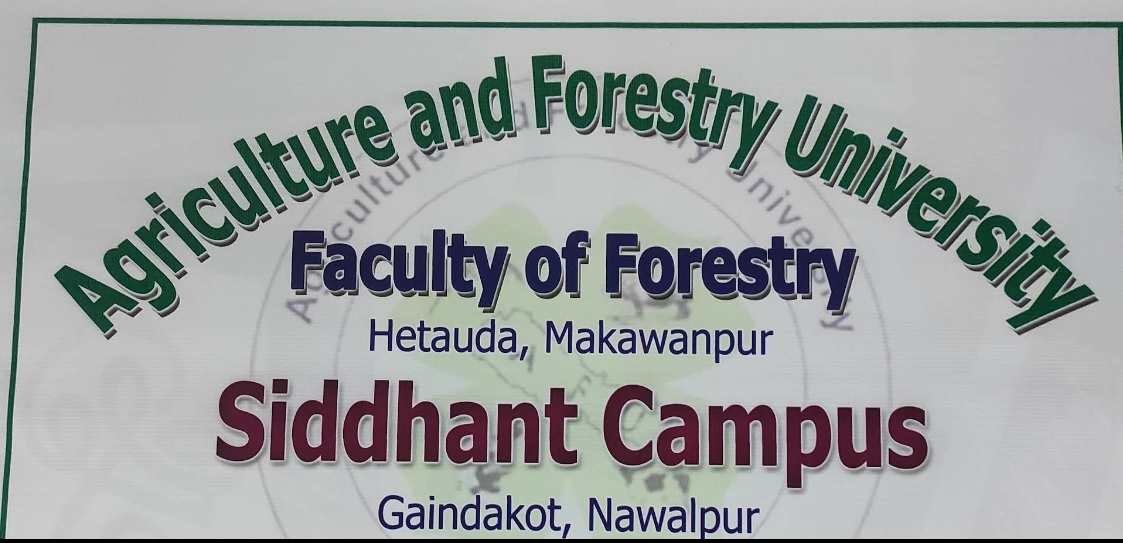
Siddhant Campus is a forestry-focused academic institution located in Gaindakot-6, Nawalparasi, Nepal. Established in 2070 B.S., the campus was founded to contribute to the development of skilled human resources in natural resource management and conservation.
The campus offers the B.Sc. Forestry program affiliated with Agriculture and Forestry University (AFU). The four-year program is organized into eight semesters and combines classroom teaching with practical classes, field practice, laboratory work, and research. Alongside academic study, Siddhant Campus gives attention to discipline, responsibility, lifelong learning, and the personal development of students.
| Particular | Details |
|---|---|
| Institution | Siddhant Campus |
| Established | 2070 B.S. (2010 AD) |
| Location | Gaindakot-6, Nawalparasi, Nepal |
| Academic Focus | Forestry and Natural Resource Management |
| Program | B.Sc. Forestry |
| Duration | Four years / Eight semesters |
| Affiliation | Agriculture and Forestry University (AFU) |
| Faculty Context | Faculty of Forestry (FOF) |
| Director | Chhabi Lal Kandel |
Siddhant Campus concentrates its academic work on forestry and natural resource management. Its educational direction reflects the need for trained people who can understand forests not only as natural ecosystems but also as resources that require careful management, conservation, and responsible use.
The campus connects forestry education with concerns such as biodiversity conservation, wildlife management, climate change, carbon management, urban forestry, forest operations, and natural resource sustainability.
This focus gives the B.Sc. Forestry program a clear subject identity. Rather than presenting forestry only as classroom study, the campus relates academic learning to practical work, field exposure, and environmental issues associated with forests and natural resources.
Siddhant Campus offers the B.Sc. Forestry program under affiliation with Agriculture and Forestry University.
| Program | Duration | Affiliation |
|---|---|---|
| B.Sc. Forestry | Four years / Eight semesters | Agriculture and Forestry University (AFU) |
The program combines teaching, field practice, practical classes, laboratory work, and research components. This structure allows students to connect academic concepts with observation and practical learning.
Forestry is a field that requires an understanding of ecosystems, vegetation, wildlife, natural resources, and human use of forests. The academic approach at Siddhant Campus reflects this combination of scientific study and applied learning.
Practical learning forms an important part of the academic environment at Siddhant Campus. Students take part in practical classes, laboratory activities, field practice, and research-oriented learning alongside classroom instruction.
This approach is relevant to forestry because many concepts become clearer when students can observe natural processes, environmental conditions, and resource-management practices beyond theoretical lessons.
The campus encourages students to understand subject matter through practical application, demonstration, and observation. Field practice further connects academic study with the environmental settings in which forestry knowledge is applied.
The academic direction of Siddhant Campus includes several areas related to forestry and natural resource management:
Forest operations
Urban forestry
Wildlife conservation and management
Biodiversity conservation and management
Natural resource sustainability
Carbon management
Climate change
Forest ecosystem management
Natural resource conservation
These areas reflect some of the environmental and management concerns that forestry professionals may encounter.
Population pressure on forests, changing climate conditions, fire risks, and the movement of pests can affect forest ecosystems. Carbon management and urban forestry also form part of the broader discussion around how forestry professionals respond to changing environmental and human needs.
A practitioner of forestry is known as a forester. Forestry work can involve the management, conservation, restoration, and responsible use of forests and associated natural resources.
Activities connected with forestry may include:
Ecological restoration
Timber harvesting and forest operations
Protection of natural resources
Preparation of forest management plans
Management of public and privately owned forest land
Selection of sites for tree planting
Planning and supervision of forestry projects
Forest ecosystem management
Promotion of renewable forest products
The profession therefore involves both environmental understanding and practical management responsibilities.
Siddhant Campus brings together teachers, professors, instructors, staff members, classrooms, practical classes, laboratories, field practice, and research activities within its forestry program.
The campus also places importance on student development beyond academic performance. Its educational values include:
Discipline
Lifelong learning
Respect
Responsibility
Honesty
Acceptance
Compassion
These values are connected with the campus's broader approach to personal development and student welfare.
Parents are also encouraged to maintain contact with faculty members and campus management. This reflects an approach in which communication among students, teachers, families, and the administration forms part of the educational environment.
Laboratory and practical activities support the applied nature of forestry education at Siddhant Campus.
Students are encouraged to observe, demonstrate, and apply what they study rather than depend only on theoretical instruction. Practical classes and laboratory work provide settings where academic concepts can be examined more closely.
Together with field practice, these activities support the connection between classroom learning and the physical and environmental conditions relevant to forestry.
Research is included alongside teaching and field practice in the academic approach of Siddhant Campus.
The campus also identifies research and extension as areas for institutional development. Within forestry, these areas can connect academic study with questions related to forests, biodiversity, natural resource use, environmental change, and conservation.
This direction complements the campus's undergraduate teaching by placing research within the broader study of forestry and natural resource management.
Siddhant Campus does not limit its educational focus to academic instruction alone. Student development is also associated with responsibility, conduct, communication, and participation in the learning environment.
The emphasis on discipline, respect, honesty, compassion, acceptance, and lifelong learning reflects this wider view of education.
For forestry students, interpersonal responsibility also matters because natural resource work can involve interaction with communities, institutions, professionals, and other groups connected with forests and environmental management.
Siddhant Campus is led by Director Chhabi Lal Kandel.
The institutional direction under his leadership emphasizes teaching, mentoring, practical learning, research, student responsibility, and the continued development of forestry education.
It also recognizes the expanding concerns of forestry professionals, including climate change, biodiversity conservation, carbon management, urban forestry, wildlife management, and natural resource sustainability.
The B.Sc. Forestry program at Siddhant Campus is affiliated with Agriculture and Forestry University (AFU).
The campus is associated academically with the Faculty of Forestry (FOF). This places its undergraduate forestry program within the academic framework of Agriculture and Forestry University while Siddhant Campus provides the teaching and learning setting for its students.
Forests are an important part of natural ecosystems and require planned management, conservation, and responsible use. Forestry addresses these responsibilities through scientific study and professional practice.
The field extends beyond tree planting. It includes forest ecosystems, wildlife, biodiversity, restoration, natural resource management, planning, conservation, and the relationship between forests and human needs.
Siddhant Campus was established around this connection between forestry education and the development of human resources capable of working with natural resources and conservation.
| Contact Type | Details |
|---|---|
| Address | Gaindakot-6, Nawalparasi, Nepal |
| Telephone | 078-502403 |
| Mobile | 9851168293 |
| info@siddhantcampus.edu.np |
Siddhant Campus was established in 2070 B.S.
Siddhant Campus is located at Gaindakot-6, Nawalparasi, Nepal.
The campus offers the B.Sc. Forestry program.
The B.Sc. Forestry program at Siddhant Campus is affiliated with Agriculture and Forestry University (AFU).
The program runs for four years and is organized into eight semesters.
Yes. The academic approach includes practical classes, laboratory work, field practice, classroom teaching, and research components.
The academic direction includes forest operations, urban forestry, wildlife and biodiversity conservation, natural resource sustainability, carbon management, climate change, and forest ecosystem management.
Chhabi Lal Kandel is the Director of Siddhant Campus.