The Faculty of Forestry (FOF) is one of three faculties under Agriculture and Forestry University (AFU) in Nepal. Based in Hetauda, Makawanpur, the faculty focuses on forestry, environment, and natural resource management through academic study, research, and field-based learning. Its academic activities cover undergraduate, postgraduate, and doctoral education in forestry-related fields.
The faculty began its academic program in 2013 with B.Sc. Forestry and later developed postgraduate study through M.Sc. and PhD programs. Teaching and research are organized through eight academic departments, with practical learning supported by field visits, case studies, research activities, and a 95 ha forest used for hands-on academic work.
| Area | Details |
|---|---|
| Institution | Faculty of Forestry (FOF), Agriculture and Forestry University (AFU) |
| Location | Hetauda, Makawanpur, Nepal |
| Academic start | 2013 |
| First program | B.Sc. in Forestry |
| Academic levels | Bachelor's, Master's, and PhD |
| Academic departments | 8 |
| Faculty members | 16 |
| Administrative and technical staff | 35 |
| Practical learning resource | 95 ha forest |
| Phone | +977-57-524154, +977-57-527354 |
| deanforestry@afu.edu.np | |
| Website | www.afu.edu.np/forestry |
Agriculture and Forestry University was established in 2010 after legislation for the university was passed in June of that year. Its development involved the upgrading and merging of the Institute of Agriculture and Animal Science at Rampur, Chitwan, and the Institute of Forestry at Hetauda, Makawanpur.
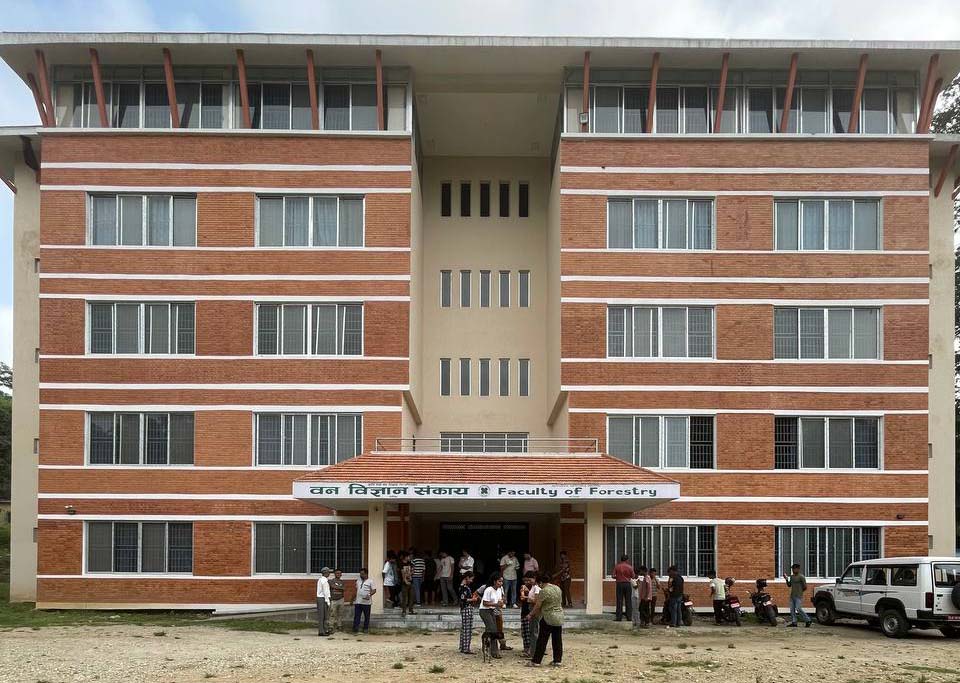
AFU operates through three faculties:
Faculty of Agriculture (FOA)
Faculty of Animal Science, Veterinary Science and Fisheries (FAVF)
Faculty of Forestry (FOF)
Within this structure, the Faculty of Forestry concentrates on education and research connected with forests, environmental concerns, and natural resource management. Its academic direction links forestry education with sustainability, field practice, research, and community-related natural resource issues.
The faculty began academic activities in 2013 with B.Sc. Forestry. Postgraduate academic programs in forestry science, including Master of Science and Doctor of Philosophy study, also began in Hetauda in 2013.
The academic work of the Faculty of Forestry covers forestry, environmental studies, biodiversity, watershed management, wildlife, forest products, forest measurement, silviculture, natural resource economics, policy, and related areas.
Its teaching and research approach combines classroom study with practical work. Students may take part in field activities, case studies, laboratory or practical exercises connected with their courses, and research work.
Research activities also address community-based issues. Faculty members and students work across forestry research, natural resource management, policy, and practice while connecting academic work with local contexts.
The Faculty of Forestry provides academic study at undergraduate, postgraduate, and doctoral levels.
| Level | Program | Academic Note |
|---|---|---|
| Bachelor's | B.Sc. in Forestry | Academic program began in 2013 |
| Master's | M.Sc. Forestry | Two-year, four-semester program |
| Master's | M.Sc. Forestry (Biodiversity) | Postgraduate forestry-related study |
| Master's | M.Sc. Forestry (Environmental Science) | Postgraduate forestry-related study |
| Doctoral | PhD in Forestry | Doctoral study through research-based pathways |
Postgraduate programs operate under the Directorate of Post Graduate Programme. The M.Sc. program combines coursework with research, while doctoral study requires an academic and research background that meets the stated admission conditions.
B.Sc. Forestry was the first academic program started by the Faculty of Forestry in 2013.
From 2019, bachelor's-level forestry study was also conducted through:
College of Natural Resources Management (CNRM), Katari, Udaipur District, as a constituent college
Shiddant College, Susta Purba, Nawalparasi District, as an affiliated college
Each of these institutions has a stated capacity of 50 students for the bachelor's program.
The M.Sc. program runs for four semesters, with each semester lasting six months. It combines coursework and research and requires students to complete thesis work in the final semester.
For M.Sc. Forestry, applicants must hold a B.Sc. Forestry or equivalent degree and have completed a minimum of 16 years of education under the 10+2+4 structure.
Admission is based on an entrance examination.
For M.Sc. Forestry (Biodiversity) and M.Sc. Forestry (Environmental Science), eligible academic backgrounds include:
B.Sc. Forestry
B.Sc. Environmental Science
M.Sc. Botany
M.Sc. Zoology
B.Sc. Ag.
Equivalent degree
Applicants are also required to have completed a minimum of 16 years of education.
The master's program progresses from subject-based coursework to research preparation and thesis work.
The first semester includes subjects such as:
Advance Silviculture
Sustainable Forest Management
Wild Life and Protected Area Management
Advance Wood and Non-wood Utilization
Advance Watershed Management
Advance Natural Resource Economics
Term Paper and Seminar
Study areas include:
Community Based Forest Management and Governance
World Forestry System
Climate Change and Impacts on Natural Resources
Environmental Impact Assessment
Agroforestry Systems and Management
Renewable Energy Resources and Bio-Energy
Forest Policy, Laws and International Conventions
Biodiversity Conservation and Restoration
Term Paper and Seminar
The third semester moves further into research preparation and specialized study. Components include:
Statistical Analysis and Research Methodology
Research and Thesis
Computer Programming (C++)
GIS Application in Natural Resources
Special Study
Students select special papers according to the program structure.
The final semester is centered on:
Research and Thesis
Seminar
This stage allows students to concentrate on research and complete the thesis requirement.
The PhD program includes two study routes: Degree by Course and Research and Degree by Research.
Applicants are required to have an M.Sc. degree in Forestry or a related subject with first division on a percentage basis or a CGPA of 3.25/4.0 in a related or relevant field. Prerequisite courses may apply according to the applicant's previous M.Sc. study.
Other requirements include:
At least one research article as first author
English as the medium of undergraduate and postgraduate study, with IELTS, TOEFL, or PTE considered in special cases
Two confidential recommendation letters
At least one recommendation from a university professor in the relevant subject
An acceptable research proposal for the PhD dissertation
Assured research funding
This route requires at least five years of work experience in academic, research, or development activities after completing an M.Sc. degree.
Applicants must have passed the M.Sc. degree with at least second division on a percentage basis or a CGPA of 2.5/4.0 in a related or relevant field. Prerequisite courses may apply according to previous academic study.
Research publication requirements vary according to the applicant's academic result:
Applicants with first division or CGPA 3.25/4.0 must have at least two first-author research articles.
Applicants with second division or a CGPA below 3.25/4.0 must have at least three first-author research articles.
Applicants must also meet the stated English-medium requirement or the applicable language proficiency condition, submit two confidential recommendation letters, prepare an acceptable concept research proposal, and have assured research funding.
Academic teaching and research are organized through eight departments:
Department of Basic Science and Humanities
Department of Ecology and Environmental Science
Department of Forest Products Utilization
Department of Forest Survey and Engineering
Department of Natural Resource Management
Department of Silviculture and Forest Biology
Department of Soil and Watershed Management
Department of Wildlife and Protected Reserve
These departments cover biological, environmental, technical, management, and policy-related areas within forestry education.
Practical work forms a distinct part of the faculty's academic activities. A 95 ha forest supports field-based learning where students can apply concepts covered in their courses.
Practical exposure includes:
Course-related field visits
Case studies
Field-based observations and exercises
Research activities
Laboratory and practical components in relevant subjects
Thesis and dissertation work at postgraduate levels
This combination gives students direct academic exposure to forest and natural resource settings alongside classroom and research-based study.
The Faculty of Forestry has eight departments with 16 faculty members involved in undergraduate and postgraduate teaching. Academic work is supported by 35 administrative and technical staff members.
Faculty and students also take part in research related to forestry, natural resources, communities, policy, and management. The academic setting brings together teaching, mentoring, fieldwork, research, and postgraduate supervision within the forestry discipline.
Institution: Faculty of Forestry (FOF), Agriculture and Forestry University (AFU)
Location: Hetauda, Makawanpur, Nepal
Phone: +977-57-524154, +977-57-527354
Email: deanforestry@afu.edu.np
Website: www.afu.edu.np/forestry
Meta Title: Faculty of Forestry, AFU Hetauda: Profile and Programs Nepal
Meta Description:
The Faculty of Forestry is located in Hetauda, Makawanpur, Nepal.
The faculty began its academic program in 2013 with B.Sc. in Forestry. Postgraduate study in forestry science also started in Hetauda in 2013.
Its academic programs include B.Sc. in Forestry, M.Sc. Forestry, M.Sc. Forestry (Biodiversity), M.Sc. Forestry (Environmental Science), and PhD study in Forestry.
The M.Sc. program runs for four semesters, with each semester lasting six months. The program combines coursework and research, with thesis work in the final semester.
Applicants must have a B.Sc. Forestry or equivalent degree and a minimum of 16 years of education under the 10+2+4 structure. Admission is based on an entrance examination.
The faculty has eight departments covering basic science, ecology and environmental science, forest products, forest survey, natural resource management, silviculture, soil and watershed management, and wildlife.
The faculty has a 95 ha forest used for practical academic work. Field visits, case studies, practical exercises, and research activities also form part of the learning process.