



Birmingham City University (BCU) is a university based in Birmingham, England, United Kingdom. Its principal corporate address is the Curzon Building, 4 Cardigan Street, Birmingham B4 7BD. The institution is legally constituted as a Higher Education Corporation and holds its own degree-awarding powers.
BCU operates through two main campuses, City Centre and City South, together with specialist teaching sites across Birmingham. Its academic organisation consists of six Schools and Royal Birmingham Conservatoire. This structure brings together creative disciplines, business, law and social sciences, architecture and the built environment, computing, engineering, health sciences, nursing and midwifery, and specialist performing arts.
The university developed through the consolidation of several Birmingham educational institutions rather than from a single organisation continuously carrying the same name. Its present identity reflects nineteenth-century art education, the formation of the City of Birmingham Polytechnic in 1971, university status in 1992, later institutional mergers, and the adoption of the Birmingham City University name in 2007.
| Detail | Information |
|---|---|
| University Name: | Birmingham City University (BCU) |
| Location: | Birmingham, England, United Kingdom |
| Institutional Status: | Higher Education Corporation |
| Degree-Awarding Authority: | Holds its own degree-awarding powers |
| Principal Address: | Curzon Building, 4 Cardigan Street, Birmingham B4 7BD |
| Historical Roots: | Traces its institutional origins to 1843 |
| University Status: | Gained university status in 1992 |
| Current Name Adopted: | Birmingham City University in 2007 |
| Main Campuses: | City Centre Campus and City South Campus |
| Academic Structure: | Six Schools plus Royal Birmingham Conservatoire |
| Study Levels: | Foundation, undergraduate, postgraduate taught and postgraduate research |
| Academic Areas: | Arts, business, law, social sciences, architecture, built environment, computing, engineering, health sciences, nursing, midwifery and performing arts |
| Specialist Sites: | Royal Birmingham Conservatoire, School of Art, School of Jewellery, Ruskin Hall and RBC Digbeth |
| Library Provision: | Curzon Library, Mary Seacole Library and specialist library services for Art and Jewellery |
| Research: | Conducted across multiple academic disciplines, with postgraduate research and doctoral study available |
| Admissions: | Course-specific, with separate requirements for academic qualifications, English-language evidence and specialist selection where applicable |
| Student Support: | Includes wellbeing, disability and inclusion support, learning assistance, careers guidance, financial advice and immigration-related support where applicable |
Birmingham City University is a Higher Education Corporation created under the Education Reform Act 1988. Its university title and degree-awarding powers were granted under the Further and Higher Education Act 1992. The institution therefore awards its own university qualifications rather than depending on another university to validate its degrees.
BCU is also an exempt charity under Schedule 3 of the Charities Act 2011. It is not registered with the Charity Commission in the same manner as a conventional registered charity. The Office for Students acts as its principal regulator for this purpose.
The university operates under an Instrument and Articles of Government. Responsibility is divided between the Board of Governors, the Academic Board and the University Executive Team.
The Board of Governors is the governing body. Its members also act as trustees for charity-law purposes. The Academic Board is the university's principal academic authority and advises the governing body on academic standards, academic quality and related matters.
Executive management is led by the Vice-Chancellor. The Chancellor has a ceremonial and ambassadorial role rather than responsibility for routine institutional management. Keeping these functions separate is important when interpreting the university's governance structure.
BCU's authority to award degrees is distinct from professional accreditation. The university can confer its own academic qualifications, while recognition by professional or regulatory bodies applies to individual courses where such arrangements exist. Accreditation attached to one programme does not automatically extend to other courses in the same School.
The earliest strand of BCU's institutional history dates to October 1843, when the Birmingham Society of Artists opened the Birmingham Society of Arts and School of Design. The institution now known as Birmingham City University did not exist under one continuous name from that date; its present form emerged through mergers and reorganisations involving several Birmingham colleges and specialist schools.
A major consolidation took place in 1971, when five colleges were brought together to form the City of Birmingham Polytechnic. This established the polytechnic from which the present university developed.
Changes in English higher education under the Further and Higher Education Act 1992 allowed polytechnics to adopt university status. The name University of Central England in Birmingham was approved by the Privy Council on 16 June 1992.
The institution continued to expand after gaining university status. In 1995, it merged with the Birmingham and Solihull College of Nursing and Midwifery and the West Midlands School of Radiography. Those mergers became part of the institutional history behind BCU's later provision in nursing, midwifery, health and related disciplines.
The university adopted the name Birmingham City University in 2007.
Changes to the university estate have continued alongside changes in academic organisation. Royal Birmingham Conservatoire's purpose-built teaching and performance building opened on the City Centre Campus in 2017. An extension at City South opened in 2018, adding to facilities used for health-related education. STEAMhouse opened in 2022 in the former Belmont bicycle works.
Older specialist locations also remain part of BCU. The School of Art continues to use the Margaret Street site, while the School of Jewellery is based in Birmingham's Jewellery Quarter. The result is an institution whose academic history is visible in both purpose-built university buildings and specialist sites associated with particular disciplines.
BCU's academic structure comprises six Schools and Royal Birmingham Conservatoire. The Schools group related departments while maintaining separate disciplinary identities.
The School of Arts contains:
Art and Design
English and Media
Fashion and Jewellery
The Business School contains:
Accountancy, Finance and Economics
Management, Business and Marketing
The School of Law and Social Sciences contains:
Criminology and Sociology
Education
Law
The School of Architecture, Built Environment, Computing and Engineering contains:
Architecture and Built Environment
Computer Science
Engineering
The School of Life and Health Sciences contains:
Health and Social Care Professions
Life and Sports Sciences
Psychology and Counselling
The School of Nursing and Midwifery contains:
Adult Nursing
Mental Health and Learning Disability Nursing
Midwifery and Children's Health
Royal Birmingham Conservatoire provides specialist education in music, acting and related performance disciplines.
Study is available at foundation, undergraduate, postgraduate taught and postgraduate research levels. BCU also provides apprenticeships, professional development and other forms of study.
A fixed institution-wide course count is not a useful description of BCU because programme availability differs by academic level, entry period, mode of study and subject. The School structure provides a clearer view of the university's academic scope without turning an institutional profile into a course catalogue.
The same distinction applies to professional recognition and placements. Accreditation, compulsory placements, optional placement years, teaching sites and selection procedures belong to individual programmes rather than automatically to an entire School.
BCU operates through two main campuses, City Centre and City South, with additional specialist locations. It is therefore not organised around one continuous campus used by every academic department.
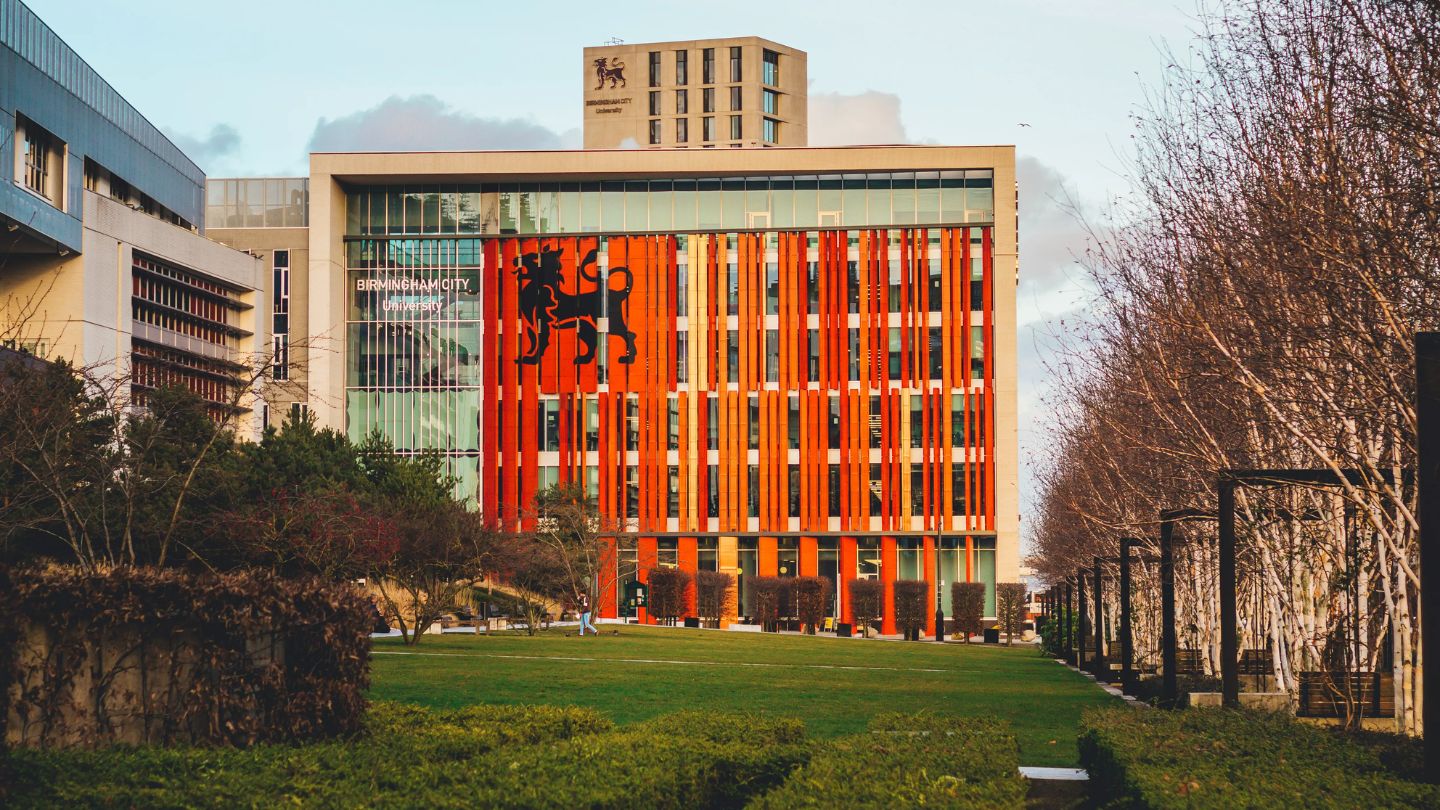
The City Centre Campus is centred in Birmingham's Eastside district. Its buildings include Curzon, Parkside, Millennium Point, Joseph Priestley, STEAMhouse, Benjamin Zephaniah and the Research Hub. Royal Birmingham Conservatoire is also located within the City Centre area.
City South is in Edgbaston and is principally associated with Health Professions, Nursing and Midwifery, Life Sciences and Social Work.
Other specialist locations include the School of Art at Margaret Street, the School of Jewellery in the Jewellery Quarter, Ruskin Hall in Bournville and RBC Digbeth.
This distributed arrangement means that a student's main teaching location depends heavily on discipline. School membership alone does not establish that every course within that School is taught in the same building.
The Curzon Building serves as BCU's principal corporate address and accommodates teaching associated with Business, Law, Social Sciences and English. It also contains Curzon Library, one of the university's principal library locations.
Teaching facilities in Curzon include mock courtrooms, the City Trading Room and psychology laboratories. These spaces support different forms of subject-based teaching: legal simulation, finance-related activity and psychology teaching use facilities designed for their respective disciplines.
Parkside is associated with arts, design and media. Its function differs from Curzon's concentration on business, law and related subjects and illustrates the specialist division of teaching space within the City Centre Campus.
Millennium Point and STEAMhouse are used for combinations of computing, engineering, built-environment and digital activity. STEAMhouse occupies the former Belmont works site and forms part of BCU's more recent estate development.
The City Centre Campus is therefore a group of academic buildings with distinct uses rather than a single multi-purpose teaching block. Different Schools and departments occupy spaces suited to their teaching requirements.
City South is BCU's principal campus for several health-related disciplines. Its main academic areas include Health Professions, Nursing and Midwifery, Life Sciences and Social Work.
Facilities include mock wards, an operating-department suite, biomedical and microbiology laboratories, digital anatomy tables, a birthing room and spaces designed to reproduce home-based care settings.
These facilities support courses in which students need laboratory work, simulation or preparation for professional practice. Nursing, midwifery and allied health education can combine academic study with simulated clinical activity and, where required by a programme, supervised placements.
The facilities should not be treated as universally used by every student based at City South. Access depends on the academic requirements of the individual programme and module.
City South also reflects an important part of BCU's institutional development. The university's earlier mergers with nursing, midwifery and radiography providers contributed to the academic disciplines now represented within its health-related Schools.
Royal Birmingham Conservatoire is BCU's specialist institution for music, acting and related performance study. Its purpose-built facility is located at 200 Jennens Road on the City Centre Campus.
The building covers about 9,000 square metres and contains teaching, rehearsal, practice and performance spaces. Its academic use differs substantially from standard classroom-based university teaching because performance education requires purpose-designed rehearsal and presentation facilities.
The Conservatoire also has activity at Ruskin Hall in Bournville and RBC Digbeth.
Admission to performance-based study can involve specialist selection procedures such as auditions. These processes differ from the application arrangements used for many conventional undergraduate courses and reflect the Conservatoire's particular academic function within BCU.
The School of Art at Margaret Street represents another longstanding strand of the university's specialist provision. The site remains associated with art education within BCU rather than being absorbed entirely into the newer Eastside estate.
The School of Jewellery is located in Birmingham's Jewellery Quarter around St Paul's Square and Vittoria Street. Its location maintains a direct geographical connection between jewellery education at BCU and the part of Birmingham historically associated with the trade.
These specialist sites are an important part of the university's structure because they show that BCU's academic identity is not confined to its two main campuses.
BCU's library provision is distributed across its teaching locations. Curzon Library serves the City Centre Campus, while Mary Seacole Library serves City South. Separate library provision also supports the School of Art and the School of Jewellery.
Physical library services are supplemented by electronic academic resources and online support. The distribution of libraries mirrors the wider campus model, allowing subject communities at specialist sites to use services associated with their main teaching locations.
The university's broader academic facilities also follow disciplinary requirements.
Law teaching can use mock courtrooms. Finance-related study has access to the City Trading Room. Psychology has laboratory facilities. Arts and media teaching uses specialist production spaces. Computing, engineering and built-environment activity is supported across buildings including Millennium Point and STEAMhouse.
City South contains clinical simulation and laboratory facilities, while Royal Birmingham Conservatoire provides rehearsal, practice and performance spaces.
This subject-based allocation is more informative than describing BCU's facilities as one uniform university resource. The equipment and spaces relevant to an engineering student differ substantially from those used in nursing, jewellery, art or conservatoire study.
BCU describes its curriculum as practice-based, with applied learning, employer engagement and practical experience forming part of its institutional approach to teaching.
That approach does not mean every course contains the same type or amount of practical activity. The form of practice-based study depends on the discipline and programme.
Certain courses in education, health, nursing, midwifery and social work include placements as part of professional preparation. Other programmes may offer an optional Professional Placement Year. Some courses include shorter forms of work-related activity instead.
A compulsory placement that forms part of professional training is different from an optional placement year. Students on optional routes receive support with finding and applying for opportunities, but the availability of a placement pathway is not the same as a guaranteed position with a particular employer.
Professional accreditation follows the same programme-specific principle. BCU teaches in fields where professional bodies may recognise or accredit particular qualifications, but accreditation belongs to the relevant course and applicable entry arrangements. It should not be generalized across an entire School or the university as a whole.
The distinction between academic and professional authority is therefore central to understanding BCU. The university has its own degree-awarding powers, while any additional professional recognition depends on the relevant programme and professional body.
Research at Birmingham City University spans academic areas represented across its Schools and specialist units. These include art and design, business, the built environment, computing and digital technology, education and social work, engineering, health and social care, law, media, music and performance, psychology and the social sciences.
BCU maintains research centres and supports doctoral study. Applicants to postgraduate research degrees follow a research-degree process rather than the route used for taught postgraduate study.
The university participated in the UK-wide Research Excellence Framework 2021. Its submission involved 310 staff across 14 Units of Assessment and more than 700 research outputs.
REF results are organised by Unit of Assessment and distinguish between outputs, impact and the conditions supporting research. Results therefore differ by academic discipline and should not be treated as though one institutional figure applies equally to every subject.
The university's research activity sits alongside its teaching role rather than replacing its practice-based emphasis. Research degrees, research centres and disciplinary research are part of the same institutional structure that supports foundation, undergraduate and taught postgraduate education.
BCU's international activity includes overseas recruitment, student exchange and formal relationships with institutions outside the United Kingdom.
Its partnership arrangements include Memoranda of Understanding, student-exchange agreements, progression agreements, articulation agreements and franchise agreements. These arrangements have different academic purposes.
A student-exchange agreement supports study between participating institutions. Progression and articulation agreements establish defined routes between qualifications or programmes. Franchise arrangements involve delivery through another institution while BCU retains academic oversight of the programme.
These distinctions matter because the existence of a relationship between BCU and another institution does not mean every partnership creates the same academic rights or qualification route.
BCU also works with authorised country representatives in some international markets. International academic entry is assessed according to both the applicant's qualification system and the requirements of the chosen programme.
Country-specific academic equivalencies therefore operate alongside course-specific entry requirements. A qualification threshold used for applicants from one education system cannot be treated as a universal international standard.
Admissions at Birmingham City University are organised according to study level, programme and applicant type rather than through one institution-wide academic threshold.
International undergraduate and taught postgraduate applicants can use different application routes depending on the programme and circumstances. These include direct application to the university where available and application through authorised country representatives. Undergraduate applicants can also apply through UCAS.
Postgraduate research degrees have a separate application route. Specialist and professionally oriented programmes can use additional procedures.
Entry decisions are therefore tied to the exact programme. Academic requirements differ by subject and qualification system, while some courses require additional evidence or selection stages.
Creative disciplines may require a portfolio. Performance-based courses within Royal Birmingham Conservatoire may involve auditions. Education, Social Work, Nursing and Midwifery, Allied Health Professions and other professionally oriented areas can use selection requirements connected to the nature of the course.
BCU also has separate arrangements for areas such as advanced entry and transfers.
English-language requirements are similarly programme-dependent. The university accepts recognised forms of English-language evidence, but the level required depends on the course rather than on one threshold that can safely be applied to every applicant.
An institution-wide acceptance-rate percentage is therefore not an appropriate substitute for the university's actual admissions structure. Selection varies by subject, qualification background and any additional requirements attached to a programme.
BCU provides student services covering academic, personal and practical needs. These include financial advice, disability and inclusion support, wellbeing services, learning support, library assistance and immigration-related support for students to whom it applies.
The type of support available to an individual student depends on the service and, where relevant, assessed need.
Careers and Student Opportunities provides help with career planning, CV preparation, applications and interview preparation. Careers Connect is used for careers-related services and opportunities.
BCU also provides careers support to graduates for a period after completion of their studies. This service is separate from any claim about employment outcomes: access to careers support does not mean that the university guarantees employment.
Placement support is integrated with careers provision where it applies to a course. Mandatory professional placements and optional placement years remain academically different arrangements and are handled according to programme requirements.
No single employment statistic can represent the outcome of every BCU graduate across all subjects. Graduate destinations depend on discipline, qualification, further study and individual circumstances.
BCU works with multiple student-accommodation providers serving students studying around its City Centre and City South campuses.
The accommodation portfolio is primarily based on single-occupancy student rooms. Couple and family housing generally falls outside the main student-residence model and is associated instead with the private rental sector.
Accommodation is not uniform across all residences. Property type, room arrangement and contract structure differ between locations.
BCU's distributed campus model also affects how accommodation relates to study. A student whose course is principally taught at City South has a different daily location from a student based at Margaret Street, the School of Jewellery, Royal Birmingham Conservatoire or the Eastside buildings.
The teaching site attached to a programme is therefore an important part of understanding how the university operates in practice.
Birmingham City University brings together academic traditions that developed through different parts of Birmingham's educational history. Its nineteenth-century roots lie in art and design education, while later mergers added technical, commercial, professional and health-related disciplines.
Those origins remain visible in the present institution. BCU combines newer multi-building campuses with specialist sites that continue to serve art, jewellery and performing-arts education.
Its six Schools provide the main academic organisation, while Royal Birmingham Conservatoire retains a specialist role within the university. Teaching ranges from foundation study to doctoral research, alongside apprenticeships and professional development.
The university's own degree-awarding authority establishes its position as an independent degree-awarding institution. Professional accreditation, placements, auditions, portfolios and other specialist requirements remain attached to individual courses rather than being generalized across BCU.
Its physical structure is equally distinctive. Business, law, media, computing, engineering, health, jewellery, art and conservatoire education use different buildings and specialist resources across Birmingham. Libraries and support services are distributed to match this academic geography.
BCU is therefore best understood as a multi-site Birmingham university formed through a long sequence of educational developments and institutional mergers, with broad academic coverage, specialist professional and creative facilities, independent degree-awarding powers, research activity across several disciplines, and admissions and professional requirements that operate primarily at programme level.
Birmingham City University is a Higher Education Corporation based in Birmingham, England. It holds its own degree-awarding powers and operates under an Instrument and Articles of Government. The Office for Students acts as its principal regulator for charity-law purposes.
BCU traces its earliest institutional roots to 1843, when the Birmingham Society of Artists opened the Birmingham Society of Arts and School of Design. Five colleges were brought together to form the City of Birmingham Polytechnic in 1971. The institution gained university status in 1992 as the University of Central England in Birmingham and adopted the name Birmingham City University in 2007.
Birmingham City University is located in Birmingham, England, United Kingdom. Its principal corporate address is the Curzon Building, 4 Cardigan Street, Birmingham B4 7BD.
BCU operates two main campuses: City Centre Campus and City South Campus. It also uses specialist locations across Birmingham, including Royal Birmingham Conservatoire, the School of Art at Margaret Street, the School of Jewellery in the Jewellery Quarter, Ruskin Hall in Bournville and RBC Digbeth.
BCU is organised into six Schools: the School of Arts; Business School; School of Law and Social Sciences; School of Architecture, Built Environment, Computing and Engineering; School of Life and Health Sciences; and School of Nursing and Midwifery. Royal Birmingham Conservatoire forms an additional specialist academic unit for music, acting and related performance disciplines.
Yes. Birmingham City University has its own degree-awarding powers. Professional accreditation or recognition, where applicable, is separate and applies to individual programmes rather than automatically to every course offered by the university.
BCU provides study at foundation, undergraduate, postgraduate taught and postgraduate research levels. Its wider academic provision also includes apprenticeships and professional development.
The City Centre Campus contains buildings used for subjects including business, law, social sciences, arts, media, computing, engineering and built-environment study. City South is principally associated with Health Professions, Nursing and Midwifery, Life Sciences and Social Work. Art, jewellery and conservatoire education also use specialist sites elsewhere in Birmingham.
Facilities vary by subject and location. They include mock courtrooms, the City Trading Room, psychology laboratories, arts and media production spaces, computing and engineering facilities, clinical simulation areas, biomedical and microbiology laboratories, digital anatomy resources, and specialist rehearsal and performance spaces at Royal Birmingham Conservatoire.
Yes. Library provision is distributed across BCU's academic sites. Curzon Library serves the City Centre Campus, Mary Seacole Library serves City South, and separate library provision supports the School of Art and the School of Jewellery. Electronic academic resources and online support are also available.
Placement arrangements depend on the programme. Some professional courses include compulsory placements, while other courses may offer an optional Professional Placement Year or shorter work-related activities. Optional placement opportunities are not the same as guaranteed placements.
Admission requirements vary by study level, course and applicant background. Undergraduate applicants may use UCAS, while direct application is available for some international and postgraduate routes. Research degrees follow a separate application process. Some programmes also require portfolios, auditions, interviews or other course-specific selection procedures.
No. English-language requirements are programme-specific. BCU accepts recognised forms of English-language evidence, but applicants need to meet the requirement attached to their chosen course.
The verified institutional research does not establish an official university-wide acceptance-rate percentage. Admissions are determined through course-specific requirements, applicant qualifications and any additional selection conditions attached to the programme.
Research spans areas represented across BCU's Schools and specialist units, including art and design, business, computing, engineering, education, health and social care, law, media, music and performance, psychology and the social sciences. The university also supports postgraduate research and doctoral study.
BCU recruits students internationally and maintains international partnerships, exchange arrangements and other academic agreements. International applicants are assessed according to both the requirements of their chosen programme and the qualification system in which they previously studied.
Student services include financial advice, disability and inclusion support, wellbeing services, learning support, library assistance, careers guidance and immigration-related support for students to whom it applies.
BCU works with several student-accommodation providers serving students studying around its City Centre and City South campuses. Accommodation arrangements vary by property, and students should consider the teaching location of their course when choosing where to live.
