The College of Applied Food and Dairy Technology (CAFODAT) is an academic institution in Kumaripati, Lalitpur, focused on food technology, dairy technology, nutrition and dietetics, and information technology. Established in 2005, the college conducts university-level programs under Purbanchal University and a technical diploma program under the Council for Technical Education and Vocational Training (CTEVT).
CAFODAT’s academic identity is closely connected with applied science. Its food, dairy, and nutrition programs combine scientific study with laboratory work, processing knowledge, quality control, product development, and human health. The inclusion of the Bachelor of Information Technology broadens the college’s academic portfolio beyond its core food and nutrition disciplines.
The college is managed by professionals from food science, dairy technology, nutrition, dietetics, academia, research, and entrepreneurship. Its teaching team includes faculty members with subject-specific academic and professional experience. This combination supports classroom instruction, laboratory learning, and exposure to the practical settings in which food technologists, dairy technologists, nutritionists, dietitians, and information technology graduates may work.
Established: 2005
Location: Kumaripati, Lalitpur, Nepal
Affiliations: Purbanchal University and the Council for Technical Education and Vocational Training (CTEVT)
Academic focus: Food technology, dairy technology, nutrition and dietetics, and information technology
Study levels: Diploma, bachelor’s, and master’s programs
B.Tech Food seats: 48
B.Tech Dairy seats: 33
BIT seats: 48
M.Sc. Nutrition and Dietetics seats: 33
Academic facilities: Practical laboratories, science laboratories, audiovisual classrooms, computer laboratory with internet access, and library resources
Practical exposure: Laboratory sessions, workshops, seminars, guest lectures, industrial visits, and educational excursions
Scholarship schemes: Basanta-Michiko-Shah Scholarship, Mohan Bikram Shah Raj Raja Scholarship, DDC Scholarship, and Merit-Based CAFODAT Scholarship
Academic team: Faculty and management members from food science, dairy technology, nutrition, dietetics, academia, research, and entrepreneurship
Accessibility: The Kumaripati location is connected by public transportation within Lalitpur and the wider Kathmandu Valley
CAFODAT was established to prepare technically capable human resources for Nepal’s food, dairy, nutrition, and dietetics sectors. Its academic direction places importance on scientific understanding, practical competence, food quality, nutritional assessment, and the relationship between food production and public health.
The college’s stated mission centres on preparing graduates who can work in professional areas such as food and dairy technology, food inspection, food science, quality control, nutrition, and dietetics. These fields require more than theoretical knowledge. They involve laboratory discipline, knowledge of raw materials, processing systems, hygiene, food safety, product quality, human nutrition, and responsible professional practice.
Its broader vision connects education and training with the development of competent technical personnel. It also recognises the importance of producing safe food products, analysing nutritional value, encouraging balanced diets, and supporting social and economic development through food and nutrition-related work.
This institutional direction is reflected in the range of programs available—from a technical diploma to bachelor’s and postgraduate study. Students can therefore enter the field at different academic levels and build knowledge according to their previous education and intended area of work.
CAFODAT is located in Kumaripati, Lalitpur. Kumaripati is an established education and commercial area within Lalitpur and is served by public transportation. The location allows students from different parts of Kathmandu Valley to reach the college through commonly used transport routes.
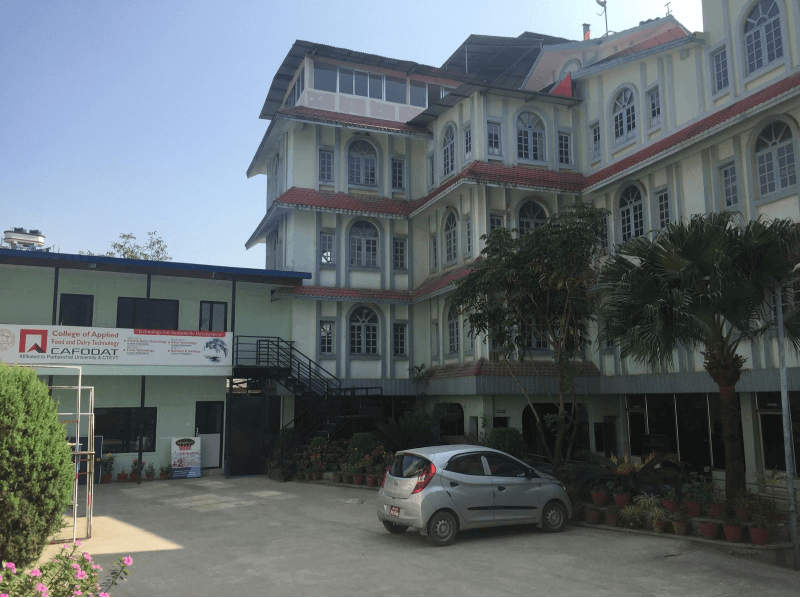
The college operates in a multi-storey academic building shown across its institutional publications. The premises accommodate classrooms, laboratories, study facilities, administrative functions, and spaces used for practical academic activities.
For students considering a science-based program, the location is relevant because regular attendance is important for laboratory sessions, demonstrations, practical classes, group work, and academic activities that cannot be completed through textbook study alone.
CAFODAT’s bachelor’s and master’s programs are affiliated with Purbanchal University, primarily through its Faculty of Science and Technology. The university provides the academic framework, curriculum, examination structure, and degree affiliation for the relevant programs.
The Diploma in Food and Dairy Technology is affiliated with CTEVT. This places the diploma within Nepal’s technical and vocational education system and gives it a different academic purpose from the university degrees. The diploma is intended to develop middle-level technical personnel, while the bachelor’s and master’s programs involve more extensive academic, analytical, and professional study.
The distinction between the affiliations is important. Students applying for the diploma follow the requirements connected with CTEVT, whereas applicants to the bachelor’s and postgraduate programs follow the applicable Purbanchal University academic and admission provisions.
CAFODAT offers technical, undergraduate, and postgraduate programs. The approved seat numbers provided for its Purbanchal University programs are shown below.
| Program | Academic structure | Approved seats |
|---|---|---|
| B. Tech. Food | Four years, eight semesters | 48 |
| B. Tech. Dairy | Four years, eight semesters | 33 |
| Bachelor of Information Technology | Purbanchal University program | 48 |
| M.Sc. in Nutrition and Dietetics | Two years, four semesters | 33 |
The Diploma in Food and Dairy Technology runs for three years across six semesters under CTEVT. Its seat number is separate from the Purbanchal University seat allocation shown above.
The Diploma in Food and Dairy Technology is a three-year, six-semester program affiliated with CTEVT. It is designed to prepare middle-level technical personnel for food processing, dairy manufacturing, quality control, laboratory work, and related production activities.
Students study the science, technology, and processes involved in producing food and dairy products. The academic content covers food processing, preservation, packaging, quality control, dairy technology, and the preparation of products such as milk, cheese, butter, yoghurt, and milk-based sweets.
The program also includes areas such as food chemistry, food microbiology, and food regulations and safety. These subjects help students understand the composition of food, the role of microorganisms, causes of spoilage, hygienic handling, processing conditions, and the standards associated with safe production.
Learning takes place through lectures, laboratory sessions, and hands-on training. This structure is important because technical work in food and dairy settings requires students to understand both the scientific reason behind a process and the correct way to perform it.
The diploma aims to develop practical skills in product development, quality control, and process management. Graduates may seek work in food-processing companies, dairy industries, quality-control units, laboratories, production sections, food-service operations, or research-support roles. They may also continue their studies in food technology, dairy technology, food science, food engineering, or related fields, subject to the admission rules of the institution concerned.
The B.Tech Food Technology program is a four-year bachelor’s degree organised across eight semesters under Purbanchal University. It was developed to prepare practical-oriented food technologists with scientific and technical knowledge relevant to Nepal’s food sector.
Food technology deals with the conversion of agricultural and biological raw materials into safe, stable, and usable food products. Students therefore need to understand what happens to food during handling, processing, preservation, packaging, storage, and distribution.
The program covers areas associated with food chemistry, food microbiology, food processing and preservation, food analysis, engineering principles, quality control, food safety, and product development. These areas are interconnected. A processing method cannot be selected without considering the nature of the raw material, microbial risk, nutritional quality, equipment, packaging, storage conditions, and consumer safety.
Laboratory study helps students examine food composition, conduct analysis, observe microbiological processes, and understand quality parameters. Processing-oriented study introduces the principles used in preserving foods and controlling changes caused by heat, moisture, microorganisms, enzymes, oxygen, and storage conditions.
The curriculum is intended to build competence for technical roles in food production, quality assurance, product development, laboratory analysis, inspection, research, and process supervision. Graduates may work in food industries, government or private laboratories, quality-control departments, research organisations, educational institutions, or food-related enterprises, depending on the requirements of each role.
The approved intake for B. Tech. Food at CAFODAT is 48 seats.
The Bachelor in Food and Dairy Technology pathway includes the college’s dairy-focused bachelor’s study, commonly presented as B. Tech. Dairy. It runs for four years across eight semesters under Purbanchal University, with 33 approved seats.
Dairy technology focuses on milk as a biological raw material and on the scientific processes used to handle, preserve, test, process, and convert it into dairy products. Students study subjects connected with dairy chemistry, dairy microbiology, milk processing, dairy engineering, quality control, and dairy product technology.
The scientific foundation is important because milk is highly perishable and its quality can be affected by collection practices, temperature, microorganisms, handling, equipment, and storage. Dairy technologists therefore need to understand the complete chain from raw milk reception to processing, packaging, quality assessment, and product distribution.
Practical work enables students to connect classroom concepts with testing and production procedures. They may examine the composition and quality of milk, observe processing operations, study equipment, and learn how different dairy products are manufactured and assessed.
The degree can support pathways in dairy processing plants, milk collection and chilling systems, product-development units, quality-control laboratories, research settings, production management, and technical services. The program may also provide a foundation for postgraduate study in dairy science, food technology, nutrition, and related disciplines.
The Bachelor of Information Technology is offered under Purbanchal University with an approved capacity of 48 seats.
BIT gives CAFODAT an academic area outside food, dairy, and nutrition sciences. It is intended for students seeking university-level study in information technology within the college’s academic environment.
The program also connects naturally with the growing use of information systems across laboratories, food businesses, research, inventory systems, quality documentation, data management, and institutional administration. However, BIT remains a separate academic program with its own university curriculum and learning requirements rather than a food-technology specialisation.
Students considering BIT should review the current university curriculum, entrance arrangements, academic schedule, and admission requirements before applying.
The M.Sc. in Nutrition and Dietetics is a two-year postgraduate program divided into four semesters. It is affiliated with Purbanchal University and has an approved intake of 33 students.
Nutrition examines how food and nutrients affect the body, health, growth, well-being, and disease. Dietetics applies nutritional principles to the planning and management of diets, particularly for individuals or groups with defined health and nutritional needs.
The program covers human nutrition, food science, dietetics, nutrition-related research, and national and international nutrition policy. Students examine the biochemistry of nutrients, physiological and metabolic processes involved in nutrient use, the relationship between diet and health, nutritional assessment, and the design of diets for different populations.
This combination gives the program both scientific and applied dimensions. Students need to understand nutrients and metabolism while also learning how nutritional knowledge is used in clinical, community, institutional, and public-health settings.
Eligibility extends to applicants with relevant backgrounds in science, health, agriculture, and biological disciplines. The curriculum identifies degrees such as B. Tech. Food, B. Tech. Dairy, B.Sc. in Nutrition, Nursing or B.N., Public Health, Agriculture, Animal Husbandry, Biochemistry, Biotechnology, Pharmacy, Medicine, and equivalent qualifications from recognised universities. Applicants from shorter biological-science programs in areas such as microbiology, biochemistry, chemistry, and biology are also included within the stated eligibility provisions.
The postgraduate level requires students to engage with scientific literature, nutritional assessment, analytical work, diet planning, research methods, and the interpretation of evidence. These skills may be relevant to hospitals, clinics, community nutrition programs, food-service management, public-health organisations, research institutions, academic settings, and nutrition-related projects.
Graduates may pursue work as nutritionists or dietitians where the position, institutional rules, and professional requirements match their qualification. They may also enter research, teaching, nutritional assessment, community-based programs, food and health projects, or further academic study.
CAFODAT provides practical laboratories for food, dairy, nutrition, and science-related learning. Laboratory access is central to the college’s academic model because several programs require students to observe, test, process, measure, and analyse materials rather than study them only in theory.
The available facilities include:
Practical laboratories
Science laboratories
Audiovisual classrooms
Computer laboratory with internet access
Library and study resources
Equipment and spaces used for demonstrations and practical classes
Food and dairy laboratories support learning in areas such as product preparation, raw-material assessment, processing, microbiology, chemistry, and quality control. Nutrition students use scientific and analytical learning to understand food composition, nutrient functions, assessment methods, and diet planning.
The computer laboratory supports information technology students as well as learners who need digital resources for assignments, presentations, data handling, academic research, and report preparation. Audiovisual classes allow instructors to use diagrams, demonstrations, presentations, and technical illustrations where visual explanation improves understanding.
The library supports course-based reading and independent study. For specialised programs, access to reference materials is particularly useful because students work with scientific terminology, processing principles, research concepts, standards, and technical procedures.
The college’s faculty and management structure brings together food scientists, dairy technologists, nutritionists, dietitians, academicians, researchers, entrepreneurs, and professionally experienced teachers.
This range of backgrounds matters in applied education. A food-science concept may need explanation from a chemical, microbiological, engineering, quality-control, or commercial perspective. Nutrition education may similarly involve physiology, biochemistry, public health, diet planning, food service, and research.
Faculty members are responsible for helping students connect these areas through lectures, practical sessions, demonstrations, assignments, laboratory work, and academic supervision. Subject-based guidance is also important when students progress to projects, research work, industrial exposure, or advanced study.
CAFODAT uses activities such as guest lectures, workshops, seminars, industrial visits, excursions, and practical sessions to extend learning beyond regular classroom instruction.
Industrial visits allow students to observe production environments, machinery, workflow, hygiene controls, raw-material handling, packaging, storage, and quality-management practices. Such visits can help students recognise how scientific principles are applied under operating conditions.
Guest sessions and workshops can introduce students to specialised topics, professional practices, industry problems, and developments within food, dairy, nutrition, and related sectors. Seminars also give students opportunities to listen, present, discuss, and organise technical information.
The college maintains links with food industries, institutions, and universities in Nepal and abroad. These connections support academic interaction and professional exposure while giving students a wider view of the sectors connected with their studies.
CAFODAT has scholarship provisions for eligible and academically deserving students. The named schemes associated with the college include:
Basanta-Michiko-Shah Scholarship
Mohan Bikram Shah Raj Raja Scholarship
DDC Scholarship provided by Dairy Development Corporation
Merit-Based CAFODAT Scholarship
These schemes represent different forms of academic or sponsored support. Scholarship availability, selection conditions, coverage, and continuation requirements may differ between schemes and admission cycles.
Students seeking financial support should contact the college administration during the admission period and ask about the applicable criteria, application procedure, academic requirements, and supporting documents.
CAFODAT’s specialised programs are suited to students who are comfortable with science, laboratory work, technical procedures, observation, measurement, and structured practical learning.
Food technology may appeal to students interested in food processing, safety, quality, preservation, product development, and laboratory analysis. Dairy technology is relevant to those interested in milk production systems, dairy processing, product manufacturing, engineering, and quality control.
Nutrition and dietetics requires an interest in human biology, health, food, metabolism, dietary assessment, and communication with individuals or communities. The diploma is appropriate for students seeking technical preparation at the middle level, while the master’s program is designed for advanced study after an eligible undergraduate qualification.
BIT serves a different student group interested in computing and information technology. Its presence gives applicants an additional academic option within the same college.
Applicants should select a program according to their previous qualification, academic interests, and intended level of study. Diploma, bachelor’s, and master’s admissions follow different academic frameworks because they are administered through CTEVT or Purbanchal University.
Students should contact the administration office for the current admission schedule, entrance arrangements, eligibility process, fee structure, scholarship application, required documents, and class commencement dates.
Seat capacity should also be considered during application. The approved allocations are 48 seats for B. Tech. Food, 33 for B. Tech. Dairy, 33 for M.Sc. in Nutrition and Dietetics, and 48 for BIT.
College of Applied Food and Dairy Technology offers a concentrated academic environment for food technology, dairy technology, nutrition and dietetics, and information technology in Kumaripati, Lalitpur.
Its program structure ranges from a CTEVT diploma to bachelor’s and postgraduate degrees under Purbanchal University. Laboratory facilities, specialised faculty, practical instruction, industrial visits, workshops, and scholarship schemes support the academic work attached to these programs.
For students interested in how food is processed, tested, preserved, evaluated, and connected with human health—or those seeking BIT study under Purbanchal University—CAFODAT provides clearly defined academic pathways within its respective disciplines.
The College of Applied Food and Dairy Technology (CAFODAT) is located in Kumaripati, Lalitpur, Nepal. The area is connected with public transportation routes serving Lalitpur and other parts of the Kathmandu Valley.
CAFODAT was established in 2005. Its academic work focuses on food technology, dairy technology, nutrition and dietetics, and information technology.
The bachelor’s and master’s programs are affiliated with Purbanchal University. The Diploma in Food and Dairy Technology is affiliated with the Council for Technical Education and Vocational Training (CTEVT).
CAFODAT offers the following programs:
Diploma in Food and Dairy Technology
B.Tech Food Technology
B.Tech Dairy Technology
Bachelor of Information Technology
M.Sc. in Nutrition and Dietetics
The approved seat capacities are:
B.Tech Food Technology: 48 seats
B.Tech Dairy Technology: 33 seats
Bachelor of Information Technology: 48 seats
M.Sc. in Nutrition and Dietetics: 33 seats
The Diploma in Food and Dairy Technology runs for three years and is divided into six semesters. It is conducted under CTEVT.
B.Tech Food Technology and B.Tech Dairy Technology are four-year bachelor’s programs organised across eight semesters under Purbanchal University.
The M.Sc. in Nutrition and Dietetics is a two-year postgraduate program divided into four semesters.
Applicants with relevant qualifications in science, technology, health, agriculture, and biological disciplines may apply. Eligible academic backgrounds include B.Tech Food, B.Tech Dairy, B.Sc. in Nutrition, Nursing or B.N., Public Health, Agriculture, Animal Husbandry, Biochemistry, Biotechnology, Pharmacy, Medicine, and equivalent degrees from recognised universities.
Graduates from biological science subjects such as microbiology, biochemistry, chemistry, and biology are also included within the stated eligibility provisions.
CAFODAT has practical laboratories, science laboratories, audiovisual classrooms, a computer laboratory with internet access, and library resources. These facilities support classroom teaching, laboratory exercises, technical demonstrations, assignments, research work, and independent study.
The college conducts laboratory sessions, workshops, seminars, guest lectures, industrial visits, excursions, and other academic activities. These activities help students connect scientific concepts with processing systems, laboratory procedures, production environments, quality-control practices, and professional applications.
Scholarship schemes associated with CAFODAT include:
Basanta-Michiko-Shah Scholarship
Mohan Bikram Shah Raj Raja Scholarship
DDC Scholarship provided by Dairy Development Corporation
Merit-Based CAFODAT Scholarship
Scholarship conditions, selection criteria, and coverage may differ according to the scheme and admission cycle.
The program includes areas connected with food chemistry, food microbiology, food processing and preservation, food analysis, engineering principles, food safety, quality control, and product development.
B.Tech Dairy Technology covers the scientific handling, testing, processing, preservation, and production of milk and dairy products. Its academic areas include dairy chemistry, dairy microbiology, milk processing, dairy engineering, quality control, and dairy product technology.
The program includes human nutrition, food science, dietetics, nutrition-related research, nutritional assessment, nutrient biochemistry, metabolism, diet planning, and national and international nutrition policy.
Graduates may pursue roles in food and dairy processing, laboratory analysis, quality control, production supervision, product development, research, inspection, technical services, and academic settings, depending on the qualification and requirements of the position.
Graduates may pursue work in hospitals, clinics, community nutrition programs, food-service management, public-health organisations, research institutions, educational settings, and nutrition-related projects where their qualification meets the applicable requirements.
Students can contact the CAFODAT administration office for the current admission schedule, entrance arrangements, eligibility process, fee structure, scholarship procedures, required documents, and class commencement dates.