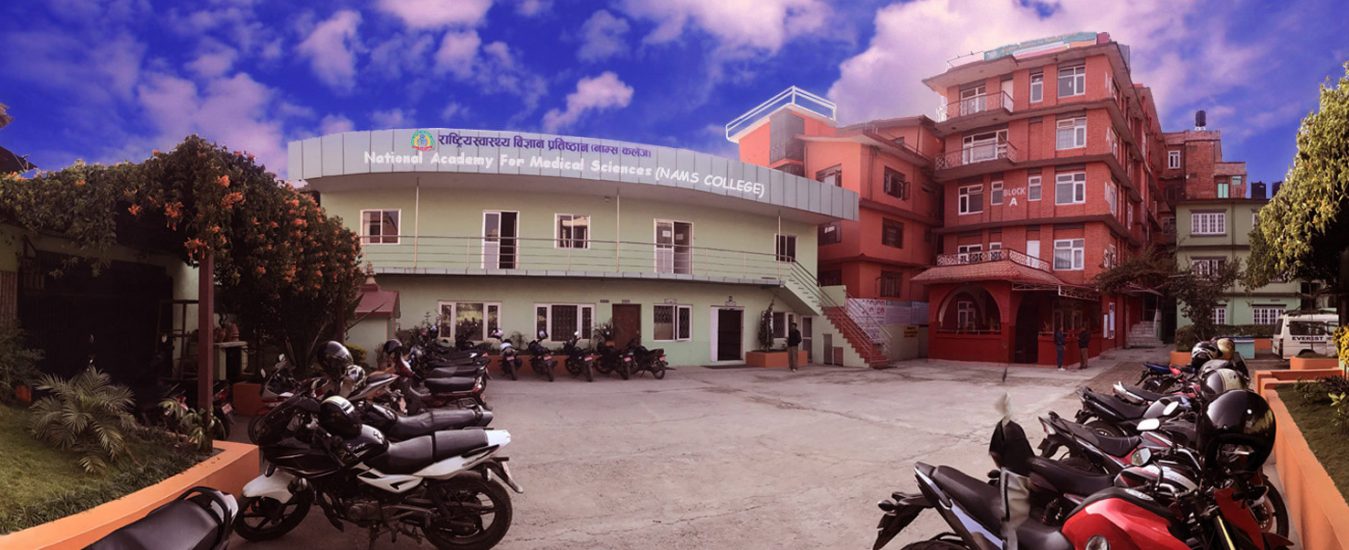
The Bachelor of Public Health (BPH) at NAMS College Kathmandu is a four-year bachelor-level program organized across eight semesters. The program is affiliated with Purbanchal University under its Faculty of Medical and Allied Sciences. The revised university curriculum dates from 2019.
BPH combines biological and health sciences with epidemiology, nutrition, family health, environmental and occupational health, community organization, statistics, health education, research, and public health management. Laboratory work and different forms of field-based practice are included as students move from foundational subjects to applied public health study.
Four-year bachelor program divided into eight semesters.
Affiliated with Purbanchal University.
Admission follows MECEE-BL under the prevailing Medical Education Commission framework.
Covers epidemiology, family health, nutrition, environmental health, community health, statistics, research, and public health management.
Includes laboratory-based practice, concurrent field-based practice, research activities, and residential field practicum.
Later semesters include public health research, project management, health information and logistics, and human resource training.
BPH is associated with the Nepal Health Professional Council for professional regulation.
Seat allocation, fees, scholarships, and related admission provisions are determined for the applicable academic intake.
| Particular | Details |
|---|---|
| Course | Bachelor of Public Health (BPH) |
| College | NAMS College Kathmandu |
| Affiliation | Purbanchal University |
| Duration | 4 years |
| Academic Structure | 8 semesters |
| Admission | MECEE-BL |
| Professional Council | Nepal Health Professional Council |
Admission to BPH at NAMS College follows the prevailing medical education admission system. Applicants must meet the eligibility requirements applicable to the BPH program and qualify through MECEE-BL.
The admission process follows the rules, guidelines, code of conduct, scholarship provisions, seat allocation arrangements, fee structure, and admission procedures set by the Medical Education Commission (MEC).
MEC determines seats for the relevant academic intake. Seat numbers, fees, scholarship provisions, examination guidelines, and admission arrangements may therefore change between academic years. Earlier intake figures should not be treated as permanent allocations.
The first semesters establish a base in public health and health sciences. Subjects include Introduction to Public Health, Anatomy, Physiology and Patho-physiology, Public Health Microbiology, Public Health Biochemistry, Applied Professional English, Public Health Entomology and Rodentology, Public Health Pharmacy, Pharmacology and Toxicology, First Aid and Safety, Basic Foods and Nutrition, Ecosystem and Environmental Health, and Epidemiology of Risk Factor and Communicable Diseases. Laboratory-based practice accompanies several basic science subjects.
As the course progresses, students study areas such as family health, reproductive health and gender, epidemiology of non-communicable diseases and mental health, public health epidemiology methods, sociology and anthropology in public health, rural and urban health, statistics and computer applications, community organization, disaster management, health education, school health, and public health services. Concurrent field-based practice is integrated with several of these subjects.
The later part of the program includes Health Management Information System and Logistic Management, Public Health Statistics and Computer Application laboratory work, public health research proposal writing, and a Comprehensive Public Health Management Field Practicum conducted as residential field-based practice. The eighth semester includes Education and Training of Human Resource, Public Health Profession and Entrepreneurship, Public Health Project Management, training program conduction, proposal writing, and Public Health Research Practicum.
Practical learning is built into different stages of the BPH curriculum rather than being limited to one final placement.
Students encounter laboratory-based practice during the early semesters. Later subjects introduce concurrent field-based practice, term-paper preparation, research proposal development, public health management fieldwork, training activities, and research practicum.
At NAMS College, the wider academic setting includes laboratories, a library and e-library, multimedia-supported classrooms, counseling and guidance, and a Center for Teaching, Learning, and Evaluation.
Through the eight-semester structure, students work across several connected areas of public health:
population and community health;
communicable and non-communicable disease epidemiology;
family and reproductive health;
nutrition and environmental health;
occupational health and disaster management;
community organization and health education;
statistics and computer applications;
health information and logistics;
public health research;
project and program management; and
field-based public health practice.
The combination of these areas gives the program a population-focused approach while retaining laboratory, research, community, and management components.
The curriculum prepares graduates for work connected with public health programs, community health activities, epidemiological work, health education, research, health information, project activities, and public health management.
The exact professional role available to a graduate depends on licensing status, recruitment criteria, experience, academic preparation, and the requirements of the employing organization. The BPH curriculum also develops a foundation in research and program management through proposal writing, field practicum, training activities, and research practicum.
BPH is associated with the Nepal Health Professional Council (NHPC). NAMS has included BPH among the programs connected with NHPC professional regulation.
Completing the academic degree and entering regulated professional practice are separate stages. After completing the BPH program, graduates must pass the applicable professional council licensing examination before entering the profession.
BPH fees, scholarships, and seat distribution operate under the prevailing MEC framework for the relevant admission cycle.
MEC decisions and the applicable academic calendar may revise the fee structure, scholarship arrangements, seat allocation, examination provisions, and other admission conditions from one intake to another. For this reason, historical seat or fee figures are not fixed values for later academic sessions.