The Diploma in Pharmacy at Little Buddha College of Health Science, Kathmandu, is a three-year pharmacy program conducted under the academic framework of the Council for Technical Education and Vocational Training (CTEVT). It follows a yearly system and combines basic science, pharmaceutical subjects, laboratory work and professional field practice.
The course is structured around the work performed by pharmacy assistants in public and private health institutions. Students study medicine preparation, dispensing, medicine use, pharmaceutical production, quality-related work and pharmacy services in hospital and community settings.
| Area | Details |
|---|---|
| Course | Diploma in Pharmacy |
| College | Little Buddha College of Health Science |
| Location | Kathmandu, Nepal |
| Academic body | CTEVT |
| Level | Diploma |
| Duration | 3 years |
| Academic system | Yearly system |
| Admission | CTEVT entrance examination and merit-based selection |
| Professional council | Nepal Pharmacy Council |
The Diploma in Pharmacy takes three years. Each academic year consists of 35 academic weeks or 210 working days, excluding the examination period, with 40 hours assigned to an academic week.
The first year builds the scientific and general academic foundation needed for later pharmacy study. Pharmacy-specific subjects become the main focus in the second year, while the third year combines advanced pharmacy study with hospital, community and workplace practice.
The first year covers:
English
Nepali
Social Studies
Anatomy & Physiology
Physics
Chemistry
Zoology
Botany
Mathematics & Statistics
Several science subjects include practical components, giving students a foundation in biological and physical sciences before they move into the main pharmacy curriculum.
The second year shifts directly into pharmaceutical sciences and pharmacy-related health subjects. Students study:
Pharmaceutics-I
Pharmacology I
Pharmaceutical Chemistry I
Pharmacognosy
Biochemistry & Microbiology
Pharmacotherapeutics I
Pharmaceutical Management
Public Health Pharmacy
Practical work accompanies Pharmaceutics, Pharmacology, Pharmaceutical Chemistry, Pharmacognosy, Biochemistry & Microbiology and Public Health Pharmacy.
This stage develops knowledge of dosage-form preparation, medicines and their effects, pharmaceutical substances, medicinal sources, microbiology, therapeutic use of medicines, pharmacy management and the public health role of pharmacy.
The third year moves further into applied pharmacy practice. Major subjects include:
Pharmaceutics II
Pharmacology II
Pharmaceutical Chemistry II
Hospital & Clinical Pharmacy
Pharmaceutical Jurisprudence and Community Pharmacy Practice
Pharmacotherapeutics II
Comprehensive Field Practice
Practical components remain part of Pharmaceutics, Pharmacology, Pharmaceutical Chemistry, Hospital & Clinical Pharmacy, and Pharmaceutical Jurisprudence and Community Pharmacy Practice.
The inclusion of pharmacy law, professional ethics, community pharmacy and hospital practice places professional responsibilities alongside pharmaceutical science during the final year.
The third year includes eight weeks of comprehensive field practice or workplace learning at 40 hours per week.
Four weeks are assigned to Hospital Pharmacy Practice. The remaining four weeks cover health facility or community pharmacy practice, pharmaceutical industry and regulatory-body exposure. The field-practice component carries 200 marks.
During this period, students work with activities such as prescription reading and interpretation, medicine dispensing, patient communication, medicine-use observation, pharmaceutical manufacturing processes, quality assurance and regulatory functions. The field practice also includes exposure to medicine distribution in hospital or health-facility settings.
Applicants should have passed SEE or SLC. For SEE, the curriculum specifies a minimum GPA of 2.0 with at least C grade in Compulsory English, Mathematics and Science, or the requirements prescribed through the applicable CTEVT admission guidelines.
Applicants are required to submit:
SEE/SLC pass certificates
Citizenship or birth registration certificate
They must also pass the entrance examination administered by CTEVT. Applicants who meet the entry qualification and admission criteria are selected on the basis of the merit list.
A minimum of 90 percent attendance in each subject is required to appear in the respective final examination.
Students must secure at least 40 percent in theory and 50 percent in practical components. They must obtain the required pass marks separately in internal assessment and the yearly final examination for each subject.
The grading structure is:
| Result | Marks |
|---|---|
| Distinction | 80% and above |
| First Division | 65% to below 80% |
| Second Division | 50% to below 65% |
| Pass Division | Pass marks to below 50% |
Students must complete all course components from all three years to receive the Diploma in Pharmacy. The curriculum allows back papers under CTEVT rules, with all subjects required to be completed within six years from the date of enrollment.
The combination of classroom study, laboratory work and field practice develops skills connected with:
reading and interpreting prescriptions
dispensing medicines
communicating medicine-use information to patients
pharmaceutical preparation and production
medicine quality assessment
hospital and community pharmacy services
pharmaceutical supply and management
rational use of medicines
pharmaceutical regulations and professional practice
The program also introduces students to manufacturing processes, quality assurance, medicine distribution and regulatory activities through its final-year workplace component.
Graduation and entry into regulated pharmacy practice are separate stages.
After completing the Diploma in Pharmacy, graduates must pass the applicable professional licensing examination under the Nepal Pharmacy Council before entering the profession. The CTEVT curriculum also connects successful course completion with eligibility for registration under the relevant council provisions.
The course prepares graduates for pharmacy assistant-level responsibilities in settings connected with hospital pharmacy, community pharmacy, health facilities and pharmaceutical production.
The curriculum also identifies eligibility for positions equivalent to Non-gazetted 1st Class/Level 5 (technical), subject to the applicable requirements of the Public Service Commission of Nepal and other concerned agencies.
Actual employment depends on professional licensing, recruitment criteria, available positions, individual skills and other requirements attached to a particular role.
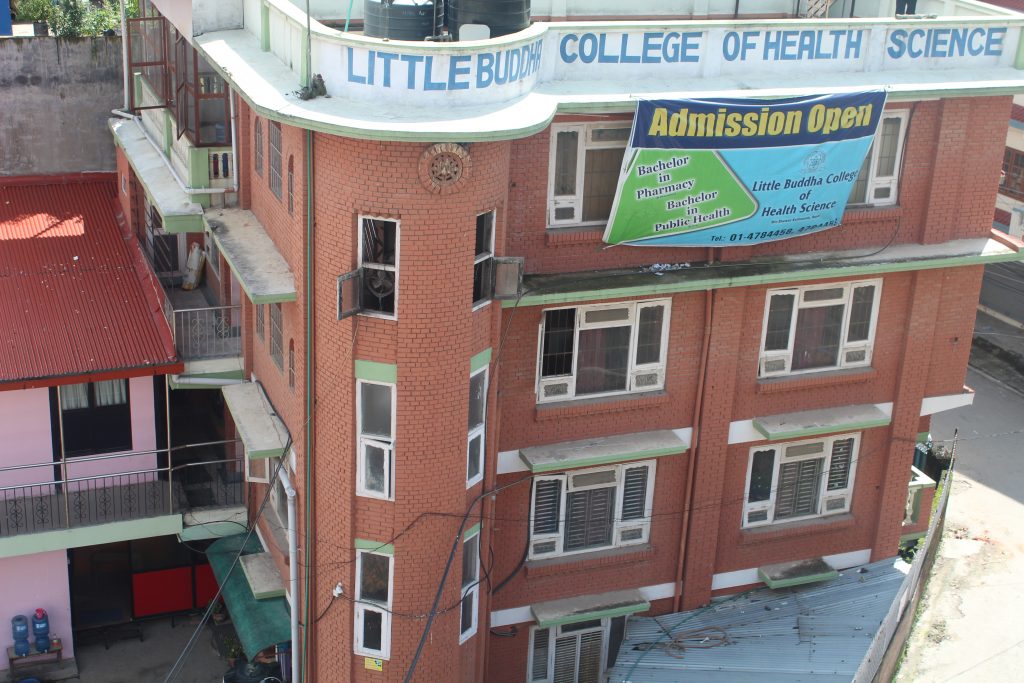
Diploma in Pharmacy students study within the health science setting of Little Buddha College of Health Science in Kathmandu. The college has classrooms, a library, computer-supported study facilities and laboratories, along with student activities and educational visits.
These facilities support a course in which science practicals, pharmacy laboratory work and professional field practice are integral parts of the three-year academic structure.