Crimson College of Technology (CCT) is located at Devinagar, Butwal, Rupandehi, Lumbini Province, Nepal. Established in 2000 AD and affiliated with Pokhara University, the college offers bachelor’s and master’s programs across management, information technology, pharmacy, nursing, medical laboratory technology, and public health.
Its current academic portfolio includes BBA, BCA, BCSIT, B Pharm, BSc MLT, BPH, BSc Nursing, Bachelor of Nursing Science in Oncology, and M Pharm in Clinical Pharmacy. The college also operates Crimson Hospital, a 100-bed hospital with a 24-hour emergency service that has been in operation since 2012.
| Particular | Details |
|---|---|
| Institution | Crimson College of Technology (CCT) |
| Location | Devinagar, Butwal, Rupandehi, Lumbini Province, Nepal |
| Established | 2000 AD |
| Affiliation | Pokhara University |
| Academic areas | Management, Science & Technology, Health Science |
| Academic level | Bachelor’s and Master’s |
| Hospital | Crimson Hospital |
| Hospital capacity | 100 beds |
| Emergency service | 24 hours |
| Hospital operating since | 2012 |
| Transportation | Four college buses serving Rupandehi, Nawalparasi, and Kapilvastu |
| Laboratory provision | Ten laboratory rooms |
| Other facilities | Library, computer facilities, health-science laboratories, cafeteria, transportation |
Crimson College of Technology has operated in Butwal since 2000 AD. Its academic activities cover management, information technology, and health sciences, giving students access to programs with markedly different areas of study within the same institution.
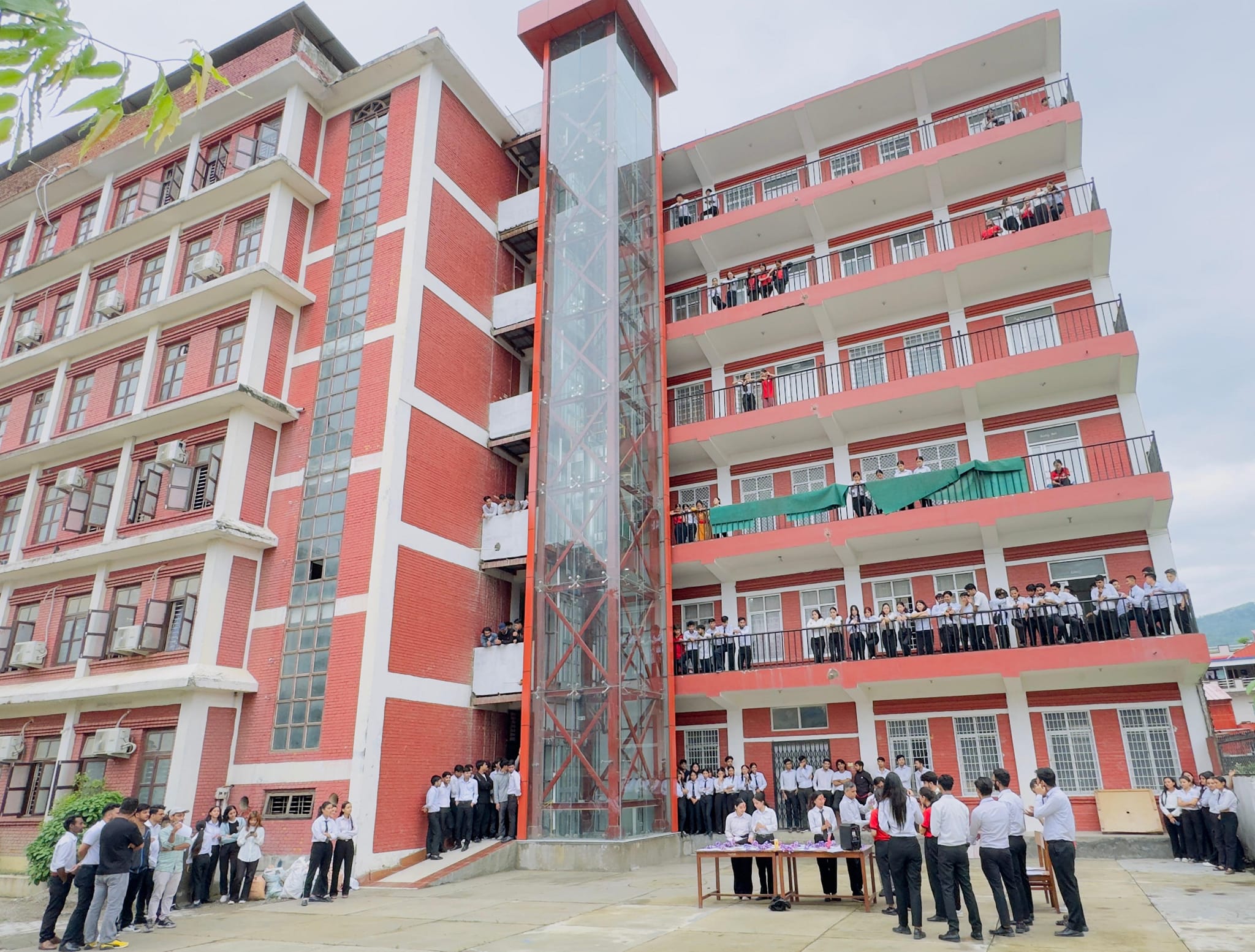
The college is affiliated with Pokhara University. Its academic offering includes undergraduate programs in business administration, computer applications, information technology, pharmacy, medical laboratory technology, public health, and nursing, along with a master’s program in clinical pharmacy.
CCT is based in Devinagar, Butwal, Rupandehi, within Lumbini Province. For students travelling from surrounding areas, the college operates four buses serving Rupandehi, Nawalparasi, and Kapilvastu.
The institutional motto is “Education for Better Life.” Its stated academic direction connects professional education with human values, ethical responsibility, practical skills, accountability, honesty, creativity, and lifelong learning.
The campus supports its academic programs through laboratories, computer facilities, a library, reading resources, transportation, and a cafeteria. Health-science education is also associated with Crimson Hospital, which has 100 beds and provides a 24-hour emergency service.
Crimson College of Technology is affiliated with Pokhara University. Its programs fall broadly into management, information technology, and health science.
The management and computing side includes:
Bachelor of Business Administration
Bachelor of Computer Application
Bachelor of Computer System and Information Technology
The health-science side includes:
Bachelor of Public Health
BSc Nursing
Bachelor of Nursing Science in Oncology
Bachelor of Pharmacy
BSc Medical Laboratory Technology
M Pharm in Clinical Pharmacy
These programs differ in academic level, subject matter, practical requirements, and professional orientation. Students considering CCT therefore need to examine the requirements of the individual course they intend to pursue rather than treating admission to all programs as a single process.
The Pokhara University programs and stated seat capacities at CCT are:
| Program | Level | Seats |
|---|---|---|
| Bachelor of Public Health (BPH) | Bachelor’s | 10 |
| BSc Nursing | Bachelor’s | 40 |
| Bachelor of Nursing Science in Oncology | Bachelor’s | 10 |
| M Pharm in Clinical Pharmacy | Master’s | 5 |
| Bachelor of Business Administration (BBA) | Bachelor’s | 96 |
| Bachelor of Computer System and Information Technology (BCSIT) | Bachelor’s | 48 |
| Bachelor of Computer Application (BCA) | Bachelor’s | 48 |
| Bachelor of Pharmacy (B Pharm) | Bachelor’s | 40 |
| BSc Medical Laboratory Technology (BSc MLT) | Bachelor’s | 20 |
The seat distribution ranges from five places in M Pharm in Clinical Pharmacy to 96 in BBA. BCA and BCSIT each have 48 seats, while B Pharm and BSc Nursing each have 40.
BBA is a four-year undergraduate program organized across eight semesters. Its academic content covers core areas of business and management, including accounting, economics, finance, human resource management, business communication, and related managerial subjects.
CCT has 96 seats for BBA, the highest seat allocation among the programs included in its current program list.
The degree is structured for students studying how organizations operate and how different business functions connect. Alongside theoretical study, the program addresses analytical, communication, and managerial areas that form part of undergraduate business education.
BCA is a four-year bachelor’s program divided into eight semesters. It combines computer education with management-related study rather than treating computing as a purely technical subject.
Its academic areas include software development, systems development, organizational management, networks, system administration, and computer applications. The structure connects computing skills with the organizational settings in which information systems and software are used.
CCT has 48 seats for BCA.
The college supports IT study through computer laboratory facilities. Students have access to computing resources used for programming, database work, software applications, and related practical assignments. Digital library resources also form part of the IT learning environment.
BCSIT is a four-year undergraduate program combining information technology with business and management concepts.
Its academic direction includes the analysis, design, development, and maintenance of information systems used in organizations. The course connects technical computing with management information requirements and organizational processes.
CCT has 48 seats for BCSIT.
Although BCA and BCSIT share some computing-related areas, their academic emphasis is not identical. BCA gives more direct attention to computer applications and software-related work, while BCSIT connects information technology more closely with information systems and organizational use.
B Pharm is a four-year undergraduate program divided into eight semesters. It introduces students to pharmaceutical science and academic areas connected with medicines, pharmaceutical preparation, analysis, production, quality-related work, and pharmacy practice.
CCT has 40 seats for B Pharm.
The pharmacy program is supported by laboratory infrastructure used for practical study. Available facilities include chemistry-related laboratory space and analytical equipment associated with pharmaceutical and health-science education.
BSc Medical Laboratory Technology is a four-year undergraduate program divided into eight semesters. CCT has 20 seats for the course.
The program focuses on laboratory science used in health-related testing and investigation. Its academic areas include hematology, parasitology, microbiology, biochemistry, and related medical laboratory work.
Practical laboratory learning forms a substantial part of this field. The health-science facilities at CCT include microbiology and chemistry laboratory spaces, anatomy and physiology facilities, and analytical equipment used in laboratory study.
BSc MLT differs from a general biological science degree because its academic focus is tied specifically to medical laboratory procedures, diagnostic laboratory methods, laboratory analysis, and technical accuracy.
BSc Nursing is a four-year undergraduate program with 40 seats at CCT.
Its academic scope covers nursing science and care in hospital and community settings. Areas of study include preventive, promotive, and therapeutic nursing care, together with nursing leadership, management, research, and professional practice.
The course combines classroom learning with practical nursing preparation. CCT’s health-science environment includes Crimson Hospital as well as nursing and other health-related teaching facilities.
Bachelor of Public Health is a four-year undergraduate program with 10 seats at CCT.
BPH approaches health mainly from population and community perspectives. Its academic areas include public health science, health interventions, public health tools and methods, management, laboratory learning, community skills, and field-related study.
The program contains 52 courses grouped into six broad components:
Basic Health Sciences
Public Health Sciences
Public Health Intervention
Public Health Tools and Methods
Public Health Management
Public Health Laboratory/Community Skill Development Courses
The program therefore combines health science with community work, research methods, health systems, management, and field learning.
CCT offers Bachelor of Nursing Science in Oncology with 10 seats.
The oncology focus distinguishes this program from the four-year BSc Nursing degree. It forms part of the college’s nursing and health-science portfolio and should be considered separately from BSc Nursing because the two programs have different academic identities.
M Pharm in Clinical Pharmacy is the master’s-level pharmacy program offered at CCT. It has five seats.
Its inclusion gives the pharmacy department programs at both bachelor’s and master’s levels, with B Pharm available as the undergraduate degree and M Pharm in Clinical Pharmacy at the graduate level.
Applicants considering this program need to distinguish its admission requirements from those of the undergraduate pharmacy course.
CCT’s stated mission connects academic professionalism with human values through education.
Its vision places emphasis on ethical and social responsibility together with lifelong skills.
The institutional objectives include:
providing higher-education opportunities through career-oriented courses;
offering education at a reasonable cost;
supporting social and cultural activities;
encouraging technical and job-oriented education;
fostering enthusiasm and creativity among students; and
developing practical life skills together with morality, accountability, honesty, and dedication.
These objectives correspond with the college’s mix of management, technology, and health-science education.
CCT has ten laboratory rooms furnished with machinery, equipment, servers, chemicals, and furniture used across its academic programs.
The facilities reflect the different practical needs of information technology and health-science students.
| Facility | Main Academic Use |
|---|---|
| Computer laboratory | Programming, software, database, and IT-related practical work |
| Microbiology laboratory | Microbiology-related health-science practical work |
| Chemistry laboratory | Chemistry and pharmaceutical laboratory study |
| Anatomy and physiology laboratory | Anatomy and physiology learning |
| HPLC equipment | Instrument-based laboratory analysis |
| UV spectrophotometer | Analytical laboratory work |
| General laboratory rooms | Practical work across technical and health-science subjects |
Health-science facilities include microbiology, chemistry, anatomy, and physiology spaces. Equipment associated with practical laboratory teaching includes High Performance Liquid Chromatography and a UV spectrophotometer.
The separation of different laboratory areas reflects the requirements of the college’s various disciplines. Pharmacy, medical laboratory technology, nursing, public health, and computing each depend on different types of practical learning facilities.
The computer laboratory supports practical work for BCA, BCSIT, and other technology-related study.
Available software resources include Microsoft Office, Visual Studio, Turbo C, Microsoft SQL Server, Photoshop, and other licensed software used for academic activities.
Digital library access is also associated with the college’s computer and information facilities. These resources support programming, database work, software practice, assignments, and other computer-based learning.
For BCA and BCSIT in particular, regular access to computer facilities complements classroom teaching because both programs contain practical technical components.
CCT maintains a library containing textbooks and reference materials for students across its academic departments.
The library is supported by a reading room and digital resources. E-books and e-journals are included among the available learning resources.
This combination serves students from several disciplines, including management, computing, pharmacy, medical laboratory technology, nursing, and public health, each of which has different academic reading and reference requirements.
The library, reading room, and digital access together form the main study-resource facilities available outside classrooms and laboratories.
Crimson Hospital has been operating since 2012. It has 100 beds and provides a 24-hour emergency service.
The hospital forms part of the wider setting in which CCT runs its health-science programs. The college offers nursing, pharmacy, public health, and medical laboratory technology alongside this hospital facility.
Academic programs and hospital services serve different functions, but the presence of both within the CCT setting places health-science education alongside an operating healthcare facility.
The college provides transportation through four buses serving students from Rupandehi, Nawalparasi, and Kapilvastu.
Transportation is part of the regular student-support infrastructure for those travelling to and from the campus.
CCT also has a cafeteria or canteen serving breakfast, lunch, tea, snacks, and other food items. The facility supports students who remain on campus for classes, laboratory sessions, reading, and other academic activities during the day.
CCT has several scholarship categories.
| Scholarship Category | Basis |
|---|---|
| Pokhara University Scholarships | University-related category |
| Merit Based Scholarships | Academic merit |
| Test Based Scholarships | Test performance |
| Need Based Scholarships | Financial need |
| National & International Talent Scholarships | Talent-based category |
| CCT Silver Jubilee Scholarships | College scholarship category |
These categories represent different forms of scholarship support associated with the institution. Eligibility and selection depend on the individual scholarship category rather than one common scholarship arrangement.
Students taking health-science programs may need to follow the requirements relevant to their particular discipline.
The Medical Education Commission, Nepal Health Professional Council, Nepal Pharmacy Council, and Nepal Nursing Council are relevant reference points for the respective health-education and professional areas covered by CCT’s programs.
Requirements differ by course and field, so these bodies should not be treated as applying identically to every health-science program.
Crimson College of Technology is located at Devinagar, Butwal, Rupandehi, Lumbini Province, Nepal.
The college’s transportation network serves students from Rupandehi, Nawalparasi, and Kapilvastu. Its campus environment includes classrooms, laboratories, computer facilities, library and reading resources, a cafeteria, transportation services, and the hospital associated with its health-science setting.
For students comparing programs at CCT, practical considerations include the course itself, available seats, academic level, laboratory requirements, and daily travel arrangements.
Crimson College of Technology is located at Devinagar, Butwal, Rupandehi, Lumbini Province, Nepal.
The college was established in 2000 AD.
Crimson College of Technology is affiliated with Pokhara University.
The college offers Bachelor of Public Health, BSc Nursing, Bachelor of Nursing Science in Oncology, M Pharm in Clinical Pharmacy, Bachelor of Business Administration, Bachelor of Computer System and Information Technology, Bachelor of Computer Application, Bachelor of Pharmacy, and BSc Medical Laboratory Technology.
CCT has 96 seats for BBA, 48 seats for BCA, and 48 seats for BCSIT.
The stated seat capacities are 10 for BPH, 40 for BSc Nursing, 10 for Bachelor of Nursing Science in Oncology, five for M Pharm in Clinical Pharmacy, 40 for B Pharm, and 20 for BSc MLT.
Yes. Crimson Hospital has 100 beds, provides a 24-hour emergency service, and has been operating since 2012.
The college has ten laboratory rooms. Facilities include computer, microbiology, chemistry, anatomy and physiology laboratory spaces, along with HPLC equipment and a UV spectrophotometer.
Yes. The college operates four buses serving students from Rupandehi, Nawalparasi, and Kapilvastu.
Scholarship categories include Pokhara University Scholarships, Merit Based Scholarships, Test Based Scholarships, Need Based Scholarships, National & International Talent Scholarships, and CCT Silver Jubilee Scholarships.