Lumbini Banijya Campus is a community-based management campus in Devinagar, Butwal Sub-Metropolitan City, Rupandehi. Established in 1982 AD (2038 BS) and affiliated with Tribhuvan University, it runs undergraduate and postgraduate management programs under both university and autonomous frameworks. The campus also holds reaccreditation from the University Grants Commission (UGC) Nepal and is presented with QAA re-accredited status.
The campus began with morning-shift PCL classes and later expanded into degree-level management education. Its academic structure combines TU-governed programs with autonomous offerings in applied business management, finance, and banking. The institutional setup also shows a defined governance and academic support system that includes the Campus Management and Development Council, Management Committee, Campus Chief, IQAC, EMIS, academic sections, administrative sections, and several functional cells.
Established in 1982 AD (2038 BS); formally inaugurated on 20 February 1982
Located in Devinagar, Butwal Sub-Metropolitan City, Rupandehi, near the East-West and Siddhartha highways
Affiliated with Tribhuvan University
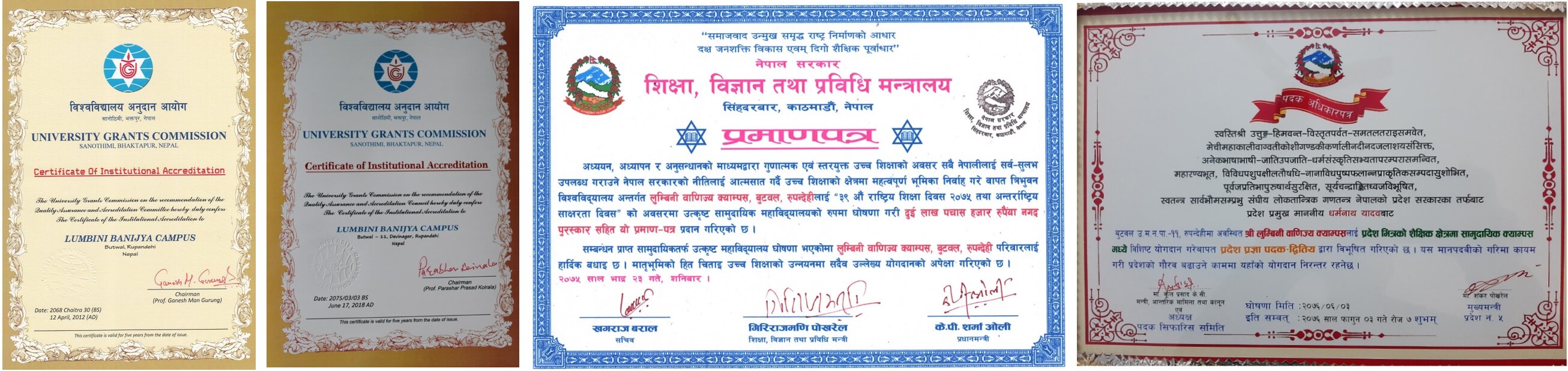
Reaccredited by the University Grants Commission (UGC) Nepal with QAA re-accredited status
Runs TU-governed programs and five autonomous management programs
Programs available: BBS, BBM-A, BMS, BBA-FA, MBS, MBS-F, and MBA-BF
Academic and support facilities include a library, e-library, computer labs, seminar halls, cafeteria, transportation service, incubation center, counseling support, and placement-related support
Teaching and administration are supported by EMIS, IQAC, departments, exam-related units, ECA, clubs, and specialized cells
Scholarship provisions include merit-based and merit-cum-means support, along with targeted scholarships in the BBA-FA program
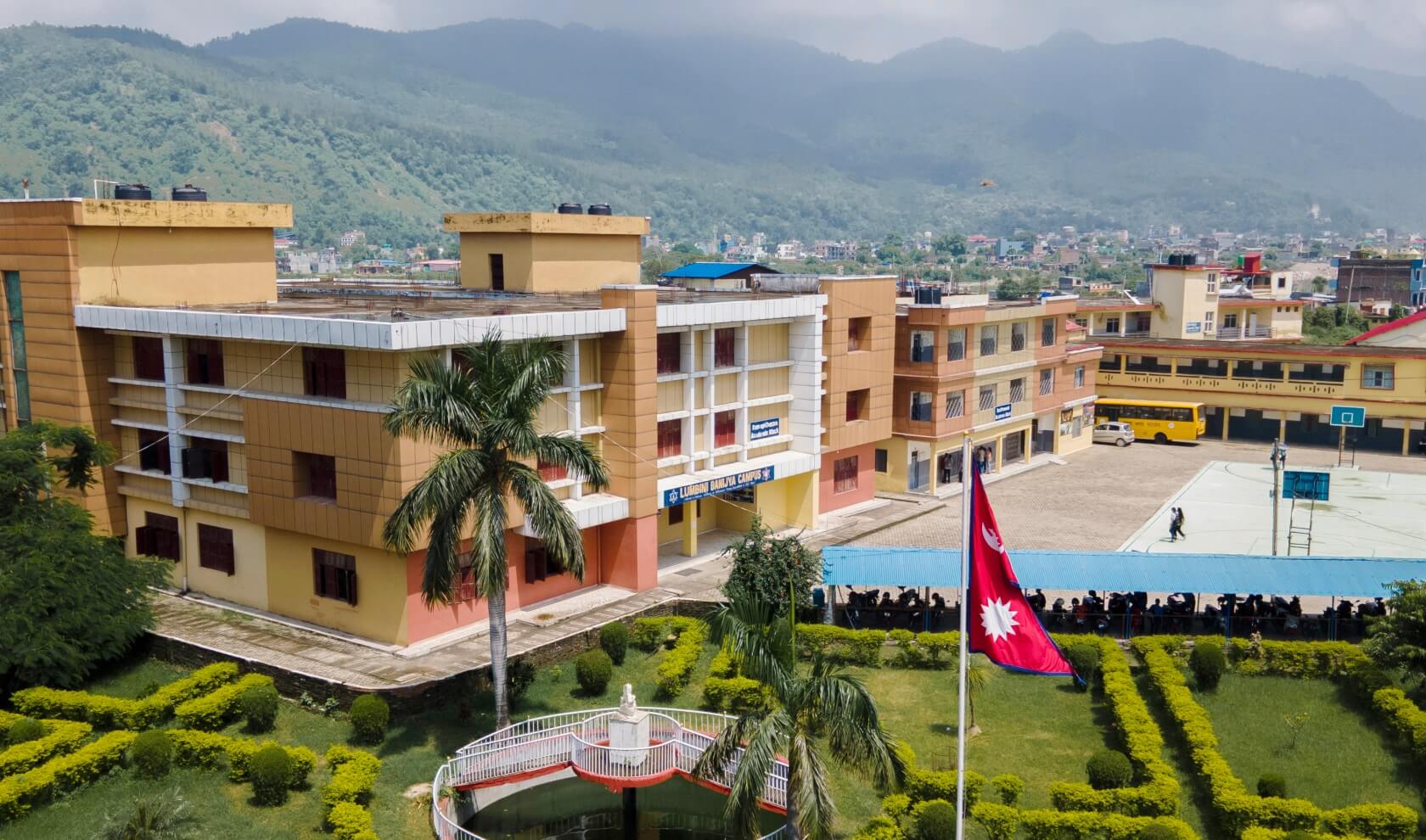
Lumbini Banijya Campus was initiated in the early 1980s and formally inaugurated on 20 February 1982. It first operated from the Butwal Municipality Building in Ward No. 1 with PCL classes in the morning shift. B.Com classes began in 1986 with 42 students in the first year. The campus later phased out PCL and received approval to run MBS in 2001. Expansion continued with BBM under TU affiliation in 2014 and MBA-BF in 2017 under autonomy.
Its location in Devinagar places the campus within a major urban and transport corridor of Butwal. The source material links the campus with the East-West and Siddhartha highways, which gives it regional accessibility for students coming from different parts of the district and beyond.
Institutionally, the campus is tied to Tribhuvan University and presents itself as a management-focused academic institution. Its academic base is built around management and business education rather than a multi-faculty structure. Leadership messages also describe the campus as having continuously provided specialized management education since its legal recognition.
The governance structure shown in the campus organizational chart is more detailed than a simple administrative hierarchy. At the top is the Campus Management and Development Council, followed by the Management Committee. The Campus Chief sits at the center of the academic and administrative system, supported by Assistant Campus Chiefs for the morning and day shifts. The structure also includes the Academic Council, stakeholders, IQAC, advisors, and examination function.
Below that level, the system is divided into Academic Section, EMIS, and Administrative Sections. Academic delivery is connected to program coordinators, departments or faculties, and subject areas such as Research and Development, Management, Accountancy, Finance and Marketing, and Economics, Statistics, and Language. Supporting cells include Counseling and Placement, Student Evaluation and Monitoring, Exam, Library Management, Public Relation, and Publication and Communication. ECA, clubs, the administrative department, exam department, store, library, and financial administration are also shown as formal parts of the campus structure.
This institutional arrangement matters because it shows that academic delivery, student services, examination work, information management, and administrative functions are distributed through defined units rather than being handled informally.
Lumbini Banijya Campus runs a mix of TU-governed and autonomous management programs.
Bachelor of Business Studies (BBS)
Master of Business Studies (MBS)
The MBS program is identified as a two-year postgraduate program under the Faculty of Management of Tribhuvan University. Its stated objective is to prepare students for managerial roles and higher-level functional work in areas such as management, accounting, marketing, and information systems.
Bachelor of Business Management - Applied (BBM-A)
Bachelor of Management Studies (BMS)
Bachelor of Business Administration in Finance and Accounting (BBA-FA)
Master of Business Studies - Finance (MBS-F)
Master of Business Administration in Banking and Finance (MBA-BF)
The source material also notes that the campus runs five autonomous programs alongside the TU-governed BBS and MBS. In that model, the autonomous side gives the campus room to organize course delivery and evaluation within the approved framework.
The academic profile of the campus is centered on business and management studies. Program descriptions and institutional notes connect the campus with finance, accounting, banking, marketing, management, entrepreneurship, business research, and applied managerial learning. Skill-oriented support mentioned in the material includes writing, presentation, public speaking, and entrepreneurial training.
Undergraduate applicants for BBM-A, BBA-FA, and BMS must have passed 10+2 or an equivalent qualification with at least D+ grade in all subjects of Classes 11 and 12.
Entrance examination is required for BBM-A, BBA-FA, and BMS. The material refers to written tests such as LBCMAT or TU CMAT for bachelor's level.
Applicants for the BBS program must have passed 10+2 or an equivalent examination. A program-specific note for TU BBS also states second division, 45 percent and above, or 1.8 CGPA as the entry threshold.
Applicants for MBS must have passed a bachelor’s degree or equivalent and must pass the entrance examination conducted by Tribhuvan University.
Applicants for MBA-BF and MBS-F must hold BBS, BBA, or an equivalent qualification in any discipline with a minimum of second division marks and must pass the entrance examination.
The broader admission process may include a written entrance test, group discussion, individual presentation, and personal interview for selected postgraduate contexts. The material also refers to TU CMAT for master's level in relation to master’s admission contexts.
Admission openings are described as taking place in spring and fall, and the BBA-FA scholarship note refers to biannual intake.
The campus material presents the faculty body as academically qualified and research-oriented, with heads of departments working alongside program coordinators to manage academic delivery. This matters because the academic organization is not limited to classroom teaching alone; it also includes research, evaluation, and program-level coordination.
The teaching process is described through specific practices rather than general claims. These include interactive classroom sessions, business case studies, simulations, group activities, article reviews, term papers, academic writing, guest lectures, panel discussions, research-based assignments, and presentations. The same material links classroom teaching with field work, research exposure, and practical business scenarios.
A more recent institutional note adds the Research Management Cell (RMC) to this academic environment. The RMC is described as a body for promoting and coordinating research culture among faculty and students. Its work covers proposal development, research planning, collaboration, ethical compliance, workshops, training, funding support, and publication. That expands the academic picture beyond teaching and shows how the campus connects coursework with institutional research processes.
Quality-related structures are also present. IQAC appears in the organizational chart and in academic quality references, while EMIS is positioned as a formal academic and administrative unit. Together, these indicate that teaching, academic records, and internal coordination are handled through designated systems.
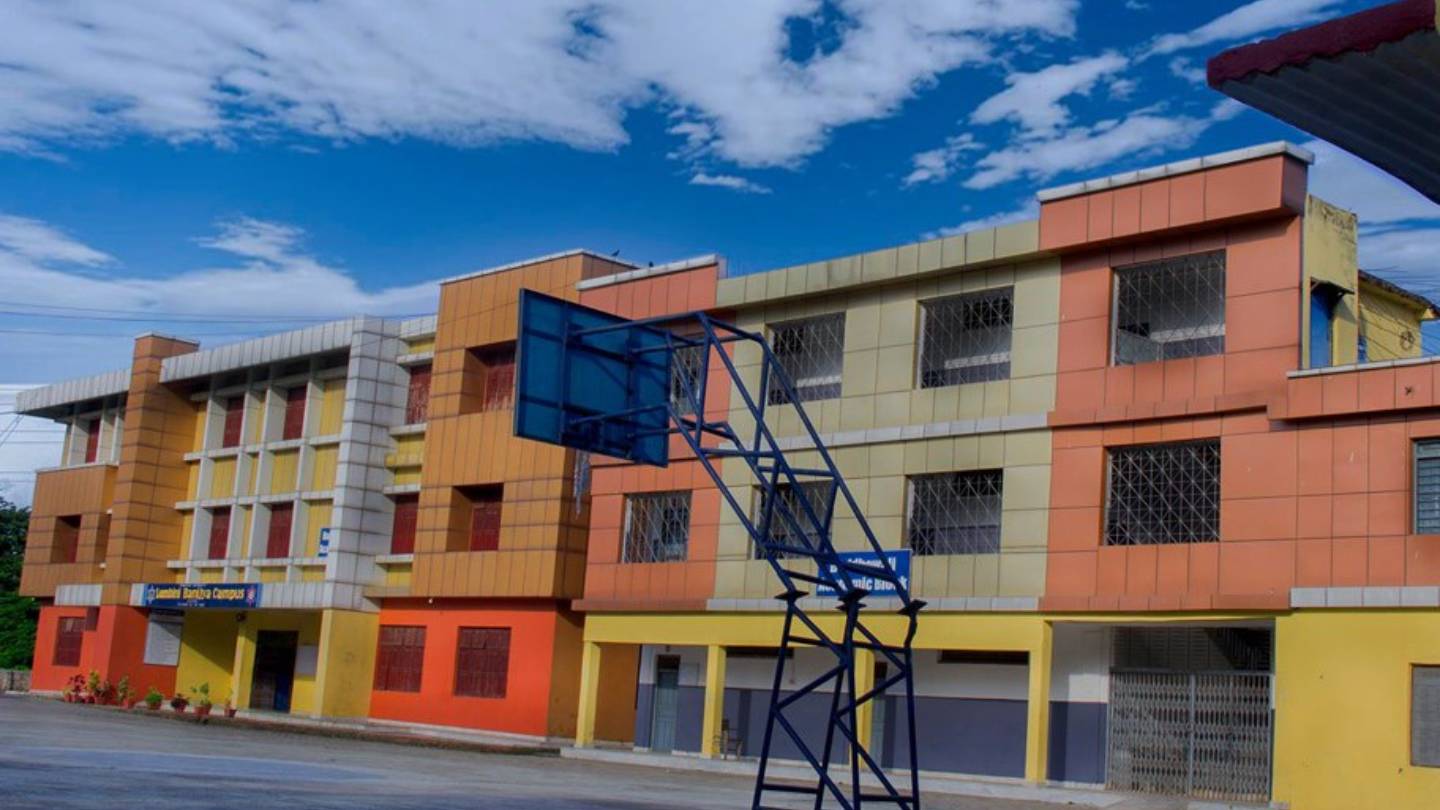
Physical library and e-library
Central library access to journals and digital resources
Computer labs with internet and software support
Seminar halls for workshops, events, and conferences
Classrooms with lighting and ventilation
Cafeteria
Transportation service
Incubation center
Counseling support
Placement-related support
EMIS for academic and administrative information management
Academic section and administrative sections
Exam department
Library management unit
Store and financial administration units
ECA and clubs as organized campus functions
The sources also connect the campus with ICT-based administration and learning support. EMIS is shown in the organizational structure, and the institutional material places information management alongside academic and administrative operations.
Student life at Lumbini Banijya Campus is tied closely to management-oriented academic activity. The annual pattern of campus events includes guest lectures by industry professionals, management fests, business simulations, cultural programs, student-led events, social service projects, and environmental awareness activities. These are presented as recurring parts of campus life rather than one-time additions.
The student experience also includes field visits and internships. That is one of the more useful details in the source because it shows how the campus tries to connect management study with business practice outside the classroom. This connection is reinforced by entrepreneurship-related features such as the incubation center and, in leadership messaging, the innovation-oriented direction of the campus.
The organizational chart adds another layer to campus experience by showing how student support is structured. Counseling and placement, student evaluation and monitoring, ECA, clubs, library management, exam support, and public communication all appear as formal units inside the campus system. That suggests that student affairs are not treated as separate from academic administration.
Inter-college competitions
Public speaking and debate forums
Music and dance performances
Annual sports meet and tournaments
Community outreach and volunteering
Cultural programs
Student-led events
Management fests
Business simulations
Social service and environmental awareness activities
Merit-based scholarships
Merit-cum-means scholarships
Support for students from disadvantaged backgrounds
Support for differently-abled students
Awards for academic toppers
Financial aid for low-income students
Support for students from marginalized communities
Incentives linked to ECA participation and leadership roles
For BBA-FA, biannual intake is noted with two sections of 44 students each
In the BBA-FA scholarship structure, 10 percent of 80 students, that is 8 students, are eligible for scholarship
The entrance topper in LBCMAT receives a 20 percent waiver of semester fees in the first semester
Selected scholarship recipients in the BBA-FA structure receive a 50 percent semester fee waiver
Continuity of scholarship in that structure requires passing each semester
The BBA-FA scholarship note connects eligibility with prior study in Nepalese government, community, or trust institutions and Nepali citizenship
Formally inaugurated on 20 February 1982
Began B.Com classes in 1986 with 42 students in the first year
Approved to run MBS in 2001
Approved to run BBM under TU affiliation in 2014
Approved to run MBA-BF under autonomy in 2017
First community campus in Lumbini Province to receive UGC accreditation and reaccreditation
Received the Best Community Campus Award 2075 from the Ministry of Education, Nepal
Honored again as an outstanding community campus on Education Day in 2080 BS
Received UGC Nepal re-accreditation for a continuous third time on 16 July 2025
Messages from Prof. Dr. Tara Prasad Upadhyaya, Campus Chief, and Mr. Surendra Prasad Shrestha, Chairman, place the campus within a long-running community-supported tradition of management education. Their emphasis falls on research orientation, practical learning, community trust, and the need to keep academic work responsive to changing student and institutional requirements.
The leadership message also connects the campus with entrepreneurship support, incubation-oriented work, and a longer-term institutional goal of becoming a deemed university. In that context, the chairman refers to land support in Charpala Community Forest, Butwal, and preparatory work such as scoping and an initial DPR linked to the deemed-university process. The same leadership direction places weight on operational improvement, technical education, and the effort to connect education with self-employment and enterprise.
Lumbini Banijya Campus stands out in the source material as a management-focused campus with a long operating history in Butwal. Its institutional profile is defined by TU affiliation, UGC reaccreditation, a combination of university and autonomous programs, and a structured academic-administrative system.
For prospective students, the most decision-useful features are clear: the campus runs both bachelor's and master's level management programs, maintains defined academic and support units, uses research and presentation-based teaching practices, and provides access to library, lab, seminar, counseling, scholarship, and extracurricular systems. Its profile is strongest where academic structure, governance, and program diversity meet.
College Name: Lumbini Banijya Campus (लुम्बिनी वाणिज्य क्याम्पस)
Location: Devinagar, Butwal Sub-Metropolitan City-13, Rupandehi, Lumbini Province, Nepal
Phone: +977 071-410500 / 071-410245
Email: info@lbc.edu.np
Website: www.lbc.edu.np
Contact Lumbini Banijya Campus's administrative office for detailed information on the course, admissions, location, fees, scholarships, facilities, counseling, or eligibility.
Lumbini Banijya Campus runs BBS, BBM-A, BMS, BBA-FA, MBS, MBS-F, and MBA-BF.
Yes. The campus is affiliated with Tribhuvan University. The source material also indicates that it runs five autonomous programs alongside TU-governed BBS and MBS.
The campus is reaccredited by the University Grants Commission (UGC) Nepal and is presented with QAA re-accredited status. The material also refers to a continuous third-time UGC reaccreditation dated 16 July 2025.
Entrance examination is required for BBM-A, BBA-FA, and BMS. The process refers to written tests such as LBCMAT or TU CMAT for bachelor's level. For MBS, students must pass the TU entrance examination. For MBA-BF and MBS-F, an entrance examination is also required.
For BBS, applicants must have passed 10+2 or an equivalent qualification. A program-specific BBS note also gives second division, 45 percent and above, or 1.8 CGPA as the entry threshold. For MBS, applicants must have passed a bachelor’s degree or equivalent and must pass the entrance exam conducted by Tribhuvan University.
The campus provides merit-based and merit-cum-means scholarships, along with support for students from disadvantaged backgrounds, differently-abled students, low-income families, marginalized communities, and students recognized for academic performance or participation in ECA and leadership activities. The BBA-FA program also includes a separate scholarship arrangement with fee waivers and entrance-topper support.
The campus provides a physical library, e-library, computer labs, seminar halls, classrooms, cafeteria, transportation service, incubation center, counseling and placement-related support, ECA, clubs, exam-related units, and EMIS-based academic and administrative support.
The organizational structure places the Campus Management and Development Council and Management Committee at the top, with the Campus Chief at the center of operations. Academic Section, EMIS, Administrative Sections, IQAC, advisors, examination, departments, program coordinators, and several functional cells form the working structure of the campus.