Pokhara University School of Engineering is a constituent school of Pokhara University under the Faculty of Science and Technology. Established in 2009, the School operates from Pokhara-30, Khudi, Kaski, Nepal, and provides bachelor's and master's education across engineering, computing, technology, and related interdisciplinary fields.
Its bachelor's programs cover civil, civil and rural, computer, software, information technology, electrical and electronics, and mechanical engineering. At master's level, the academic range extends into structural engineering, hydropower engineering, construction management, sanitary engineering, electrical power systems, computer engineering, computer science, bioinformatics, and disaster-related engineering.
SOE programs do not follow a single academic pattern. Undergraduate engineering degrees begin with mathematics, science, computing, drawing, mechanics, electrical or electronics fundamentals, and other foundational subjects before moving into branch-specific study. Master's programs are more specialized and use different combinations of advanced coursework, research, project work, laboratories, electives, and thesis requirements.
| Particular | Details |
|---|---|
| Institution | Pokhara University School of Engineering |
| Institution type | Constituent School |
| Parent university | Pokhara University |
| Faculty | Faculty of Science and Technology |
| Established | 2009 |
| Location | Pokhara-30, Khudi, Kaski, Nepal |
| Academic levels | Bachelor's and Master's |
| Academic area | Engineering, computing, technology, and related interdisciplinary fields |
The School functions directly within Pokhara University, an autonomous and non-profit public institution. Pokhara University's wider institutional direction connects higher education with teaching, learning, research, national development, and community service. The School of Engineering contributes to this academic structure through undergraduate engineering education and specialized graduate study.
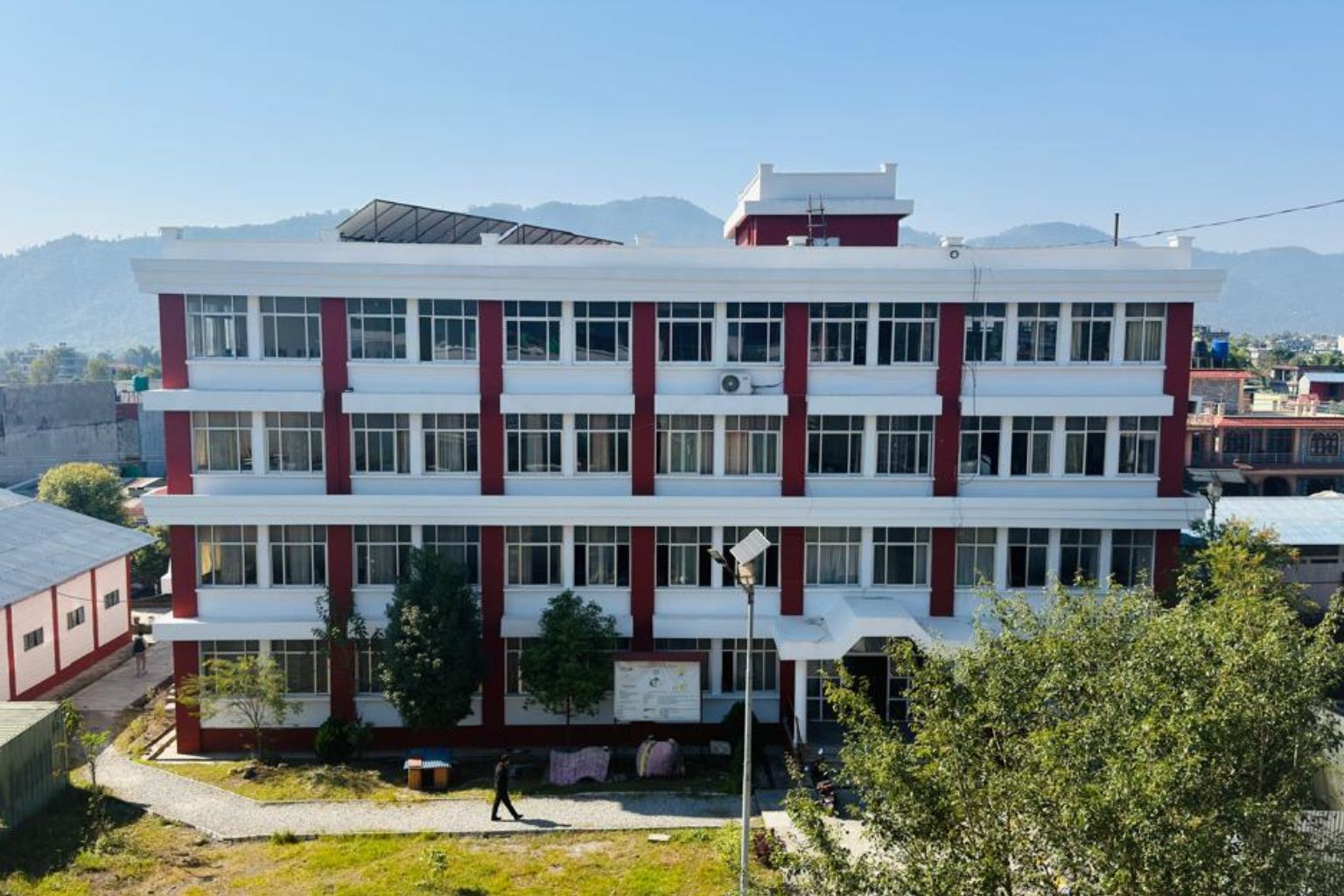
Being a constituent school is an important institutional distinction. The School is an academic unit of Pokhara University rather than a separate affiliated college offering university programs under affiliation. Its academic programs therefore sit directly within the university's Faculty of Science and Technology.
The School is located at Pokhara-30, Khudi, Kaski, Nepal. Its location places it within Pokhara Metropolitan City.
The same Pokhara-30 location is used in graduate program information for the School. The M.Sc. in Structural Engineering identifies its location as the School of Engineering, Pokhara University, while the M.Sc. in Bioinformatics is identified with Pokhara-30, Khudi, Kaski, Nepal.
The School brings several branches of engineering and computing into one university academic setting. This means students at different levels may be studying areas ranging from civil infrastructure and mechanical systems to software, computer engineering, power systems, structural analysis, bioinformatics, construction management, hydropower, and sanitary engineering.
The School offers the following bachelor's and master's programs with the stated seat capacities.
| Level | Program | Seats |
|---|---|---|
| Bachelor's | Bachelor of Mechanical Engineering (BE Mechanical Engineering) | 48 |
| Bachelor's | Bachelor of Engineering in Information Technology (BE IT) | 48 |
| Bachelor's | Bachelor of Civil Engineering (BE Civil) | 115 |
| Bachelor's | Bachelor of Electrical and Electronics Engineering | 48 |
| Bachelor's | Bachelor of Civil and Rural Engineering (BE Civil and Rural) | 48 |
| Bachelor's | Bachelor of Computer Engineering (BE Computer) | 48 |
| Bachelor's | Bachelor of Software Engineering (BE Software) | 48 |
| Master's | Master of Computer Engineering | 30 |
| Master's | MSc in Computer Science | 30 |
| Master's | Master of Science in Sanitary Engineering | 30 |
| Master's | MSc in Structural Engineering | 15 |
| Master's | MSc in Bioinformatics | 15 |
| Master's | Master of Science in Construction Management | 30 |
| Master's | MSc in Electrical Engineering in Power System | 15 |
| Master's | MSc in Hydropower Engineering | 15 |
| Master's | MSc in Public Health and Disaster Engineering (MSc PH) | 15 |
The undergraduate portfolio gives students separate routes into infrastructure, computing, software, information technology, electrical and electronics, mechanical systems, and rural engineering. The master's portfolio narrows these areas into advanced professional and research-oriented fields.
The degree titles should be read carefully. BE Computer, BE Software, and BE IT are separate bachelor's programs. BE Civil and BE Civil and Rural are also distinct degrees. At master's level, Master of Computer Engineering and M.Sc. in Computer Science have different academic entry backgrounds despite both being computing-oriented programs.
The general academic requirement for engineering study under Pokhara University's science and technology stream is based on completion of Grade 12 Science or an equivalent qualification from a recognized institution.
Applicants are expected to meet the following academic conditions:
Completion of Grade 12 in the Science stream or an equivalent qualification.
Study of Physics, Chemistry, and Mathematics.
At least one course carrying a minimum of 100 full marks or 5 credits in each required subject.
A minimum C grade or 45 percent in Physics, Chemistry, and Mathematics at Grade 12.
An overall GPA of at least 2.0 on a 4.0 scale or an equivalent result.
Mathematics of at least 100 marks studied in Grade 11 or Grade 12.
These requirements establish the common academic foundation for entry into engineering. The actual program selected after meeting that foundation determines what the student studies over the following semesters.
Bachelor of Civil Engineering is the largest bachelor's program by the stated seat capacity, with 115 seats. Its curriculum is organized across eight semesters and carries 129 credits.
The first year establishes a broad engineering base. Students study Applied Chemistry, Applied Physics, Calculus I, Computer Programming, Engineering Drawing, Applied Mechanics, Algebra and Geometry, Basic Electrical and Electronics Engineering, Civil Engineering Materials, Civil Engineering Workshop, Engineering Geology, and Introduction to Energy Engineering.
The curriculum becomes more civil-engineering focused from the middle semesters. Subjects include:
Building Technology
Fluid Mechanics
Numerical Methods
Strength of Materials
Surveying I and II
Hydraulics
Probability and Statistics
Soil Mechanics
Structural Analysis I and II
Engineering Hydrology
Foundation Engineering
Transportation Engineering I and II
Water Supply Engineering
Concrete Technology and Masonry Structure
Irrigation and Drainage Engineering
Sanitary Engineering
Later semesters add Engineering Economics, Design of Steel and Timber Structure, Construction Project Management, Design of R.C.C. Structures, Estimating and Valuation, Hydropower Engineering, electives, and Engineering Professional Practice.
The curriculum also contains defined project and practical components. Project I appears in the fourth semester, Survey Field Project in the fifth semester, and Project II in the seventh semester. The eighth semester includes a six-credit internship.
This sequence shows the way the degree progresses from engineering fundamentals into structures, geotechnical work, transportation, water resources, construction, surveying, sanitation, hydropower, project work, and professional practice.
Bachelor of Computer Engineering is a four-year, eight-semester undergraduate engineering program carrying 130 credits. It has 48 seats.
The degree combines hardware and software study. Its academic scope includes computer organization and architecture, systems programming, operating systems, digital hardware design, programming, databases, communication systems, electronics, and other computing-related engineering subjects.
The first semester includes Basic Electrical Engineering, Calculus I, Communication Techniques, Computer Workshop, Digital Logic, Electronic Devices and Circuits, and Programming in C.
The second semester combines Algebra and Geometry, Applied Chemistry, Applied Physics, Basic Engineering Drawing, Data Structure and Algorithms, Instrumentation, and Object Oriented Programming in C++.
By the third semester, students encounter subjects including Computer Graphics, Data Communication, Database Management System, Microprocessor and ALP, and Operating Systems.
The stated academic goals of the program emphasize engineering problem solving, design, communication, professional responsibility, teamwork, and continued learning. Its subject combination reflects the position of computer engineering between software, digital systems, electronics, hardware, networking, and computer architecture.
Bachelor of Mechanical Engineering has 48 seats. Its 2024 curricular structure begins with mathematics, applied science, computing, engineering drawing, mechanics, electrical and electronics fundamentals, thermodynamics, workshop practice, measurement, materials, and manufacturing-related study.
The first semester carries 16 credits and includes:
Calculus-I
Applied Physics
Applied Chemistry
Fundamentals of Computer Programming
Engineering Drawing-I
Engineering Mechanics-I
The second semester carries 17 credits. Students study Algebra and Geometry, Basic Electrical and Electronics Engineering, Engineering Drawing-II, Engineering Mechanics-II, Engineering Thermodynamics-I, and Workshop Technology.
The third semester carries 18 credits and introduces Calculus-II, Electrical Machines, Instrumentation and Measurement, Strength of Materials, Engineering Thermodynamics-II, and Manufacturing and Production Processes.
The sequence establishes a mechanical engineering foundation that connects mathematics and science with drawing, mechanics, thermodynamics, electrical machines, measurement, material strength, workshops, and manufacturing processes.
Four other bachelor's programs each have 48 seats: BE IT, BE Software, Bachelor of Electrical and Electronics Engineering, and BE Civil and Rural Engineering.
Together with BE Computer, BE Civil, and Mechanical Engineering, these programs widen the undergraduate academic choices within the School.
The three computing-related bachelor's degrees should not be treated as different names for the same program. BE Computer, BE Software, and BE IT are separate academic programs. A student comparing them should therefore look at the individual course structure rather than deciding only from the common computing theme in their titles.
The same distinction applies to civil engineering. BE Civil and BE Civil and Rural Engineering are separately named programs. BE Civil has a 115-seat capacity, while BE Civil and Rural Engineering has 48 seats.
Electrical and Electronics Engineering forms another branch in the bachelor's portfolio, with 48 seats, adding an engineering route distinct from civil, mechanical, and computing study.
SOE master's programs are built around more specialized academic fields than the bachelor's degrees. Entry therefore depends strongly on the applicant's previous degree.
The available graduate programs include computer engineering, computer science, structural engineering, bioinformatics, construction management, electrical power systems, hydropower engineering, sanitary engineering, and public health and disaster engineering.
Several of the programs require a closely related engineering bachelor's degree. Others, particularly M.Sc. in Computer Science and M.Sc. in Bioinformatics, accept a broader range of prior academic backgrounds.
| Program | Academic background for entry | Minimum academic requirement |
|---|---|---|
| Master of Computer Engineering | Bachelor's in Computer Engineering or equivalent | PU CGPA 2.0, or second division/equivalent from another recognized institution |
| M.Sc. in Computer Science | Four-year bachelor's in Engineering or Computer Science; or B.Sc. in Data Science, Physics, Statistics, Mathematics, or equivalent | PU CGPA 2.0, or second division/equivalent |
| M.Sc. in Structural Engineering | Bachelor's in Civil Engineering or equivalent | PU CGPA 2.0, or second division/equivalent |
| M.Sc. in Hydropower Engineering | Bachelor's in Civil Engineering or equivalent | PU CGPA 2.0, or second division/equivalent |
| M.Sc. in Sanitary Engineering | Civil, Civil and Rural, Hydropower, Environmental Engineering, or equivalent | PU CGPA 2.0, or second division/equivalent |
| M.Sc. in Electrical Engineering in Power System | Electrical Engineering, Electrical and Electronics Engineering, or equivalent | PU CGPA 2.0, or second division/equivalent |
| M.Sc. in Construction Management | Civil, Civil and Rural, Hydropower Engineering, Architecture, or equivalent | PU CGPA 2.0, or second division/equivalent |
M.Sc. in Bioinformatics accepts a wider academic range. Eligible four-year backgrounds include Basic Sciences, Computer Science, Information Technology, Computer Engineering, Medical Laboratory Technology, Pharmacy, Microbiology, Biochemistry, Biotechnology, Public Health, Nursing, BDS, MBBS, or an equivalent degree from a recognized institution.
This difference in eligibility is significant when comparing master's programs. Structural Engineering and Hydropower Engineering are tied closely to Civil Engineering backgrounds, while Computer Engineering has its own defined computing-engineering entry route. Computer Science and Bioinformatics admit applicants from a broader combination of academic disciplines.
M.Sc. in Structural Engineering is a two-year, four-semester, full-time program carrying 60 credits. The program was established in 2017 and focuses on Structural and Earthquake Engineering. It has 15 seats.
Its academic work covers structural analysis, design, construction, assessment, rehabilitation, earthquake engineering, research, and related professional practice.
The first semester consists of Advanced Structural Analysis, Structural Dynamics, Advanced Solid Mechanics, Soil Dynamics and Foundation Engineering, and Computational Methods.
The second semester includes Finite Element Method, Earthquake Engineering and Seismic-Resistant Design, Advanced Structural Materials, Elective I, and Elective II.
The third semester includes Advanced Structural Design, Structural Engineering Laboratory, Research Project Work, Elective III, and Elective IV. The final semester contains a 12-credit thesis.
The elective pool allows students to work within different areas of structural specialization. Subjects include:
Design of Bridge Structures
Design of High-Rise Structures
Design of Hydraulic Structures
Design of Industrial Structures
Design of Masonry Structures
Fracture Mechanics
Nonlinear Structural Analysis
Optimization Techniques in Structural Design
Performance-Based Design
Prestressed Concrete Design
Seismic Risk Assessment
Structural Condition Assessment and Retrofitting
Structural Control and Base Isolation
Structural Health Monitoring
Sustainable Engineering Materials
Theory of Plates and Shells
The academic format also includes workshops, seminars, presentations, project-based work, field visits, research activity, and thesis work.
M.Sc. in Bioinformatics is a two-year, 60-credit, full-time graduate program with 15 seats.
The degree brings together computational biology, omics science, algorithmic analysis, and research training. It concludes with supervised thesis work.
Its entry pathway is broader than many engineering master's programs. Applicants may come from computing, engineering, basic science, laboratory science, pharmacy, microbiology, biochemistry, biotechnology, public health, nursing, dentistry, medicine, or equivalent four-year academic backgrounds.
The program therefore sits at the intersection of computing and biological or health-related academic fields rather than following the entry pattern of a single traditional engineering branch.
M.Sc. in Construction Management is a two-year program spread across four semesters. It has 30 seats.
The academic structure contains 45 credit hours of coursework and 15 credit hours of research project work, giving the program a total 60-credit structure.
Its curriculum combines construction-management study with analytical work, decision-making, leadership, communication, and project-management subjects. The academic components include foundation and analytical courses, core and functional courses, capstone study, electives, and research.
Students take two three-credit electives. The research component involves fieldwork, empirical analysis, and thesis preparation.
The teaching format includes classroom discussion, presentations, group work, case analysis, guest lectures, and off-campus research project work. Each regular semester runs for 15 weeks excluding examinations.
Applicants may enter from Civil Engineering, Civil and Rural Engineering, Hydropower Engineering, Architecture, or an equivalent academic background, subject to the stated graduate academic threshold.
Master of Computer Engineering and M.Sc. in Computer Science each have 30 seats, but they follow different entry routes.
Master of Computer Engineering requires a bachelor's degree in Computer Engineering or an equivalent degree. The program therefore follows a relatively direct progression from undergraduate computer engineering into advanced study.
M.Sc. in Computer Science accepts a wider academic range. Eligible backgrounds include a four-year bachelor's degree in any branch of Engineering or Computer Science, along with B.Sc. qualifications in Data Science, Physics, Statistics, Mathematics, or an equivalent program.
For both programs, the stated academic threshold is a minimum CGPA of 2.0 at bachelor's level for Pokhara University graduates or at least second division or equivalent from another recognized university or institution.
M.Sc. in Hydropower Engineering has 15 seats and requires a bachelor's degree in Civil Engineering or an equivalent qualification.
M.Sc. in Sanitary Engineering has 30 seats. Its eligible backgrounds include Civil Engineering, Civil and Rural Engineering, Hydropower Engineering, Environmental Engineering, or an equivalent degree.
M.Sc. in Electrical Engineering in Power System has 15 seats and requires a bachelor's degree in Electrical Engineering, Electrical and Electronics Engineering, or an equivalent program.
These master's programs show how graduate study at the School becomes more branch-specific. Hydropower and Sanitary Engineering build from civil and related engineering backgrounds, while Power System study follows electrical and electrical-electronics education.
MSc in Public Health and Disaster Engineering (MSc PH) has 15 seats.
It appears within the SOE master's program portfolio alongside the engineering, computing, infrastructure, and interdisciplinary graduate degrees. Its inclusion adds another specialized area to the SOE postgraduate academic range.
Fee-paying master's admission follows an entrance and merit-based procedure.
The admission process includes:
The Admission Committee calls for applications for the entrance examination.
Eligible applicants participate in the entrance examination.
A merit list of successful candidates is published.
A period may be allowed for correction of the published merit list.
A revised merit list may be issued where required.
Successful candidates are informed about spot admission.
Spot admission proceeds according to merit rank and the published schedule.
Candidates complete document verification and admission formalities.
Applicants or their guardians attend the scheduled spot-admission process with the required academic and identification records. Candidates are called according to merit order and complete the relevant admission formalities after document review.
If fee-paying seats remain after an admission round, another spot-admission process may be conducted following the merit-based procedure.
The admission process includes submission or verification of the following records:
Citizenship, national identity, or another identity certificate and a copy for Nepali applicants.
Passport and/or national identity card and a copy for foreign applicants.
Academic certificates and copies, including transcript, degree certificate, and character certificate.
Equivalent academic records where applicable.
Two passport-size photographs.
Completed admission form.
Proof of the required admission payment.
Official sponsorship letter where an applicant is being sponsored by an organization or institution.
Applicants should ensure that academic records used during admission correspond with the information submitted during the application process.
A useful way to understand SOE academic structure is to look beyond program titles and examine how study is organized.
In BE Civil, coursework is combined with surveying, project work, practical subjects, and a six-credit internship. Project I appears in the fourth semester, a Survey Field Project in the fifth semester, Project II in the seventh semester, and the internship in the eighth semester.
Computer Engineering combines mathematics, programming, electronics, digital logic, electrical engineering, data structures, instrumentation, computer graphics, data communication, databases, microprocessors, and operating systems. Its structure therefore crosses both hardware and software areas.
Mechanical Engineering begins with mathematics, physics, chemistry, programming, drawing, mechanics, thermodynamics, workshop technology, electrical machines, measurement, strength of materials, and manufacturing. The curricular structure includes lecture, tutorial, and practical schedules.
At master's level, research becomes more prominent. Structural Engineering includes a Structural Engineering Laboratory, Research Project Work, electives, and a 12-credit thesis. Construction Management contains 15 credit hours of research project work involving fieldwork and empirical analysis. Bioinformatics concludes with supervised thesis work.
The academic approach therefore changes according to the program rather than imposing one identical study pattern across the School.
Students choosing among the bachelor's programs are entering distinct engineering areas, even where subjects overlap in the early semesters.
Civil Engineering covers a wide infrastructure-related academic range. Its curriculum includes structures, geotechnical engineering, surveying, transportation, water resources, construction management, sanitation, hydropower, project work, and internship.
Computer Engineering combines computing with engineering. Programming and software subjects appear alongside digital logic, electronics, instrumentation, microprocessors, communication systems, operating systems, and other hardware-oriented study.
Mechanical Engineering begins with mechanics, thermodynamics, drawing, workshops, manufacturing, electrical machines, measurement, materials-related study, mathematics, and applied sciences.
BE Software and BE IT provide separate computing-oriented routes alongside Computer Engineering, while Electrical and Electronics Engineering represents another technical branch. Civil and Rural Engineering is offered separately from the larger BE Civil program.
For applicants, the important point is not simply that all are engineering degrees. The degree selected determines the branch-specific subjects, later-semester specialization, and academic direction of the program.
Master's applicants need to consider their previous degree before comparing seat numbers or program titles.
Civil Engineering graduates have direct academic routes into Structural Engineering and Hydropower Engineering. Civil and related engineering backgrounds also appear in the eligibility for Sanitary Engineering and Construction Management.
Electrical Engineering and Electrical and Electronics Engineering backgrounds connect with the M.Sc. in Electrical Engineering in Power System.
Computer Engineering graduates have the defined academic route into Master of Computer Engineering. M.Sc. in Computer Science accepts a broader combination of engineering, computer science, data science, physics, statistics, and mathematics backgrounds.
Bioinformatics is broader again, admitting eligible four-year graduates from computing, engineering, science, laboratory, health, and life-science disciplines.
The graduate portfolio therefore ranges from tightly defined engineering specializations to interdisciplinary master's programs with wider entry backgrounds.
Yes. The School of Engineering is a constituent school of Pokhara University under the Faculty of Science and Technology.
It was established in 2009.
The School is located at Pokhara-30, Khudi, Kaski, Nepal.
The School offers bachelor's and master's programs in engineering, computing, technology, and related interdisciplinary fields.
Bachelor of Civil Engineering has 115 seats. The other bachelor's programs listed here have 48 seats each.
It is a four-year, eight-semester program carrying 130 credits.
The BE Civil curriculum carries 129 credits across eight semesters.
Applicants are required to complete Grade 12 Science or an equivalent qualification with Physics, Chemistry, and Mathematics, meet the stated subject-grade requirements, and have an overall GPA of at least 2.0 or equivalent.
It is a two-year, four-semester, full-time program carrying 60 credits.
Yes. Its fourth semester includes a 12-credit thesis.
It is a two-year, 60-credit, full-time master's program that concludes with supervised thesis work.
It is a two-year program with 45 credit hours of coursework and 15 credit hours of research project work.
No. Eligibility differs by program. Some master's degrees require a specific engineering bachelor's background, while M.Sc. in Computer Science and M.Sc. in Bioinformatics accept a broader range of qualifying degrees.
The process includes application, an entrance examination, publication of a merit list, and merit-based spot admission with document verification and admission formalities.