The M.Sc. in Electrical Engineering in Power System is a master's-level engineering program offered by Pokhara University School of Engineering under the Faculty of Science and Technology of Pokhara University. The program provides a specialized postgraduate route for graduates of Electrical Engineering, Electrical and Electronics Engineering, or an equivalent academic program.
SOE has 15 seats for the program. The master's admission structure divides these into 13 fee-paying seats and 2 scholarship-quota seats. Admission follows an entrance examination, merit-list publication, and merit-based spot-admission procedure.
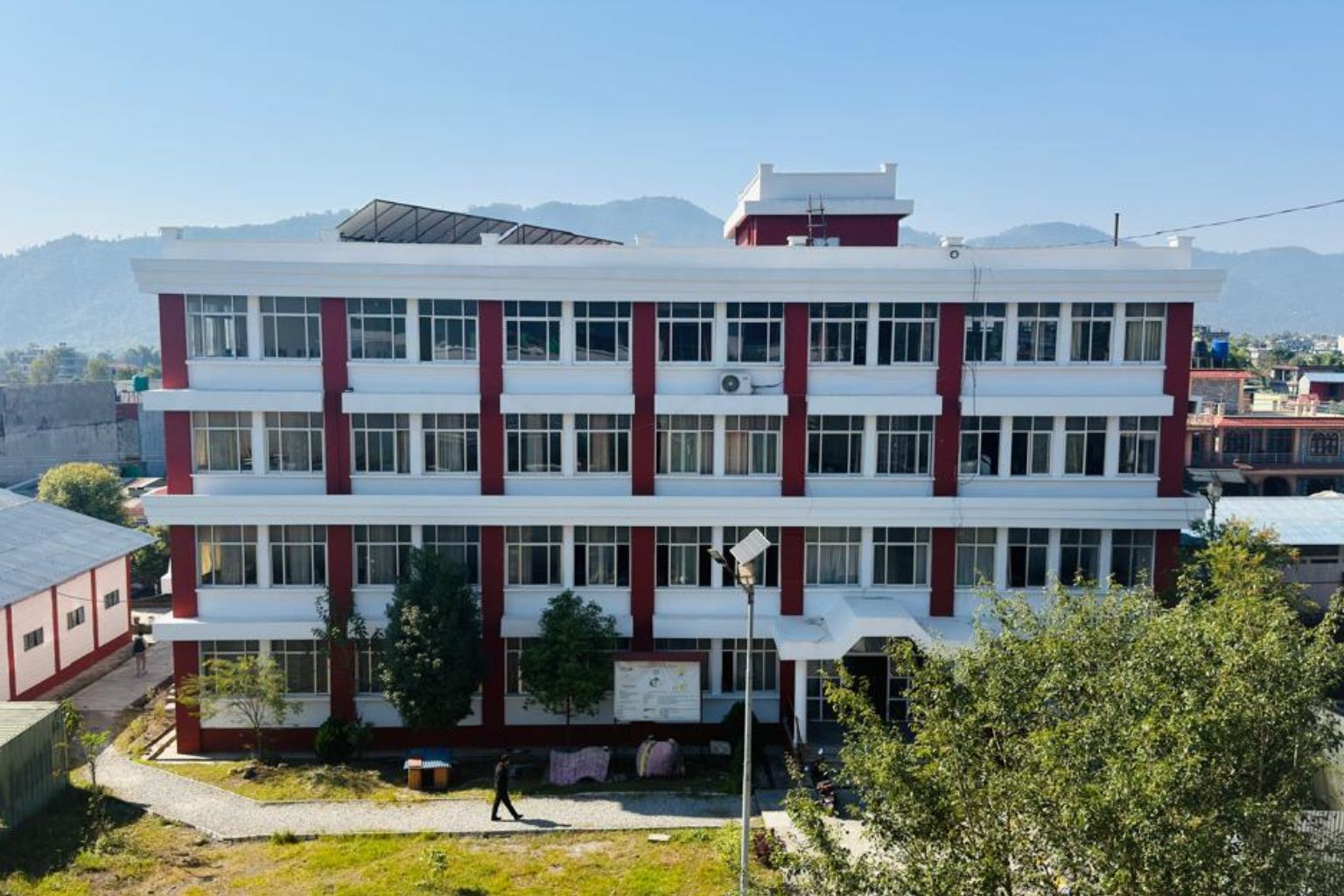
| Particular | Details |
|---|---|
| Course | M.Sc. in Electrical Engineering in Power System |
| Institution | Pokhara University School of Engineering |
| University | Pokhara University |
| Faculty | Faculty of Science and Technology |
| Level | Master's |
| Seats | 15 |
| Fee-paying quota | 13 |
| Scholarship quota | 2 |
| Eligible backgrounds | Electrical Engineering, Electrical and Electronics Engineering, or equivalent |
| Location | Pokhara-30, Khudi, Kaski, Nepal |
M.Sc. in Electrical Engineering in Power System forms part of the graduate engineering portfolio at SOE. It is positioned specifically within Electrical Engineering and Power System study rather than being a general engineering master's degree.
The program sits alongside other postgraduate options at SOE in Computer Engineering, Computer Science, Structural Engineering, Hydropower Engineering, Sanitary Engineering, Bioinformatics, Construction Management, and other specialized fields.
Its entry requirements clearly distinguish it from these other master's programs. Applicants need a prior academic background in Electrical Engineering, Electrical and Electronics Engineering, or an equivalent degree. A Civil Engineering, Computer Engineering, or unrelated bachelor's qualification does not appear among the specifically named entry routes for this program.
This makes previous engineering specialization important when selecting the course. Students should compare their bachelor's degree directly with the stated eligibility before proceeding with the graduate admission process.
Applicants must have completed a bachelor's degree in:
Electrical Engineering;
Electrical and Electronics Engineering; or
An equivalent degree or program from a recognized university or institution.
Applicants also need to satisfy the minimum bachelor's-level academic requirement.
For graduates of Pokhara University, the minimum requirement is a CGPA of 2.0 at bachelor's level.
Applicants graduating from another recognized university or institution need a minimum second division or an equivalent grade at bachelor's level.
These requirements contain two separate conditions: the applicant must have the appropriate academic background and must also meet the minimum bachelor's-level result.
SOE also offers Bachelor of Electrical and Electronics Engineering at undergraduate level.
Electrical and Electronics Engineering is explicitly named among the qualifying bachelor's backgrounds for M.Sc. in Electrical Engineering in Power System. This provides a clearly defined postgraduate route for graduates who complete that undergraduate degree and later meet the master's admission requirements.
The master's eligibility also accepts Electrical Engineering or an equivalent degree or program from a recognized institution, so entry is not restricted only to graduates of SOE.
M.Sc. in Electrical Engineering in Power System has a total intake capacity of 15 seats.
The seat structure is:
| Admission Category | Seats |
|---|---|
| Fee-paying quota | 13 |
| Scholarship quota | 2 |
| Total | 15 |
The seat allocation is part of the graduate admission framework at SOE.
Because admission proceeds through an entrance and merit-based process, meeting the academic eligibility criteria does not itself confirm admission. Candidates must also participate in the applicable entrance procedure and complete admission formalities according to merit and available seats.
Admission to the fee-paying master's programs at SOE follows a defined sequence.
The Admission Committee first calls for applications for the entrance examination. Eligible candidates participate in the entrance examination, after which a merit list of successful candidates is published.
The admission procedure may include a period for correction of the published merit list. A revised merit list may then be published where required. Candidates who pass are informed about spot admission.
The main stages are:
Application for the master's entrance examination.
Entrance examination conducted under the graduate admission process.
Publication of the merit list of successful candidates.
Correction period for the merit list where applicable.
Publication of a revised merit list where required.
Notice for spot admission.
Admission according to merit rank and available seats.
Completion of document review and enrollment formalities.
The procedure makes merit ranking central to final admission rather than treating entrance participation alone as sufficient.
Successful candidates proceed to spot admission according to the applicable schedule.
Candidates or their guardians attend the admission process with the required identification and academic records. Candidates are called according to their position in the merit list and complete the necessary admission formalities.
If seats remain after an admission round, the graduate admission framework allows another merit-based spot-admission process to fill available places.
For applicants, this means both the merit list and the announced admission schedule are important parts of the enrollment process.
Successful candidates need the prescribed identification, academic, and admission records during spot admission.
The required documents include:
Original citizenship, national identity, or another identity certificate and one copy for Nepali applicants.
Original passport and/or national identity card and one copy for foreign applicants.
Original academic certificates and copies.
Transcript.
Degree certificate.
Character certificate.
Equivalent academic records where applicable.
Two passport-size photographs.
Completed admission form.
Proof of the required admission payment.
Official sponsorship letter where the applicant is being sponsored.
Applicants should keep the academic records used for admission consistent with the information submitted during the application process.
The bachelor's-degree requirement is one of the most important details for prospective students.
M.Sc. in Electrical Engineering in Power System does not use the broad eligibility structure found in some interdisciplinary master's programs. The specified routes are Electrical Engineering, Electrical and Electronics Engineering, or an equivalent qualification.
The phrase "equivalent degree/program" allows recognition of an equivalent academic background, but it should not be interpreted as unrestricted eligibility from any engineering discipline. The qualifying degree must fall within the stated equivalence framework of the admission process.
Applicants must also satisfy the academic result requirement independently of their degree title.
A Pokhara University graduate with an eligible bachelor's degree needs at least a 2.0 CGPA at bachelor's level. A graduate from another recognized institution needs at least second division or an equivalent result.
The graduate programs at SOE use different academic entry routes.
For example, M.Sc. in Structural Engineering and M.Sc. in Hydropower Engineering specify Civil Engineering or an equivalent degree. Master of Computer Engineering specifies Computer Engineering or an equivalent qualification. M.Sc. in Computer Science accepts a wider group of engineering, computer science, and specified science backgrounds.
M.Sc. in Electrical Engineering in Power System follows its own entry route through Electrical Engineering and Electrical and Electronics Engineering.
This difference matters because students should not assume that eligibility for one SOE master's program automatically establishes eligibility for another. The previous bachelor's discipline remains a program-specific admission condition.
The course is directly relevant to graduates who have already completed Electrical Engineering or Electrical and Electronics Engineering and want to continue into postgraduate study identified specifically with Power System.
Before applying, prospective students should consider:
Whether their bachelor's degree matches the stated academic background.
Whether they satisfy the minimum bachelor's-level academic result.
Their readiness to participate in the entrance examination.
Competition within the 15-seat intake.
The distinction between the fee-paying and scholarship quotas.
Their intention to continue postgraduate study within Electrical Engineering and Power System.
The course should therefore be approached as a specialized graduate option following an appropriate electrical engineering foundation.
A practical application sequence begins with eligibility rather than the entrance examination.
Applicants should first confirm the exact title and equivalence of their bachelor's degree. They should then check whether their bachelor's-level academic result meets the minimum requirement.
After establishing these two points, the applicant can proceed through the applicable graduate application and entrance process.
The merit list determines the order used during admission, while the available seat capacity determines how many candidates can be enrolled within the stated intake.
Yes. It is one of the graduate engineering programs offered by Pokhara University School of Engineering under the Faculty of Science and Technology.
The program has 15 seats: 13 fee-paying seats and 2 scholarship-quota seats.
Applicants need a bachelor's degree in Electrical Engineering, Electrical and Electronics Engineering, or an equivalent degree or program from a recognized university or institution.
Pokhara University graduates need a minimum CGPA of 2.0 at bachelor's level.
Applicants from another recognized university or institution need at least second division or an equivalent grade at bachelor's level.
Yes. The master's admission procedure includes an entrance examination followed by merit-list publication and merit-based admission.
Yes. Electrical and Electronics Engineering is specifically named among the eligible bachelor's backgrounds.