College of Engineering and Management (COEM) is an engineering college in Shitalnagar, Nepalgunj, Banke, Lumbini Province, Nepal, established in 2013. It is affiliated with Pokhara University and accredited by the Nepal Engineering Council.
The college offers two undergraduate engineering programs: Bachelor of Civil Engineering and Bachelor of Engineering in Information Technology (BE IT). Its academic approach combines classroom teaching with practical classes, project work, field activities, site visits, internships, presentations, assignments, and periodic assessments.
Students have access to a library, computer labs, internet facilities, progress reporting, career counseling, and scholarship provisions.
| Category | Details |
|---|---|
| Established | 2013 |
| Location | Shitalnagar, Nepalgunj, Banke, Lumbini Province, Nepal |
| Affiliation | Pokhara University |
| Accreditation | Nepal Engineering Council |
| Academic level | Undergraduate engineering |
| Programs | Bachelor of Civil Engineering; Bachelor of Engineering in Information Technology |
| Program duration | 4 years / 8 semesters |
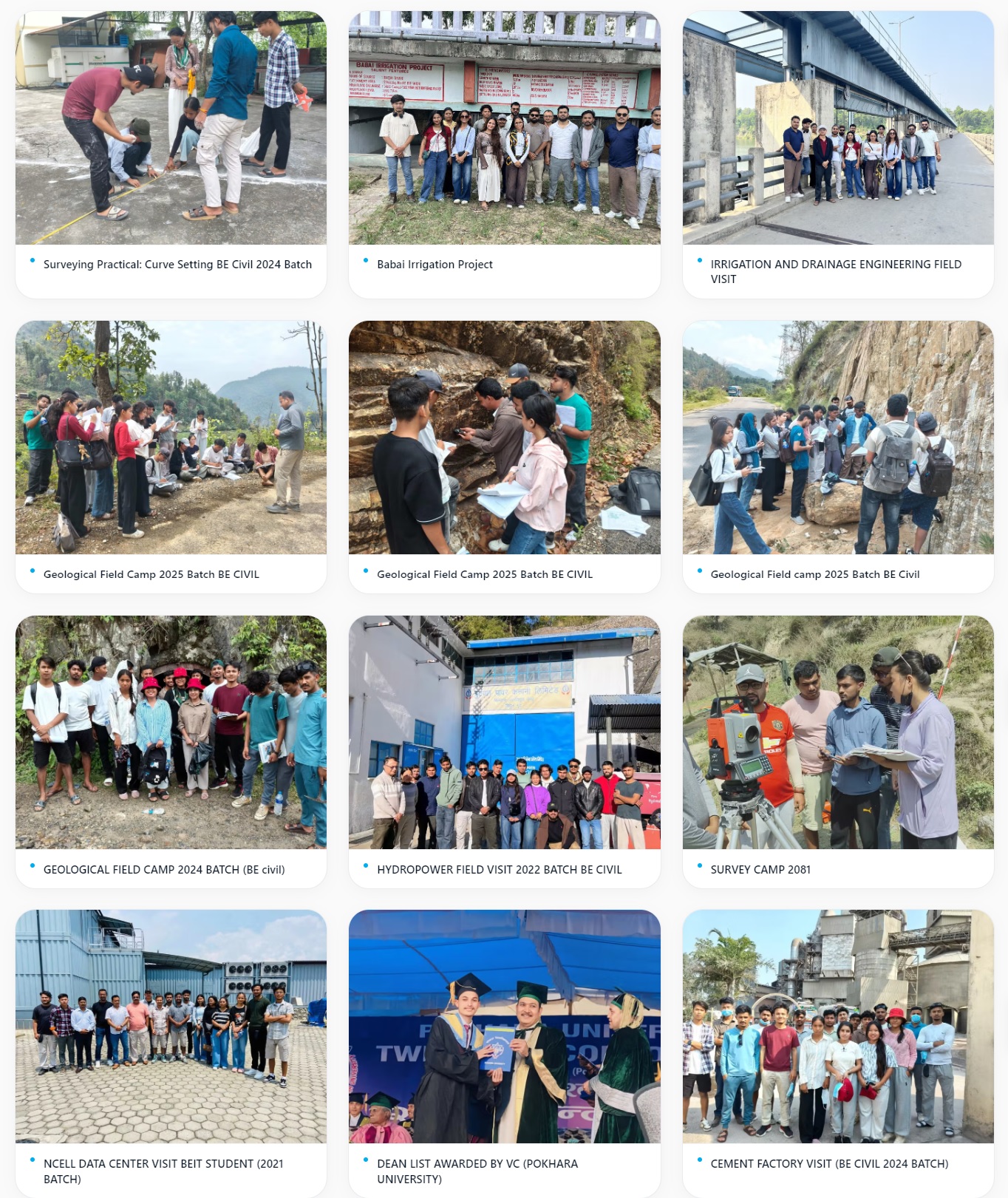
| Academic approach | Lectures, practical classes, projects, fieldwork, site visits, internships, and assessments |
| Learning facilities | Library, computer labs, and internet access |
| Student support | Progress reporting, career counseling, and scholarships |
COEM was established with a focus on engineering education that combines theoretical study with practical learning. Its academic offering is concentrated on civil engineering and information technology at the undergraduate level.
The college's mission centers on providing practical and theoretical knowledge that prepares students for employment and service to communities and the country. Its vision focuses on preparing technically capable engineering personnel who can contribute through professional work.
The college is located in Shitalnagar, Nepalgunj, Banke, Nepal. Nepalgunj falls under Nepalgunj Sub-Metropolitan City.
COEM is affiliated with Pokhara University. Its engineering programs operate within the university's academic framework.
The college is also accredited by the Nepal Engineering Council.
COEM offers two bachelor's-level engineering programs.
| Program | Duration | Academic focus |
|---|---|---|
| Bachelor of Civil Engineering | 4 years / 8 semesters | Structures, materials, surveying, geotechnical engineering, hydraulics, transportation, construction, and project work |
| Bachelor of Engineering in Information Technology | 4 years / 8 semesters | Programming, software development, databases, operating systems, networks, algorithms, information security, and projects |
The Bachelor of Civil Engineering program covers mathematical, scientific, analytical, design, and practical areas of civil engineering.
The curriculum includes Applied Chemistry, Applied Physics, Calculus, Computer Programming, Engineering Drawing, Applied Mechanics, Civil Engineering Materials, Engineering Geology, Fluid Mechanics, Strength of Materials, Surveying, Hydraulics, Soil Mechanics, Structural Analysis, Foundation Engineering, Transportation Engineering, Water Supply Engineering, construction-related study, project work, and internship.
The Pokhara University Bachelor of Civil Engineering 2025 structure runs across eight semesters with a total of 129 credits. The curriculum includes 112 lecture hours, 60 tutorial hours, and 71 practical hours in its overall structure.
Project work is included at different stages of the program, and the eighth semester includes a six-credit internship.
The BE IT program covers computing and information technology from an engineering perspective.
Its academic areas include:
Programming
Software development
Database systems
Operating systems
Computer networks
Data structures
Algorithms
Software engineering
Web development
Mobile application development
Information security
System administration
Practical learning is supported through projects and internship-related activities. The program is structured over four years and eight semesters.
COEM uses several teaching and assessment methods to connect academic study with practical work.
Academic activities include:
Lectures and classroom discussions
Practical classes
Classroom presentations
Project work
Audio-visual presentations
Demonstrations
Special talk programs
Fieldwork
Case studies
Internships
Site visits
Assignments
Seminars
Other practical sessions
This approach allows students to study engineering concepts through classroom instruction, practical sessions, projects, and field-based activities.
Student assessment takes place throughout the academic period.
The college uses:
Periodic class tests
Mid-term examinations
Sent-up examinations
Assignments
Projects
Presentations
Other academic assessments
Regular progress reports are also used to monitor student performance and identify areas that require further academic attention.
COEM provides academic facilities and support services connected with its engineering programs.
These include:
Library
Computer laboratories
Internet access for students
Practical learning sessions
Regular student progress reporting
Faculty and staff support for academic activities
Post-study career counseling
Scholarship provisions for eligible students
Practical components form part of both engineering programs.
Civil Engineering students take part in activities connected with surveying, construction, materials, structures, hydraulics, geotechnical study, transportation, projects, fieldwork, and internship.
BE IT students undertake programming, software-related assignments, technical projects, computing laboratory work, and internship activities.
The college also provides post-study career counseling for students considering professional practice, further education, entrepreneurship, public service, or other directions connected with their academic background.
COEM has scholarship provisions for academically strong students and students with financial need. Scholarship support includes categories linked to Pokhara University rules as well as additional merit provisions.
| Scholarship category | Basis |
|---|---|
| Full scholarship | Entrance performance and applicable Pokhara University eligibility criteria |
| Partial scholarship | Academic performance and applicable eligibility criteria |
| Need-based scholarship | Demonstrated financial need and applicable eligibility criteria |
| Merit-based scholarship | Academic performance or significant extracurricular achievement |
Students seeking scholarship support submit an application with the required documents to the college administration. Applications are reviewed according to eligibility conditions and available funds.
Pokhara University's engineering eligibility requirements apply to students seeking admission to engineering programs.
The academic requirements include:
Completion of Grade 12 in the Science stream or an equivalent qualification from a recognized institution
Study of Physics, Chemistry, and Mathematics
At least a C grade or 45% in each of Physics, Chemistry, and Mathematics
An overall GPA of at least 2.0 on a 4.0 scale or equivalent
Mathematics study meeting the university's stated marks requirement in Grade 11 or Grade 12
Participation in the applicable entrance examination
Admission selection is based on entrance performance and merit.
The college's undergraduate academic offering is limited to two engineering disciplines.
Civil Engineering covers subjects related to structures, construction, surveying, water, transportation, soil, materials, and engineering design.
Information Technology covers programming, databases, networking, operating systems, security, algorithms, software development, and related computing areas.
Both programs combine classroom study with practical components, projects, and internship-related learning.
The college administration handles inquiries related to courses, admission, eligibility, fees, scholarships, facilities, counseling, and location.
College of Engineering and Management was established in 2013.
The college is located in Shitalnagar, Nepalgunj, Banke, Nepal.
COEM is affiliated with Pokhara University.
Yes. The college is accredited by the Nepal Engineering Council.
COEM offers Bachelor of Civil Engineering and Bachelor of Engineering in Information Technology.
Both programs are structured over four years and eight semesters.
The college provides a library, computer labs, internet access, practical learning activities, progress reporting, career counseling, and scholarship provisions.
Yes. Scholarship provisions include full, partial, need-based, and merit-based categories subject to the applicable eligibility conditions.
Teaching includes lectures, discussions, practical classes, presentations, projects, fieldwork, site visits, internships, assignments, seminars, demonstrations, and periodic assessments.