




Essential AI Skills Every Nepali Student Must Master
After 2023, the world reached a turning point that can be considered the height of the Fourth Industrial Revolution. When ChatGPT and generative AI became accessible to the general public, they permanently changed the way we work, think, and learn.
In the context of Nepal, our education system is still largely traditional. Although AI-related subjects are gradually being included in the curricula of Tribhuvan University, Kathmandu University, and Pokhara University, the pace of the market is hundreds of times faster than the pace of curriculum change. Just as learning basic computer skills used to be compulsory, today AI literacy has become even more essential.
“Will AI take away my job?” This question is now in the mind of every Nepali student. According to the World Economic Forum (WEF) Future of Jobs Report, AI could displace 85 million jobs, but at the same time create 97 million new jobs. Those new jobs will go to people who have the skills to work with AI.
The aim of this article is not only to inform Nepali students about AI, but to provide detailed, practical guidance on which skills to learn, how to learn them, and how to apply them in their careers.
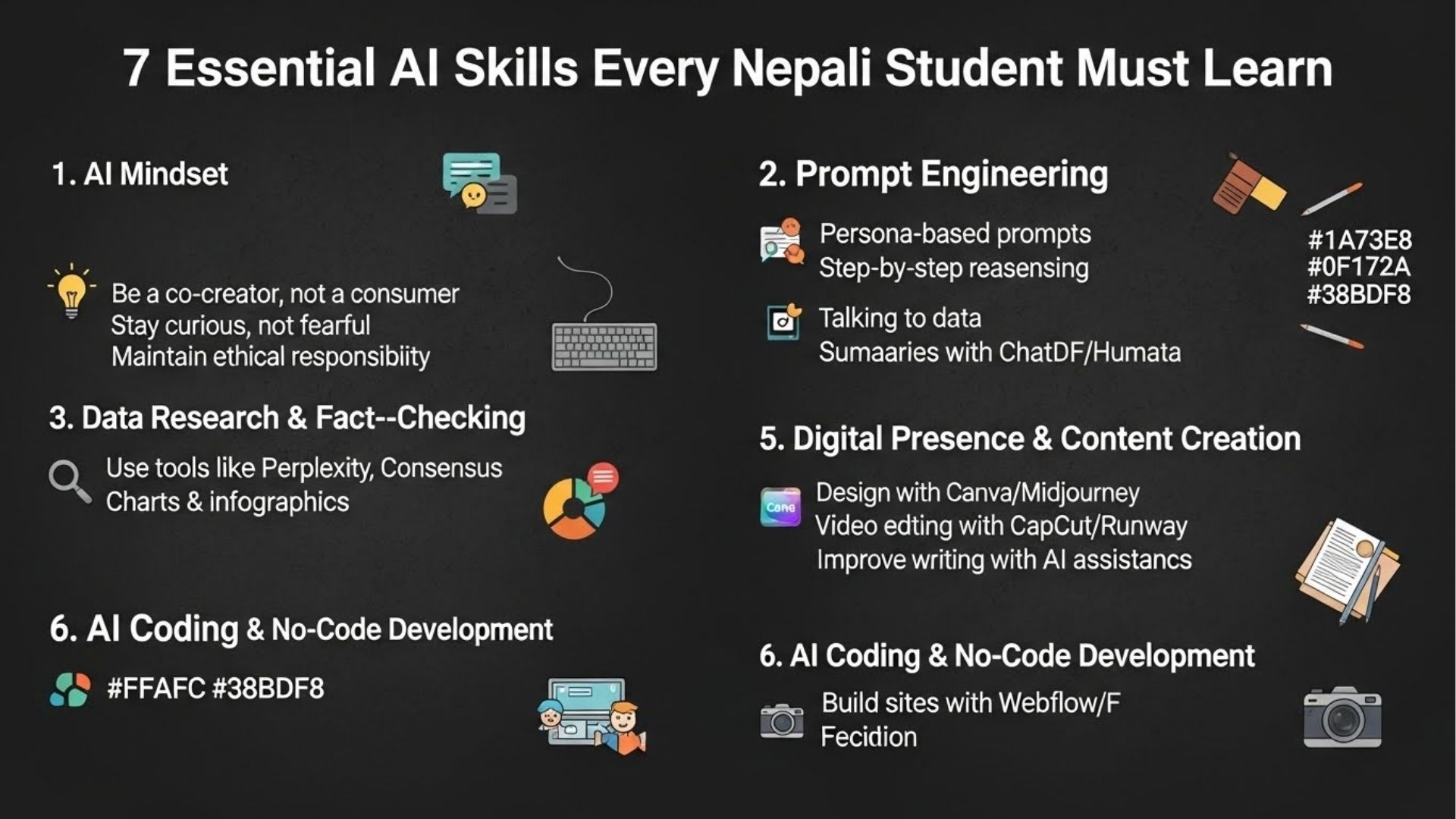
Table of Content
- Essential AI Skills Every Nepali Student Must Master
- AI Mindset – Thinking Before Skills
- Seven Essential Basic and Advanced AI Skills
- Sector-Specific Uses of AI Skills
- Practical Action Plan for Nepali Students
- Conclusion
AI Mindset – Thinking Before Skills
Before learning any technical skill, the mindset needs to be right. Nepali students need to make three major shifts in how they look at AI.
1. Be a Co-Creator, Not Just a Consumer (Don’t Just Consume, Co-Create)
Many students use AI only for entertainment or as a “machine that does homework.” This is a mistake. Treat AI as your co-pilot. AI is not the one driving the car; you are still the driver. AI’s role is to show you the route and inform you about the condition of the engine.
2. Choose Curiosity Over Fear
Thoughts like “Now that AI has come, what is the use of studying?” are pessimistic and should be abandoned. AI cannot replace human intellect. Its role is to augment human capability and expand what people can do.
3. Ethical Responsibility
When using AI, the biggest need and challenge is to maintain academic integrity and uphold ethical standards.
Seven Essential Basic and Advanced AI Skills
Here, seven core AI skills that every Nepali student should learn—regardless of faculty—are discussed in depth.
1. Prompt Engineering: The Art of Communicating with AI

Prompt engineering is like the “coding” of the future, but it is done in English (or Nepali) instead of programming languages. The art of asking the right questions to get the best results from AI models (LLMs) is what we call prompt engineering.
Understanding it more deeply:
Many students simply type, “Write an application for leave.” This is a level-1 prompt. A skilled student should know how to write a level-5 prompt.
Actionable Skills:
-
Persona Assigning: Put AI into a specific role.
Example: “You are a senior Human Resource (HR) manager with 20 years of experience. I am a fresher and need to write an application for an internship at a corporate company. These are my skills… Please draft a very professional and polite email for me.” -
Chain-of-Thought Prompting: Ask AI to think step by step by breaking down complex problems.
Example: “Analyze the impact of remittance on Nepal’s economy. First list the advantages, then the disadvantages, and finally suggest long-term policy solutions.” -
Iterative Refinement: Do not be satisfied with the first answer. Learn to say, “This answer is too formal, please rewrite it in simpler language,” or “Add the latest data about Nepal to this answer.”
Why this is necessary:
In a future job, when your supervisor says, “Write an email to the client,” you should be able to prepare an excellent email within five minutes. Those who know how to write good prompts can be up to ten times more productive than average employees.
2. AI-Augmented Research and Fact-Checking
.jpg)
In Nepal, fake news and misinformation are widespread. Models like ChatGPT sometimes “hallucinate,” meaning they confidently present things that are not true. Therefore, being able to use AI for research while not trusting it blindly is a critical skill.
Things to learn:
-
Smart Search Tools: Google Search alone is not enough. Learn to use tools like Perplexity AI, Consensus, or Elicit. These tools do not give random talk; they provide answers with references to academic papers and sources.
-
Literature Review: At the bachelor’s or master’s level, students may need to read hundreds of papers for their thesis. By using tools like ChatPDF or Humata, you can extract the summary of a 50-page PDF in a few seconds and ask, “What are the main findings of this report?”
-
Cross-Verification: Develop the habit of checking AI-generated data against official sources such as the Nepal Rastra Bank or the Central Bureau of Statistics.
Warning:
Copy-pasting college assignments directly from AI is not a research skill; it is intellectual theft. Use AI for ideas and structure, but the writing should be your own.
3. Data Analysis and Visualization
Today’s era is the era of data. In the past, to learn data analytics you needed to be very strong in maths and coding. Now AI has democratized this field.
Practical skills:
-
Excel + AI: Microsoft Excel is still the king of the corporate world. Learn to use AI (Copilot) inside Excel to generate formulas, clean data, and create pivot tables.
-
Talking to Data: Upload your spreadsheet to tools like Julius AI or ChatGPT Advanced Data Analysis and ask questions such as, “In the last five years, in which month were sales highest?” or “Based on this data, forecast next year’s figures.”
-
Visual Storytelling: Learn to present data not just as numbers but also as graphs and charts. The ability to turn complex data into infographics will make you stand out in management and marketing fields.
Nepali context:
Whether working in an NGO or running your own business, this skill is essential for understanding customer behaviour and making decisions accordingly.
4. Digital Presence and Content Creation
There is a serious unemployment problem in Nepal, but freelance opportunities are vast. If you know how to use AI tools for content creation, you can earn a good income even as a student.
Tools and skills to learn:
-
Visual Design: Use tools like Canva (Magic Studio), Midjourney, or DALL-E 3 to design logos, social media posts, and brochures. Even if you are not a graphic designer, you can create professional-looking designs.
-
Video Creation: Video is currently the most powerful medium. Learn to use tools like CapCut (with AI features), Runway, or HeyGen—from scriptwriting to video editing.
-
Writing Assistant: Improve your writing style for blogs, captions, or articles using tools such as Claude 3 or Grammarly GO.
Opportunity:
Many small and medium enterprises (SMEs) in Nepal need digital marketing support. With AI, you can handle the work of multiple clients in less time.
5. AI Coding and No-Code Development

Do you think that building an app or website always requires a four-year IT degree? Now that is no longer necessary. AI has turned even those who do not know how to code into creators.
For non-IT students:
-
No-Code Tools: Learn to build websites on platforms like Framer, Webflow, or Bubble with the help of AI.
-
App Generation: You can ask AI for the logic to solve a common problem and then use a no-code tool to turn it into an app.
For IT students:
-
AI Pair Programming: Learn to use GitHub Copilot, Cursor, or Tabnine. These tools can increase your coding speed by more than 50 percent.
-
Debugging and Refactoring: Use AI to identify bugs in your code and to optimize it for better performance.
-
Legacy Code Translation: Learn to use AI to translate old code written in one programming language into a newer language.
6. AI Ethics, Security, and Privacy
This may not look like a technical skill, but without it, all other skills can become harmful. To prevent and protect against misuse of technology, this knowledge is essential.
Key aspects:
-
Data Privacy: Never enter your personal details, citizenship number, bank passwords, or a company’s confidential data into public AI tools (such as the free version of ChatGPT). That data may be used for AI training.
-
Deepfake Awareness: In Nepal too, groups that use fake audio and video for fraud have already become active. You need to know how to recognize AI-generated fake audio or video and stay alert.
-
Algorithmic Bias: AI answers are often based on Western data. As a result, they may not align with Nepali culture, laws, or social values. Students must develop the wisdom to recognise these mismatches.
7. Adaptability and Learning Agility
In the field of AI, what is “new” today becomes “old” tomorrow. Therefore, rather than being an expert in just one tool, the most important skill is the ability to learn new things quickly.
How to develop this:
-
Continuous Learning: Build the habit of spending at least two hours a week reading or watching updates about AI.
-
Experimentation: When a new tool appears, it is a good habit to immediately try it and ask, “What is this?”
-
Critical Thinking: After the machine gives an answer, do not stop asking “Why?” and “How?”
Sector-Specific Uses of AI Skills
The use of AI varies according to the student’s field of study. Some examples are given below.
1. Management (BBA/MBA) Students
-
Market Research: Use AI to analyse competitors.
-
Financial Modeling: Use Excel and AI to forecast balance sheets and cash flows.
-
Business Communication: Use AI as an editor for emails, proposals, and reports.
2. Engineering and IT Students
-
Automation: Learn to automate repetitive tasks using Python scripts and AI.
-
System Design: Use AI to get ideas for system architecture and to optimise code.
3. Humanities and Social Science Students
-
Language Translation: Use AI to translate English literature or articles into Nepali for better understanding, while preserving originality.
-
Digital Archives: Use OCR and AI to digitize and analyse historical and cultural documents.
-
Sociological Analysis: Use AI to analyse large volumes of survey data.
4. Medical and Nursing Students
-
Medical Research: Use AI summarization tools to stay updated on recently published medical journals and new treatment methods.
-
Diagnosis Support: Maintain theoretical knowledge of how AI is assisting in diagnosis, for example, in radiology.
Practical Action Plan for Nepali Students
Reading an article is not enough. To put this into practice, follow the six-month roadmap below.
Month 1: Basics
-
Open accounts on ChatGPT, Claude, and Gemini.
-
Complete free courses such as Google’s “AI Essentials” or Microsoft’s “Career Essentials in Generative AI” on platforms like Coursera or LinkedIn Learning.
-
Practise the basics of prompt engineering.
Months 2–3: Applying AI in Your Field
-
Start using AI tools in your studies (assignments and projects), not for copying, but for understanding.
-
Explore AI features in Canva or other design tools.
-
Learn AI-related tools for Excel or data handling.
Months 4–5: Advanced Use and Projects
-
Complete a small project, such as starting a blog using AI, creating a data report, or designing a marketing plan.
-
Study AI ethics and security in depth.
Month 6: Portfolio and Career Development
-
Add skills such as “AI Literacy” or “Prompt Engineering” to your CV.
-
Share your projects on LinkedIn.
Conclusion
Although Nepal is geographically landlocked, in the world of technology, we are “sky-linked.” AI has placed a student from Mugu and a student from Manhattan on the same opportunity platform. The only difference is who recognises this power and actually uses it.
A degree certificate may take you to the interview room, but it is your skills that will help you walk out of that room with an offer letter. AI is a wave that cannot be stopped. Wisdom lies in learning how to swim and surf on this wave.
Start today. Open an AI tool and begin learning something new. The future is in your hands, and AI is at your fingertips.







Comments 0
No comments yet. Be the first to start the conversation.