



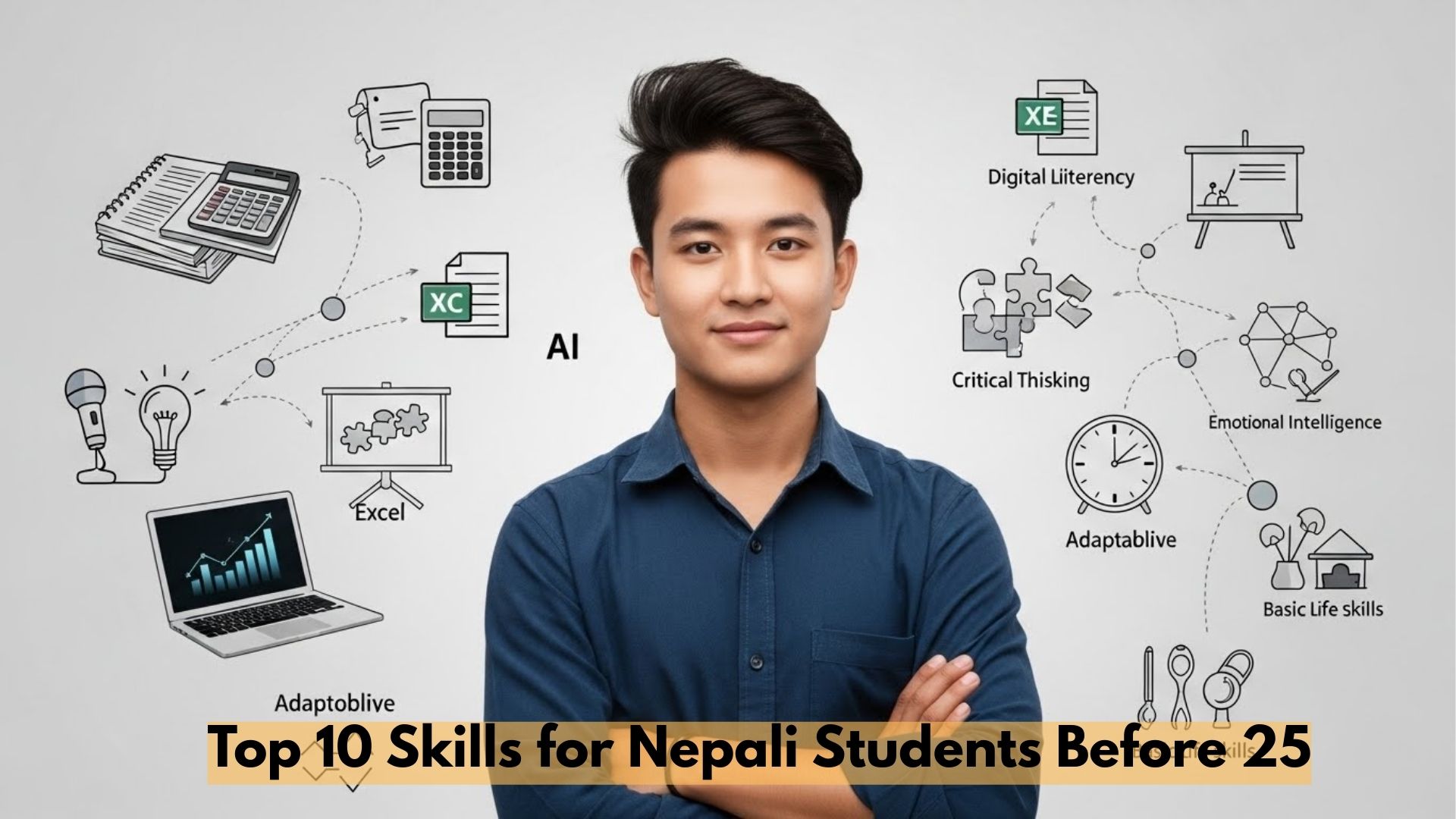
Top 10 Skills Every Nepali Student Must Learn Before 25
A Degree Alone Is Not Enough
Looking closely at the reality of Nepal’s current education system and job market, one bitter truth appears: “We are distributing degrees, not competence.”
Every year thousands of students graduate with a bachelor’s degree from Tribhuvan University and other universities. They hold certificates in their hands, but they lack the practical skills needed to get a job or create their own opportunities. According to the Nepal Labour Force Survey (NLFS), the number of educated unemployed in Nepal is alarming. A major reason is the gap between skills and formal education.
The age of 25 is a milestone from which the real test of adult life begins. If you have not equipped yourself with the right skills by then, struggle in later life is almost certain. Whether you plan to go abroad for study or work, or to build a career or business in Nepal, these ten skills beyond textbooks are indispensable today.
The ten skills discussed here are based on research, experience and global standards, and they can change the direction of your life.
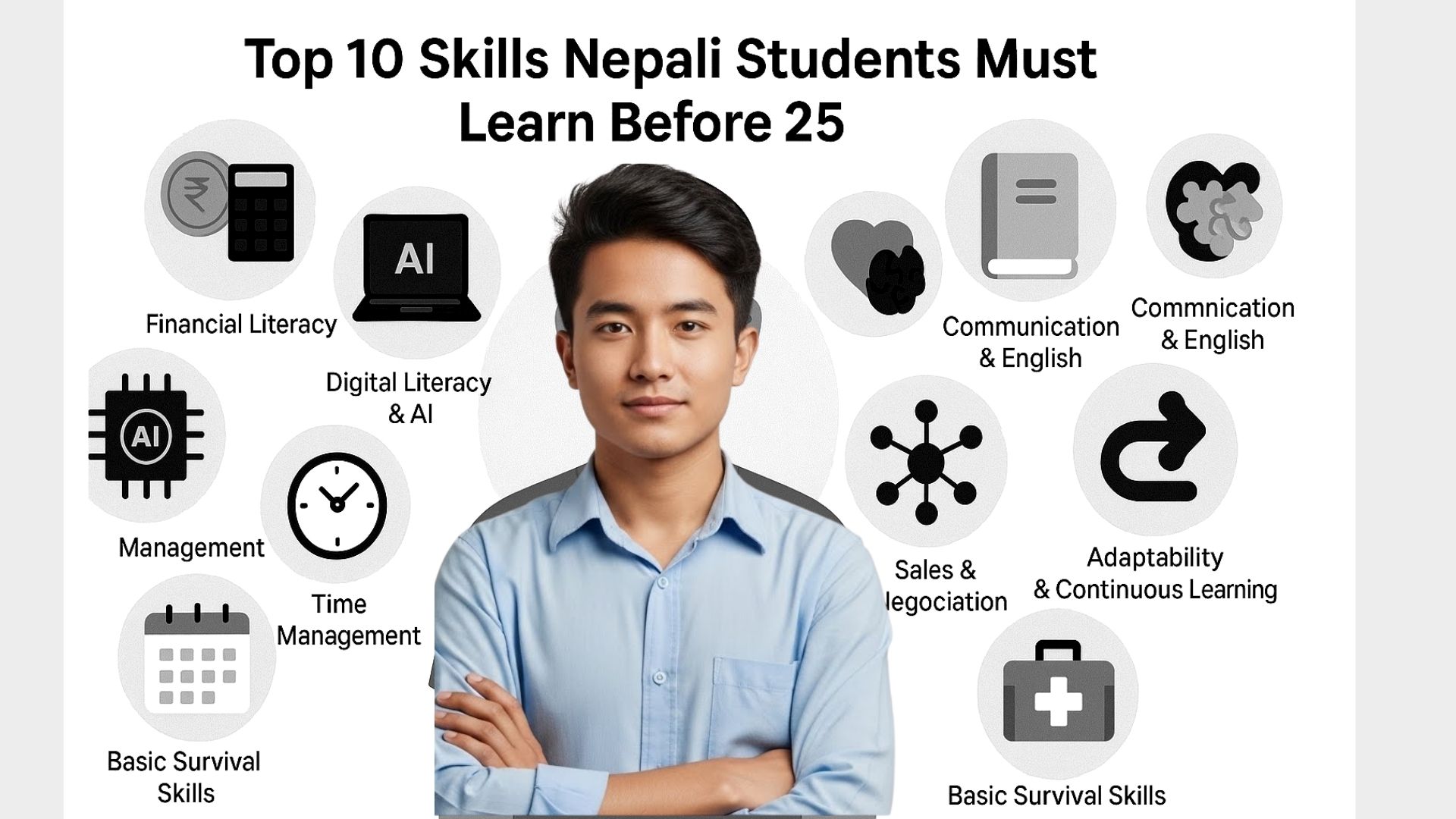
1. Financial Literacy and Money Management
Most Nepali students remain financially dependent on their parents until they reach 25. When they receive their first income, many spend unnecessarily or invest in the wrong places because they do not know how to manage money.
Why this skill is necessary
Various reports of Nepal Rastra Bank show that the level of financial literacy in Nepal is still low. Among young people the tendency is to earn and immediately spend. Without understanding the stock market (NEPSE), the tax system and the importance of saving, many youths fall into debt traps.
What to learn
-
Budgeting: Tracking income and expenses using the 50/30/20 rule (50% needs, 30% wants, 20% saving or investment).
-
Investing: Ways to put money to work so that it beats inflation, and basic knowledge of compounding, the stock market and mutual funds.
-
Tax and laws: Understanding how Nepal’s tax system works, including PAN and TDS.
Practical tips
Start tracking your expenses from today. Begin investing even with a small amount. Read books such as Robert Kiyosaki’s ‘Rich Dad Poor Dad’, which can change how you think about money.
2. Digital Proficiency and AI Adaptation
In the present era, saying “I know computers” does not just mean being able to use a mouse. Since 2023 the world has been changing so fast that a person who does not know how to use artificial intelligence will soon be almost like being illiterate.
Why this skill is necessary
According to the World Economic Forum’s Future of Jobs Report, many traditional jobs will be displaced in the next five years and new types of jobs will be created. In Nepal too, the use of technology has increased significantly in banking, teaching and marketing.
What to learn
-
Data analysis with Excel: Becoming proficient in Microsoft Excel, which is a basic requirement in almost every office.
-
AI tools: Using tools like ChatGPT, Claude or Midjourney to increase productivity. ‘Prompt engineering’ is becoming an important new skill.
-
Basic technical skills: Simple video editing, graphic design with tools such as Canva, and full familiarity with Google Workspace (Docs, Sheets, Drive).
Practical tips
Instead of spending time only on Facebook and TikTok, take an advanced Excel course on YouTube or Coursera. Learn to use AI as an assistant to complete assignments or work more quickly.
3. Effective Communication and English Proficiency
Communication is not just speaking; it is the ability to make others clearly understand your ideas. Many Nepali students have knowledge, but their ability to articulate it is weak. Because English is a global language, having a strong command of it is essential.
Why this skill is necessary
Whether in Nepali corporate houses or foreign universities, your first impression is shaped by how you speak and write. There are many examples of capable candidates being rejected in interviews because of weak communication skills.
What to learn
-
Public speaking: The ability to speak confidently in front of many people.
-
Writing skills: Effective email writing and formal report writing.
-
English language: Improving English not only for IELTS or PTE but to access global knowledge.
-
Active listening: The ability to listen carefully to others and understand them.
Practical tips
Practise speaking in front of a mirror. Listen to English podcasts. Do not avoid giving presentations in college. Joining Toastmasters clubs can be very beneficial.
4. Critical Thinking and Problem Solving
Nepal’s education system often encourages rote learning. Yet in real life no one asks, “What is the value of x?” The main point is how to analyse the complex problems that arise in life and how to solve them.
Why this skill is necessary
Employers want staff who do not panic when they see a problem but come with solutions. The habit of asking “why?” and “how?” sets you apart from the crowd.
What to learn
-
Analysis: The ability to check the truth of any information or news, especially in an era of fake news.
-
Logic: The ability to make decisions based more on reasoning than on emotion.
-
Creativity: Thinking differently from conventional ways to find solutions.
Practical tips
Do not accept anything exactly as it appears without questioning. Engage in reasoned debates with friends. Play brain-stimulating games such as chess or sudoku.
5. Time Management and Discipline
There is a common problem in Nepali society often called “Nepali time.” Arriving at 11 o’clock for a programme that was scheduled for 10 is considered normal. But if you do not understand the value of time by the age of 25, success will remain far away.
Why this skill is necessary
Time is the only resource that never returns once it is gone. Poor time management in student life leads to stress during exams, and missing deadlines in professional life can even cost a job.
What to learn
-
Prioritisation: Using tools such as the Eisenhower Matrix to separate urgent tasks from those that can be done later.
-
Punctuality: Respecting other people’s time.
-
Deep work: Developing the habit of focusing fully on one task without distraction.
Practical tips
Use the Pomodoro technique (25 minutes of work followed by 5 minutes of rest). Build the habit of making a to-do list the night before for the next day.
6. Emotional Intelligence and Mental Health Awareness
IQ, or intellectual ability, may help you get a job, but EQ, or emotional ability, helps you keep that job and reach higher levels of success.
Why this skill is necessary
Depression and anxiety are rising among young people in Nepal. Because many cannot cope with rejection, suicide cases have increased. Understanding and managing emotions is a major life skill.
What to learn
-
Self-awareness: Noticing how you feel at a given moment and why.
-
Empathy: The ability to put yourself in another person’s position and understand their feelings.
-
Resilience: The ability to rise again after failures such as visa rejection or exam failure.
Practical tips
Practise meditation or yoga to manage stress. Share your feelings with friends or family. Do not hesitate to seek counselling when needed.
7. Networking and Relationship Building
There is a common misunderstanding in Nepal that many things happen only through “connections” or “source-force.” In professional language this is called networking, and it should not be confused with nepotism.
Why this skill is necessary
No matter how talented you are, if people do not know you, opportunities will not reach you. Around 80% of jobs are filled without public advertisements, mainly through networks.
What to learn
-
Professional networking: Creating a profile on LinkedIn and connecting with experts in your field.
-
Value addition: Understanding that networking is not only about asking but also about being able to offer something to others.
-
Mentorship: Finding experienced people in your field and accepting them as mentors.
Practical tips
Participate in college events, seminars and workshops. When meeting people, instead of only asking “What do you do?”, ask questions such as “What is the most interesting thing in your work right now?” Become active on LinkedIn from today.
8. Sales and Negotiation Skills
Many people think sales means only selling products. In reality, we are selling something every day – our skills in an interview, a plan to go out with friends, or a proposal to our parents to increase pocket money.
Why this skill is necessary
Whether you are a doctor, engineer or pilot, you must be able to convince others about your services or ideas. In Nepal’s markets, people who cannot negotiate are often taken advantage of.
What to learn
-
Persuasion: The art of getting people to agree with your ideas.
-
Salary negotiation: The ability to discuss your salary and benefits openly when you receive a job offer.
-
Creating win-win situations: Approaches to making agreements that benefit both sides.
Practical tips
Practise bargaining when you buy things in the market. Try selling your old items on platforms such as Hamrobazar. This teaches you how to deal with customers.
9. Adaptability and Continuous Learning
Many of the things we studied in school are no longer useful. In the 21st century, a literate person is not only someone who can read and write, but someone who can unlearn and relearn.
Why this skill is necessary
COVID-19 showed that circumstances can change at any time. In Nepal’s unstable political and economic environment, adaptability is even more essential for survival.
What to learn
-
Growth mindset: Shifting from “I cannot do this” to “I can learn this.”
-
Multi-skilling: Not depending on a single skill; for example, a management student also learning some coding or design.
Practical tips
Set a goal to learn something new every month, whether it is cooking a new dish or using new software. Do not be afraid of change.
10. Basic Survival Skills
Finally, but extremely important. Many Nepali students go abroad for higher education or live in rented rooms in cities. Without knowing how to cook basic food, wash clothes, or do simple repairs, they face many difficulties.
Why this skill is necessary
Independence increases your self-confidence. Once you step out of your parents’ home into the real world, these small but important skills are necessary.
What to learn
-
Cooking: Being able to cook at least five or six types of healthy meals.
-
Driving: Learning to drive two-wheelers or four-wheelers and obtaining a licence.
-
First aid: Providing basic care in cases of common injuries or illness.
-
Household fixes: Tasks such as changing a fuse, repairing a tap, or stitching on a button.
Practical tips
Help your parents with household work. If you plan to go abroad, start practising washing your own clothes and cooking from today.
Conclusion: The Way Forward
The age of 25 is not just a number; it is a transition period. These ten skills may not appear in any university syllabus, but they are essential for passing the university of life.
As Nepali students we face challenges such as political instability, lack of jobs and weak infrastructure. Yet in today’s digital age opportunities are also limitless. You can work for a company in the United States from a remote village in Mugu, or start a world-class venture while living in Kathmandu.
The difference lies in one question – are you ready to make yourself capable?
Your action plan from here
-
Identify which of these skills you currently lack.
-
Focus on one skill each month.
-
Use the internet wisely through YouTube, podcasts and online courses.
-
Start small but stay consistent.
Remember that investing in yourself is the safest investment in the world and the one with the highest return.







Comments 0
No comments yet. Be the first to start the conversation.