



Learning well is not only about spending more hours with books, videos, notes, or online courses. It is a skill set. The right learning skills help you plan your time, understand ideas, remember what matters, apply knowledge, and improve after mistakes.
Quick Answer:
Effective learning skills are practical habits and strategies that help you learn with purpose. Useful skills include goal setting, time management, active reading, note-taking, retrieval practice, spaced practice, self-explanation, feedback seeking, and metacognition. These skills work best when used together in a simple routine, not as one-time study tricks.
This guide is for students, online learners, adult learners, professionals, and lifelong learners. It does not promise instant results. Learning speed and memory depend on the subject, your prior knowledge, practice quality, rest, feedback, and consistency.
Table of Content
- Quick Summary: 20 Effective Learning Skills
- How These Learning Skills Work Together
- Planning and Self-Management Skills
- Understanding and Processing Skills
- Memory and Practice Skills
- Communication and Collaboration Skills
- Reflection and Adaptability Skills
- Start With These 5 Skills First
- 7-Day Practice Plan
- Common Learning Mistakes to Avoid
- What You Should Do Next
Quick Summary: 20 Effective Learning Skills
| No. | Learning Skill | What It Helps With | Try This First |
|---|---|---|---|
| 1 | Goal setting | Direction | Write one clear goal for today’s session |
| 2 | Time management | Planning | Block one focused study period |
| 3 | Focus management | Attention | Remove one major distraction |
| 4 | Consistency | Study routine | Repeat one small habit daily |
| 5 | Active reading | Understanding | Preview headings and ask questions |
| 6 | Note-taking | Organizing ideas | Summarize notes in your own words |
| 7 | Critical thinking | Better judgment | Ask what evidence supports the idea |
| 8 | Source evaluation | Research quality | Check author, date, and purpose |
| 9 | Digital and AI literacy | Responsible tool use | Verify important AI answers |
| 10 | Retrieval practice | Memory | Recall without looking |
| 11 | Spaced practice | Long-term retention | Review again after a delay |
| 12 | Interleaving | Flexible problem-solving | Mix related question types |
| 13 | Self-explanation | Deeper understanding | Explain why each step works |
| 14 | Dual coding | Visual understanding | Turn notes into a diagram |
| 15 | Asking better questions | Finding gaps | Ask one precise question |
| 16 | Explaining clearly | Testing understanding | Teach the idea simply |
| 17 | Peer learning | Shared correction | Compare answers with a partner |
| 18 | Feedback seeking | Improvement | Ask what to improve next |
| 19 | Metacognition | Self-checking | Mark what you know and do not know |
| 20 | Adaptability | Better strategy choice | Change your method after mistakes |
How These Learning Skills Work Together
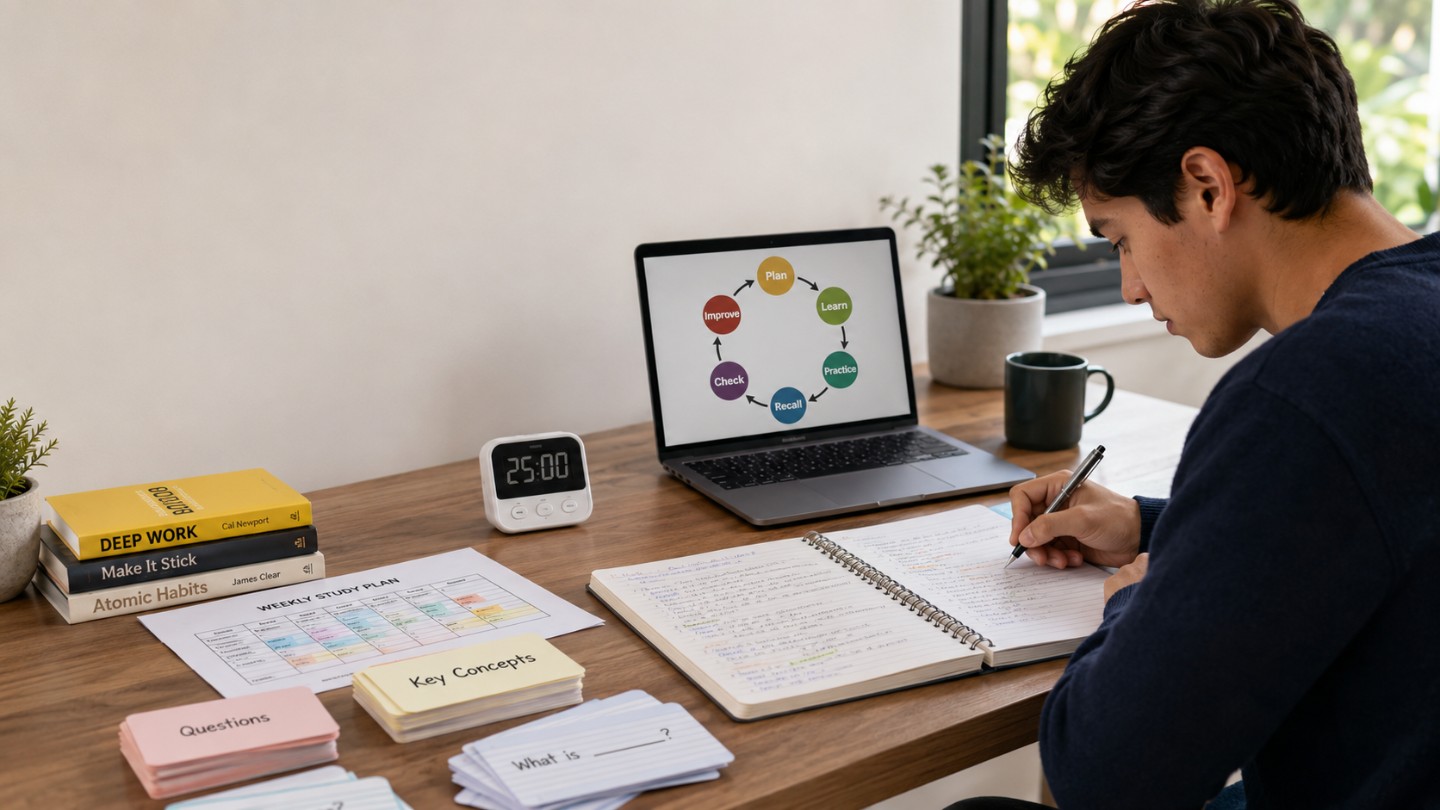
Effective learning usually follows a cycle:
Plan → Learn → Practice → Recall → Check → Improve
You set a goal, study the material, practice using it, try to recall it from memory, check your accuracy, and adjust your method.
Some skills in this article are general learning habits, such as time management and consistency. Others are more directly supported by learning-science research, such as retrieval practice, spaced practice, interleaving, and self-explanation. Cornell’s Learning Strategies Center lists retrieval practice, interleaving, and spaced practice among effective study strategies for long-term learning.
Planning and Self-Management Skills
1. Goal Setting
A clear goal gives your learning session a target. “Study science” is vague. “Explain Newton’s second law and solve five related problems” is clearer.
Use two types of goals:
-
Outcome goal: The larger result you want, such as passing an exam or completing a course.
-
Process goal: The action you will take today, such as reviewing one chapter or answering ten questions.
Practice today: Write this sentence before studying: “By the end of this session, I should be able to…”
2. Time Management
Time management helps you avoid last-minute pressure. It also helps you divide large tasks into smaller parts.
Instead of writing “finish assignment,” break it into smaller actions: read sources, make an outline, write the first draft, revise, and check references. Oxford’s study-skills guidance includes time management, reading, note-taking, referencing, and revision as areas of academic study support.
Practice today: Schedule one 30–45 minute learning block for your most important topic.
3. Focus Management
Focus is the ability to protect your attention long enough to understand something properly. You do not need a perfect study environment, but you do need fewer interruptions.
Close unrelated tabs. Keep your phone away for a short period. Use one notebook or one document for the task in front of you.
Practice today: Study one topic for 25 minutes without switching tasks.
4. Consistency
Consistency matters because learning improves through repeated contact with ideas. A short daily routine is often easier to maintain than a large plan that collapses after two days.
Start small. A 20-minute review after class, work, or an online lesson can stop small doubts from turning into a backlog.
Practice today: Attach one study habit to an existing routine, such as after breakfast or after school.
Understanding and Processing Skills
5. Active Reading
Active reading means reading with a question in mind. Instead of reading passively, you preview the topic, notice headings, ask questions, and summarize the main idea.
This is useful for textbooks, articles, research papers, online lessons, and exam materials.
Practice today: Before reading, write three questions the text should answer.
6. Effective Note-Taking
Good notes are not a full copy of the lesson. They are a tool for understanding, review, and recall.
Choose a method based on the task:
-
Use outline notes for structured topics.
-
Use Cornell-style notes for lectures.
-
Use mind maps for connected ideas.
-
Use tables for comparison topics.
Practice today: After taking notes, write a short summary without copying the original wording.
7. Critical Thinking
Critical thinking helps you judge whether an idea is accurate, complete, useful, or weak. It is especially important when reading online sources, comparing arguments, or solving unfamiliar problems.
Ask:
-
What is the claim?
-
What evidence supports it?
-
What is missing?
-
Is there another possible explanation?
Practice today: Choose one claim from your lesson and write one reason that supports it and one limitation.
8. Research and Source Evaluation
Research skill is not just finding information. It is deciding whether the information deserves trust.
Check the author, source, date, evidence, and purpose. For academic tasks, use official sources, textbooks, university pages, peer-reviewed research, and credible institutional resources when available.
Practice today: Before using one source, check who created it, when it was updated, and why it was published.
9. Digital and AI Literacy
Digital tools can support learning, but they can also create false confidence. AI tools can help you generate quiz questions, simplify explanations, compare ideas, or organize notes. They should not replace your own thinking.
A Cornell Engineering learning blog advises using AI to support strategies such as retrieval, interleaving, spaced study, reflection, and metacognition rather than using it as a shortcut around learning.
Practice today: Ask an AI tool to create five practice questions. Answer them yourself, then verify the answers from your course material or a reliable source.
Memory and Practice Skills
10. Retrieval Practice
Retrieval practice means trying to bring information to mind without looking at the answer first. It can include blank-page recall, practice questions, flashcards, diagrams from memory, or explaining a topic aloud.
Cornell describes retrieval practice as actively recalling information from memory. The Learning Scientists also identify retrieval practice as one of six strategies for effective learning.
Practice today: Read a short section, close the material, and write everything you remember. Then check what you missed.
11. Spaced Practice
Spaced practice means spreading study over time instead of cramming. It gives your brain repeated chances to return to the same material.
Cornell describes spaced practice as studying material in intervals rather than in one crammed session. The Learning Scientists also list spacing among six strategies for effective learning.
Practice today: Review today’s topic tomorrow, again after three days, and again after one week.
12. Interleaving
Interleaving means mixing related topics or problem types during practice. Instead of doing twenty nearly identical questions, you switch between related types so you learn when to use each method.
Cornell includes interleaving among effective study strategies, and UC San Diego Psychology lists interleaved practice as one of the additional learning techniques learners may try alongside spaced and retrieval practice.
Practice today: Mix three types of questions from the same chapter and solve them in random order.
13. Self-Explanation
Self-explanation means explaining an idea, step, or answer in your own words. It is useful because it makes you check whether you truly understand the reason behind an answer.
UC San Diego Psychology lists self-explanation among potentially useful learning methods, while noting that spaced practice and retrieval practice have especially strong evidence.
Practice today: After solving a problem, write: “This step works because…”
14. Dual Coding and Visual Thinking
Dual coding means using words and visuals together. This may include diagrams, timelines, charts, flow maps, labeled sketches, or concept maps.
This does not mean every learner has one fixed “visual learning style.” It means some information becomes easier to understand when you represent it in more than one format. The Learning Scientists include dual coding in their six strategies for effective learning.
Practice today: Turn one paragraph of notes into a simple diagram.
Communication and Collaboration Skills
15. Asking Better Questions
Good questions identify the exact point where learning breaks down. “I don’t understand chapter 3” is broad. “Why does this formula use acceleration instead of velocity?” is easier to answer.
Practice today: Turn one confusing topic into a specific question.
16. Explaining Ideas Clearly
When you explain an idea simply, you test your understanding. If your explanation becomes vague, you may need to review the topic.
Use a teach-back method:
-
State the idea simply.
-
Give one example.
-
Explain why it works.
-
Answer one follow-up question.
Practice today: Explain one idea in under two minutes without looking at notes.
17. Collaboration and Peer Learning
A useful study group has a purpose. Members compare answers, ask questions, test each other, and explain difficult points.
Keep the group small. Give each person a role if needed: questioner, explainer, checker, and summarizer.
Practice today: Compare one answer with a peer and discuss where your methods differ.
18. Feedback Seeking
Feedback shows the gap between your current work and stronger work. It is most useful when you ask for specific guidance.
Instead of asking, “Is this good?” ask:
-
What is unclear?
-
Which step is wrong?
-
What should I improve first?
-
What would make this answer stronger?
Practice today: Ask for one improvement point on one answer, paragraph, project, or practice task.
Reflection and Adaptability Skills
19. Metacognition and Self-Assessment
Metacognition means thinking about your own learning. It helps you notice what you know, what you only recognize, and what you cannot explain yet.
Use a simple traffic-light check:
-
Green: I can explain this.
-
Yellow: I partly understand this.
-
Red: I cannot explain this yet.
Practice today: Mark each topic after studying as green, yellow, or red.
20. Reflection and Adaptability
Reflection helps you adjust your learning method. After a quiz, assignment, practice session, or course module, ask what worked and what needs to change.
Do not keep repeating a method only because it feels familiar. If rereading does not help you answer questions, add retrieval practice. If cramming leaves you confused, add spaced review. If notes are messy, change your note-taking method.
Practice today: Write one thing you will keep, one thing you will stop, and one thing you will try next.
Start With These 5 Skills First
If the full list feels too much, start here:
-
Goal setting: Know what you are trying to learn.
-
Time management: Give learning a place in your schedule.
-
Retrieval practice: Test yourself without looking.
-
Spaced practice: Review again later.
-
Metacognition: Check what you actually understand.
These five skills give you direction, routine, memory support, and a way to improve. They are also a practical starting point because they fit almost any subject or learning goal.
7-Day Practice Plan
| Day | Skill Focus | What to Do | Output |
|---|---|---|---|
| Day 1 | Goal setting | Choose one topic and write a clear goal | One goal sentence |
| Day 2 | Time and focus | Study for one distraction-free block | One completed session |
| Day 3 | Active reading | Read with three questions in mind | Three answered questions |
| Day 4 | Note-taking | Rewrite notes in your own words | One short summary |
| Day 5 | Retrieval practice | Use blank-page recall | One recall sheet |
| Day 6 | Spaced practice | Review the same topic again | Corrected weak points |
| Day 7 | Reflection | Check what worked and what did not | One improved plan |
Common Learning Mistakes to Avoid
| Mistake | Better Choice |
|---|---|
| Rereading only | Recall from memory, then check |
| Cramming | Spread review across days |
| Highlighting too much | Highlight less and summarize more |
| Copying notes word for word | Rewrite ideas in your own words |
| Studying without feedback | Check answers and ask for corrections |
| Using AI without verification | Confirm important answers from reliable sources |
| Trying to change everything at once | Start with one or two skills |
Dunlosky and colleagues reviewed ten learning techniques and made recommendations about their relative usefulness. Their review is a useful reminder that study methods should be judged by evidence, not only by how familiar or comfortable they feel.
What You Should Do Next
Do not try to master all 20 skills at once. Choose one topic you are learning now. Set a clear goal, study for one focused block, test yourself without looking, review again later, and reflect on what needs to change.
Better learning starts when you stop relying only on long study hours and begin using better learning actions. Small, repeated improvements are easier to maintain than a perfect plan you cannot follow.







Comments 0
No comments yet. Be the first to start the conversation.