



Table of Content
- 10 Trending Skills Every Student Should Learn: A Complete Guide for Future Careers
- Background and Current Context
- 10 Important Skills Every Student Must Learn
- Practical Importance of Skill Development and the Global Perspective
- Challenges in Learning Skills and Possible Solutions
- Decision-Making Guidance: Which Skill Should You Start With?
- Conclusion
10 Trending Skills Every Student Should Learn: A Complete Guide for Future Careers
Globalization and rapid technological development have completely changed today’s education system and job market. Some skills considered important a decade ago are becoming irrelevant today, while new technologies and work styles are creating demand for new skills. Traditional academic degrees are still important, but a degree alone is not enough to succeed in a competitive global market.
This article is intended for students, parents, teachers, and anyone who wants to build a future career. It provides a detailed explanation of 10 trending skills that are in high demand today and will be essential in the future. Its main objective is to explain the current needs of the global market and guide students to prepare themselves by learning timely skills.
Background and Current Context
According to international organizations such as the World Economic Forum, the Fourth Industrial Revolution is displacing millions of traditional jobs while creating new types of employment. With the rise of automation and artificial intelligence, employers have started giving high priority to technical knowledge as well as human and emotional skills.
The world is now moving from a knowledge-based economy toward a skill-based economy. This means employers are paying more attention to “What can you do by using that knowledge?” than to “What do you know?” Therefore, regardless of country or academic background, students must maintain a balance between hard skills and soft skills.
10 Important Skills Every Student Must Learn
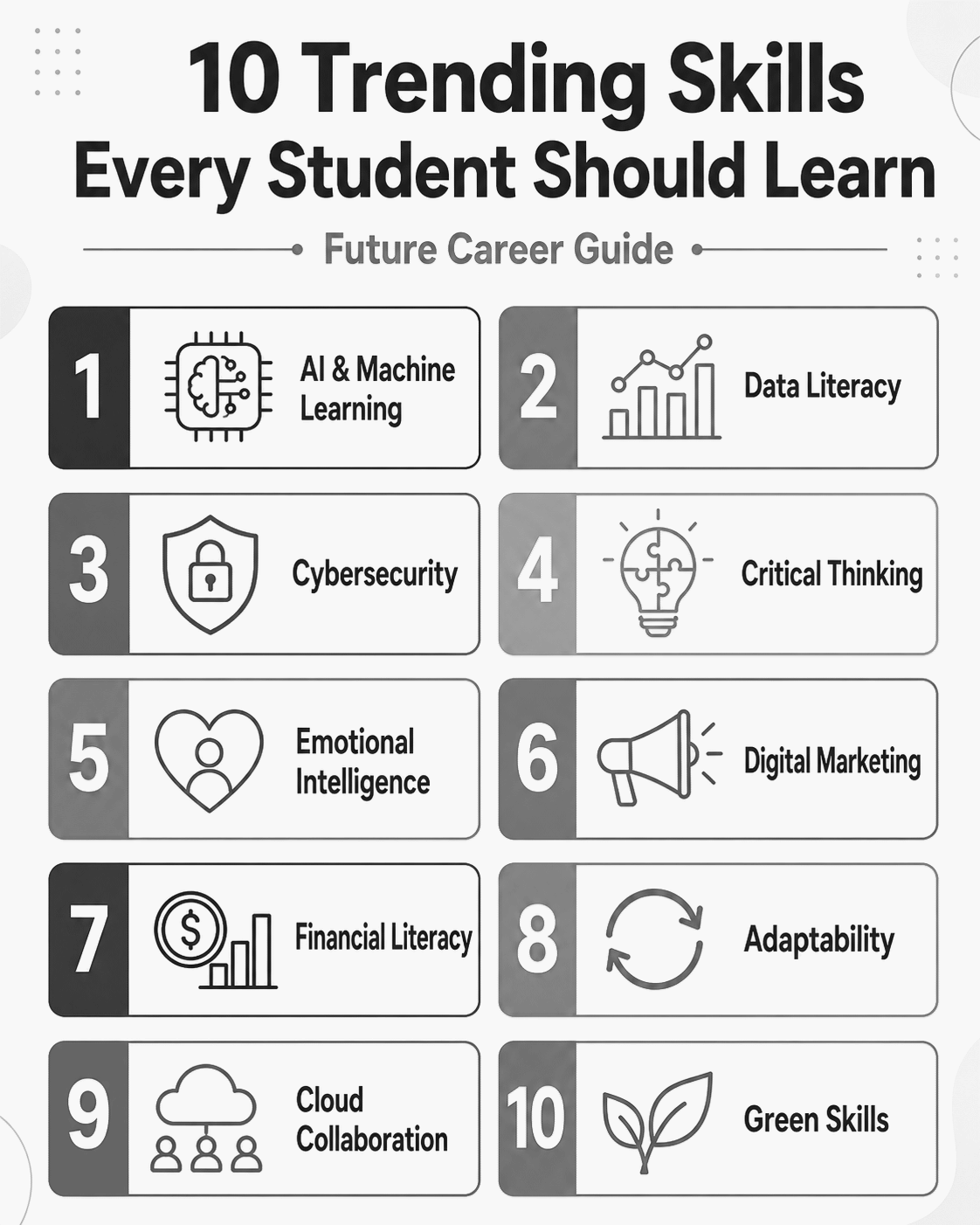
The 10 skills listed below are in high demand in today’s global market and are proven skills that will remain relevant for a long time in the future.
1. Artificial Intelligence and Machine Learning
Artificial Intelligence, or AI, is no longer only a matter of the future; it has already become part of the present. Generative AI tools such as ChatGPT and Gemini have transformed the way people work.
Why is it important?
AI will not replace humans alone; rather, people who know how to use AI will replace those who do not know how to use it. This idea has been widely accepted globally. Students need to understand the correct and ethical use of AI, AI ethics, prompt engineering, and the basic principles of machine learning.
These skills help students conduct research, analyze data, and complete daily tasks more quickly.
How can students learn it?
Students can take basic free AI courses from online platforms such as Coursera and edX. Technical students can learn to build machine learning models through programming languages such as Python. Non-technical students can learn how to use AI tools in their own fields.
2. Data Literacy and Analysis
In today’s digital age, data literacy is known as the ability to read data, understand it, interpret it, and reach conclusions based on it. Data is also described as the new oil.
Why is it important?
Every company, institution, or government uses data for decision-making. Data analysis is essential for analyzing market conditions, understanding customer behavior, and finding solutions to problems.
Candidates who can understand data are given priority in every sector.
How can students learn it?
Students can begin with Microsoft Excel or Google Sheets. After that, they can learn data visualization tools such as SQL, Tableau, or Power BI.
3. Cybersecurity
As our lives become increasingly digital, the risk of cyberattacks is also increasing. Cybersecurity is the practice of protecting computer systems, networks, and data from theft or damage.
Why is it important?
Cybersecurity skills are needed to protect personal privacy and safeguard confidential information belonging to large companies. Knowledge of cybercrimes such as phishing and malware, along with safe internet browsing practices, is a basic requirement for every student.
How can students learn it?
Students can start with personal security practices such as strong password management, two-factor authentication, and the use of secure networks. Those who are interested can pursue further study in ethical hacking or network security.
4. Critical Thinking and Complex Problem Solving
In today’s age of information overload, critical thinking is the ability to distinguish correct information from false information, including fake news.
Why is it important?
Machines and AI can easily perform routine tasks, but critical thinking is needed to solve unexpected and complex human or business problems. People who can analyze logically, view problems from different perspectives, and develop creative solutions are in high demand in the global market.
How can students develop it?
Students should build a habit of checking the credibility of the source when reading any information or news. They should practice asking questions such as “Why?” and “How?”
This skill can be developed through debate, case study analysis, and strategy-based games.
5. Emotional Intelligence and Empathy
Emotional intelligence, or EQ, is the ability to understand, control, and positively manage one’s own emotions and the emotions of others.
Why is it important?
In the workplace, technical knowledge, or IQ, may help a person get a job, but emotional intelligence, or EQ, helps them reach leadership positions. Empathy is considered extremely important for teamwork, stress management, and improving relationships with customers or colleagues.
How can students develop it?
Students should practice active listening. They should try to see situations from another person’s point of view.
Developing the habit of thinking before reacting during stressful situations helps improve emotional intelligence.
6. Digital Marketing and Content Creation
Digital marketing is the process of delivering any product, service, or idea to a target audience through digital media.
Why is it important?
As the use of social media and the internet continues to grow worldwide, companies are shifting their advertising and branding to digital platforms. Skills such as search engine optimization, social media management, video editing, and copywriting are now among the most in-demand skills.
This skill is also necessary for students to build their personal branding.
How can students learn it?
Students can take free digital marketing courses offered by Google, HubSpot, and Meta. They can gain practical experience by writing blogs, creating videos, or managing a social media page.
7. Financial Literacy and Management
Financial literacy is the basic understanding of how money is earned, spent, saved, and invested.
Why is it important?
Financial literacy is often not taught in the formal curriculum of schools and universities. As a result, many young people begin their careers without understanding debt management, taxes, and investment.
Students who understand inflation, budgeting, and the power of compound interest can make their future financially secure.
Note: Investment, tax, and financial rules differ from country to country. Therefore, it is important to consult local laws and official sources.
How can students learn it?
Students can begin by tracking their daily expenses and preparing a budget. They can also read books related to financial literacy, such as Rich Dad Poor Dad and The Psychology of Money, and learn the basics of the stock market or investment from reliable financial sources.
8. Adaptability and Continuous Learning
Adaptability is the ability to adjust quickly to changing circumstances, new technologies, or new work environments.
Why is it important?
Technology is changing so quickly that what is learned today may not be useful five years from now. Therefore, only students who can learn, unlearn, and relearn will be able to remain relevant in the future market.
How can students develop it?
Students should not be afraid to use new technologies and tools. They should build the habit of accepting new challenges outside their comfort zone.
They should maintain a growth mindset, which means believing that ability can be improved through continuous effort.
9. Cloud Computing and Digital Collaboration
Cloud computing means using computing services such as servers, storage, databases, and software through the internet.
Why is it important?
After the COVID-19 pandemic, remote work and hybrid work styles have become common globally. Knowing how to use digital collaboration tools such as Google Workspace, Microsoft 365, Zoom, Slack, and Trello has become a basic requirement for almost any job.
How can students learn it?
Students should use these online tools while working on projects with friends. They can practice editing documents together in Google Drive or conducting virtual meetings.
10. Sustainability and Green Skills
Green skills refer to the knowledge and technical abilities needed to maintain environmental balance, reduce the effects of climate change, and promote sustainable development.
Why is it important?
Climate change is becoming a serious global problem. Countries and multinational companies have set net-zero emission targets. As a result, millions of new jobs are being created in renewable energy, waste management, and corporate sustainability, including ESG, which stands for Environmental, Social, and Governance.
Every future professional will need to know how to work in an environmentally friendly way.
How can students learn it?
Students should keep themselves updated on global issues related to the environment and climate change. They should also apply practices in their personal lives that reduce their carbon footprint.
Practical Importance of Skill Development and the Global Perspective
The main benefit of learning these 10 skills is that they prepare students to become global citizens. Today, there are many opportunities to work for international companies from anywhere in the world through the internet, including freelancing and remote jobs.
However, from a global perspective, developing countries may face challenges in accessing high-speed internet and modern technology. Still, basic skills such as critical thinking, adaptability, and emotional intelligence do not require expensive technology.
Challenges in Learning Skills and Possible Solutions
Information overload: With countless resources available on the internet, students may feel confused about where to begin.
Solution: Focus on only one skill at a time.
Time management: It can be difficult to find time to learn new skills alongside formal education, such as college or school.
Solution: Set aside only 30 to 45 minutes a day and continue learning regularly.
Cost concerns: Some courses may be expensive.
Solution: Make full use of free materials available on YouTube, Coursera financial aid, and other open-source platforms.
Decision-Making Guidance: Which Skill Should You Start With?
It is neither possible nor necessary to learn all 10 skills at the same time. Students should set priorities based on their interests, academic background, and future goals.
-
Identify your interest: Do you like data and technology, such as AI and coding, or human interaction and management, such as EQ and marketing?
-
Maintain balance: Try to learn one hard skill, such as data analysis, along with one soft skill, such as critical thinking.
-
Apply skills practically: Work on projects or look for internships to apply what you have learned.
Conclusion
The pace of technological change is certain to become even faster in the coming decade. Traditional education gives us basic knowledge, but the trending skills mentioned above prepare us for future uncertainty and competition.
From artificial intelligence to emotional intelligence, and from financial literacy to sustainability, these skills help students become capable individuals who can not only seek jobs but also create opportunities.
Choosing one skill of interest and starting to learn it today is the first step toward a brighter future.







Comments 0
No comments yet. Be the first to start the conversation.