



Green skills are the knowledge, abilities, values, attitudes, and practical capabilities that help people reduce environmental impact, use resources responsibly, adapt work to environmental requirements, and make more sustainable decisions.
They are not limited to environmental scientists, renewable-energy technicians, or sustainability specialists. A finance professional may apply green skills when examining climate-related risks. A software developer may use them when evaluating the resource demands of a digital service. A teacher may connect sustainability to a subject, while a procurement officer may assess supplier evidence and material choices.
In each case, sustainability becomes part of an existing professional decision. A person does not necessarily need to leave their field or begin an entirely new career.
Students can start through coursework, supervised projects, volunteering, and community activities. Working professionals can build green skills through existing responsibilities. Career changers can map their transferable experience before deciding whether they need role-specific or technical training.
Answer Summary: Green skills can support work across finance, technology, education, healthcare, marketing, operations, public service, engineering, and other fields. Start with the environmental effects of a real task, choose two or three relevant capabilities, practise them through an assessed or supervised activity, and document the evidence accurately. Formal qualifications matter in some specialist fields, but they are not required for every role.
Table of Content
- What are green skills?
- Why do green skills matter across careers?
- Seven green capabilities that transfer across roles
- Green skills in different career areas
- How to identify the green skills your role needs
- How to build green skills without starting over
- How to present green skills on a resume or in an interview
- Common mistakes to avoid
- A practical next-step plan
Key Takeaways:
-
Green skills can be applied in conventional as well as environmental occupations.
-
Different roles require different combinations and levels of sustainability capability.
-
Technical knowledge works alongside analysis, collaboration, measurement, and communication.
-
Awareness of a topic is not the same as being able to apply it reliably.
-
Practical evidence may come from coursework, workplace tasks, volunteering, or supervised projects.
-
A certificate does not guarantee competence, recognition, employment, or higher pay.
-
Environmental claims should be specific, evidence-based, and limited to a person’s actual contribution.
What are green skills?
Green skills help people understand environmental effects and apply that understanding to products, services, processes, and workplace decisions.
The UNESCO-UNEVOC green-skills definition describes these skills as relevant across sectors and workforce levels. It includes occupation-specific technical capabilities alongside transversal knowledge, values, attitudes, and decision-making skills.
This means green skills are not one fixed checklist. A nurse, accountant, engineer, designer, teacher, and data analyst may contribute to more sustainable outcomes, but they will do so through different responsibilities.
Green skills may involve:
-
understanding environmental impacts and climate-related risks;
-
recognising how work uses energy, materials, water, equipment, or digital infrastructure;
-
evaluating environmental information and claims;
-
comparing direct, indirect, and long-term effects;
-
collaborating with other teams and affected groups;
-
adapting processes when evidence or requirements change;
-
applying specialised methods where a profession requires them.
Green skills are broader than green jobs
A person can use green skills without holding a job formally classified as environmental.
| Term | Working meaning | Career relevance |
|---|---|---|
| Green skills | Capabilities used to reduce environmental impact, adapt work, and support sustainable outcomes | Can appear across many sectors and functions |
| Green job | An occupation whose central tasks or outcomes contribute to environmental objectives | Environmental work is usually a major responsibility |
| Greening occupation | An existing occupation whose tasks or skill requirements are changing because of environmental goals or conditions | Familiar work may require updated knowledge, tools, or methods |
An accountant examining climate-related financial information may be applying green skills without becoming an environmental specialist. A product designer considering durability, repair, materials, and disposal may also use them within an established profession.
The International Labour Organization’s work on skills for green jobs places skills development within the wider preparation of workers for more environmentally sustainable economies. This transition may create specialist occupations, but it can also change responsibilities inside existing roles.
Four layers of green skills
A useful way to understand green skills is to separate foundational awareness, transversal capability, role-specific application, and specialised expertise.
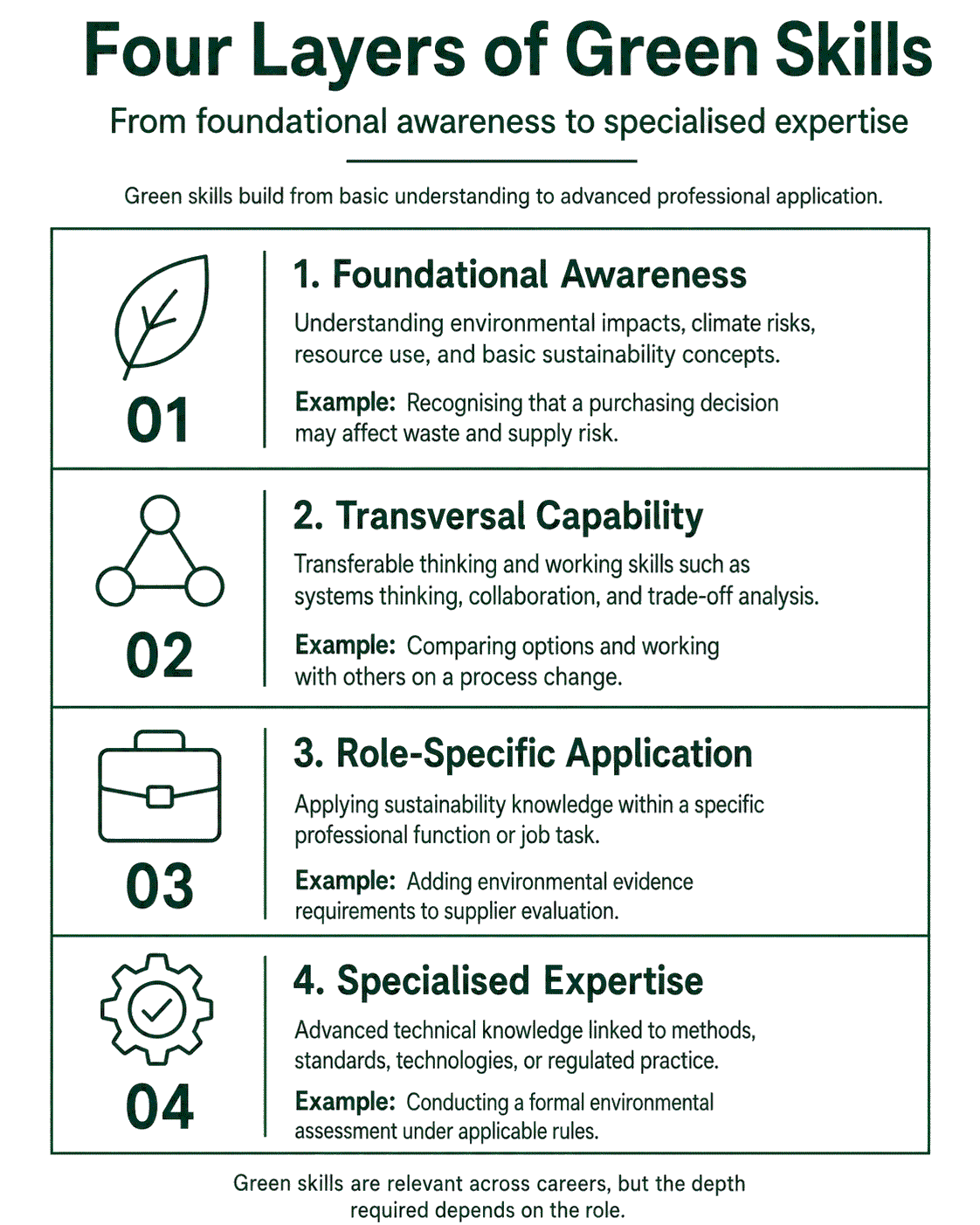
This four-layer model is a practical editorial framework. It is not an official international classification.
| Skill layer | What it involves | Workplace example |
|---|---|---|
| Foundational awareness | Understanding environmental effects, climate risks, resource use, and basic sustainability concepts | Recognising that a purchasing decision may affect waste and supply risk |
| Transversal capability | Thinking and working skills that transfer across functions | Comparing trade-offs and collaborating on a process change |
| Role-specific application | Applying sustainability knowledge within a professional function | Adding evidence requirements to supplier evaluation |
| Specialised expertise | Advanced knowledge connected to technologies, methods, standards, or professional practice | Conducting a formal environmental assessment under applicable rules |
Foundational awareness helps a person recognise an issue. Transversal capability helps them examine and communicate it. Role-specific skills connect it to their work. Specialised expertise becomes necessary when a task depends on advanced methods, formal standards, or regulated professional responsibility.
The distinction between hard skills and soft skills is related but not identical. Technical analysis may be ineffective without communication and collaboration, while good intentions do not replace reliable methods or subject knowledge.
Why do green skills matter across careers?
Green skills matter because environmental considerations increasingly influence planning, risk, purchasing, design, technology, operations, reporting, education, and public services.
The World Economic Forum’s Future of Jobs Report 2025 drew on responses from more than 1,000 employers representing over 14 million workers across 55 economies. In that survey, 47 per cent of employers expected climate-change mitigation to transform their businesses by 2030, while 41 per cent expected climate-change adaptation to do so. Environmental stewardship also entered the report’s ten fastest-growing skills for the first time.
These findings describe the expectations of surveyed employers. They are not predictions that apply equally to every business, country, occupation, or worker.
LinkedIn’s 2025 Climate Talent Stocktake reported an 8 per cent year-on-year increase in the share of green hires, compared with a 4 per cent increase in the share of workers listing green skills. It also reported that more than half of green hires were entering roles that had not traditionally required green skills.
LinkedIn’s figures come from platform-based analysis of profiles, skills, job postings, and hiring signals. They are not a complete census of the global workforce, and they do not show that adding a green skill to a profile will improve an individual’s employment outcome.
The practical message is not that everyone must collect sustainability credentials. It is that environmental effects may be becoming part of decisions made in a current or target role.
Green skills may help workers:
-
identify environmental and climate-related risks;
-
reduce avoidable resource use without weakening quality or safety;
-
evaluate evidence behind sustainability claims;
-
respond to changing technologies, standards, or organisational expectations;
-
explain environmental information accurately;
-
coordinate changes across teams;
-
consider long-term and indirect effects;
-
document outcomes rather than rely on intentions.
Digital and environmental capabilities may also overlap. Someone studying future skills in the age of AI may need to consider not only what a digital tool can do, but also its infrastructure, governance, resource demands, and wider effects.
Seven green capabilities that transfer across roles
Some green capabilities can support work in several fields, although their importance and required depth vary.
The European Commission Joint Research Centre’s GreenComp sustainability competence framework identifies 12 interconnected competences across four areas: embodying sustainability values, embracing complexity, envisioning sustainable futures, and acting for sustainability. GreenComp is a European reference framework, not a global certification or legal standard.
The following seven capabilities translate related ideas into practical workplace behaviour.
Systems thinking and problem framing
Systems thinking examines how one decision affects different parts of a wider process.
A change that reduces waste in one department may increase transport, storage, energy use, or maintenance elsewhere. A cheaper material may create later problems involving durability, disposal, safety, or supply continuity. A digital process may reduce paper use while increasing computing and storage demands.
Useful questions include:
-
What is the direct environmental effect?
-
What indirect effects may appear elsewhere?
-
Could an impact be shifted to another group, location, or stage?
-
Which teams or external parties influence the outcome?
-
What trade-offs should be documented?
GreenComp describes systems thinking as examining a sustainability problem across time, space, context, and interacting systems. It describes problem framing as defining the people, scope, difficulty, and context involved before selecting an approach. (Joint Research Centre)
Systems thinking does not require someone to predict every consequence. It requires them to identify relevant connections before presenting a decision as an improvement.
Critical evaluation
Critical evaluation helps a person assess the strength, limits, and relevance of environmental information.
Sustainability claims may depend on estimates, assumptions, selected indicators, labels, or incomplete data. A worker reviewing such a claim may need to check:
-
who produced the information;
-
which method was used;
-
what period and location the evidence covers;
-
what was measured and excluded;
-
whether two options were compared under equivalent conditions;
-
whether the conclusion is stronger than the evidence permits.
The purpose is not to dismiss every environmental statement. It is to distinguish supported findings from vague, selective, or promotional claims.
Resource awareness
Resource awareness means understanding how a task, process, service, or product uses resources.
The relevant resources depend on the occupation. A facilities worker may focus on energy and water. A designer may examine materials and durability. A software team may consider computing, storage, and infrastructure. A healthcare team may examine avoidable waste while protecting infection control and patient safety.
Resource awareness becomes a practical skill when a worker can:
-
connect consumption to a defined task;
-
identify a realistic change;
-
consider possible side effects;
-
monitor the result;
-
report the limits of the evidence.
Using fewer resources is not automatically an improvement if service quality, safety, accessibility, or reliability declines.
Evidence, data, and measurement
Measurement helps distinguish environmental intention from demonstrated results.
A credible improvement normally includes:
-
a defined starting condition;
-
a specific action;
-
a consistent measurement method;
-
a recorded output or result;
-
an explanation of uncertainty and trade-offs.
Not every role requires advanced environmental modelling. Many workers can still maintain accurate records, check data quality, document assumptions, or contribute information to a wider assessment.
A project should not be described as environmentally beneficial when its baseline, scope, or measurement method is unclear.
Collaboration and change
Environmental challenges often cross departmental and professional boundaries.
A procurement decision may involve finance, legal review, operations, technical teams, suppliers, and end users. A reporting process may require data from several departments. A service change may affect communities that were not involved in its initial design.
Collaboration may include:
-
identifying who is affected;
-
listening to different forms of expertise;
-
explaining evidence in accessible language;
-
recording disagreement and trade-offs;
-
agreeing who is responsible for each action;
-
checking whether a change creates unfair burdens.
Collaboration does not remove the need for technical expertise. It helps people apply that expertise within complex organisations and communities.
Adaptability and continuous learning
Adaptability helps workers respond when environmental evidence, tools, requirements, or working conditions change.
This capability includes:
-
recognising when an existing process needs review;
-
learning a method connected to a real task;
-
revising a decision when new evidence appears;
-
identifying the limits of one’s competence;
-
seeking technical or professional support when a task exceeds those limits.
Adaptability does not mean collecting every available credential. It means maintaining the knowledge needed for changing responsibilities.
This approach is closely connected to lifelong learning for career growth, particularly when learning is tied to a defined task and evidence of application.
Responsible communication
Responsible communication presents environmental information accurately and within its evidential limits.
A responsible claim explains:
-
what changed;
-
which part of the process was assessed;
-
how evidence was collected;
-
what result was observed;
-
what remains uncertain;
-
who was responsible for the work.
Broad labels such as “green”, “eco-friendly”, “carbon-neutral”, or “sustainable” can mislead when the speaker cannot explain the method, scope, and supporting evidence.
Responsible communication is relevant to marketing, reporting, teaching, recruitment, management, public communication, resumes, interviews, and professional portfolios.
Green skills in different career areas
Green skills become easier to understand when they are linked to decisions, capabilities, and evidence rather than job titles alone.
| Career area | Decision and relevant capability | Possible evidence |
|---|---|---|
| Business and finance | Examine climate risk, reporting assumptions, budgets, or long-term scenarios | Risk note, documented assumptions, reporting contribution |
| Software and data | Compare infrastructure, computing, storage, and design choices | Monitoring record, efficiency test, trade-off analysis |
| Marketing and design | Review product claims, materials, messaging, and design choices | Evidence file, claim checklist, approved revision |
| HR and education | Map skill gaps, design learning, and support organisational change | Learning plan, competency map, assessment output |
| Procurement and operations | Assess suppliers, materials, waste, resilience, and resource use | Supplier criteria, process record, resource comparison |
| Healthcare and public service | Improve systems while protecting safety, quality, access, and equity | Approved process change, audit record, service review |
| Engineering and environmental work | Apply technical methods, standards, and specialist assessments | Technical calculation, regulated record, verified project output |
These are simplified illustrations. They do not establish universal duties, legal requirements, or proof that an environmental benefit occurred.
Business, finance, and management
Business and finance professionals may use green skills when environmental conditions affect risk, planning, investment assumptions, budgeting, reporting, supply continuity, or long-term strategy.
Relevant capabilities may include:
-
scenario thinking;
-
evidence appraisal;
-
climate-risk awareness;
-
data interpretation;
-
documentation of assumptions;
-
cross-functional decision-making.
A responsible proof point may be a documented contribution to a risk assessment or reporting process. The description should state the person’s actual responsibility rather than imply ownership of an organisation-wide result.
Financial and regulatory decisions must follow the professional, legal, and institutional requirements that apply in the relevant jurisdiction.
Technology, software, and data
Technology professionals may apply green skills by measuring resource use, comparing infrastructure choices, reducing unnecessary computation, improving system efficiency, or considering lifecycle effects.
An environmentally preferable choice cannot be judged by one resource measure alone. The decision may also involve:
-
performance;
-
security;
-
reliability;
-
privacy;
-
accessibility;
-
cost;
-
user needs.
A configuration that lowers computing use may not be suitable if it reduces reliability or access. Evidence may include monitoring records, controlled tests, design documentation, or a written explanation of trade-offs.
Marketing, communications, and design
Marketing and communication professionals may apply green skills when reviewing claims, checking evidence, explaining limitations, and avoiding misleading language.
Designers may consider:
-
material selection;
-
product lifespan;
-
repairability;
-
packaging;
-
user behaviour;
-
disposal;
-
digital performance.
“Created a sustainable campaign” is too broad to demonstrate competence.
More responsible wording would explain which claim was reviewed, what evidence was checked, what wording changed, and which part of the work belonged to the individual.
HR, education, and people development
Human resources teams may identify skill gaps, plan fair access to learning, revise job responsibilities, and support workers affected by changing tasks.
Educators may connect sustainability to subjects such as economics, design, technology, science, business, health, or citizenship. The aim is not to place the same environmental lesson in every subject, but to identify where sustainability questions genuinely relate to the learning outcome.
Possible evidence includes a competency map, assessed learning activity, revised lesson plan, training evaluation, or documented contribution to a workforce plan.
Procurement, supply chain, and operations
Procurement and operations professionals influence materials, suppliers, equipment, logistics, waste, continuity, and resource use.
Relevant capabilities may include:
-
responsible-sourcing criteria;
-
supplier evidence review;
-
resource measurement;
-
lifecycle thinking;
-
resilience planning;
-
process improvement.
Environmental considerations must remain connected to quality, safety, delivery, applicable law, organisational policy, and verified supplier information.
Healthcare and public service
Healthcare and public-service workers may contribute through facilities decisions, procurement, service design, transport planning, waste handling, public education, and resource stewardship.
Any environmental change must protect the primary purpose of the service. In healthcare, this includes patient safety, infection control, clinical quality, privacy, and access. In public services, it may include fairness, reliability, accessibility, legal duties, and public accountability.
The green skill is not simply using fewer resources. It is improving resource decisions without weakening essential services.
Engineering and environmental roles
Some occupations require advanced technical skills, formal standards, recognised qualifications, or professional licences.
These roles may involve:
-
environmental assessment;
-
building or energy performance;
-
pollution control;
-
engineering design;
-
technical compliance;
-
environmental monitoring;
-
specialist reporting.
Education, accreditation, licensing, and professional requirements differ among countries and professions. Readers should verify them through the relevant institution, regulator, or professional body.
How to identify the green skills your role needs
The most useful starting point is a real task or decision, not a long list of sustainability terms.
1. Map the main tasks
Write down tasks that influence:
-
products or services;
-
purchasing;
-
equipment;
-
buildings;
-
data and digital infrastructure;
-
transport;
-
materials;
-
communication;
-
people and learning;
-
policy or public decisions.
Focus on what a person does rather than the job title. Workers with the same title may have different responsibilities.
2. Identify possible environmental effects
For each task, ask whether it affects:
-
energy or resource use;
-
materials and waste;
-
transport and supply chains;
-
environmental or climate-related risk;
-
product or service design;
-
public or consumer claims;
-
reporting or compliance;
-
impacts transferred to another group or location.
A task may have no meaningful environmental component. Do not force a connection where one is weak.
3. Check role and industry signals
Review current job descriptions, professional guidance, organisational goals, technical standards, and local requirements.
Relevant wording may include:
-
resource efficiency;
-
responsible sourcing;
-
climate risk;
-
environmental reporting;
-
lifecycle assessment;
-
sustainable design;
-
resilience;
-
waste reduction;
-
energy performance;
-
environmental compliance.
The word “green” may be absent even when a responsibility has an environmental dimension.
4. Prioritise two or three skills
Choose skills that are:
-
connected to real responsibilities;
-
appropriate for the person’s authority and experience;
-
possible to practise;
-
supported by a suitable learning route;
-
capable of producing reviewable evidence.
Trying to study every sustainability topic at once can lead to shallow understanding and weak evidence.
5. Define acceptable evidence
Decide what would demonstrate the skill before selecting a course or project.
Evidence may include:
-
an assessed analysis;
-
a measurement record;
-
an approved process change;
-
a design comparison;
-
a supplier-evaluation method;
-
a lesson or training activity;
-
a portfolio explanation;
-
verified feedback from a supervisor or instructor.
The evidence should show what the person did, how the task was approached, and what limitations remained.
Read job descriptions critically
A job description may combine essential duties, preferred experience, organisational aims, and broad employer language.
Separate:
-
required tasks from optional interests;
-
technical requirements from general awareness;
-
regular responsibilities from occasional projects;
-
legal or professional duties from employer preferences.
This distinction helps determine whether the role needs foundational awareness, transversal capability, role-specific practice, or specialist expertise.
Separate awareness from competence
Awareness means understanding a concept and recognising why it matters.
Competence means applying relevant knowledge accurately, consistently, and within appropriate professional limits.
Reading about carbon accounting does not make someone qualified to perform it. Completing a short responsible-procurement course does not prove that the learner can assess suppliers under an organisation’s legal, technical, and operational conditions.
A learning activity becomes stronger evidence when it includes practice, assessment, feedback, and a clear connection to the target task.
How to build green skills without starting over
Many green skills can be developed through existing education, employment, community activity, or professional learning.
Formal education or an approved qualification may be necessary for specialist and regulated work. It is not the only route to foundational, transversal, or some role-specific capabilities.
Choose learning that matches the task
A learning option should be judged by what it teaches and what evidence it produces.
Check:
-
whether the curriculum covers the target task;
-
whether the content matches the learner’s level;
-
whether practical work is included;
-
whether assessment and feedback are meaningful;
-
whether the provider has relevant subject credibility;
-
whether accreditation or recognition matters for the intended role;
-
whether the content applies to the learner’s location and sector;
-
whether the time and cost match its expected use.
For this guide, a certificate means evidence that a learner completed or was assessed in a defined course or programme. It does not, by itself, prove broad professional competence, international recognition, or employment value.
A degree is generally a broader academic qualification involving a longer and deeper programme of study. It may provide foundations for specialist occupations, but it is not required for every green skill used in an existing career.
Recognition varies among employers, professions, institutions, and countries. A credential should not be described as globally accepted without direct evidence.
| Learning route | Useful when | Limits and possible proof |
|---|---|---|
| Short assessed course | A focused knowledge or method gap needs attention | Depth may be limited; proof may include an assessed task or project |
| Degree or formal programme | The target field needs broad academic preparation or specialist entry | Requires more time and cost; proof includes coursework, projects, and the qualification |
| Workplace project | The skill can be applied to an existing responsibility | Depends on access and supervision; proof may include records, analysis, or approved changes |
| Student or community project | Work experience is limited and a supervised task is available | Scope and data may be restricted; proof includes documented contribution and feedback |
| Mentoring or professional learning | The learner needs targeted guidance and review | Quality depends on the mentor and task; proof includes revised work and documented feedback |
Learning routes for students and graduates
Students can connect green skills to their existing subjects rather than waiting for a dedicated environmental job.
Possible routes include:
-
adding a resource, lifecycle, or climate-risk question to an assignment;
-
comparing materials or design choices in a project;
-
analysing evidence behind an environmental claim;
-
joining a supervised campus or community activity;
-
documenting a volunteering contribution;
-
creating a portfolio note that explains the method and limitations.
For example, a student project might compare material choices for a design assignment. The student should state the criteria used, the information available, and what could not be concluded.
Such a project does not prove an environmental benefit unless the relevant effects were measured using an appropriate method.
Learning routes for working professionals
Professionals can begin with a decision already connected to their role.
Examples include:
-
reviewing one supplier-evaluation criterion;
-
measuring resource use in a defined process;
-
checking the evidence behind a public claim;
-
contributing to a risk or reporting exercise;
-
comparing two design or infrastructure options;
-
helping create a role-specific learning plan.
The project should be limited enough to supervise and document. Workplace confidentiality, safety, law, data protection, and professional standards still apply.
Learning routes for career changers
Career changers do not need to discard their existing experience before identifying skill gaps.
Begin by mapping transferable capabilities such as:
-
research and evidence review;
-
project management;
-
data analysis;
-
procurement;
-
communication;
-
teaching;
-
budgeting;
-
risk assessment;
-
stakeholder coordination.
Then identify the environmental knowledge needed to apply that capability in the target role.
A project manager moving towards sustainability-related work may already understand schedules, budgets, risk, documentation, and cross-team coordination. The learning gap may concern environmental methods, terminology, standards, or sector context rather than project management itself.
This is an illustration, not a claim about a particular person or employer.
Create a small evidence project
A small project can turn learning into observable practice.
Use this sequence:
-
Define one process or decision.
-
Record the starting condition.
-
Select a method you can explain.
-
Make or recommend a limited change.
-
Measure or document the output.
-
Record trade-offs and uncertainty.
-
Identify what should be checked next.
The project should remain within the learner’s authority and competence. Specialist, regulated, or safety-sensitive work requires appropriate supervision and local professional guidance.
How to present green skills on a resume or in an interview
Green skills should be described through tasks, methods, evidence, and scope rather than unsupported labels.
Readers who need broader application guidance can also review how to prepare a professionally written resume.
Resume example structure
Use this pattern:
Action + task + method + verified result or output + scope
Illustrative wording:
“Reviewed supplier-evaluation criteria, added documented environmental evidence requirements, and recorded the revised process for management approval.”
Another example:
“Compared computing-resource use before and after a configuration change using team monitoring data and documented the performance trade-offs.”
These examples describe an action and method without inventing a numerical result or claiming organisation-wide responsibility.
Before adding a statement, check:
-
Is the task specific?
-
Can the method be explained?
-
Is the result measured or limited to an output?
-
Is the person’s responsibility stated accurately?
-
Does the wording avoid unsupported environmental conclusions?
Interview example structure
Use this sequence:
Context + decision + evidence + trade-off + learning
Explain:
-
the situation or decision;
-
your responsibility;
-
the evidence reviewed;
-
the action taken;
-
the verified output or result;
-
the remaining limitations;
-
what you learned.
State whether you led the work, supported it, performed the analysis, or completed one part. Precise scope makes the example easier to assess.
Portfolio evidence
A portfolio item may include:
-
the question or decision;
-
the method used;
-
the information sources;
-
a sample output;
-
feedback received;
-
the limits of the work;
-
the next improvement.
The guide on how to build a professional portfolio provides additional context for organising work samples and explaining professional development.
Remove confidential, private, personal, or restricted information. Do not publish workplace or institutional documents without permission.
Common mistakes to avoid
Confusing concern with competence
Concern for environmental issues is a value or motivation. A green skill requires the ability to apply relevant knowledge, methods, or judgement to a task.
Treating a certificate as complete proof
A certificate may show participation or assessment. Its value depends on curriculum depth, assessment quality, provider credibility, role relevance, and local recognition.
Making unsupported environmental claims
Do not describe a product, campaign, process, or project as sustainable, carbon-neutral, zero-waste, or environmentally beneficial unless the evidence supports that wording.
Claiming responsibility for a team result
Describe your contribution rather than presenting an organisational achievement as an individual result.
Ignoring trade-offs
A proposed change may affect cost, safety, privacy, accessibility, reliability, quality, employment, or equity. Responsible sustainability work records these effects.
Assuming requirements are global
Professional duties, environmental regulations, accreditation, reporting rules, and credential recognition differ among countries and sectors.
Collecting unrelated skills
A focused capability linked to a real task and supported by evidence is more useful than a long list of loosely connected sustainability terms.
A practical next-step plan
Green skills are most credible when they are built around a real decision rather than an abstract claim.
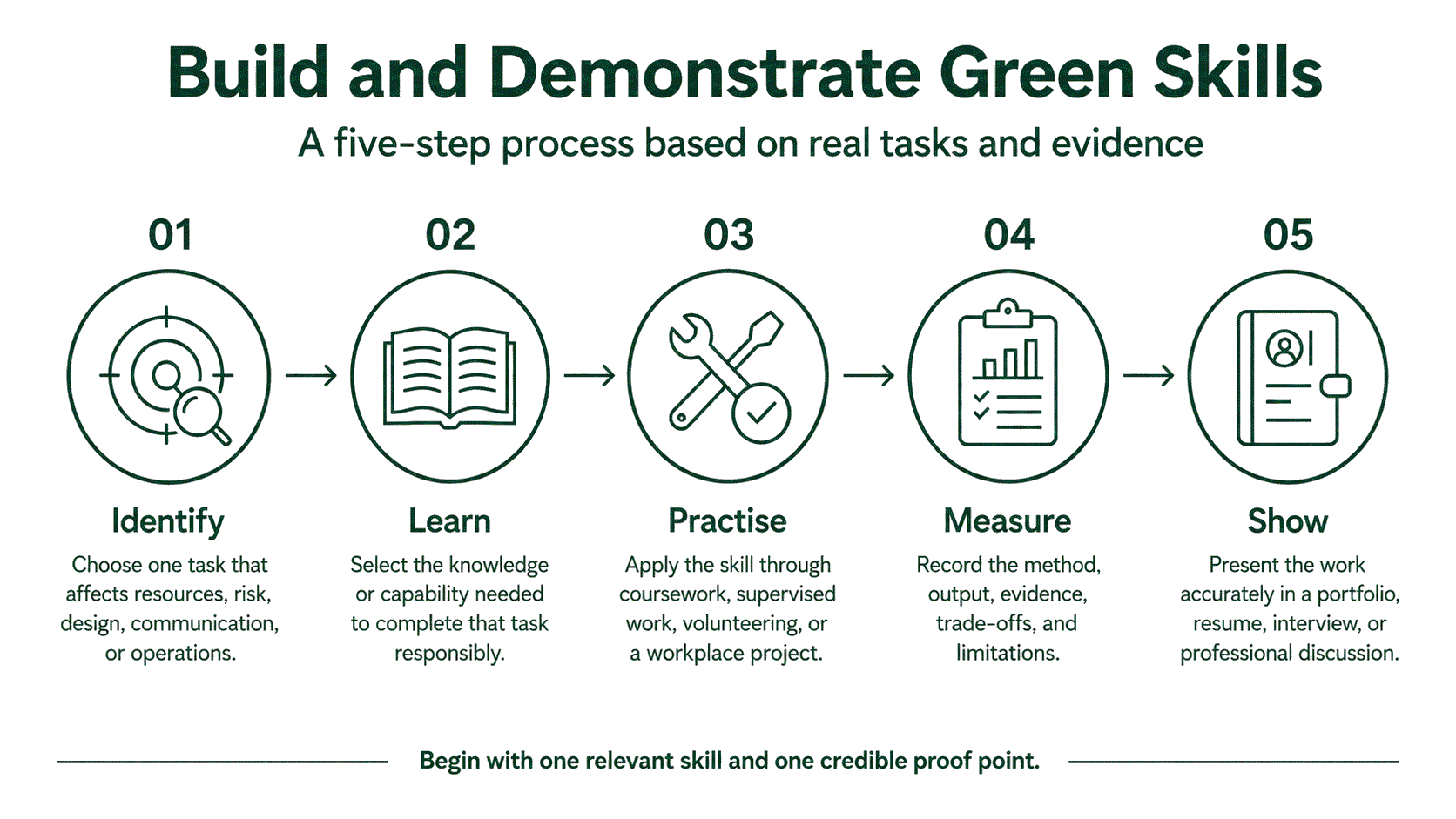
Use this five-part process:
-
Identify: Choose one task in a current or target role that affects resources, risk, design, communication, or operations.
-
Learn: Select one capability needed to make that decision responsibly.
-
Practise: Apply the capability through coursework, a supervised project, volunteering, or a workplace activity.
-
Measure: Record the method, output, evidence, trade-offs, and limitations.
-
Show: Describe the work accurately in a portfolio, resume, interview, or professional discussion.
Begin with one skill and one proof point. After applying and documenting it, decide whether the next need is another transversal capability, a role-specific method, or specialist training.
The aim is not to adopt a new professional identity immediately. It is to make sustainability knowledge useful within real work while remaining honest about competence, evidence, and local requirements.







Comments 0
No comments yet. Be the first to start the conversation.