



Table of Content
- Careers AI Is Least Likely to Replace
- Key Takeaways
- What Does “Least Likely to Replace” Mean?
- How This Career List Should Be Evaluated
- 20 Careers to Review for Lower AI Replacement Risk
- How Education Pathways Compare: Certificate vs Degree
- Pros and Cons of These Career Paths
- Career Outcomes and Realistic Limits
- Decision Criteria for Students and Career-Switchers
- Conclusion
Careers AI Is Least Likely to Replace
Choosing a career during the spread of AI tools requires more than asking whether a job title sounds safe. The more useful question is whether the core work depends on human judgment, physical skill, trust, care, accountability, or changing real-world conditions.
This guide explains how to evaluate careers AI is least likely to replace. It does not claim that any career is immune to technology. AI may support documentation, scheduling, drafting, research, design, planning, or routine communication. However, some careers may remain harder to replace fully because they require human presence, ethical decisions, hands-on work, personal trust, or responsibility for safety.
The guide is written for students, parents, counselors, and career-switchers comparing education and training options. It includes a proposed list of 20 careers, but each career should be verified against current labor-market data, local credential rules, and employer expectations before personal decision-making.
Summary
The careers AI is least likely to replace are usually those that depend on human care, judgment, physical presence, trust, and accountability. Healthcare, skilled trades, education, social service, public safety, and built-environment roles may be stronger candidates, but no career should be treated as permanently safe. Career planning should compare tasks, credentials, local demand, and long-term learning needs.
Key Takeaways
-
No career should be treated as AI-proof.
-
Task exposure matters more than job titles alone.
-
Human judgment and trust can reduce replacement risk.
-
Hands-on work is often harder to replace fully.
-
Credentials matter in licensed and regulated fields.
-
Certificates and degrees serve different career purposes.
-
Local demand and training quality should be checked before choosing.
What Does “Least Likely to Replace” Mean?
“Least likely to replace” means AI is less likely to take over the core responsibility of the role. It does not mean AI will have no effect on the job.
Replacement Is Different From Support
AI may support workers without replacing them. For example, an AI tool may help draft a report, organize notes, create practice questions, summarize information, or suggest possible next steps. A human may still need to check accuracy, make decisions, communicate with people, and take responsibility for the outcome.
This distinction matters because many careers will change at the task level. A role can become more technology-supported while still requiring human skill.
Work Context Matters
A career may be harder to replace when the work happens in varied, physical, or sensitive settings. Work that involves homes, classrooms, clinics, construction sites, public spaces, workshops, or emergencies may require adaptation that software alone cannot provide.
Work context also includes who is affected by the decision. Roles involving patients, students, clients, families, public safety, or infrastructure often require trust and accountability.
Four Traits That May Lower Replacement Risk
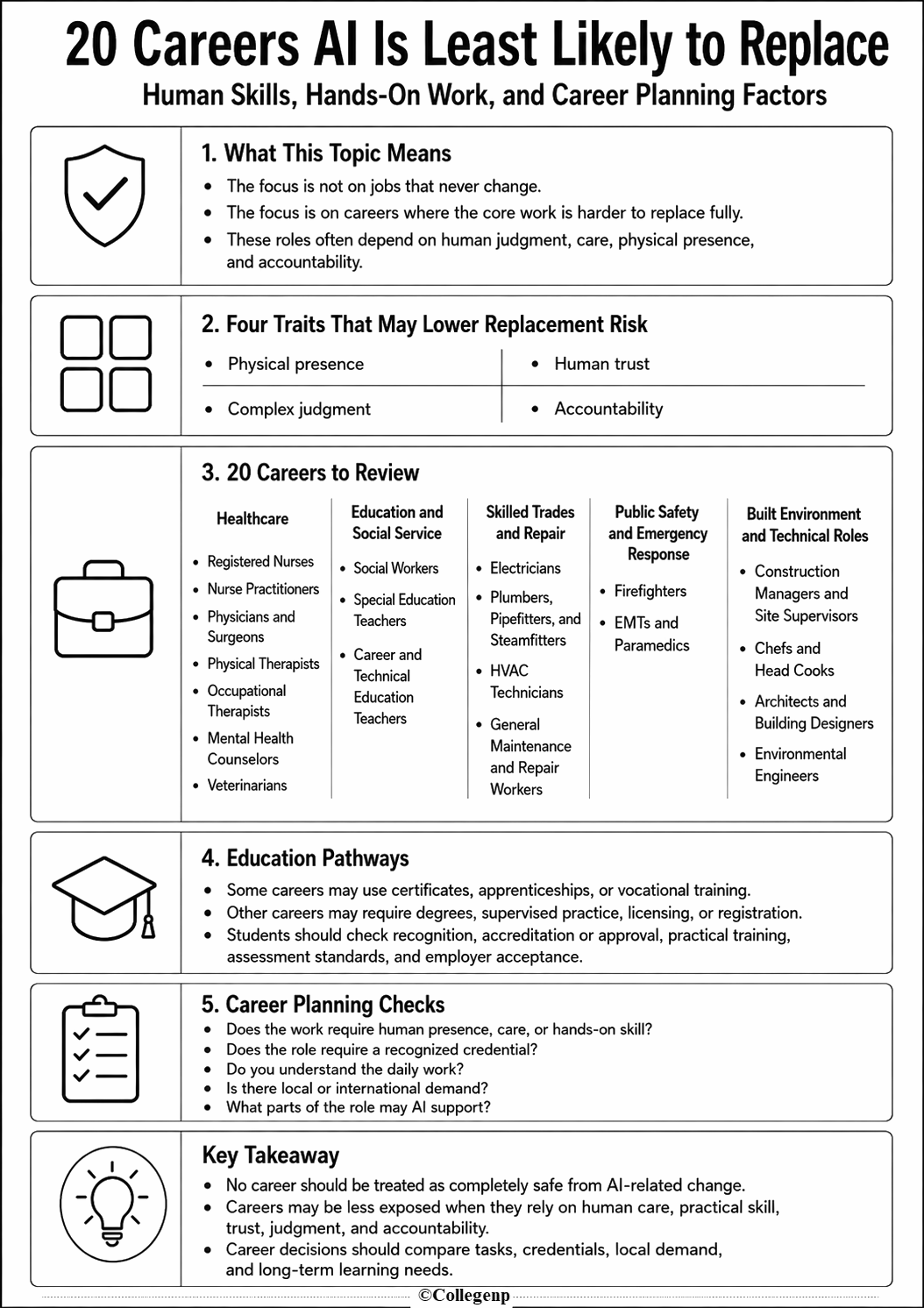
Careers may be less exposed to full AI replacement when they include these traits:
-
Physical presence: The worker must inspect, repair, move, build, treat, supervise, or respond in person.
-
Human trust: The role depends on relationships, care, listening, teaching, or emotional judgment.
-
Complex judgment: The worker must make decisions under uncertainty.
-
Accountability: The role is tied to safety, ethics, licensing, regulation, or public responsibility.
These traits should be verified with occupational data before making strong claims about any specific career.
How This Career List Should Be Evaluated
This list is best used as a starting point for career research. Each role should be checked against current occupational sources, local labor-market data, and credential requirements.
Limits of Any AI-Resistance List
No list can promise job security. A career may be hard to automate but still have difficult working conditions, long training, low entry-level pay, limited local openings, physical strain, or emotional stress.
AI may also affect entry-level work differently from experienced work. Routine tasks may be supported or reduced, while advanced judgment and supervision may remain human-led.
20 Careers to Review for Lower AI Replacement Risk
The following careers are proposed candidates for lower AI replacement risk because they may involve hands-on work, human care, judgment, safety, or accountability.
1. Registered Nurses
Registered nursing may be less exposed to full AI replacement because patient care often requires observation, communication, judgment, and direct support.
AI may assist with records, reminders, or information retrieval. Human nurses may still be needed for patient interaction, coordination, care decisions, and response to changing conditions.
2. Nurse Practitioners
Nurse practitioners may be harder to replace fully because their work can involve patient assessment, communication, clinical judgment, and professional accountability.
This career should be verified through current licensing, education, and occupational sources before career choose.
3. Physicians and Surgeons
Physicians and surgeons may be less replaceable because diagnosis, treatment, procedures, consent, ethics, and patient responsibility require high levels of judgment and accountability.
AI may support research, documentation, image review, or decision support, but professional responsibility remains a key issue to verify.
4. Physical Therapists
Physical therapy may be less exposed to full replacement because rehabilitation often requires hands-on assessment, movement observation, patient motivation, and adjustment of treatment.
AI may support exercise reminders or progress tracking, but the human role should be verified through professional and occupational sources.
5. Occupational Therapists
Occupational therapy may be harder to replace because it can involve helping people adapt daily activities, work tasks, school tasks, and home environments.
This role often depends on context, communication, and practical adaptation. Verification should confirm duties, credentials, and work settings.
6. Mental Health Counselors
Mental health counseling may be less replaceable because trust, confidentiality, listening, ethics, and professional boundaries are central to the work.
AI may provide general information or structured prompts, but counseling requires careful verification due to safety, licensing, and ethical considerations.
7. Social Workers
Social work may be harder to replace fully because it can involve complex human needs, family systems, community resources, advocacy, and sensitive decisions.
AI may support note-taking or resource searches, but human judgment and accountability should be verified through occupational and professional sources.
8. Special Education Teachers
Special education teaching may be less exposed to full replacement because it involves individualized instruction, classroom judgment, student support, family communication, and adaptation.
AI may support lesson materials, but the human role should be verified through education and teacher-credential sources.
9. Career and Technical Education Teachers
Career and technical education teachers may be less replaceable when they teach practical skills that require demonstration, supervision, safety, and feedback.
This role should be verified through education sources, credential rules, and occupational data.
10. Electricians
Electricians may be less exposed to full AI replacement because electrical work often requires site inspection, installation, testing, safety judgment, and physical repair.
AI may help with diagrams, codes, or troubleshooting, but human hands-on skill and licensing should be verified.
11. Plumbers, Pipefitters, and Steamfitters
Plumbing and pipefitting roles may be harder to replace because they involve physical systems, buildings, tools, repair, installation, and variable site conditions.
12. HVAC Technicians
Heating, ventilation, air conditioning, and refrigeration roles may be less replaceable because they involve physical equipment, diagnostics, maintenance, and field conditions.
AI may support diagnostic steps, but technicians may still be needed to inspect, repair, and verify systems.
13. General Maintenance and Repair Workers
General maintenance and repair work may be less exposed because it often combines practical troubleshooting across buildings, equipment, and systems.
The strength of this claim depends on the specific workplace and should be verified with occupational data.
14. Construction Managers and Site Supervisors
Construction management and site supervision may be harder to replace because building projects require coordination, safety oversight, communication, scheduling, and response to changing site conditions.
AI may support planning or documentation, but human supervision and accountability should be verified.
15. Firefighters
Firefighting may be less replaceable because emergency response requires physical presence, teamwork, judgment, public trust, and action in unpredictable settings.
AI may assist with dispatch, mapping, or information, but trained responders are central to the role. Verification is needed for current career requirements and outlook.
16. EMTs and Paramedics
Emergency medical technicians and paramedics may be less exposed because emergency care requires rapid assessment, communication, transport decisions, and direct response in varied locations.
AI may support documentation or dispatch, but the human role should be verified through emergency medical service sources.
17. Veterinarians
Veterinary work may be harder to replace because it includes animal examination, diagnosis, treatment, procedures, communication with owners, and professional responsibility.
AI may support information retrieval or diagnostics, but clinical judgment and licensing should be verified.
18. Chefs and Head Cooks
Chefs and head cooks may be less exposed to full replacement when their work depends on taste, timing, kitchen leadership, creativity, safety, and customer expectations.
Automation may support ordering or repetitive preparation. The level of risk should be verified by food-service occupational sources.
19. Architects and Building Designers
Architecture and building design may be less replaceable when the work involves clients, safety, regulations, site constraints, usability, materials, and coordination with other professionals.
AI may help create design options, but professional judgment and responsibility remain important points for verification.
20. Environmental Engineers
Environmental engineering may be less exposed when the work connects technical analysis, field conditions, regulation, infrastructure, and public or environmental safety.
AI may support modeling or reports, but engineering accountability and professional standards should be verified.
How Education Pathways Compare: Certificate vs Degree
Career pathways vary widely. Some roles may use certificates, apprenticeships, or vocational training, while others may require degrees, supervised practice, licensing, or professional registration.
What Is a Certificate?
A certificate is commonly a focused education or training credential tied to a specific skill area or occupation. Certificate length, recognition, and value vary by country, provider, and employer.
What Is a Degree?
A degree is commonly a broader academic credential that may include theory, general education, research, and advanced study. Some careers require degrees for licensing or professional entry.
Main Credential Types for AI-Resistant Careers
Possible pathways include certificates, apprenticeships, diplomas, associate degrees, bachelor’s degrees, graduate degrees, professional degrees, licenses, and registrations.
The correct pathway depends on the role. For example, skilled trades may use apprenticeships, while healthcare, teaching, engineering, and therapy roles may require formal degrees and licensing.
Quality Signals to Check Before Enrolling
Students should check:
-
Recognition by a relevant authority
-
Accreditation or official approval
-
Curriculum depth
-
Practical training
-
Assessment standards
-
Instructor qualifications
-
Employer acceptance
-
Licensing alignment
-
Transferability to further study or work
Pros and Cons of These Career Paths
Careers with lower AI replacement risk may offer durable human-centered work, but they also require careful comparison.
Time, Cost, and Flexibility
Some pathways may be shorter and practical, while others may require several stages of study and supervised practice. Shorter training can be useful, but only if employers or licensing bodies recognize it.
Students should compare tuition, tools, exam fees, time away from work, placement requirements, and the chance to earn while training.
Depth, Recognition, and Transferability
Degrees may offer broader recognition and access to advanced study. Certificates may be faster and more focused. Apprenticeships may combine work and training.
Transferability matters for students who may move between regions or countries. A credential that works in one place may not meet requirements elsewhere.
Long-Term Learning Value
A strong pathway should teach durable skills, not only tool use. Durable skills include communication, safety, judgment, practical problem-solving, ethical awareness, and the ability to learn new systems.
AI may change tools and workflows, so career resilience depends on continuing learning.
Career Outcomes and Realistic Limits
Lower AI replacement risk does not guarantee strong career outcomes. Outcomes depend on training quality, local demand, credential recognition, employer screening, and working conditions.
Employer Screening and Licensing
Many human-centered or hands-on careers require proof of competence. Employers may screen for credentials, supervised experience, practical skill, communication, references, safety habits, and licensing.
Students should check official requirements before choosing a course or program.
Sector Differences
The same career can vary by setting. Healthcare work can differ between hospitals and community settings. Skilled trades can differ between residential, commercial, and industrial work. Teaching can differ across school levels and institutions.
Daily work should be reviewed before choosing a path.
What AI May Still Change
AI may change documentation, scheduling, research, drafting, design, diagnosis support, customer communication, and planning. Workers in lower-exposure careers may still need to learn how to use AI tools responsibly.
A strong career plan should combine human skills with technology awareness.
Decision Criteria for Students and Career-Switchers
The best choice is not the career with the strongest label. It is the career that fits your abilities, interests, training access, local demand, and long-term goals.
The Career-Fit Self-Check
Ask:
-
Does the work require human presence, care, or hands-on skill?
-
Does the role require a recognized credential?
-
Can I access the required training?
-
Do I understand the daily work?
-
Is there local or international demand?
-
Can the credential transfer if I move?
-
Which tasks may AI support?
-
What human skills will remain central?
Student Pathway Examples
A student interested in healthcare may compare nursing, emergency medical services, therapy, and other patient-care pathways.
A student interested in practical work may compare electrical, plumbing, HVAC, maintenance, and construction pathways.
A student interested in people and learning may compare teaching, counseling, social work, and training roles.
Working-Professional Pathway Examples
A worker concerned about AI exposure may look for roles that add fieldwork, care, technical service, supervision, or regulated responsibility.
A graduate may strengthen employability through practical training, internships, supervised experience, or recognized credentials.
A tradesperson may later move into supervision, inspection, teaching, or small-business management if the pathway fits their goals.
Conclusion
Careers AI is least likely to replace are best understood through tasks, not job titles. Roles that involve human care, practical skill, trust, judgment, physical presence, and accountability may be harder to replace fully than roles built mainly around routine digital work.







Comments 0
No comments yet. Be the first to start the conversation.