



Table of Content
- 20 Practical Skills Every Young Person in Nepal Should Learn
- Group 1: Digital and Creative Skills
- Group 2: Administrative and Corporate Support Skills
- Group 3: Hands-On Vocational Skills
- Group 4: Modern Soft and Hybrid Skills
- How to Learn These Skills
- Important Precautions
- Conclusion
20 Practical Skills Every Young Person in Nepal Should Learn
In today’s job market, the importance of practical skills has increased alongside academic degrees. A degree provides a foundation, but real work ability, problem-solving skills, digital literacy, and professional behavior help young people move toward employment, self-employment, or freelancing.
Many students in Nepal complete formal education from schools, colleges, or universities. However, their preparation does not always match the practical skills demanded by the job market. To reduce this gap, skills that can be learned in a short time can be useful.
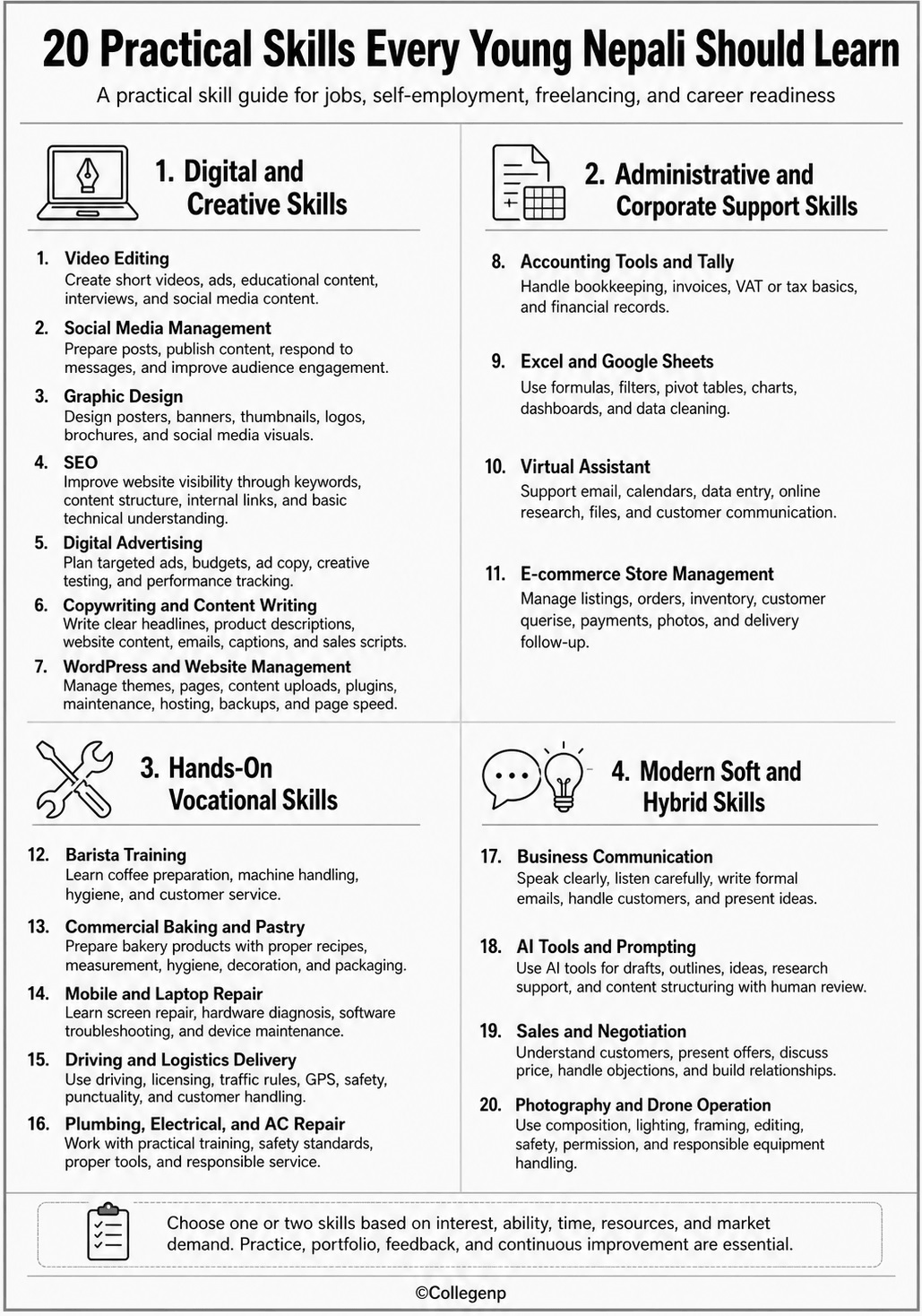
This article presents 20 practical skills that may be useful for young people in Nepal, grouped into four categories.
Group 1: Digital and Creative Skills
Digital skills are connected with the internet, computers, mobile devices, and online platforms. These skills can support local businesses, online work, freelancing, and personal brand building.
1. Video Editing
With the growing use of YouTube, TikTok, Instagram Reels, online advertising, and digital media, video editing has become a useful skill. Tools such as Adobe Premiere Pro, Final Cut Pro, and CapCut can be used to create short videos, advertisements, educational content, interviews, or social media content.
Young people with creative thinking, storytelling ability, and a clean editing workflow can use this skill for freelance or institutional work.
2. Social Media Management
From small shops to large organizations, businesses communicate with customers through Facebook, Instagram, TikTok, and other platforms. Social media management includes preparing posts, publishing content on time, responding to messages, maintaining the brand image, and improving audience engagement.
This skill requires language ability, communication style, basic design sense, and an understanding of customer behavior.
3. Graphic Design
Businesses, educational institutions, media outlets, campaigns, and personal brands need posters, banners, thumbnails, logos, brochures, and social media designs. Basic design can be started with Canva. Later, tools such as Adobe Photoshop or Illustrator can be learned to make design skills more professional.
In graphic design, knowing how to use tools alone is not enough. Color, typography, layout, readability, and clarity of message are also important.
4. SEO
Search Engine Optimization, or SEO, is the process of making a website or content easier to find on search engines. It includes keyword research, on-page optimization, content structure, internal linking, and basic technical understanding.
SEO is useful for blogs, news sites, e-commerce platforms, educational institutions, and local businesses. After learning this skill, one can work in content, website management, or digital marketing.
5. Digital Advertising / Performance Marketing
Digital advertising involves using Meta Ads, Google Ads, or other paid media platforms to deliver advertisements to a targeted audience. It includes audience selection, budget planning, ad copy, creative testing, and result analysis.
Learning this skill requires time, practice, and data interpretation. Simply boosting a post is not digital marketing; understanding campaign objectives, conversions, and performance tracking is important.
6. Copywriting and Content Writing
Copywriting is not only about informing customers; it is writing that motivates people to take action through a clear message. It includes preparing advertising headlines, product descriptions, website content, emails, social media captions, and sales scripts.
This can be a useful skill for young people who have a good command of language, the ability to understand readers’ needs, and a concise writing style.
7. WordPress and Website Management
Small business websites, blogs, portfolios, institutional websites, or basic e-commerce sites can be created using platforms such as WordPress or Shopify. At the beginner level, even without coding knowledge, one can learn theme setup, page building, content uploads, plugin management, and basic maintenance.
While learning website management, one should also understand basic aspects such as domain, hosting, security, backup, and page speed.
Group 2: Administrative and Corporate Support Skills
These skills are used in offices, businesses, organizations, and online work. They can be useful in management, data handling, customer service, and daily administration.
8. Accounting Tools / Tally
Small businesses, shops, NGOs, schools, cooperatives, and companies need to maintain records of financial transactions. Learning Tally, basic bookkeeping, invoices, general VAT/tax understanding, and financial record management can make it easier to enter accounting support or admin-related work.
Accuracy, confidentiality, and regular practice are necessary in this field.
9. Excel and Google Sheets
Excel and Google Sheets are much more useful than simple data entry tools. Skills such as pivot tables, filters, formulas, VLOOKUP/XLOOKUP, charts, basic dashboards, and data cleaning help make office work faster and more organized.
Spreadsheet skills are useful in data management, reporting, research support, finance, administration, and sales tracking.
10. Virtual Assistant
A virtual assistant handles tasks such as email management, calendar scheduling, data entry, customer communication, online research, file organization, and basic administrative support. Good English, time management, the ability to use digital tools, and responsible communication are necessary for this role.
This skill can open the path to remote work or freelance administrative support, but building a portfolio, reliability, and client management are important for stable income. Students can also explore online jobs Nepali students can do while studying to understand related work options.
11. E-commerce Store Management
Running an online store includes product listing, order tracking, inventory management, responding to customer queries, uploading product photos, payment coordination, and delivery follow-up. This skill can be useful for Daraz, Shopify, Instagram stores, or local online businesses.
While learning this skill, one should understand customer service, product descriptions, pricing, stock updates, and delivery coordination.
Group 3: Hands-On Vocational Skills
These skills are related to direct work, tools, services, and physical presence. Such skills can be useful for local markets, service businesses, self-employment, and skill-based jobs.
12. Barista Training
With the growth of coffee culture, barista skills have become useful in cafés, restaurants, hotels, and the hospitality sector. Espresso, cappuccino, latte, milk texture, coffee machine handling, hygiene, and customer service are its main aspects.
Barista skills can provide a foundation for café jobs, hospitality training, or a small coffee business.
13. Commercial Baking and Pastry
Demand for cakes, pastries, bread, cookies, and bakery products can be seen in hotels, cafés, bakeries, and home-based businesses. In baking, recipes, measurement, hygiene, oven handling, decoration, and packaging are important.
This skill can also provide a foundation for starting a small enterprise along with employment, but quality, cost, and market management must be understood.
14. Mobile and Laptop Repair
With the growing use of smartphones, laptops, and digital devices, repair technician skills are useful. This includes screen replacement, charging port repair, basic hardware diagnosis, software troubleshooting, and device maintenance.
While learning this skill, the right tools, safety, genuine parts, and customer trust are important.
15. Driving and Logistics Delivery
The ability to drive two-wheelers or four-wheelers, a valid driving license, knowledge of traffic rules, and the use of GPS/navigation can support delivery, ride-sharing, logistics, or office driver work. In this field, safety, punctuality, customer handling, and legal procedures must be given proper attention.
Gig logistics work can be flexible, but income may vary according to location, time, platform policy, and demand.
16. Plumbing, Electrical, and AC Repair
Skills such as plumbing, house wiring, basic electrical repair, and AC maintenance are needed in homes, offices, shops, and institutions. These skills require practical training, safety standards, proper use of tools, and responsible service.
The idea that such work is less respectable is wrong. Skilled technicians may find service opportunities in the local market.
Group 4: Modern Soft and Hybrid Skills
These skills are not limited to one profession. In any field, these skills help improve a person’s professional capacity.
17. Business Communication
Business communication includes the ability to speak clearly, listen carefully, write formal emails, express ideas in meetings, handle customers, and give presentations. Good communication skills are useful in interviews, sales, office work, freelancing, and leadership.
It is important to learn clear, polite, and purposeful communication in both Nepali and English.
18. AI Tools and Prompting
The ability to use AI tools is becoming useful in the modern workplace. ChatGPT, Gemini, Claude, or other AI tools can support email drafts, report outlines, idea generation, research support, and content structuring.
However, AI output should always be checked. Facts, language, context, and originality must be reviewed by humans. Prompting is the skill of giving AI clear, contextual, and purposeful instructions. Students can also learn about AI tools for ethical and practical use.
19. Sales and Negotiation
Sales and negotiation skills are necessary to present any product, service, or skill in the market. This includes understanding customer needs, presenting one’s offer clearly, discussing price, handling objections, and building long-term relationships.
This skill is useful in business, freelancing, marketing, customer service, and entrepreneurship.
20. Photography and Drone Operation
Basic photography includes knowledge of composition, lighting, framing, camera handling, and editing. Photography can be useful for restaurants, tourism, events, products, and social media content.
Drone operation is an additional skill, but safety, permission, and local rules must be considered while using it. Professional work requires practice, responsible use of equipment, and an understanding of client needs.
How to Learn These Skills
1. Self-Study Through Online Resources
Skills such as graphic design, Excel, WordPress, video editing, AI tools, SEO, and digital marketing can be learned through YouTube, Udemy, Coursera, and other online platforms. In self-study, discipline, practice, and portfolio building are important.
2. Local Training Institutes
Private training institutes may be available for subjects such as Tally, digital marketing, graphic design, barista training, baking, repair, driving, and office tools. When choosing an institute, one should check the trainer, course content, practical sessions, fee, and usefulness of the certificate.
3. CTEVT and Government/Recognized Training
Various technical and vocational training programs may be conducted under CTEVT. For electrical, plumbing, cooking, automobile repair, hospitality, and other skill-based programs, one should check official notices before applying.
Training opportunities may also be available through institutions such as NATHM for the hospitality sector.
Important Precautions
Learning a skill is not a magic solution. It is not realistic to expect a large income immediately after a few days of training or watching a few videos. In the beginning, practice, small projects, a portfolio, feedback, and continuous improvement are necessary.
Also, one should be careful about scams, fake data entry jobs, MLM, Ponzi schemes, or offers that ask for an advance security deposit in the name of easy high earnings. One should not pay unnecessary advance money to an employer or client to get work.
Conclusion
For young people in Nepal, practical skills are no longer optional; they are becoming necessary. It is not necessary to learn all 20 skills at once. It is more useful to focus on one or two skills based on one’s interest, ability, time, resources, and market demand.
By choosing a suitable area among digital skills, corporate support skills, hands-on vocational skills, and soft skills, and by practicing consistently, one can build a foundation for employment, self-employment, or freelancing. The real value of a skill is not shown in a certificate, but in the ability to demonstrate it through work.







Comments 0
No comments yet. Be the first to start the conversation.