



Table of Content
- The Technical Education Path After SEE: Options, Admission Process, and Future Prospects under CTEVT
- What Is CTEVT and Why Study Under It?
- The Difference Between Pre-Diploma and Diploma Courses
- Major Attractive Technical Streams and Options under CTEVT
- New Admission Rule: Direct Merit-Based Selection Without an Entrance Exam
- Study Costs and Scholarships
- What Comes After CTEVT? Does the Path to Higher Education or University Close?
- Conclusion
The Technical Education Path After SEE: Options, Admission Process, and Future Prospects under CTEVT
The first question that arises in the minds of most Nepali students and parents immediately after the Secondary Education Examination (SEE) is: “Which path should we choose for the future now?”
In the past, the common trend was to move toward higher secondary education, or Plus Two (Grades 11 and 12), for general academic study. But today, the nature of time, society, and the labor market has changed. Across the world and within Nepal, employers increasingly seek people with skills they can actually use at work rather than only theoretical knowledge. In this context, technical education has become the first choice for students who want to become self-reliant and self-employed soon after completing their studies.
In Nepal, the official and widely recognized structure for skill-based and vocational education is developed by the Council for Technical Education and Vocational Training (CTEVT). In this article, intended for students who have just appeared in SEE, we present a factual and detailed analysis of the major technical courses available under CTEVT, the latest rules and admission criteria, estimated costs, and the future opportunities these courses open up.
What Is CTEVT and Why Study Under It?

CTEVT is a national-level autonomous institution established by the Government of Nepal to produce middle-level technical manpower and skilled labor within the country. Its main objective is to prepare technical human resources who can compete directly in the labor market after SEE.
One of the biggest challenges for Nepali youth today is the fear of becoming academically unemployed after conventional education. In this situation, technical courses under CTEVT are considered highly important for the following reasons:
-
Direct connection to employment: Since around 60 to 70 percent of the study period involves practical work and OJT, students gain hands-on skills rather than only book-based knowledge.
-
A direct route to the Public Service Commission: For graduates of CTEVT diploma and pre-diploma programs, the Public Service Commission opens thousands of technical vacancies at Level 5 (equivalent to Subba) and Level 4 (equivalent to Kharidar). Since competition is limited to students from the relevant field, the chances of selection are much higher.
-
International recognition and work opportunities: Technical certificates are widely valued documents internationally. Whether for doing business in Nepal or going abroad as a skilled worker with attractive earnings, CTEVT courses are considered highly useful.
Students comparing broader technical pathways may also find opportunities in technical and skill-based education under CTEVT useful for further reading.
The Difference Between Pre-Diploma and Diploma Courses
For students coming out of SEE, there are two different study levels under CTEVT:
A. Pre-Diploma Level (formerly TSLC – Technical SLC)
This is a shorter type of training or education that runs for about 18 to 24 months, including industrial apprenticeship. In some cases, even students who have a non-graded result in SEE, or who were only marked as having appeared in the examination, may still have access to pre-diploma study.
This course teaches in-depth skills in a particular area within a short period and sends students into the market as assistants or assistant-level technicians. Examples include CMA, JTA, and TSLC Electrical. It is recognized as equivalent to Kharidar, or Level 4, in the Government of Nepal.
B. Diploma or Certificate Level
This is a 3-year, or 36-month, course that holds equivalency to Plus Two (+2). To enter this level, students must have achieved the prescribed minimum academic score in SEE and must have passed under the grading system.
In health-related subjects, it is also referred to as PCL (Proficiency Certificate Level). In the context of public service, it is valid for Level 5 posts, equivalent to Nayab Subba, and it also ensures a path toward bachelor’s study in the related subject.
Major Attractive Technical Streams and Options under CTEVT
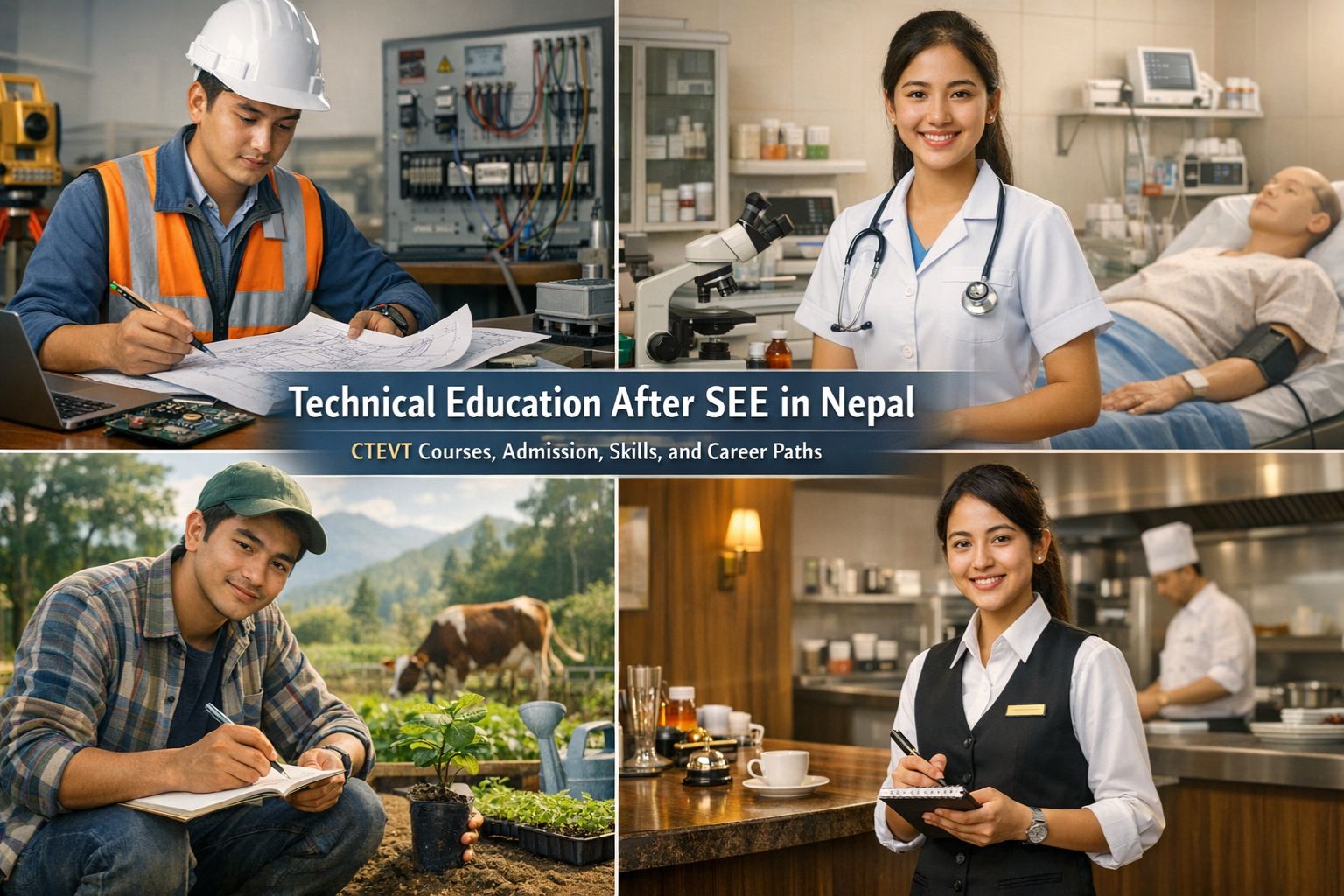
Although there are more than a hundred courses that students can choose according to their interests and nature, the most preferred and secure career-oriented subjects in the Nepali market can broadly be grouped into four categories.
Engineering Group
The engineering stream is directly connected to the country’s physical development. It remains one of the most discussed and in-demand areas among technical students.
-
Diploma in Civil Engineering: This prepares technical overseers for infrastructure development such as houses, bridges, roads, and similar works. It offers the highest number of jobs in both the Public Service Commission and private construction companies. Students interested in this route may also read Diploma in Civil Engineering in Nepal.
-
Diploma in Computer / IT: This provides opportunities to learn information technology and work related to software or hardware.
-
Diploma in Electrical and Mechanical: This is useful for working in and managing heavy industries and machinery systems ranging from hydropower projects to the Nepal Electricity Authority and automobile sectors.
-
Geomatics Engineering: This is for technical work related to land surveying, such as Amin and surveyor roles. There is especially high demand for graduates of this field in government survey offices.
Health Sciences
This stream is comparatively more competitive and strict at entry, but it is considered one of the most reliable career tracks in Nepal. Many subjects under this stream allow graduates to work in health institutions or even operate their own clinics.
-
PCL Nursing / Staff Nurse: Nursing has enormous demand in hospitals, clinics, and international caregiving, and remains a dependable profession for women, and increasingly for men as well.
-
General Medicine (HA): This course produces Health Assistants. It gives legal authority at the local level to serve as the in-charge of health institutions or even operate a medical service and provide patient care.
-
Diploma in Pharmacy: This is for medicine dispensing, production, and obtaining a license to start a medical shop.
-
Lab Technology (CMLT), Radiography, and Ayurveda: These are secure areas for self-employment in laboratory or pathology operations, X-ray and imaging-related work, and service as Ayurvedic technicians.
Agriculture and Forestry
If you are more drawn to agricultural entrepreneurship than to wearing a suit and tie, this stream is highly practical.
-
Diploma in Agriculture (Plant Science and Animal Science): This course enables students to work in modern farming research, agribusiness, or as veterinary technicians and achieve economic progress through advanced farming in Nepal itself. It is also easier to secure government employment as a JT.
-
Diploma in Forestry: This is useful for obtaining jobs as forest rangers in community forests, government parks, and climate conservation research.
Hospitality and Miscellaneous Streams
In Nepal’s economy, where tourism continues to play an important role, this field is becoming brighter day by day.
-
Diploma in Hotel Management (DHM): This helps students gain expertise in restaurant service, front-desk operations, and culinary work in five-star hotels and secure employment either in Nepal or in countries such as Dubai and Australia.
-
Food and Dairy Technology, Social Work: These fields focus on quality inspection in dairy and food factories and development work through NGOs and INGOs.

New Admission Rule: Direct Merit-Based Selection Without an Entrance Exam
Until recent years, students had to take a strict entrance examination to gain admission into technical colleges under CTEVT. These entrance exams created problems in which rural students were disadvantaged and urban coaching centers flourished at great expense.
The biggest recent policy change in CTEVT
According to the current arrangement, effective from academic session 2082, the council has completely abolished the entrance examination system. Under the new Trainee Selection, Scholarship Distribution, and Admission Guidelines, students no longer need to sit for an entrance exam for CTEVT admission.
Now, full selection for admission is based only on the student’s SEE merit, meaning total score or GPA.
Weightage scheme
With the aim of including more students from community schools in technical education, the state has created a policy that gives special weightage in admission merit. For example, some additional weightage points are added to SEE grades, with different recognition applied to government and private school students. Through the online ITMS system, students can easily select colleges and view the merit list online.
Minimum academic requirements for diploma admission
Students must have passed all subjects under the new grading system, meaning no NG result in any subject. Beyond that, minimum GPA requirements vary by field:
-
For health subjects such as Nursing and HA: a minimum average GPA of 2.0, including English, Science, and Mathematics, has been set under the revised regulations.
-
For other subjects such as Engineering and Agriculture: at least an average GPA of 1.6 is required, along with grades in basic subjects such as English, Science, and Mathematics.
Note: Since CTEVT admission notices may be revised slightly depending on the academic session, it is necessary to confirm the latest details from the official notice once admissions open.
Study Costs and Scholarships
Among the general public, there remains a fear that CTEVT courses, especially in health and related fields, require payment of several lakhs and are beyond the reach of poor families. This impression is partly shaped by some expensive colleges, but if government policy is understood properly, anyone may even study free of cost.
Classified Free Scholarships
Keeping in mind the needs of extremely poor students from all 77 districts, Dalit communities, marginalized groups such as Muslims, Madhesis, and Janajatis, persons with disabilities, and the children of martyrs and disappeared persons, the government has reserved specific free-seat quotas in private and public campuses across the country.
The notice for classified free scholarships is published first when admission forms open. Students with high merit scores who submit the form along with the required recommendation from their ward office can receive a guarantee from CTEVT to study the full course without any tuition fee. Every year, around 3,000 to 4,000 students receive such opportunities.
Estimated cost under the full-fee system
If a student does not fall within the scholarship quota, they must study by paying full fees. In government constituent schools, completing diploma-level study in fields such as Agriculture or Engineering may cost only around NPR 50,000 to NPR 150,000. In private affiliated or partnership institutions, for health sciences subjects such as Nursing and HA, the maximum fee ceiling set by the government can reach around NPR 300,000 to NPR 500,000.
What Comes After CTEVT? Does the Path to Higher Education or University Close?
The fear or rumor that “If you study diploma, diploma is the end of your academic life and you cannot do a bachelor’s degree” is very common in our communities, but it is completely false.
There was a time when bachelor’s programs were aligned mainly with Plus Two. That is no longer the case. Students who have completed a technical certificate, meaning a 3-year diploma, have already been granted full legal equivalency to +2 by Tribhuvan University, Pokhara University, Kathmandu University, Purbanchal University, and others.
For example:
-
A sub-engineer or overseer who has completed a Diploma in Civil Engineering and obtained a license can sit for the entrance exam under the Institute of Engineering (IOE) of Tribhuvan University and enroll in a B.E. in Civil Engineering. Some colleges abroad even offer credit transfer arrangements under which only 2 more years of bachelor’s study may be required.
-
Students who completed Staff Nursing or HA can pursue Post-Basic Bachelor’s study or directly continue into BSc Nursing and BPH, and can go as far as postgraduate study or even a PhD.
Therefore, your academic track does not stop anywhere. Rather, since these students possess practical hands-on skills in addition to theoretical knowledge, universities at the bachelor’s level often place even greater trust in them.
For comparison with the academic route, students may also explore the National Examinations Board (NEB), which oversees Grades 11 and 12 in Nepal.
Conclusion
Whether to stand on the ground and look upward, or to begin by building a dream; whether to spend two years in Grades 11 and 12 with general subjects, or to turn today itself toward the path of self-reliance through technical and skill-based education—this decision should ultimately be made according to your family’s condition and your own personal nature.
For those who have the practical energy to spend hours in a laboratory, with instruments, equipment, or patients, and for those who are eager to acquire a skill that remains employable in Nepal or abroad, CTEVT can prove to be an ideal gateway to employment. Since only SEE merit and weighted score are now required, students are also free from the haunting pressure once created by entrance exams. What is needed now is a good plan, a proper application process, and the determination to connect with the right option and institution.







Comments 0
No comments yet. Be the first to start the conversation.