




Table of Content
- Is It Worth Studying +2 (Classes 11 and 12) Science in Nepal?
- How “Science” Is Defined Under the New Curriculum
- Why Study +2 Science?
- The Realities and Key Challenges
- How Much Does It Cost?
- Myths, Social Pressure, and Misconceptions
- How Should This Decision Be Made? Who Is Science Really For?
- Alternative Pathways: Is Science the Only Technical Route?
- Conclusion
Is It Worth Studying +2 (Classes 11 and 12) Science in Nepal?
As the publication of Nepal’s Secondary Education Examination (SEE) results approaches, or after the results are already out, one serious question begins to weigh on the minds of students and parents alike: what should come next?
In Nepali society, a deep-rooted belief still persists: students who achieve a high GPA in SEE, or pass in the “first division,” should study Science. Those with average marks should choose Management, while weaker students should go into Humanities or Education.
But in the context of the fast-changing job market, education system, and youth psychology of the 21st century, is that social mindset still realistic today? Is Science really everything? Does paying a high fee to study +2 Science guarantee a golden future? Or is that just an illusion?
This article presents a factual and neutral analysis of the new structure of Science under the National Examination Board (NEB), its strengths and weaknesses, financial burden, and the opportunities it opens at home and abroad. It is intended to help students make the right decision based not on social pressure, but on their own interests, abilities, and realities. Students at this stage often begin by choosing the right subject after SEE in Nepal.
How “Science” Is Defined Under the New Curriculum
Until a few years ago, the faculty system was in place in Classes 11 and 12. Science, Management, Humanities, and other streams were clearly separated. But under the new curriculum framework recently implemented by the National Examination Board (NEB), the term “faculty” has effectively been removed.
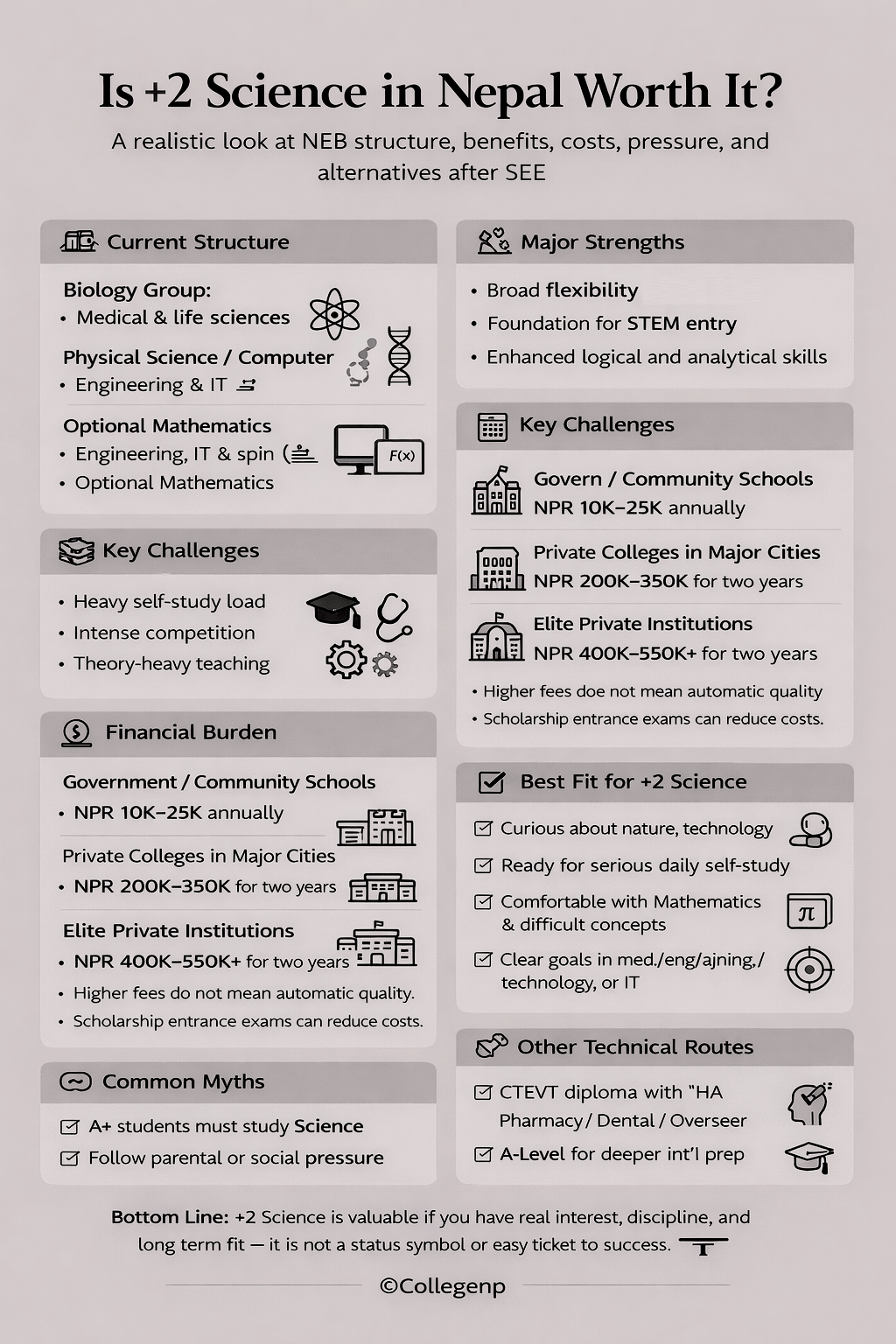
Under the new structure, students choose subjects from compulsory and optional subject groups. Students who want to remain on the Science track generally keep Physics and Chemistry as their core subjects. Along with these, they select one of two main sub-streams depending on their future goals.
Biology Group
This group includes Biology along with Physics and Chemistry. It is essential for students who want to enter fields such as MBBS, BDS, Nursing, Agriculture, and other health or life science areas.
Under the new system, students who choose Biology can also take optional Mathematics, which keeps both medical and engineering options open.
Physical Science / Computer Group
This group replaces Biology with Computer Science and includes higher Mathematics. Students who want to move into software, IT, mechanical engineering, civil engineering, and related fields generally choose this path, especially those exploring engineering courses after 12th in Nepal.
Why Study +2 Science?
If a student has genuine inner motivation and the willingness to work hard, the benefits of studying Science can be immense. Science is often regarded as the “master key” of academic pathways. Some of its major advantages are listed below.
a) Broad Career Flexibility
A student who studies Science in +2 has broad freedom to shift streams later. After completing +2 Science, the student can move into bachelor-level study in Management, such as BBA, BBS, or CA, in Humanities, such as BA or Social Work, or even into Law, such as BALLB.
By contrast, students who study Management or Humanities in +2 usually cannot later move into Medicine, Engineering, or core Science programs such as BSc Physics.
b) Foundation for Highly Respected Professions
The path toward professions that remain in high demand and command strong respect in Nepal and abroad, such as doctor, engineer, scientist, data scientist, researcher, and biotechnologist, begins with Science education in Classes 11 and 12.
c) Global Demand for STEM Education
Today’s world is built on STEM: Science, Technology, Engineering, and Mathematics. Countries such as the United States, Canada, Australia, and many European nations often give higher priority to STEM students in scholarship and migration pathways.
Students from a Science background may also find it comparatively easier to compete for strong research-oriented scholarships in foreign universities.
d) Development of Logical and Analytical Skills
Science and Mathematics train the mind to ask questions, identify causes, and solve problems. These critical and analytical thinking skills are valuable not only in professional life, but also in everyday decision-making.
The Realities and Key Challenges
Although Science sounds attractive, the journey through +2 Science is certainly not as glamorous as many imagine. For many students, it becomes stressful and even counterproductive. Students need to understand the following difficult realities before making a decision.
a) A Vast and Demanding Syllabus
The gap between SEE Science in Grade 10 and Science in Grade 11 is enormous. Compared with the general Science studied in Grade 10, the depth of Physics and Chemistry in Grade 11 is much greater.
Many Nepali students describe this as “syllabus shock.” Without regular self-study of 6 to 8 hours a day, many students begin falling behind within a few months.
b) Mental Pressure and Grade Decline
Many students who scored a 4.0 GPA in SEE are later found struggling even to pass in Grade 11. The self-doubt that comes with thinking, “How did this happen to me when I used to top my school?” can lead to severe discouragement.
On top of this, entrance exams in Nepal for Medicine and Engineering remain extremely competitive, with tens of thousands of students fighting for limited seats. That reality adds even more pressure.
c) Rote Learning Over Practical Learning
Science is supposed to be learned through practical work, but Nepal’s reality is often different. Aside from a limited number of well-equipped institutions, many school and college science labs are not adequately resourced.
Nepal’s education system still remains largely theoretical, exam-centered, and dependent on rote learning. While the world has moved rapidly forward in science and technology, our curriculum has only recently begun trying to update itself, and that process is still incomplete.
How Much Does It Cost?
The financial side of studying Science in Nepal raises serious questions. In general, Science is more expensive than Management or Humanities because it requires laboratory facilities, materials, and technical support.
Government and Community Schools
If a student studies Science in a strong community school, often called a model school, the monthly fee can be very low or nominal. Annual costs may remain within NPR 10,000 to NPR 25,000.
Private Colleges in Major Cities
In good private colleges in Kathmandu Valley and other major cities, the total cost of the two-year course can range from around NPR 200,000 to NPR 350,000.
Elite Private Institutions
In some heavily branded and highly reputed colleges in Kathmandu, the total cost for Grades 11 and 12 may reach NPR 400,000 to NPR 550,000 or even more.
One point must be clearly understood: expensive fees do not guarantee better quality. The one who studies is the student. Many colleges also offer substantial fee waivers through scholarship entrance exams, and competing for those scholarships is often the best option.
Myths, Social Pressure, and Misconceptions
Several harmful misconceptions still shape student decisions in Nepal. Without examining them honestly, it is difficult to arrive at the right conclusion.
Myth 1: “If you get an A+ GPA, you must study Science.”
In reality, SEE results alone do not reveal a student’s true aptitude. A student may earn a 4.0 GPA through memorization and exam preparation, but still have no real interest in calculus, chemical bonding, or biological analysis.
In such cases, choosing Science may become a burden rather than an opportunity. Many successful people with top grades have gone on to study Law, Economics, Commerce, and other fields instead.
Myth 2: “Management and Humanities are only for weak students.”
Bankers, successful corporate CEOs, government secretaries, policymakers, chartered accountants, and respected lawyers often come from Management and Humanities backgrounds.
It is a narrow way of thinking to believe that only careers like doctor or engineer are worthwhile. These fields can also offer bright and successful futures, provided the student develops strong skills and real competence.
How Should This Decision Be Made? Who Is Science Really For?
After looking at all sides, students and parents must arrive at an honest conclusion.
Who should choose +2 Science?
-
Students who have deep curiosity about nature, chemical reactions, how gadgets work, and the human body.
-
Students who can sit down and study seriously for 5 to 6 hours a day on their own.
-
Students who are not afraid of Mathematics and actually enjoy solving difficult problems.
-
Students whose long-term goals clearly lie in medicine, engineering, technology, or research.
Who should not choose +2 Science?
-
Students choosing Science only because their friends are doing the same.
-
Students doing it to escape parental pressure such as, “You are talented, so you must become a doctor.”
-
Students whose only goal is the assumption that Science may make foreign study or visa processing easier, despite having no real interest in the subject.
-
Students who already feel mentally exhausted by rote learning and difficult subjects.
Alternative Pathways: Is Science the Only Technical Route?
Many Nepali students treat +2 Science as the only technical pathway, but that is not true. Students who want practical skills and earlier access to employment can pursue three-year technical diploma programs under CTEVT, including Overseer, HA, Pharmacy, Agriculture, and Dental programs.
These skill-based courses often help students become employable or enter public service by the age of 19 or 20.
Likewise, students who want deeper analytical preparation and aim for international universities sometimes choose programs such as British A-Levels in the Science stream, although this remains a limited and expensive option in Nepal.
Conclusion
Ultimately, the answer to the question “Is +2 Science in Nepal worth it?” depends entirely on who you are and what you want.
Science is not a magic wand that guarantees success the moment you touch it. It is a powerful tool. If you have the passion to use it, the discipline to work hard, and the mental readiness to handle its demands, then it can indeed become one of the strongest and safest pathways to wide-ranging opportunities in Nepal and beyond.
But if you choose Science only because of social prestige, parental pressure, or fear of being judged, while suppressing your own interests and natural strengths, then this academic journey may become one of the most painful experiences of your life.
There are already many examples around us of students leaving their studies incomplete, becoming discouraged, and losing two valuable years because they followed the wrong path.
Before making your choice, prioritize campus visits, honest self-evaluation, and conversations with seniors who have already gone through the process. Let long-term clarity about your future matter more than the pride of a GPA. Success is shaped not only by which path you choose, but by how you walk it.







Comments 0
No comments yet. Be the first to start the conversation.