



Table of Content
- After SEE: Essential Life Skills Students Must Learn and the Right Roadmap
- Why Is the Free Time After SEE So Important?
- The Conflict Between Interest, Ability, and Subject Choice
- Important Skills Students Must Learn After SEE
- The World Beyond Books: A Chance to Learn Life
- Bridge Course: Commercial Illusion and Reality
- How to Choose the Right College
- SEE Results, Expectations, and the Psychological Dimension
- The Role of Parents at This Stage
- Conclusion
After SEE: Essential Life Skills Students Must Learn and the Right Roadmap
The free time after the Secondary Education Examination (SEE) is an extremely important phase in the lives of students and, in many ways, a highly sensitive period. For years, students remain bound within a fixed school structure, syllabus, and daily routine. As soon as SEE ends, they suddenly arrive at a much wider space of freedom.
In Nepal, this period is often seen only as a time to rest, play, and have fun. But from the perspective of psychology, education, and career development, this period of 3 to 4 months is one of the most golden opportunities to lay the foundation for the future.
Although the Government of Nepal has gradually integrated the Class 10 SEE examination into the broader “school level” by linking it with Classes 11 and 12, the technical and academic reality is still different. There is a significant curriculum gap between Class 10 and Class 11. The scope of study, depth of content, and the theories students are expected to understand increase sharply, so students should make full use of this free period to prepare themselves mentally.
This is not merely the time to get trapped in the commercial web of educational institutions in the name of a bridge course. It is the time to understand your own abilities, identify your interests, and learn the soft and hard skills needed for higher education.
This article presents an in-depth and fact-based analysis of the skills students must learn after SEE, how to choose a college and subject, and what role parents should play during this important stage. For broader guidance, students may also explore what to do after SEE.
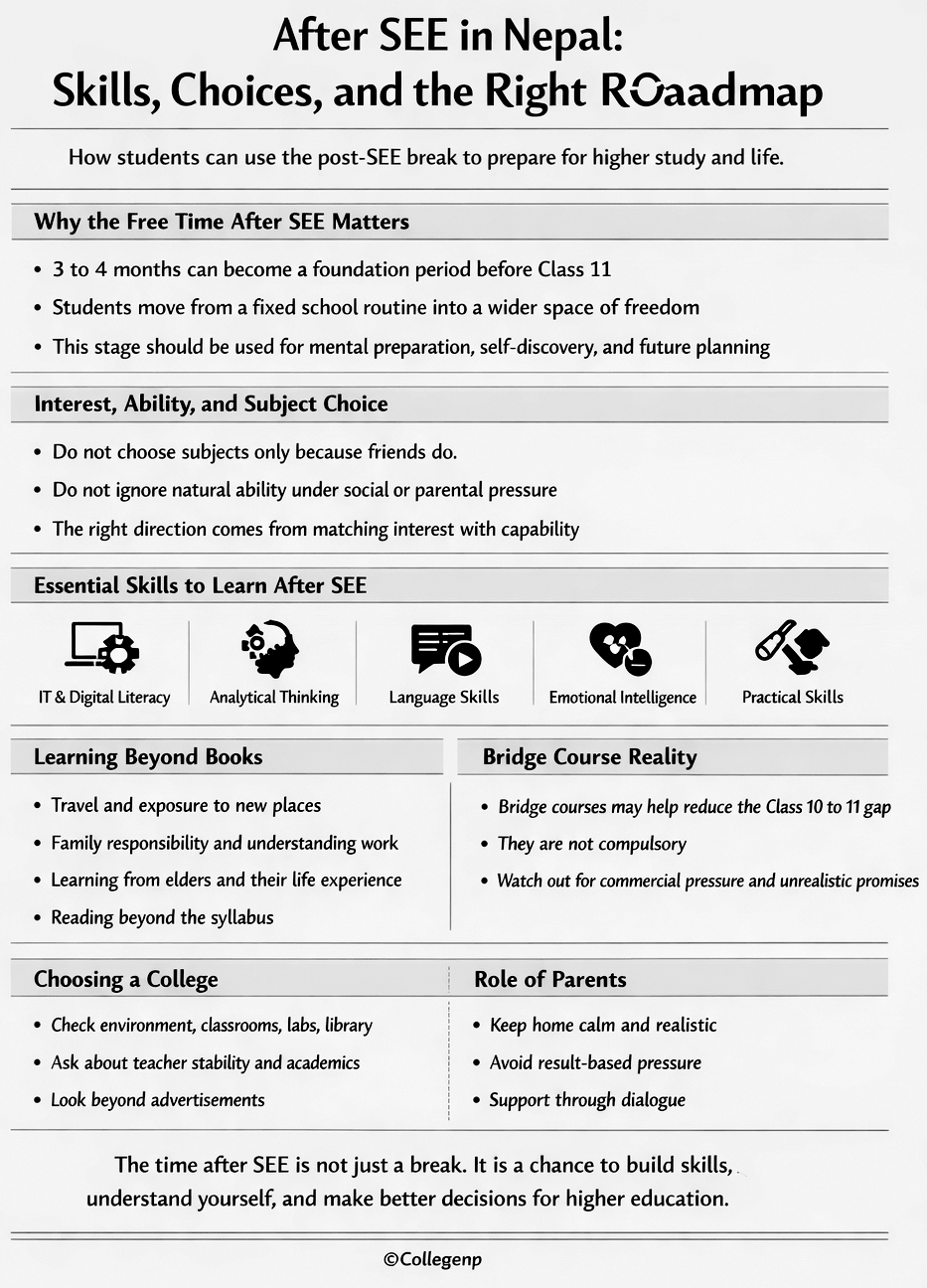
Why Is the Free Time After SEE So Important?
By the time students reach the age of taking SEE, they are usually in the middle of adolescence, around 15 to 16 years old. Along with physical and mental changes, they are also developing a new way of looking at the world. Psychology considers this phase a period of self-discovery.
Before stepping into higher studies, this is a time to build a foundation. Just as a strong base is dug and allowed to settle before constructing a tall building, this period serves the same purpose before moving from basic school education into higher secondary education in Classes 11 and 12.
An investment made at the right time creates a strong base for better academic performance later in higher education. During this period, students should guide themselves not only toward college studies but also toward becoming capable, logical, and self-reliant citizens.
The Conflict Between Interest, Ability, and Subject Choice
The first and most essential requirement of this free time is to identify one’s own interests and abilities. After SEE, the question of which subject to study and what field to build a future in troubles many students.
At this stage, students commonly make two major mistakes. The first is choosing a subject under peer pressure. The second is ignoring their own abilities and choosing subjects that society labels as “good” or that parents force on them.
Students need to use this time to sharpen themselves in understanding their area of interest and choosing the right subject for further study. If a student has the ability or intelligence to study a subject but has no inner passion for it, it becomes difficult to stay with it for the long term and achieve excellent results.
On the other hand, if a student is deeply interested in a subject but does not have the capability to understand its foundations, that too may later lead to disappointment and stress.
Therefore, just because friends are going to study science does not mean you should force yourself into it if you are not genuinely interested in mathematics and science. Do not choose a subject in Classes 11 and 12 simply because of peer influence, someone else’s advice, or pressure from others.
It is most practical and useful to build your future around the subject that truly gives you joy. No matter what subject you study, those who excel in their own field always enjoy high demand and respect.
Students who are confused at this stage may benefit from reading about how to choose a career when you have many interests and reflecting seriously on their own strengths.
Important Skills Students Must Learn After SEE
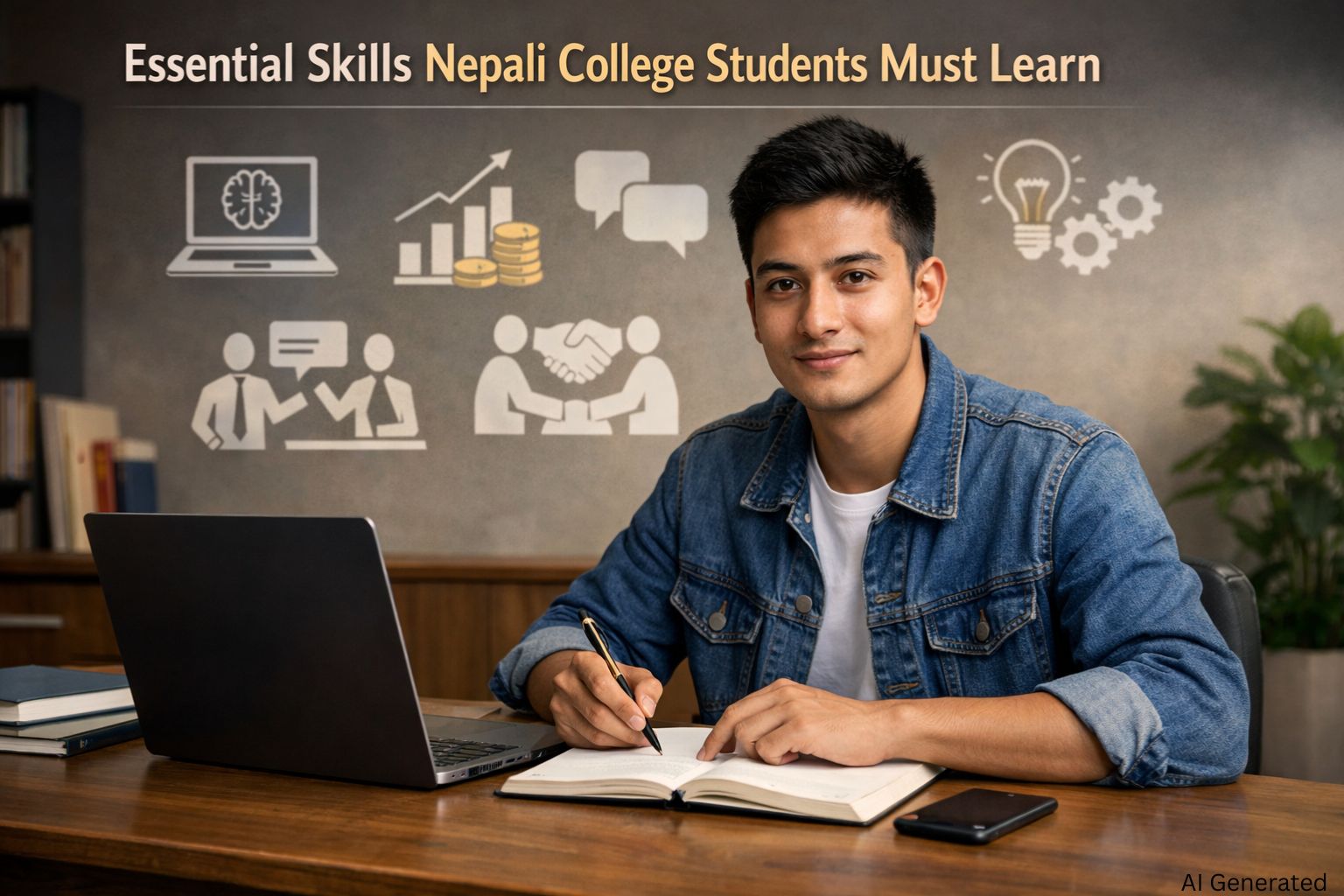
At levels above SEE, especially in Class 11 and beyond, the old habit of memorizing textbooks alone is no longer enough. Extra skills become absolutely necessary. To make college education more refined and effective, students should learn the following during this free period.
1. Information Technology (IT) and Digital Literacy
This is the age of information and technology. No matter which field a student enters, whether medicine, engineering, arts, literature, or business, technical skills have become essential. After SEE, students should go beyond basic computer education and start learning some advanced but necessary skills.
For example, how can reliable facts be searched on the internet? Which features in MS Office tools such as Word, Excel, and PowerPoint make data presentation more effective? Students who are interested in technology will benefit greatly from taking short-term training in web design, the basics of coding languages such as HTML and Python, graphic design, or video editing.
Those focusing on this area may also find it useful to read about essential computer skills every student should learn.
2. Analytical and Critical Thinking
School education in Nepal is still largely teacher-centered and based on the method of writing exactly what is in the book. But college and university education are different. There, students must analyze things by asking why and how.
That is why critical thinking must be developed. Rather than instantly believing whatever someone says, students should strengthen their ability to logically examine whether information is correct or not. To build this capacity, they should read plenty of fact-based books, philosophy, world history, science articles, and ideas published in established newspapers and magazines.
3. Language Proficiency and Communication Skills
Especially for many students educated in Nepal, communication skills are often understood only as the ability to speak. But communication also includes the ability to write well, present clearly, and argue logically.
Students who feel weak in English should invest this time in improving their English language skills. In today’s global era, English has become almost essential for higher education and career development. Since science and many other subjects are generally studied in English from the higher secondary level onward, a strong command of the language greatly boosts student confidence.
At the same time, it is equally important to improve one’s writing style and vocabulary in the mother tongue or in Nepali.
4. Emotional Intelligence (EQ)
In today’s competitive world, academic performance or IQ alone does not make a person successful. Students also need emotional intelligence.
This includes the ability to understand one’s own emotions and the emotions of others, manage stress, work in a team, and rise again with mental strength even after failure. To develop this kind of intelligence, students should practice meditation, read inspiring books, and train themselves to look at life from different perspectives.
5. Practical and Vocational Skills
Students never regret learning short-term vocational or technical skills that match their interests and the economic and family realities of their home. Those interested in technology can learn computer hardware, mobile and laptop repair, plumbing, and wiring.
Likewise, this is an excellent time to learn cooking, sewing and knitting, beautician training, gift item making, driving, or swimming. These are skills that can be useful both for daily life and for earning opportunities. Such skills can also help students become self-reliant in the future by doing part-time work and covering their own college expenses.
The World Beyond Books: A Chance to Learn Life
Not everything is learned only in training centers. The period before the new college race begins is also a valuable opportunity to learn from real-life experience.
Travel and Exposure
As far as possible, students should travel with family members or trusted friends and visit new places. Seeing Nepal’s geographical and social realities directly helps broaden the range of awareness.
Family Responsibility
Students should participate in and support the occupation or business their family is involved in, whether farming or trade. This helps them understand the value of money and awakens a sense of responsibility toward life.
Learning from Elders
They should spend time with grandparents and other elderly people in the family, listen to the stories of struggle from older generations, and absorb their experience. No Google search or textbook can provide this kind of knowledge.
Reading Beyond the Syllabus
Students should make it a daily habit to read thoughtful essays, autobiographies of successful people, and literary works by going beyond conventional reading patterns.
Bridge Course: Commercial Illusion and Reality
As soon as the final bell of the SEE examination rings, a major trend of bridge courses begins in Nepal’s urban areas. Mushrooming educational consultancies and institutes try to attract students in the name of flashy advertisements, free tests, and fake scholarships.
It is no hidden reality in Nepal that some institutions even buy students’ phone numbers by making arrangements with principals and teachers from community and institutional schools. Right after the examination ends, parents and students are often tempted by telephone calls asking them to join a bridge course at a particular institute.
To some extent, bridge courses can be useful in reducing the course gap between Class 10 and Class 11 and in helping students understand the concept of entrance preparation for higher studies abroad. But they should not be treated as compulsory. Some institutes use bridge courses to sell oversized dreams about science and management, and students who have just stepped out of school life may begin trusting such tuition centers more than their own parents after only two months of coaching. Students and parents must stay alert to avoid this situation.
Even if the family’s financial condition is weak, it is not wise to force parents into debt just because friends are going to cities or large institutes for bridge courses. Today, new courses can be prepared for at home through the internet, YouTube, and educational websites, often free of cost. Rather than coming to the city and falling into unnecessary competition and confusion, it is far more beneficial to stay in the village and use technology to improve English or learn something creative.
How to Choose the Right College

Another important task during this free period is to search for a suitable and quality college. Students should use this time very carefully to identify the right institution for higher studies. This requires more than simply looking at advertisements or posters. Students should make time to visit colleges in person and understand them directly.
The main points to consider while choosing a college are:
-
What are the study environment, classrooms, labs, and library like?
-
How experienced and stable are the teachers and professors? Some colleges hang the names of famous or reputed professors on their boards for a few months as “guest” or display faces just to attract students. Two or three months after admission, those big names disappear, and the students suffer the consequences. It is essential to ask senior students whether such a trend exists in that college.
-
Why is that college known for the subject you want to study? It is very important to gather information not only about management and administration, but also about past results and the present status of former students.
-
Does the college focus on practical and life-oriented learning, or does it only concentrate on marks? Students should spend serious time understanding this issue before deciding.
SEE Results, Expectations, and the Psychological Dimension
Students themselves can often estimate how their result may turn out as soon as the exam is over. Therefore, they should not remain anxious until the result is published or sit with unrealistic expectations. If the result does not come as expected, sudden extreme disappointment or frustration may arise in a young mind.
That is why students should prepare themselves mentally in advance to accept whatever result comes. A weak result is never a failure in life. It is only an indication that more effort is needed.
Rather than choosing a so-called difficult and prestigious subject such as science in Class 11, struggling under heavy pressure, and facing mental stress or even failure, it is a thousand times wiser to choose another subject that feels manageable and genuinely interesting and then perform excellently in life. Students who are uncertain about the science stream may reflect on whether to study science after SEE in Nepal.
The Role of Parents at This Stage
At this stage, the role of parents becomes the most important of all.
These days, one very dangerous trend has started among some parents: offering rewards based on results. Statements such as “If you get an A+ GPA, I’ll buy you a scooter,” “I’ll give you a smartphone,” “I’ll buy you a laptop,” or “I’ll buy you an expensive bike” may appear to give temporary motivation, but they can actually push children toward greed, narrow thinking, and potentially severe disappointment.
Such conditions and dreams built on impossible or unnatural expectations are counterproductive. If the expected GPA does not come, adolescents may fall into serious depression or move toward harmful decisions.
To help manage the uncertainty, fear, and tension before the results are published, parents should keep the home environment calm, supportive, and realistic. They should encourage their children only after analyzing the family’s financial condition, market needs, and the child’s own natural abilities and interests.
On the other hand, because peer influence is very powerful during adolescence, parents should closely observe their children’s friendships and activities. However, this attention should not become harsh or fear-based control. Instead of scolding, comparing them with neighbors’ children, or humiliating them, parents should help them distinguish between the right and wrong path through positive and meaningful dialogue.
Conclusion
The free time after SEE is certainly not meant for lazily hanging around on social media or blindly running here and there by copying others. It is a rare opportunity to refresh yourself, become skilled by learning new practical and technical abilities, identify your weaknesses, test your potential, and draw your future roadmap.
Rather than regretting later after time has already passed, it is far better to move forward with awareness from the beginning. Instead of following trends, sponsored advertisements, or pressure, invest in learning skills based on a realistic understanding of both your own needs and market demand.
At the same time, this valuable period should be used well to reach a serious but stress-free conclusion about what subject to study in higher secondary education, how to study, where to study, and why.







Comments 0
No comments yet. Be the first to start the conversation.