



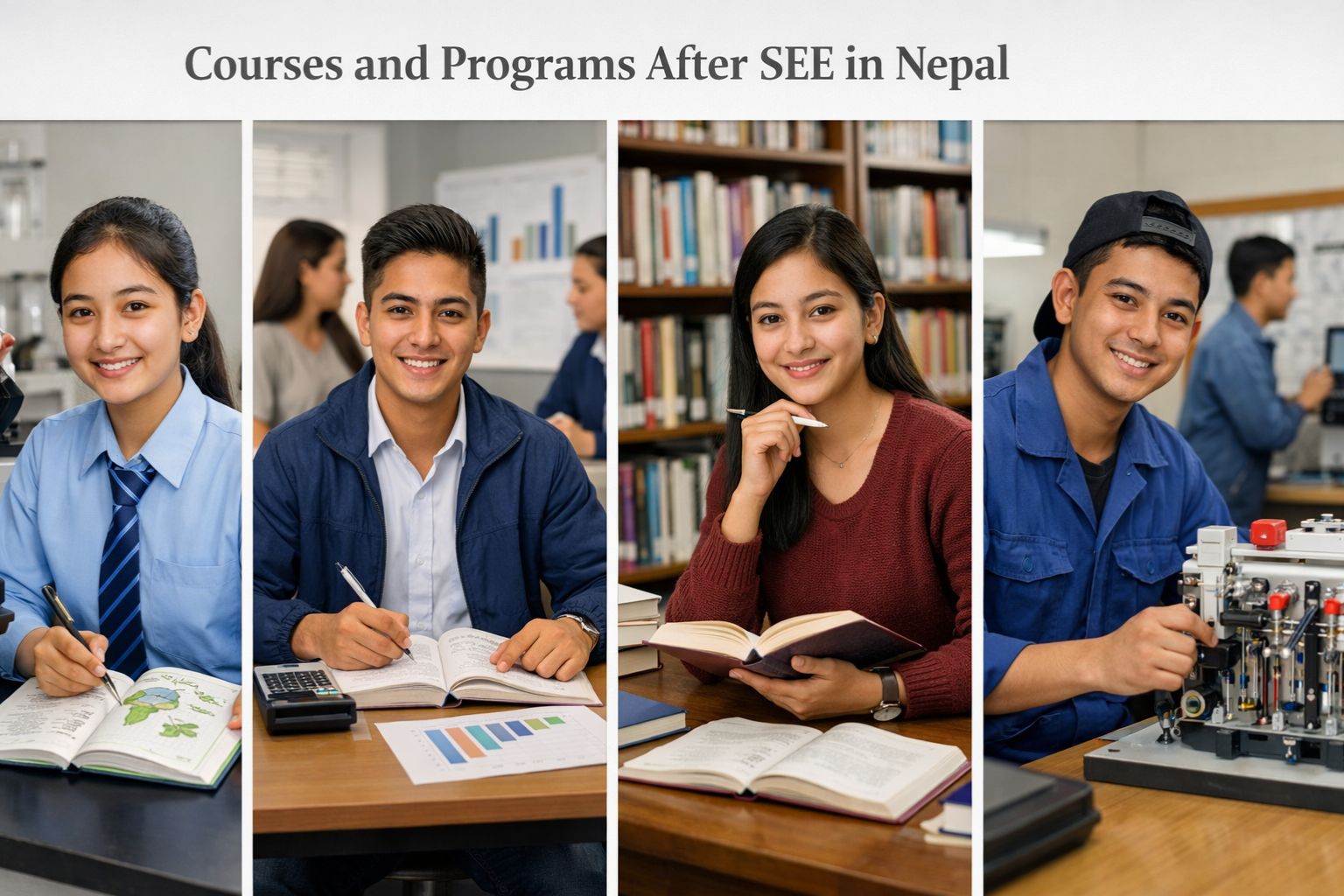
Courses and Programs to Study After SEE in Nepal
The Secondary Education Examination (SEE), formerly known as the School Leaving Certificate (SLC), is one of the most important academic milestones in Nepal. It marks the transition from school education to higher secondary, technical, or vocational study.
After SEE, students must choose a stream or program that matches their interests, academic strengths, and long-term career goals. This decision matters because it influences future study options and, in many cases, the direction of a student’s professional life.
Some students may aim for medicine, engineering, business, law, teaching, or the social sciences. Others may prefer practical, skill-based education that leads more directly to employment. Nepal offers both academic and technical pathways after SEE, giving students several options to consider carefully.
Main Study Options After SEE
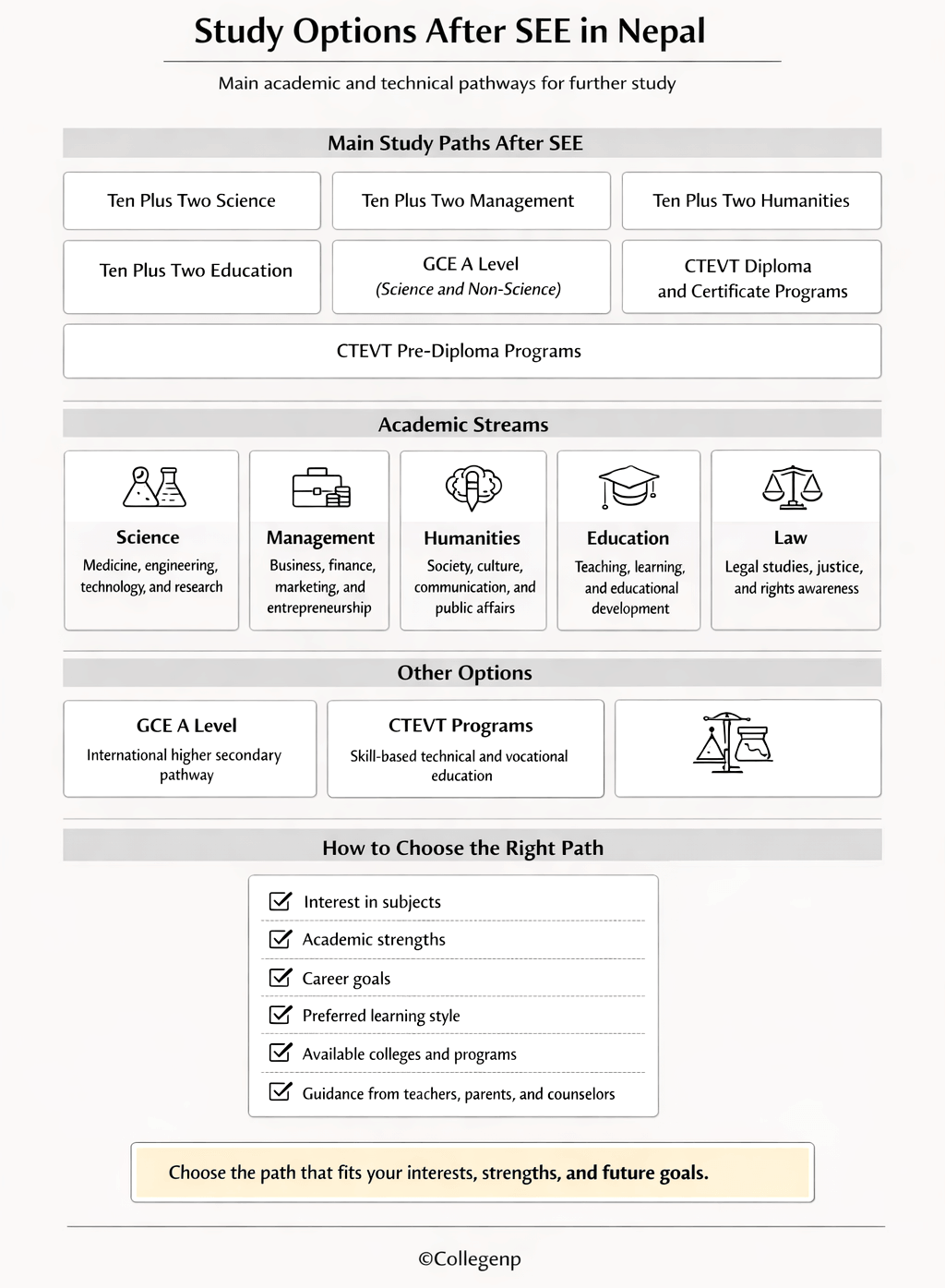
Students in Nepal can choose from the following major pathways after SEE:
-
Ten Plus Two Science
-
Ten Plus Two Management
-
Ten Plus Two Humanities
-
Ten Plus Two Education
-
Ten Plus Two Law
-
GCE A Level (Science and Non-Science)
-
CTEVT Diploma and Certificate Programs
-
CTEVT Pre-Diploma Programs
Each option has a different academic focus, subject combination, and career scope.
How to Choose the Right Course After SEE
Before selecting a stream or program, students should evaluate a few key factors:
-
personal interest in subjects
-
academic performance and strengths
-
long-term career plans
-
preferred learning style, whether theoretical or practical
-
availability of colleges and programs
-
guidance from teachers, parents, and career counselors
A well-informed choice can make later study more focused and meaningful.
Ten Plus Two Science
Ten Plus Two Science, affiliated with the National Examinations Board (NEB), is a two-year program designed for students who want a strong foundation in scientific and technical fields.
What Students Study
The Science stream generally includes subjects such as:
-
Physics
-
Chemistry
-
Biology
-
Mathematics
-
Computer Science as an optional subject in some cases
The curriculum combines theory and practical work, helping students build analytical, problem-solving, and laboratory skills.
Career and Study Scope
Students from the Science stream may go on to higher education in areas such as:
-
MBBS, BDS, Nursing, Pharmacy, and other health sciences
-
Civil, Mechanical, Electrical, Computer, and other engineering fields
-
Physics, Chemistry, Biology, Environmental Science, and Biotechnology
-
Information Technology, Computer Science, and Electronics
-
Scientific research and related disciplines
Who This Stream Suits
Science is generally suitable for students who are interested in mathematics, laboratory subjects, medicine, engineering, technology, or research-based careers.
Ten Plus Two Management
Ten Plus Two Management, also affiliated with NEB, is a two-year program for students interested in business, commerce, finance, entrepreneurship, and administration.
What Students Study
Common subjects in the Management stream include:
-
Accounting
-
Economics
-
Business Studies
-
Marketing
-
Hotel Management as an optional area in some institutions
This stream focuses on business principles, financial understanding, and organizational concepts.
Career and Study Scope
After completing Management, students can continue in areas such as:
-
BBA, BBS, and related business degrees
-
Banking, finance, auditing, and accounting
-
Marketing, sales, and advertising
-
Entrepreneurship and business operations
-
Hospitality, tourism, and event management
Who This Stream Suits
Management is a practical choice for students who are interested in commerce, business leadership, finance, or the private sector.
Ten Plus Two Humanities
Ten Plus Two Humanities offers students a broader understanding of society, culture, language, and human behavior. It is also affiliated with NEB and runs for two years.
What Students Study
This stream commonly includes subjects such as:
-
Literature
-
History
-
Geography
-
Sociology
-
Psychology
The Humanities stream encourages critical thinking, interpretation, and social understanding.
Career and Study Scope
Students from Humanities may pursue higher education and careers in:
-
Sociology, Anthropology, Political Science, and Psychology
-
Literature, History, Philosophy, and Cultural Studies
-
Journalism, mass communication, and public relations
-
Teaching and educational administration
-
Public service and government-related sectors
Who This Stream Suits
Humanities is well suited to students interested in society, communication, culture, literature, and public affairs.
Ten Plus Two Education
Ten Plus Two Education is intended for students who want to build a foundation in teaching, learning, and educational systems.
What Students Study
Typical subject areas include:
-
Educational Psychology
-
Curriculum Development
-
Teaching Methodology
-
Sociology of Education
-
Educational Technology
This stream introduces students to classroom practice, child development, and the wider role of education in society.
Career and Study Scope
Students may move into further study and work related to:
-
teaching and school education
-
educational administration
-
curriculum planning
-
educational research
-
training and development
-
special education
Who This Stream Suits
Education is a suitable option for students who are interested in teaching, academic leadership, and educational development.
Ten Plus Two Law
Ten Plus Two Law introduces students to the basic ideas, systems, and branches of legal study.
What Students Study
Common areas of study include:
-
Legal Theory
-
Constitutional Law
-
Criminal Law
-
Civil Law
-
Human Rights
The stream helps students develop legal awareness, reasoning skills, and an understanding of rights and justice.
Career and Study Scope
After completing this stream, students may continue in fields such as:
-
Bachelor of Laws (LLB) and other legal studies
-
legal support roles
-
judiciary-related preparation
-
corporate legal and compliance work
-
human rights and advocacy sectors
Who This Stream Suits
Law is a strong option for students interested in justice, legal systems, public policy, and analytical thinking.
GCE A Level
GCE AS and A Level is a globally recognized secondary-level qualification and is considered equivalent to Ten Plus Two in Nepal.
Structure and Duration
The program usually spans two years and is divided into:
-
AS Level
-
A or A2 Level
Students may choose Science or Non-Science subject combinations.
Science and Non-Science Options
The Science group generally includes subjects such as:
-
Physics
-
Chemistry
-
Mathematics
-
Biology
The Non-Science group may include subjects such as:
-
Accounting
-
Business
-
Economics
-
Sociology
-
Psychology
Career and Study Scope
Students completing A Level can apply for higher education in areas such as:
-
medicine
-
engineering
-
management
-
information technology
-
pure sciences
-
social sciences
This pathway is often chosen by students seeking broader international recognition of their qualification.
CTEVT Programs After SEE
The Council for Technical Education and Vocational Training (CTEVT) offers technical and skill-based education for students who want career-focused learning after SEE.
These programs are designed to provide practical knowledge and hands-on skills. They can lead directly to employment or serve as a foundation for further study in related fields.
CTEVT Diploma and Certificate Programs

CTEVT diploma and certificate programs generally run for three years. These programs are available across health, engineering, agriculture, hospitality, forestry, and information technology.
Major Diploma and Certificate Programs
Programs mentioned in this category include:
-
PCL Nursing
-
Diploma in Pharmacy
-
Certificate in Diagnostic Radiography
-
Certificate in Medical Laboratory Technology (CMLT)
-
Diploma in Agriculture (Plant Science)
-
Diploma in Architecture Engineering
-
Diploma in Agriculture (Veterinary Science)
-
Diploma in Automobile Engineering
-
Diploma in Civil Engineering
-
Diploma in Computer Engineering
-
Diploma in Computer Hardware/Network Engineering
-
Diploma in Electrical Engineering
-
Diploma in Electronics Engineering
-
Diploma in Food/Dairy Technology
-
Diploma in Forestry
-
Diploma in Hotel Management
-
Diploma in Information Technology
General Learning Focus
These programs are more practical and profession-oriented than conventional academic streams. They typically combine classroom instruction, technical skills, workshop practice, fieldwork, or institutional training depending on the subject area.
Career Scope
Graduates may find opportunities in:
-
hospitals, clinics, and diagnostic centers
-
engineering and construction sectors
-
agriculture and livestock services
-
forestry and environmental work
-
hotels, hospitality, and tourism
-
IT support, networking, and software-related roles
-
technical assistant and mid-level professional positions
For students who prefer applied learning and early career entry, CTEVT diploma programs can be a strong alternative to general higher secondary study.
CTEVT Pre-Diploma Programs
CTEVT also offers Pre-Diploma programs, which are generally 18 months in duration. These are designed to provide foundational technical skills and prepare students for entry-level work or further study.
Major Pre-Diploma Programs
Programs listed in this category include:
-
Pre-Diploma in Agriculture (Plant Science)
-
Pre-Diploma in Livestock Production / Animal Health
-
Pre-Diploma in Veterinary Science
-
Pre-Diploma in Civil Engineering
-
Pre-Diploma in Electrical Engineering
-
Pre-Diploma in Electronics Engineering
-
Pre-Diploma in Mechanical Engineering
-
Pre-Diploma in Auto Mechanics
-
Pre-Diploma in Water Supply and Sanitary Engineering
-
Pre-Diploma in Survey Engineering
-
Pre-Diploma in Computer Engineering
-
Pre-Diploma in Refraction and Dispensing Optician
-
Pre-Diploma in Hotel Management
-
Pre-Diploma in Culinary Arts
-
Pre-Diploma in Medical Lab Technology
-
Pre-Diploma in Radiography
-
Pre-Diploma in Ayurvedic Health Worker
-
Pre-Diploma in Agriculture (Animal Science)
-
Pre-Diploma in Computer Application and Secretarial Management
-
Pre-Diploma in Forestry
General Learning Focus
Pre-Diploma programs focus on basic technical training and job-ready skills. They are suitable for students who want shorter study duration, hands-on education, and a practical route into the workforce.
Career Scope
Depending on the discipline, graduates may work in entry-level roles in:
-
agriculture and animal care
-
civil and technical support
-
electrical and mechanical services
-
hospitality and food service
-
health support services
-
office and administrative work
-
computer and technical maintenance
These programs can also serve as a stepping stone to diploma-level education.
Academic vs Technical Pathways After SEE
After SEE, students broadly choose between two types of pathways:
Academic Pathways
These include:
-
Science
-
Management
-
Humanities
-
Education
-
Law
-
A Level
These streams are generally suited for students who plan to continue into bachelor’s and advanced academic study.
Technical and Vocational Pathways
These include:
-
CTEVT Diploma Programs
-
CTEVT Certificate Programs
-
CTEVT Pre-Diploma Programs
These are suitable for students who want practical training, industry-relevant skills, and earlier employment opportunities.
Final Thoughts
Choosing the right course after SEE is an important decision, but it should be based on fit rather than pressure. A student’s interests, aptitude, and future goals should guide the choice.
Science may suit students aiming for medical or engineering fields. Management can be a strong path for business and finance. Humanities, Education, and Law each offer distinct academic and professional directions. A Level provides another recognized higher secondary option, while CTEVT programs offer valuable skill-based alternatives for students who want practical training and career-focused study.
The best choice is the one that matches the student’s abilities, goals, and learning preferences. Thoughtful planning at this stage can create a stronger foundation for future education and career development.





Comments 0
No comments yet. Be the first to start the conversation.