




Student Subject Choice Psychology in Nepal: A Broad Study, Problems, and Practical Solutions
In Nepal’s education system, the period after the Secondary Education Examination (SEE) is a turning point where a student’s long journey begins to take shape.
Every year, as soon as the SEE results are published, nearly half a million students and their parents face a serious crossroads. “What should I study now?” is not just a simple question. It becomes the foundation for the next 40 years of a student’s professional life.
The reality is that, in our country, the subject-selection process is driven less by science and more by psychology and social pressure. In this article, we analyze Nepali students’ subject-choice mindset from multiple angles and present practical, evidence-based solutions.
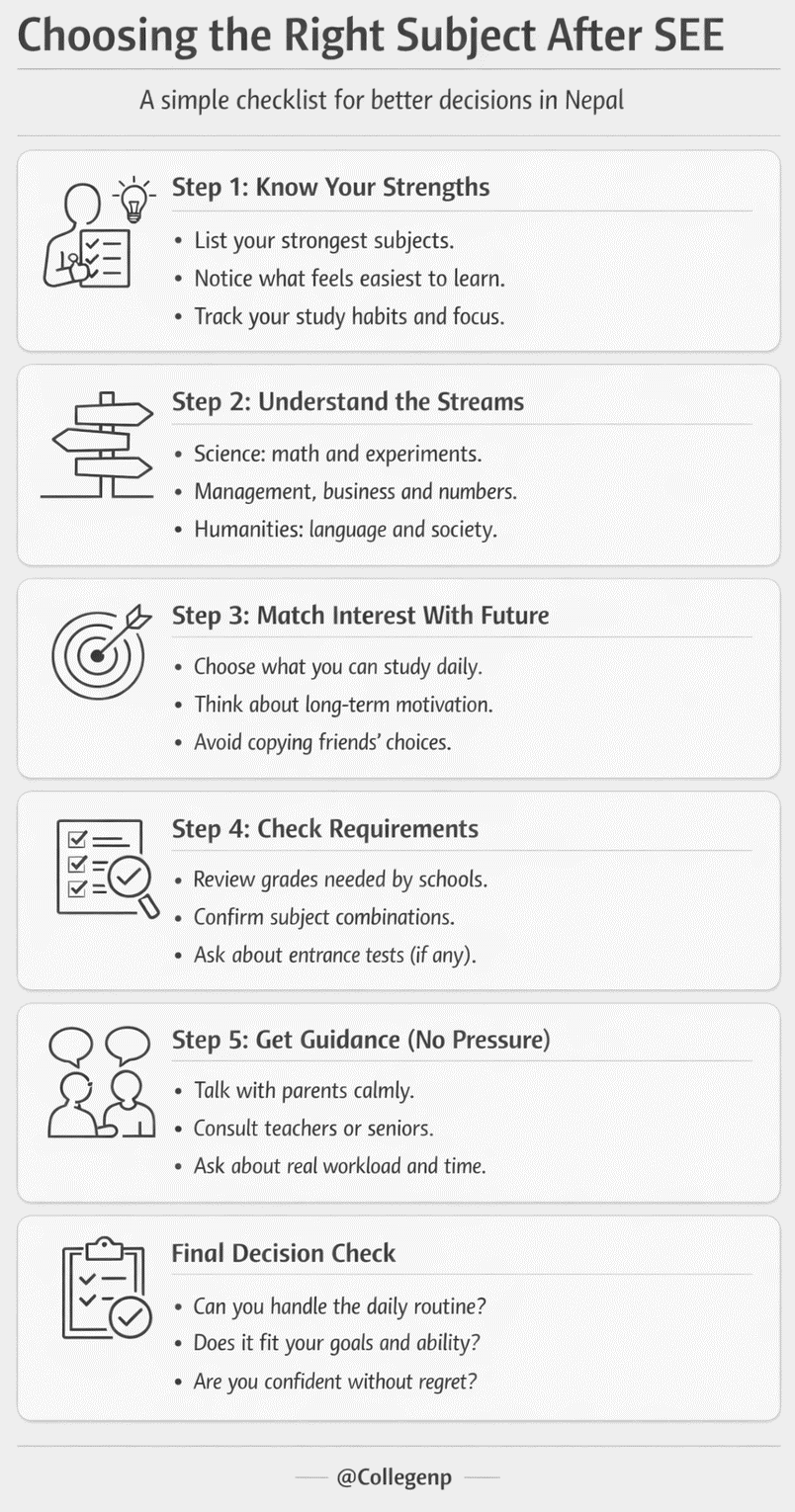
The Existing Subject-Choice Mindset in Nepal
In Nepal’s academic environment, subject selection is based more on “stratification” than on genuine “interest.” This can be studied in three major categories.
A) Science: A Standard of “Intellectual Superiority”
In Nepali society, studying science is treated not only as education but also as a matter of family prestige. Our research and experience show that students who achieve a GPA around 4.0 often face pressure based on the belief that “if you don’t study science, your intelligence will be wasted.”
The core problem is that 90% of science students feel they have only two options: doctor or engineer. As a result, students who want to pursue research goals in pure science—such as physics, chemistry, or biology—remain in the shadows.
Many students choose science only to be labeled “smart.” But due to the difficult Grade 11 curriculum and the gap between the subject and their real interest, data shows that many become victims of depression or frustration within six months.
Science is a serious, practice-based field, but here it has been turned into a “prestige battle.”
B) Management: The Attraction of Safety and “Glamour”
The second largest group after science tends to choose management. Here, two types of mindsets are commonly seen.
-
Those who feel they are not capable of studying science (in the eyes of society)
-
Those influenced by the market’s glamour (banking, hotel management, chartered accountancy)
Management is often treated as a “safe zone.” Many middle-class students who want early financial independence or plan to go abroad for work choose management.
Especially in subjects like hotel management and tourism, the main reason behind rising student interest is not love for the field, but rather the easier access to a “foreign visa” and job opportunities.
This raises a serious question: is a field that should produce original entrepreneurs instead producing only “corporate workers”?
C) Education and Humanities: Neglected and Treated as a Last Option
In Nepal’s academic structure, humanities and education faculties are portrayed as the most neglected areas and as the “place for weak students.”
In truth, these fields are among the richest for understanding society, culture, politics, philosophy, and literature. But when a student says, “I will study literature” or “I will study sociology,” the first question from many parents is: “What will you eat by studying that?”
Because of this negative mindset, the country faces a shortage of skilled teachers, journalists, writers, and philosophers.
Students who could have excelled in these fields are pushed into management or science due to social embarrassment, and they eventually lose their creativity.
Deep Factors That Influence the Decision Process
Why can a teenager not make their own future decision confidently? Behind this are three major pillars in Nepali society.
Parents’ “Unfinished Dreams” and Status Anxiety
During Collegenp research, more than 60% of students admitted they choose subjects under parental pressure.
Many Nepali parents see their children as “tools” to regain the respect they lost in society or to fulfill unfinished personal dreams. If a neighbor’s son studies science, they feel their child must also study science due to “status anxiety.”
This destroys a student’s original talent.
A Narrow Definition of a “Good Future” and Economic Fear
In Nepal, a popular narrative still survives: “If you can, get a government job; otherwise, go abroad.” Subject choices are often made based on this idea.
If someone wants to build a future in painting or music, families often scare them with the fear of “ending up starving.”
Seeking financial security is valid. But when students fail to balance talent and security, they get stuck in work they hate—yet do only for money.
Peer Pressure (Following Friends)
At the age of 15–16, what friends are doing—what college they are joining and what subject they are studying—plays a major role.
A psychological reality of adolescence is the fear of being “alone” or an “outcast.” If a best friend plans to study management at a big Kathmandu college, another student may try to follow the same path even if their capability does not match.
Decisions made under the influence of college advertisements, large buildings, and peer groups often become a trap within 1–2 years.
Research-Based Problem Analysis
Based on our study and the market situation, the following problems appear clearly.
Severe Lack of Career Counseling
In Nepal, schools teach students to read and write up to Grade 10, but they do not teach how the world actually works.
Most schools focus mainly on promoting admissions for their own Grade 11 and 12 programs. They do not have facilities like aptitude tests to scientifically measure student psychology and capability.
Forcing a student weak in mathematics to study engineering under pressure is playing with their future—and this has become common in Nepal.
Skill–Job Mismatch Between Education and the Market
Every year, thousands of engineers and MBA graduates are forced into unemployment or jobs unrelated to their field.
The main reason is ignoring market demand and technological change while choosing subjects. Even if a certificate shows all “A,” Nepali youth struggle to compete globally due to lack of soft skills and critical thinking required in real workplaces.
Economic Pressure and the “Migration Mindset”
Among lower middle-class students, a form of “migration mindset” has developed.
They choose subjects not for knowledge but for a “point system” that makes it easier to go to Australia, Canada, or the United States. As a result, the country fails to produce the agricultural experts, infrastructure specialists, and original teachers it truly needs.
When education becomes only a “ticket,” it impacts overall national productivity.
Expert Recommendation: A Practical Method for Choosing the Right Subject
Based on long academic experience, I propose a structured framework that can guide students toward the right path.
A) Self-Respecting Self-Assessment (The 3-Circle Rule)
A student should draw three circles in a notebook and choose the subject where all three intersect.
-
Do I like it? (Passion)
Does your mind feel engaged when reading the subject’s books or doing related work? -
Am I capable of it? (Capability)
Can your past results and basic skills handle the demands of this subject? -
Does the market need it? (Market Need)
Will it provide a respectable life and sustainable earning in the future?
B) Market Research Through the Lens of Technology
In the next 10 years, Artificial Intelligence (AI) will replace many traditional jobs. So, choosing a subject based only on today’s conditions is not enough.
It is necessary to understand the value of digital literacy, data analysis, and creative jobs that only humans can do.
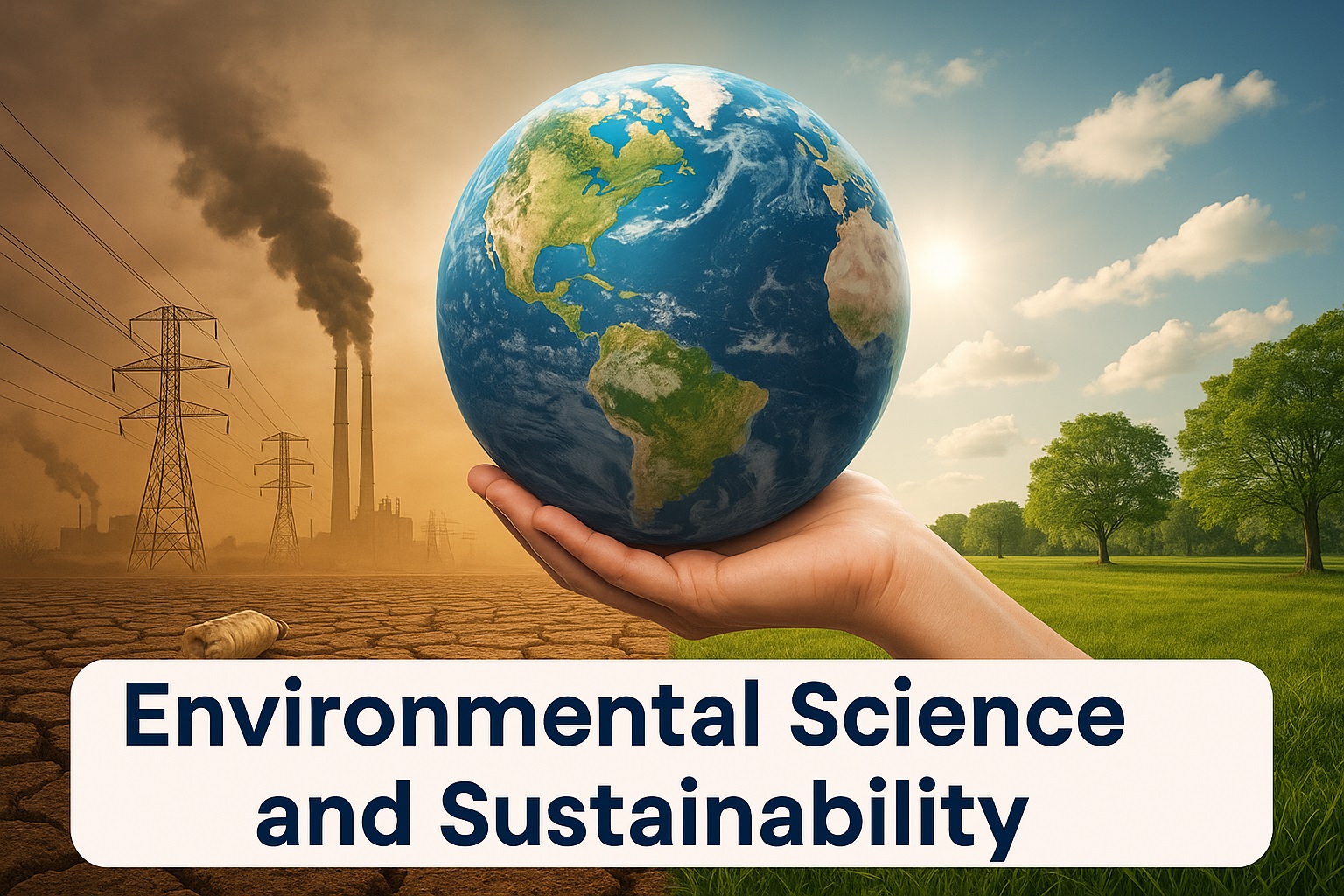
Instead of focusing only on doctor-engineer pathways, students should explore possibilities in areas such as renewable energy, climate change specialist roles, e-commerce management, and specialized law.
C) Real Exposure and Mentorship
Before studying engineering, spend a week in an engineering firm and observe the nature of the work.
Visit a hospital and understand the workload and struggles of doctors. Do not make decisions based only on colorful college brochures.
Talk to at least 10 experienced people in that field and take notes on both the positive and negative aspects.
A Changing Academic Landscape and New Opportunities
Some signs of change in traditional mindset have started to appear. Technology now allows young people to observe global education from their own room.
The IT Surge
Recently, Nepal has seen growing interest in IT, and this trend is largely practical.
Students have realized that by studying software development, cybersecurity, and digital marketing, they can earn in dollars from the global market while staying in Nepal. This mindset has also added positive energy to Nepal’s economy.
Growing Awareness of Law and Public Administration
To improve social justice and governance, the new generation seems increasingly attracted to law (LLB) and Lok Sewa.
This is a positive aspect of social transformation. Although the number is still small, young people are beginning to recognize their abilities instead of simply following the crowd.
Conclusion: A Letter to Parents and Students
The key to both Nepal’s development and your personal growth is “choosing the right subject.”
No subject is naturally “golden” or “dark.” Only your ability and your perspective change what it becomes.
Parents must understand that one successful and happy painter may contribute more to society than one unhappy engineer.
Students must also understand that choosing an easy subject is not success. Becoming excellent in a difficult subject that matches your interest is success.
Key Takeaways
-
GPA is not everything.
It may show memory strength, but it does not define your interest or life purpose. -
Avoid herd mentality.
Do not decide your life based on your friends’ choices. -
Think long-term.
Studying a subject is not only four years up to graduation—it is about the next 40 years of your working life.
The goal of education is not merely to obtain a degree. Its true goal is to build a thoughtful, sensitive, and financially capable person.
If we do not become aware today while choosing subjects, tomorrow there will be no alternative but regret—standing on a mountain of certificates.
Today, Nepal needs skilled policymakers more than doctors, competent technicians more than engineers, and entrepreneurs with new ideas more than ordinary employees.
At the moment of subject selection, your small awareness can take your entire life onto a different path.
Editorial Note
This article has been prepared based on real facts of Nepal’s educational environment and decades of experience. It is not driven by any commercial interest. Its central purpose is only to guide young students in the right direction. While choosing a subject, always remember to balance your interest with market reality.




Comments 0
No comments yet. Be the first to start the conversation.