



The health, knowledge, and skills of a country's people are the real drivers of sustainable economic growth, poverty reduction, and prosperity. For decades, we have understood human capital development mainly in terms of investments in schools, colleges, and hospitals.
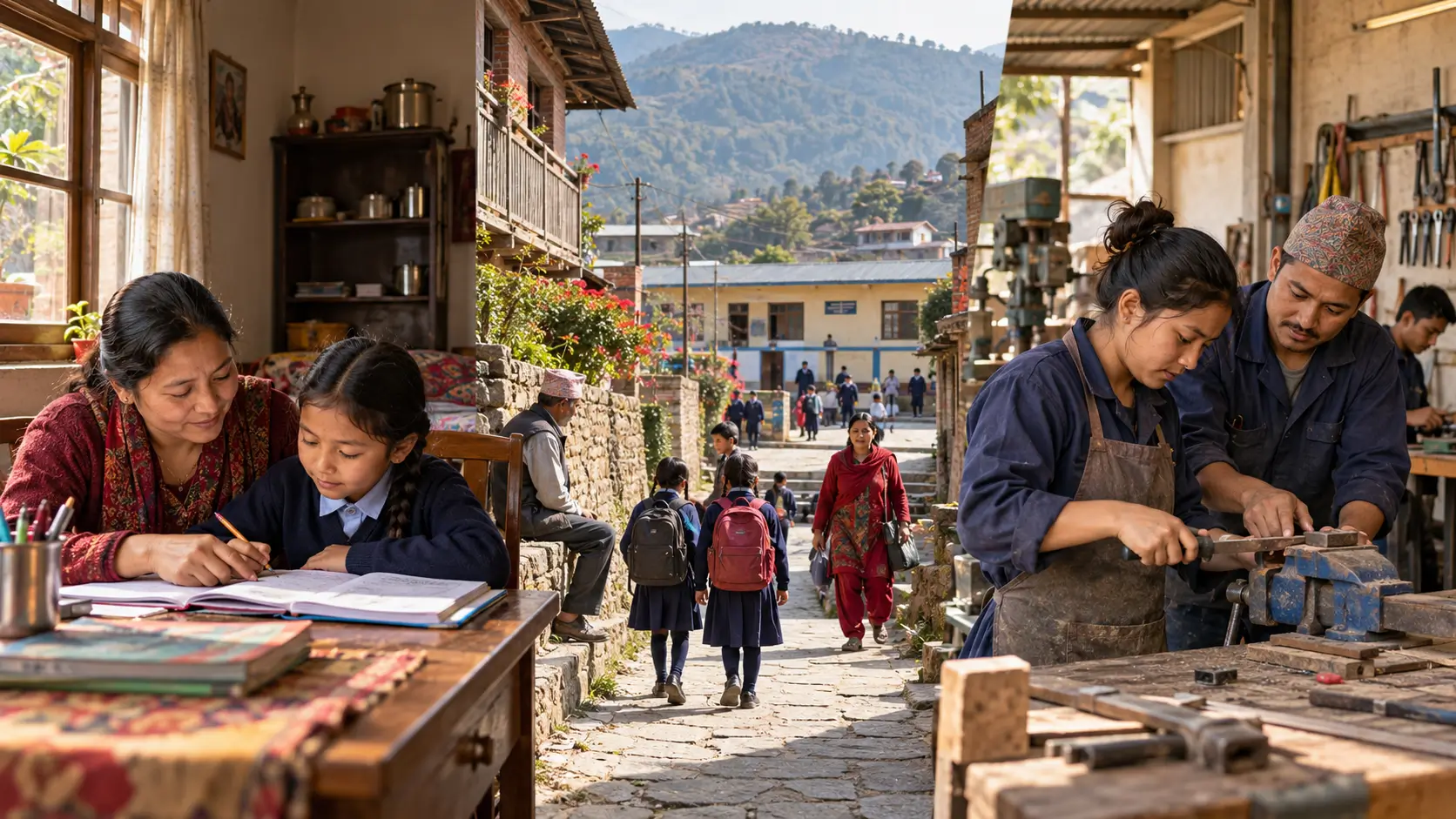
However, challenging this traditional approach, the World Bank's 2026 report, Building Human Capital Where It Matters: Homes, Neighborhoods, and Workplaces, identifies three important settings for human capital development: homes, neighborhoods, and workplaces.
Where Is Nepal Falling Behind?
Nepal's Human Development Index (HDI) stands at 0.622, while its Human Capital Index (HCI) is estimated at approximately 0.50 to 0.51.
More concerning is the country's Utilization-Adjusted Human Capital Index (UHCI), which stands at just 0.18. This indicates that Nepal is effectively utilizing less than one-quarter of its potential human capital in the economy.
Why is so much of Nepal's human potential going unused? To understand this problem, we need to examine the three main settings highlighted in the report.
1. Home: The First School and Learning Space
The earliest and most sensitive stage of human capital development begins at home. Even before children enter formal schooling, their vocabulary, foundational mathematical abilities, and cognitive development are already taking shape.
In Nepal, approximately 37 percent of children from poor households and 36 percent of children whose mothers have no formal education experience stunting.
Meanwhile, foreign employment has created another challenge. Although the migration of household heads, particularly men, brings remittances into the country, studies have shown negative effects on children's height and physical development.
Adolescents growing up in the absence of their fathers are also experiencing increasing psychosocial problems, including depression and anxiety.
Addressing these challenges requires greater attention to social protection, cash transfer programs, and maternal mental health.
2. Neighborhoods and Communities: The Influence of Local Conditions
Regardless of a family's individual circumstances, the neighborhood or community in which people live significantly influences human capital development.
Children from disadvantaged families can also make better progress when they grow up in neighborhoods with higher incomes and access to better facilities.
However, Nepal continues to experience substantial geographical and provincial disparities.
Compared with Bagmati and Gandaki provinces, Karnali and Madhesh remain considerably behind in development.
Although federalism has transferred responsibilities and authority to local governments, limited institutional capacity and inadequate coordination have prevented the expected improvements in education and health.
Children from marginalized communities, including Dalits, indigenous nationalities, and Musahars, continue to face structural discrimination and exclusion.
Addressing these inequalities requires integrated local-level programs covering nutrition, quality education, drinking water, and child protection.
Such programs should bring essential services together rather than treating each issue separately.
3. Workplaces: Where People Learn and Earn
Human capital development does not end when someone completes school or university education.
According to the article's discussion of the evidence, approximately half of the human capital people accumulate throughout their lives comes from workplace experience.
However, Nepal's labor market faces serious challenges.
Approximately 82 percent of the country's labor market is occupied by the informal sector. Women's labor force participation remains between 24 and 28 percent, while more than 33 percent of young people are not in employment, education, or training (NEET).
Because many businesses are small and operate informally, opportunities to acquire new skills remain extremely limited.
Improving conditions in the informal economy is therefore important for expanding opportunities for workplace learning and skill development.
Safe transportation and accessible childcare facilities are also necessary to encourage more women to participate in the labor market.
At the same time, workplaces must become places where employees can continuously develop their skills while earning a living.
What Should Nepal Do Next?
Nepal is currently at an important stage, with opportunities to benefit from its demographic dividend and an approaching transition from Least Developed Country (LDC) status.
The limited utilization of available human resources presents a clear warning.
Traditional investments confined to a single ministry or sector will no longer be sufficient to achieve the desired outcomes.
Sustainable development requires integrated and coordinated investments across all three settings where human capital develops: homes, neighborhoods, and workplaces.
The federal, provincial, and local governments must strengthen policy coordination to improve conditions across these settings.
Only through coordinated efforts can Nepal make better use of its human capital and translate the knowledge, health, and skills of its people into greater economic and social progress.
Reference: Based on the World Bank's report, Building Human Capital Where It Matters: Homes, Neighborhoods, and Workplaces (2026), and related articles.





Comments 0
No comments yet. Be the first to start the conversation.