



Students usually search for the NEB grading system after seeing a Class 11 or Class 12 grade sheet and wondering what A+, B+, GPA, grade point, or NG actually means. The grade table is not difficult, but the result can still feel confusing because theory marks, practical/internal assessment, GPA, and improvement rules are not always explained together.
This guide is for Class 11 and Class 12 students, parents, teachers, and bachelor admission seekers in Nepal who want to read an NEB grade sheet correctly and avoid wrong assumptions.
Quick Answer:
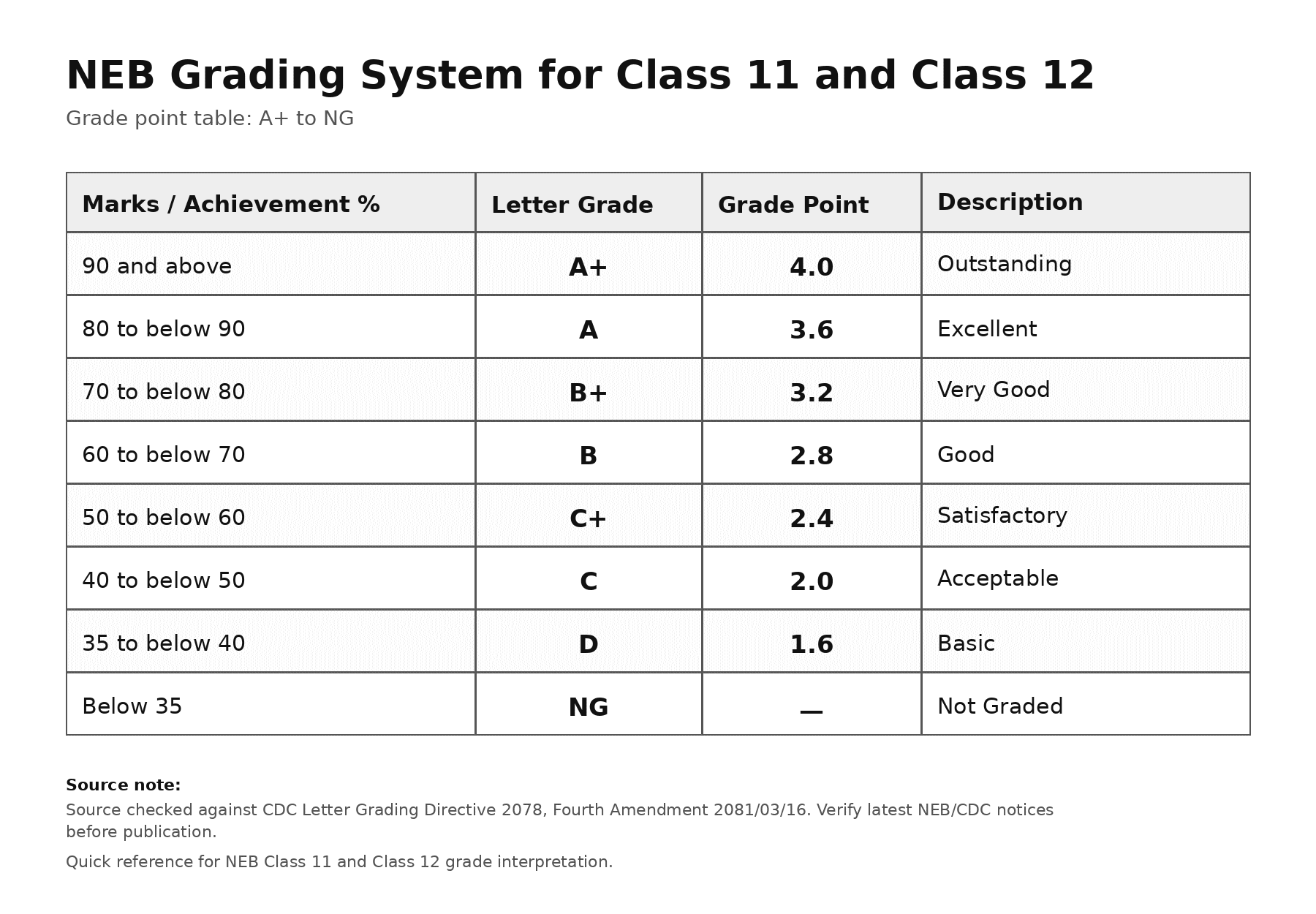
The NEB grading system for Class 11 and Class 12 uses letter grades from A+ to D and NG. A+ means 90 and above with a 4.0 grade point. A means 80 to below 90 with a 3.6 grade point. Below 35 is NG, meaning Not Graded. GPA is based on grade points and, where applicable, credit hours.
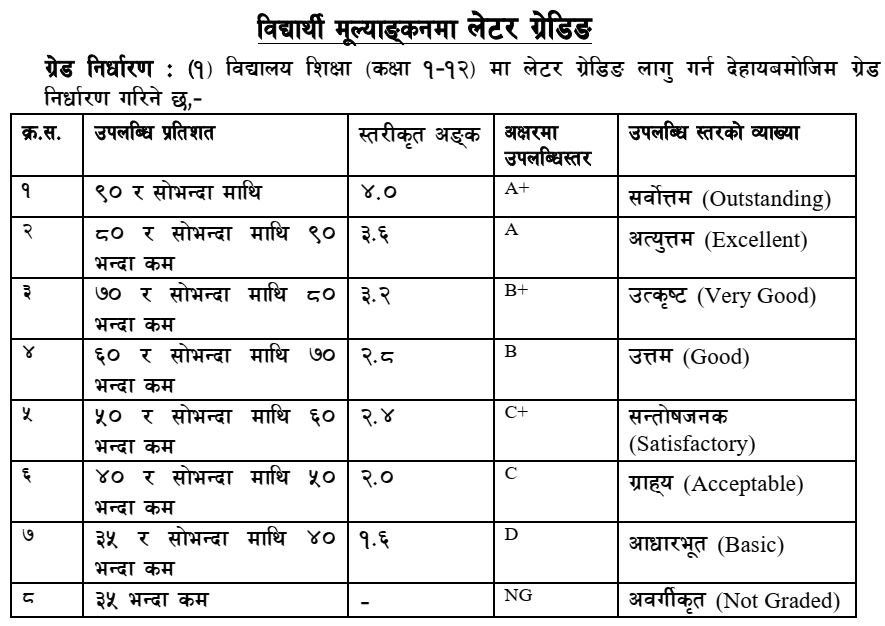
Last checked: 18 June 2026. The Curriculum Development Centre Nepal lists the Letter Grading Directive 2078, Fourth Amendment 2081/03/16, and Nuffic’s Nepal education-system reference shows the upper-secondary NEB Grade XI and XII grading table from A+ to NG.
NEB Grade Point Table for Class 11 and Class 12
The NEB grade point table is the first thing students should understand before calculating GPA or worrying about admission. The uploaded SEO brief identifies this A+ to NG table as the factual base for the article, while also warning that NEB and CDC notices should be checked before publication because rules and processes can change.
| Marks / Achievement Percentage | Letter Grade | Grade Point | Description |
|---|---|---|---|
| 90 and above | A+ | 4.0 | Outstanding |
| 80 to below 90 | A | 3.6 | Excellent |
| 70 to below 80 | B+ | 3.2 | Very Good |
| 60 to below 70 | B | 2.8 | Good |
| 50 to below 60 | C+ | 2.4 | Satisfactory |
| 40 to below 50 | 2.0 | Acceptable | |
| 35 to below 40 | D | 1.6 | Basic |
| Below 35 | NG | — | Not Graded |
NEB Grade XI and XII results with the same structure: 90–100 as A+ with 4.0, 80 to 90 as A with 3.6, 35 to 40 as D with 1.6, and below 35 as NG / Not Graded.
The table tells you what each letter grade means. It does not, by itself, explain every next step. For that, you need to check the subject component, credit hour, GPA, and whether any subject or component has NG.
What A+, A, B+, C, D and NG Mean
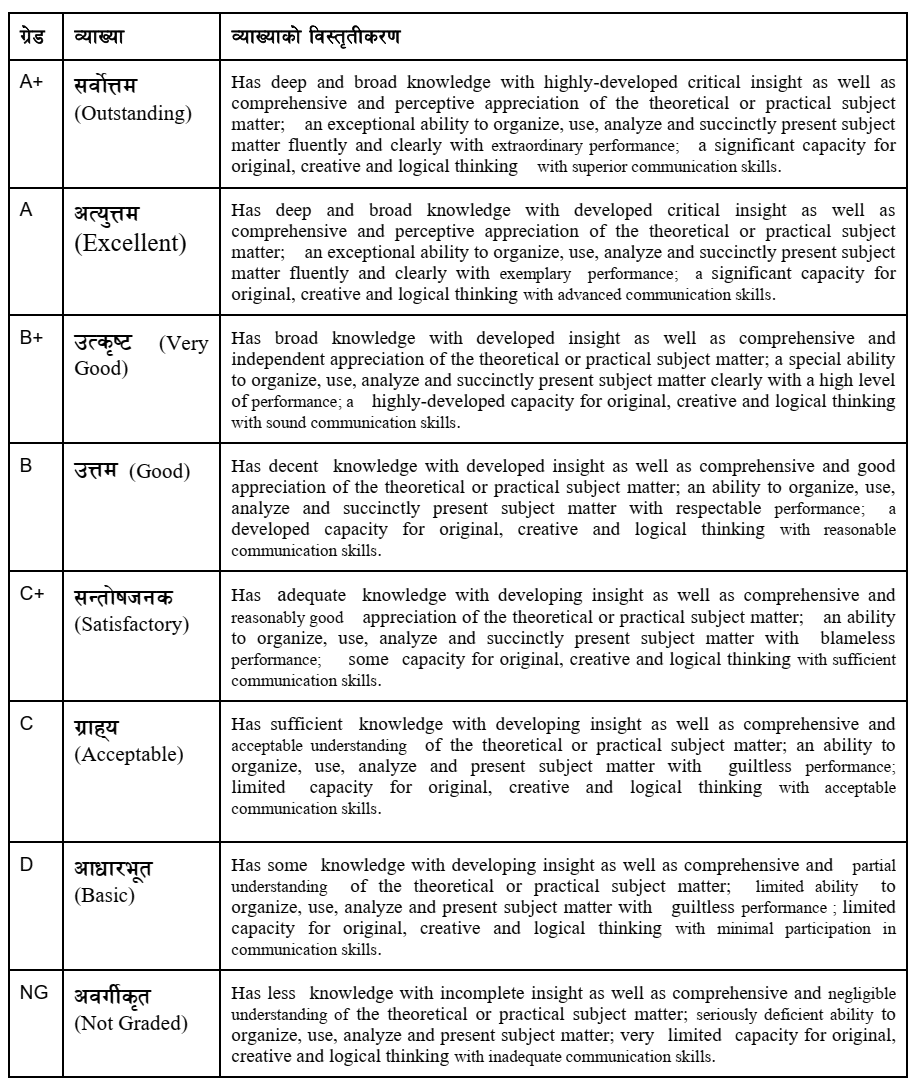
A letter grade is a short form of an achievement range. A+ is the highest grade in the current table. D is the lowest graded category. NG is different from D because NG means Not Graded and does not carry a grade point in the table.
That difference matters.
A student with D has a grade point of 1.6 for that grade band. A student with NG does not have a normal grade point for that subject or component. This is why students should not treat NG as just a low mark or enter it into a GPA calculation as if it were a normal grade.
When reading your grade sheet, check more than the final letter grade. Look at:
-
subject name;
-
theory grade, if shown;
-
practical or internal grade, if shown;
-
final subject grade;
-
grade point;
-
credit hour;
-
GPA;
-
remarks or NG status.
A result can be misunderstood if the student looks only at the final GPA and ignores subject-level details.
How to Calculate NEB GPA
GPA means Grade Point Average. It gives an average picture of your grade-point performance. Students often try to calculate GPA by adding all grade points and dividing by the number of subjects. That can help you understand the idea, but it may not always match the official GPA if credit hours differ.
A safer way to understand GPA is:
GPA = Total weighted grade points ÷ Total credit hours
Where:
Weighted grade point = Grade point × Credit hour
Here is a simple example with equal subject weight.
| Subject | Letter Grade | Grade Point |
|---|---|---|
| English | A | 3.6 |
| Nepali | B+ | 3.2 |
| Economics | B+ | 3.2 |
| Accountancy | B | 2.8 |
| Social Studies | A | 3.6 |
Total grade points:
3.6 + 3.2 + 3.2 + 2.8 + 3.6 = 16.4
Simple average:
16.4 ÷ 5 = 3.28
In this simplified example, the GPA would be 3.28.
Now look at a weighted example.
| Subject | Grade Point | Credit Hour | Weighted Grade Point |
|---|---|---|---|
| English | 3.6 | 4 | 14.4 |
| Nepali | 3.2 | 4 | 12.8 |
| Accountancy | 2.8 | 5 | 14.0 |
| Economics | 3.2 | 5 | 16.0 |
| Social Studies | 3.6 | 4 | 14.4 |
Total weighted grade points = 71.6
Total credit hours = 22
GPA = 71.6 ÷ 22 = 3.25
This example shows why credit hours matter. A subject with more credit hours can affect GPA more than a subject with fewer credit hours.
For official use, always trust the GPA shown on your grade sheet and check how your school, college, or receiving institution reads it.
Common Mistakes Students Make While Calculating GPA
The first mistake is averaging letter grades directly. You cannot calculate GPA by averaging A, B+, and C as letters. You must convert each letter grade into its grade point first.
The second mistake is ignoring credit hours. If two subjects do not have the same credit hour, they should not be treated as equal in a weighted GPA calculation.
The third mistake is treating NG as zero without confirmation. NG means Not Graded. It does not appear as a normal grade point in the grade table.
The fourth mistake is using a random GPA-to-percentage formula. Some colleges may ask for GPA only. Some may ask for original documents. Some may have their own conversion rule. Do not submit a converted percentage unless the receiving institution accepts that method.
The fifth mistake is relying only on screenshots or social media posts after results. For grade improvement, retotaling, supplementary exams, and admission, check official notices.
How Theory, Practical and Internal Grades Appear on the Grade Sheet
Many Class 11 and Class 12 subjects include theory and practical or internal assessment. This is one of the main reasons students get confused after results.
A subject may show separate performance in theory and practical/internal components. A student may do well in practical but receive a lower grade in theory, or the opposite. The final subject result depends on the structure of that subject and how the components are weighted.
A simplified grade-sheet reading may look like this:
| Subject | Component | Letter Grade | Grade Point | What to Check |
|---|---|---|---|---|
| Biology | Theory | B+ | 3.2 | Check whether theory is graded separately |
| Biology | Practical | A | 3.6 | Check practical/internal grade |
| Biology | Final | B+ | 3.2 | Read final grade with credit hour |
| Accountancy | Theory | C+ | 2.4 | Check if improvement is needed |
| Accountancy | Final | C+ | 2.4 | Check admission requirement if applying |
This is only an explanatory mockup, not an official marksheet format. Actual grade sheets may show details differently. The practical point is simple: do not look only at the final GPA. Read each subject and each component carefully.
What Does NG Mean in NEB Result?
NG means Not Graded. In the grade table used for Class 11 and Class 12 explanation, below 35 is listed as NG, and Nuffic’s upper-secondary NEB reference also lists below 35 as NG / Not Graded.
Students often feel anxious after seeing NG. The first step is to identify exactly where NG appears. Is it in one subject? Is it in theory? Is it in practical/internal assessment? Is it shown in the final subject result?
After that, check the latest NEB notice. Do not assume the rule from last year or from another student’s case. NEB publishes examination, result, supplementary, retotaling, and related notices on its official website. The NEB site also shows result links such as Supplementary Results 2082 for Grade 12 and official notice sections, which confirms that result-related processes are notice-based and time-sensitive.
Does NG Affect GPA?
NG can affect the way your result is interpreted because it is not a normal grade point. A student should not treat NG as D, and should not force NG into GPA calculation without official guidance.
The safest way to understand it is:
D is a low graded category. NG means Not Graded.
If your grade sheet shows NG, check the official notice, ask your school or college exam section, and confirm whether you need grade improvement, supplementary examination, retotaling, correction, or another process.
Class 11 vs Class 12 Grading System
The grade table can be explained in the same A+ to NG structure, but Class 11 and Class 12 may not always be handled the same way in practice.
Class 12 is directly connected with National Examinations Board board-level examinations and official NEB notices. Class 11 assessment and documentation may involve the school or college under the applicable rules and internal process.
So students should separate two questions.
What is the grade table?
The grade table uses A+, A, B+, B, C+, C, D, and NG.
Who manages the result process?
For Class 12, NEB notices are central. For Class 11, students should also verify the school or college process.
The uploaded SEO brief also warns that Class 11 assessment implementation should be verified with the target college or school context if the article discusses internal school-level processes.
NEB GPA to Percentage: Should You Convert?
Many students want to convert NEB GPA into percentage for bachelor admission, scholarship applications, abroad study, or job forms. This is understandable, but conversion should be handled carefully.
There is no single safe conversion method that should be used everywhere without checking. A college, university, scholarship body, employer, or foreign credential evaluator may have its own rule.
Use this approach:
-
If the form accepts GPA, submit GPA from the official grade sheet.
-
If the form asks for percentage, check the conversion rule from that institution.
-
If you are applying abroad, check the university or credential evaluator’s requirement.
-
If the rule is not stated, ask before submitting a converted value.
Nuffic provides an international credential-evaluation reference for Nepal and lists upper-secondary NEB percentage ranges with grade points and letter grades, but that does not mean every institution will use the same interpretation.
Grade Improvement, Supplementary Exam, Retotaling and Rechecking
Grade improvement and supplementary exam rules are not safe to explain as fixed rules without checking the latest NEB notice. Subject limits, application deadlines, form process, fee details, eligible student categories, exam centers, and result dates may change.
Before applying for any post-result process, check:
-
the exact notice title;
-
publication date;
-
eligible student category;
-
eligible subjects;
-
application deadline;
-
fee and payment method;
-
exam date;
-
exam center;
-
result publication process.
NEB’s result pages show multiple result-related notices, including retotaling and supplementary-related entries, which is why students should check the exact current notice rather than relying on general advice.
The uploaded SEO brief gives the same warning: do not claim grade improvement rules, pass criteria, result dates, or admission thresholds without checking the latest official notices.
How Colleges and Universities May Use NEB GPA
Bachelor admission is not decided by the NEB grade table alone. A college or university may check GPA, subject grades, subject combination, entrance exam marks, transcript, character certificate, migration certificate, and other documents.
For example, a management program, science program, IT program, engineering program, or health-related program may have different requirements. Some programs may require specific subjects. Some may require entrance exams. Some may have minimum grade requirements in particular subjects.
Do not ask only, “Is my GPA enough?”
Ask these questions instead:
-
Does this program accept my subject combination?
-
Is there a minimum GPA?
-
Is there a required grade in a specific subject?
-
Is there an entrance exam?
-
Are original documents required?
-
Is a student with NG allowed to apply?
-
Is GPA-to-percentage conversion needed?
The correct answer depends on the admission notice of the university, faculty, or college where you apply.
What to Check Before You Act
Before you fill out a form, apply for improvement, submit documents, or convert GPA, check these points carefully.
First, compare your grades with the A+ to NG grade point table.
Second, check whether your grade sheet separates theory and practical/internal components.
Third, check whether any subject or component has NG.
Fourth, verify the latest NEB notice from the official NEB website.
Fifth, ask your school or college exam section if your case involves NG, retotaling, correction, grade improvement, or supplementary exam.
Sixth, for bachelor admission, verify the target institution’s latest admission notice.
Seventh, do not use old blog posts, screenshots, or social media comments as final proof.
Printable NEB Grade Point Chart
Use this short version for quick reference.
| Grade | Marks Range | Grade Point |
|---|---|---|
| A+ | 90 and above | 4.0 |
| A | 80 to below 90 | 3.6 |
| B+ | 70 to below 80 | 3.2 |
| B | 60 to below 70 | 2.8 |
| C+ | 50 to below 60 | 2.4 |
| C | 40 to below 50 | 2.0 |
| D | 35 to below 40 | 1.6 |
| NG | Below 35 | Not Graded |
Suggested download asset for publication: create a PDF/PNG chart using this table and add the note, “Source checked against CDC Letter Grading Directive 2078, Fourth Amendment 2081/03/16, and official NEB/CDC updates as of the article’s last-checked date.”
Final Direction for Students
Start with your own grade sheet. Check each subject, theory/practical section, letter grade, grade point, credit hour, GPA, and remarks. If there is no NG, use the grade table to understand your performance and then check the admission requirements for your next step.
If there is NG, do not rely on rumors. Check the latest NEB notice, ask your school or college exam section, and confirm whether you need improvement, supplementary exam, retotaling, correction, or another official process.
The grade table tells you what your result means. The official notice tells you what you can do next.








Comments 0
No comments yet. Be the first to start the conversation.