



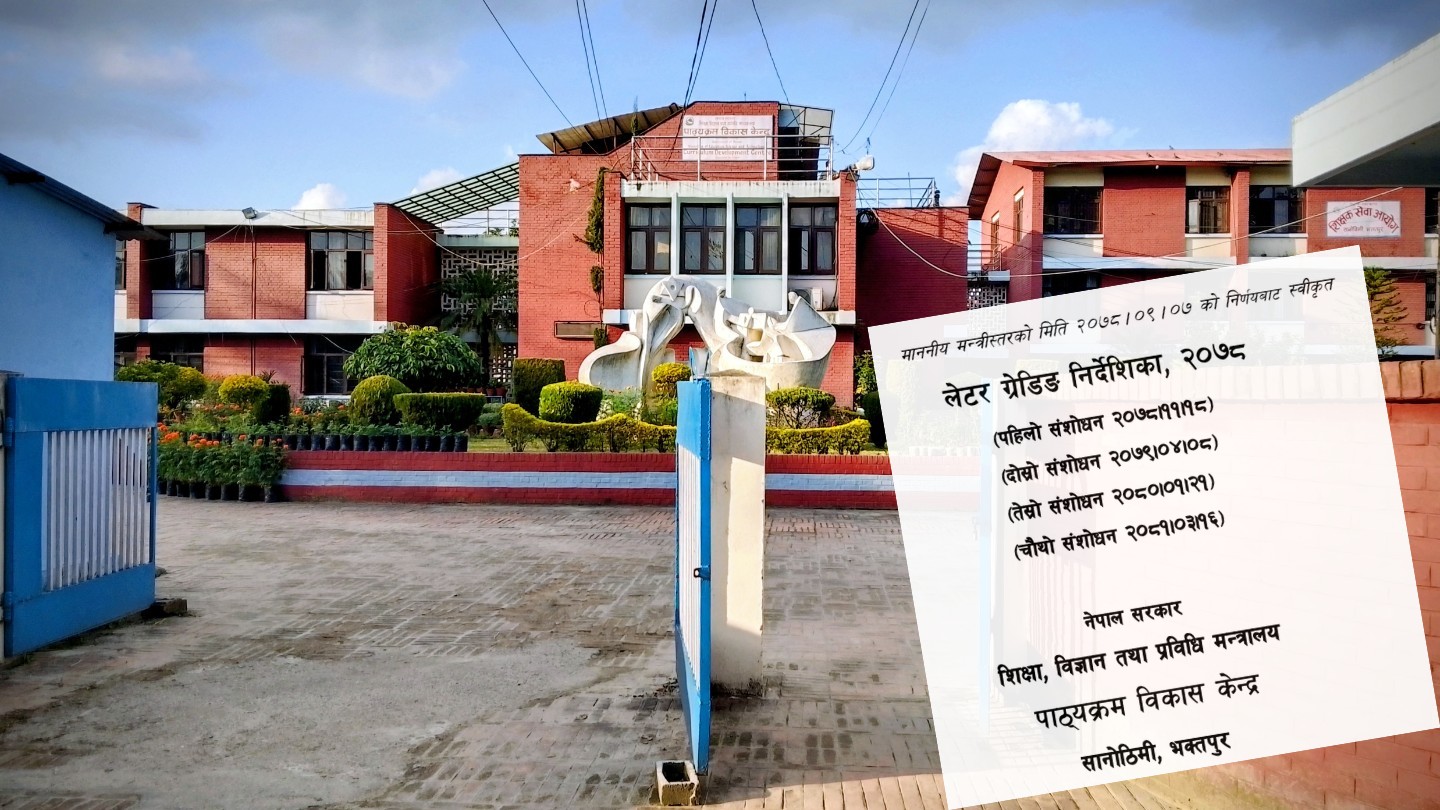
Letter Grading Sytem for Classes 1–12 in Nepal
The Letter Grading Directive, 2078, issued by the Ministry of Education, Science and Technology, sets the official framework for assessing and certifying student achievement in Nepal’s school education system from Classes 1 to 12.
Developed in line with the National Curriculum Framework for School Education, 2076, the directive aims to make student evaluation more relevant, transparent, objective, and reliable.
It defines key terms such as credit hour, letter grading, and grade point, and explains how marks obtained in internal, practical, and theoretical assessments are converted into letter grades.
The directive also outlines grade categories, achievement levels, grade improvement examinations, certification requirements, and the roles of concerned bodies including the Ministry, Curriculum Development Center, National Examination Board, Education Development and Coordination Units, and schools. Its main purpose is to certify students’ learning competency while promoting educational quality and reducing academic loss.
Preamble
As it is desirable to determine the process of letter grading in student assessment in accordance with the guidance of the National Curriculum Framework for School Education, 2076, and to maintain relevance, transparency, objectivity, and reliability in assessment and certification at the school level, the Ministry of Education, Science and Technology has issued this Directive by exercising the authority conferred by Rule 192(e) of the Education Regulations, 2059.
Table of Content
- Letter Grading Sytem for Classes 1–12 in Nepal
- Chapter 1: Name, Commencement, Definitions, and Objectives
- Chapter 2: Credit Hours
- Chapter 3: Letter Grading in Student Assessment
- Chapter 4: Roles of Concerned Bodies in the Implementation of Letter Grading
- Chapter 5: Miscellaneous
- Annex 1
- Download
Chapter 1: Name, Commencement, Definitions, and Objectives
1. Name and Commencement
-
This Directive shall be called the “Letter Grading (Fourth Amendment) Directive, 2078.”
-
This Directive shall come into force from the date of approval by the Ministry.
-
................................................
2. Definitions
Unless the subject or context otherwise requires, in this Directive:
(a) “Center” means the Curriculum Development Center under the Ministry.
(b) “Regulations” means the Education Regulations, 2059.
(c) “Council” means the National Curriculum Development and Evaluation Council constituted under Rule 32 of the Education Regulations.
(d) “Curriculum” means the level-wise or subject-wise curriculum approved by the National Curriculum Development and Evaluation Council and the Government of Nepal.
(e) “Credit hour” means a period of 32 hours spent for conducting teaching and learning.
(f) “Board” means the board constituted pursuant to Section 4A of the Education Act, 2028, as amended.
(g) “Ministry” means the Ministry of Education, Science and Technology.
(h) “Letter Grading” means the presentation in letters of the learning level achieved by a student after assessment of the prescribed competency.
(i) “Grade point” means the corresponding numerical value presented as the standardization of student assessment made in letters.
3. Objectives
The objectives of implementing letter grading in school education are as follows:
(a) To certify students’ learning competency accurately.
(b) To indicate the numerical level obtained from the measurement of learning achievement in eight letter-based levels.
(c) To promote educational quality while minimizing academic loss.
(d) To provide learning opportunities based on students’ multiple intelligences through single-subject certification.
Chapter 2: Credit Hours
4. Credit Hours and Working Hours
-
At the school level, one period for conducting teaching and learning shall generally be of sixty minutes. However, a school may manage time in such a way that the annual working hours are not reduced.
-
A period of 32 hours spent for conducting teaching and learning shall be considered one credit hour.
-
The teaching-learning time period prescribed by the existing curriculum shall be converted into credit hours and certified.
5. Credit Hours and Activities
-
Learning-related activities and additional activities conducted through direct dialogue and cooperation between teachers and students shall be counted as credit hours.
-
To participate in the examination conducted for summative assessment, a student must have attendance of 75 percent of the total days the school was open or teaching and learning was conducted.
However, in the case of students studying in open schools and alternative learning systems, the provisions related to attendance and assessment shall be as mentioned in the relevant directive.
-
While conducting classes according to the credit hours prescribed for practical work in the curriculum, assessment shall be carried out on the basis of learning-related activities and additional activities.
Chapter 3: Letter Grading in Student Assessment
6. Grade Determination
-
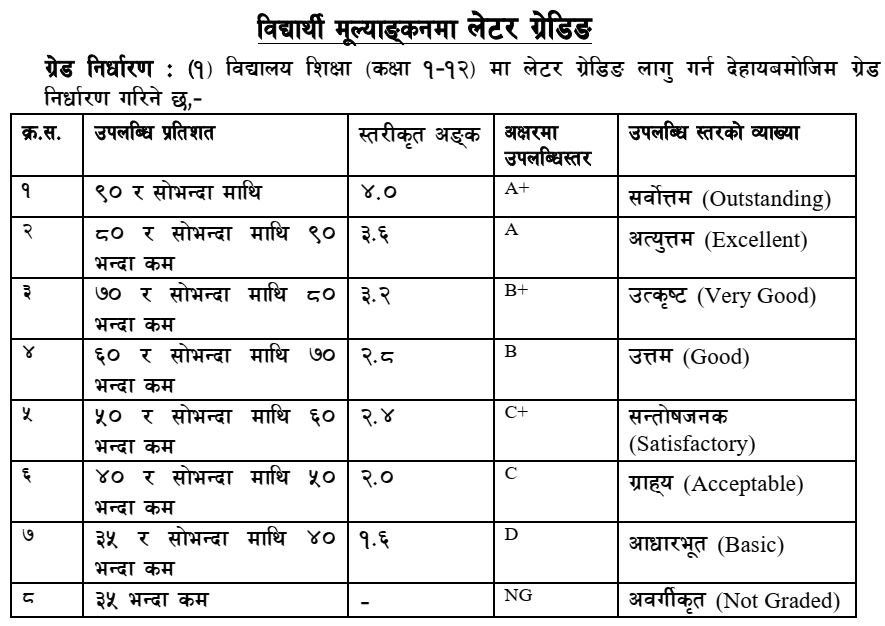
To implement letter grading in school education, Classes 1–12, grades shall be determined as follows:
| Achievement Percentage | Grade Point | Achievement Level in Letter | Explanation of Achievement Level |
|---|---|---|---|
| 90 and above | 4.0 | A+ | Outstanding |
| 80 and above and below 90 | 3.6 | A | Excellent |
| 70 and above and below 80 | 3.2 | B+ | Very Good |
| 60 and above and below 70 | 2.8 | B | Good |
| 50 and above and below 60 | 2.4 | C+ | Satisfactory |
| 40 and above and below 50 | 2.0 | C | Acceptable |
| 35 and above and below 40 | 1.6 | D | Basic |
| Below 35 | - | NG | Not Graded |
-
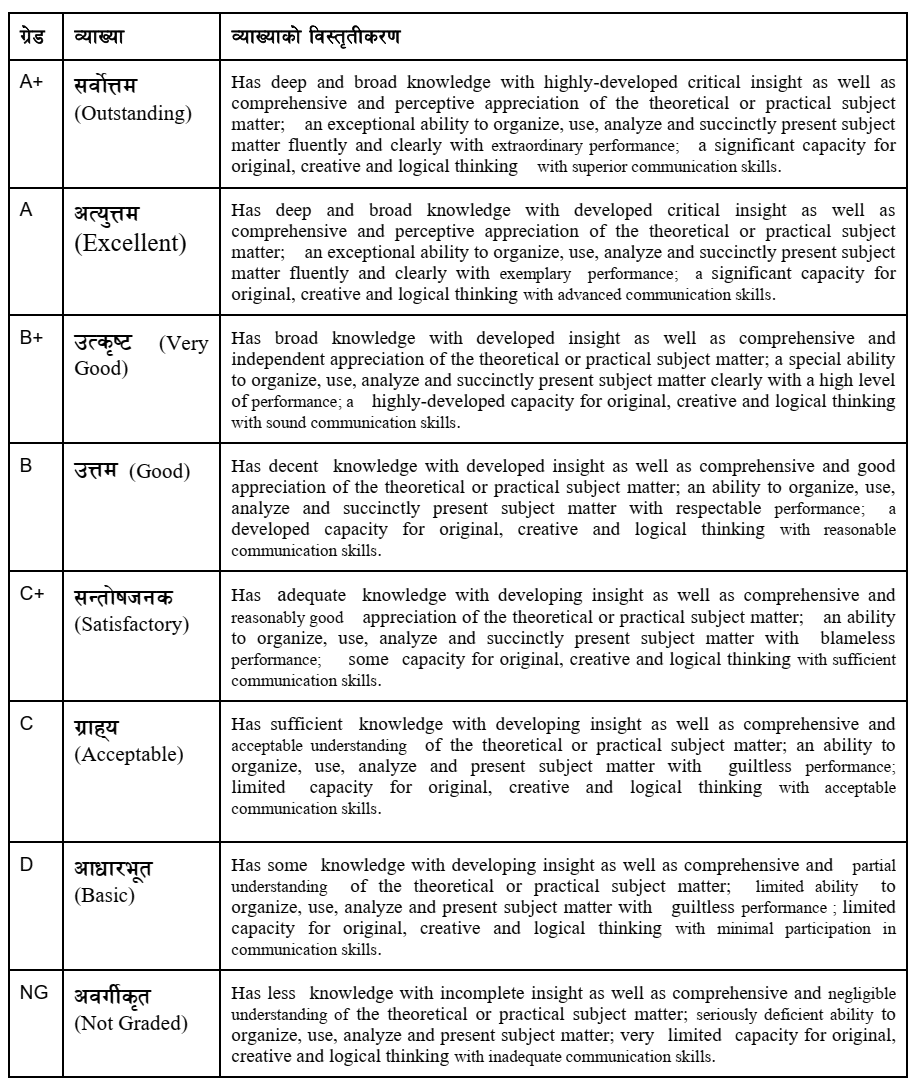
The explanations of the determined grades shall be elaborated as follows:
-
Notwithstanding anything contained elsewhere in this Directive, in the case of the Secondary Education Examination Class 10 (SEE), before the implementation of the new curriculum pursuant to the National Curriculum Framework, 2076, the National Examination Board may determine the grades and elaborate the explanations as follows in order to maintain uniformity in the practice of grade determination of marks obtained in the examination:
Grade determination and explanation and elaboration of grades are placed in Annex 1.
Added by the second amendment
| Grade | Explanation | Elaboration of Explanation |
|---|---|---|
| A+ | Outstanding | Has deep and broad knowledge with highly developed critical insight as well as comprehensive and perceptive appreciation of the theoretical or practical subject matter; an exceptional ability to organize, use, analyze, and succinctly present subject matter fluently and clearly with extraordinary performance; a significant capacity for original, creative, and logical thinking with superior communication skills. |
| A | Excellent | Has deep and broad knowledge with developed critical insight as well as comprehensive and perceptive appreciation of the theoretical or practical subject matter; an exceptional ability to organize, use, analyze, and succinctly present subject matter fluently and clearly with exemplary performance; a significant capacity for original, creative, and logical thinking with advanced communication skills. |
| B+ | Very Good | Has broad knowledge with developed insight as well as comprehensive and independent appreciation of the theoretical or practical subject matter; a special ability to organize, use, analyze, and succinctly present subject matter clearly with a high level of performance; a highly developed capacity for original, creative, and logical thinking with sound communication skills. |
| B | Good | Has decent knowledge with developed insight as well as comprehensive and good appreciation of the theoretical or practical subject matter; an ability to organize, use, analyze, and succinctly present subject matter with respectable performance; a developed capacity for original, creative, and logical thinking with reasonable communication skills. |
| C+ | Satisfactory | Has adequate knowledge with developing insight as well as comprehensive and reasonably good appreciation of the theoretical or practical subject matter; an ability to organize, use, analyze, and succinctly present subject matter with blameless performance; some capacity for original, creative, and logical thinking with sufficient communication skills. |
| C | Acceptable | Has sufficient knowledge with developing insight as well as comprehensive and acceptable understanding of the theoretical or practical subject matter; an ability to organize, use, analyze, and present subject matter with guiltless performance; limited capacity for original, creative, and logical thinking with acceptable communication skills. |
| D | Basic | Has some knowledge with developing insight as well as comprehensive and partial understanding of the theoretical or practical subject matter; limited ability to organize, use, analyze, and present subject matter with guiltless performance; limited capacity for original, creative, and logical thinking with minimal participation in communication skills. |
| NG | Not Graded | Has less knowledge with incomplete insight as well as comprehensive and negligible understanding of the theoretical or practical subject matter; seriously deficient ability to organize, use, analyze, and present subject matter; very limited capacity for original, creative, and logical thinking with inadequate communication skills. |
7. Implementation Method of Letter Grading and Grade Improvement Examination
-
The implementation method of letter grading shall be as follows:
(a) Examination and re-examination of the answer sheet of each subject shall be carried out in marks. The marks obtained from examination and re-examination, with separate marks for theory and internal assessment in the grade sheet, shall be converted into letter grades.
(b) A student who has completed the concerned level or class shall, on the basis of the grade sheet obtained, receive opportunities for professional and technical and vocational education if the concerned level or class has been completed. For further study, however, a grade sheet with Grade Point Average (GPA) and the original certificate shall be provided after completion of that level or class.
(c) The descriptor of the grades obtained by students shall be mentioned in the marksheet.
-
The provisions regarding grade improvement examination and certificate shall be as follows:
(a) In Class Eight, Class Ten, and Class Twelve, the concerned body shall provide the original certificate only after the minimum grade has been completed in all subjects.
However, an original certificate shall not be provided to a student who cannot obtain Grade C in the internal component and Grade D in the theory component subject-wise.
(b) In the case of other classes, the school itself shall provide the grade sheet and certificate in a manner not contrary to this Directive.
(c) The original certificate shall be mandatory for further study. If further study is pursued without obtaining the original certificate, equivalence shall not be granted.
(d) A student who has not been able to obtain the original certificate may participate in the grade improvement examination for two subjects up to three times. In the case of students who participate in the grade improvement examination and students who participated in internal assessment but could not participate in external assessment, the marks of internal and practical assessment shall remain valid for three years.
(d1) Notwithstanding anything contained in clause (d), a student who was absent in the annual examination at the end of Secondary Education Class 10 or who participated in such examination and obtained Not Graded in any subject shall not be prevented from participating in the grade improvement chance examination in the subject in which the student was absent or obtained Not Graded.
A student who has obtained shall not be prevented from participating in the grade improvement chance examination in the subject in which the student was absent or obtained Not Graded.
(e) An examinee who fails to obtain the prescribed grade in the regular or grade improvement examination may participate in the annual examination for up to three years only in the subject in which the prescribed grade was not obtained.
(f) The examination of a student who appears in the annual or external examination without obtaining the prescribed grade in internal assessment may be cancelled.
(g) The grades of students who have studied and passed from foreign boards shall also be determined in accordance with this procedure.
Chapter 4: Roles of Concerned Bodies in the Implementation of Letter Grading
8. Role of the Ministry
The role of the Ministry in the implementation of letter grading shall be as follows:
(a) To determine policies and standards related to letter grading.
(b) To give directions to the concerned bodies for the implementation of letter grading.
9. Role of the Center
The role of the Center shall be as follows:
(a) To implement the policy approved by the National Curriculum Development and Evaluation Council regarding letter grading.
(b) To provide necessary facilitation and technical support in the implementation of letter grading.
10. Role of the Center for Education and Human Resource Development
The role of the Center for Education and Human Resource Development shall be as follows:
(a) To facilitate the implementation of letter grading.
(b) To include letter grading in student assessment in teacher training programs.
11. Role of the Board
The role of the Board shall be as follows:
(a) To implement letter grading while conducting examinations, publishing results, and certifying student assessment.
(b) To carry out necessary coordination and facilitation in the work of concerned bodies while implementing letter grading in school education.
12. Role of the Education Development Directorate
The Education Development Directorate shall facilitate and monitor the implementation of letter grading in student assessment.
13. Role of the Education Development and Coordination Unit
The role of the Education Development and Coordination Unit shall be as follows:
(a) To implement and cause to implement letter grading in student assessment.
(b) To direct schools to implement letter grading in student assessment and to carry out necessary orientation, facilitation, and monitoring.
14. Role of the School
The role of the school shall be as follows:
(a) To implement and cause to implement letter grading in student assessment.
(b) To inform teachers, students, parents, and all stakeholders about this system and cause them to be informed.
(c) To maintain conceptual clarity by conducting orientation and discussion as necessary.
(d) To certify and provide the details of student achievement in practical work, project work, learning-related activities, and additional activities according to the records.
Chapter 5: Miscellaneous
15. Equivalence
The equivalence of the categories determined in the marking of grades obtained from letter grading shall be as provided in the Directive on Determination of Recognition and Equivalence Equivalent to Secondary Education.
16. Amendment to the Directive
The Ministry may make necessary amendments to the Directive in consultation with the concerned bodies and on the recommendation of the Center.
17. Power to Remove Difficulties
If any confusion or ambiguity arises in the implementation of the provisions mentioned in this Directive, the Ministry may remove such difficulties.
18. Repeal and Saving
-
The Procedure for Implementation of the Letter Marking System in School Education, 2072, is repealed.
-
The acts and actions carried out pursuant to the Procedure for Implementation of the Letter Marking System in School Education, 2072, shall be deemed to have been carried out pursuant to this Directive.
Annex 1
Related to Sub-section 3 of Section 6 of Chapter 3
(a) Grade Determination
| Range of Marks Obtained, in Percentage | Grade | Explanation | Grade Point |
|---|---|---|---|
| 90 and above | A+ | Outstanding | 4.0 |
| 80 and above and below 90 | A | Excellent | 3.6 |
| 70 and above and below 80 | B+ | Very Good | 3.2 |
| 60 and above and below 70 | B | Good | 2.8 |
| 50 and above and below 60 | C+ | Satisfactory | 2.4 |
| 40 and above and below 50 | C | Acceptable | 2.0 |
| 30 and above and below 40 | D+ | Partially Acceptable | 1.6 |
| 20 and above and below 30 | D | Insufficient | 1.2 |
| Below 20 | E | Very Insufficient | 0.8 |
(b) Explanation and Elaboration of Grades Determined Pursuant to Clause (a)
| Grade | Explanation | Elaboration of Explanation |
|---|---|---|
| A+ | Outstanding | Exceptional evidence of understanding and summarizing the subject matter; demonstration of extraordinary performance in problem-solving, creativity, critical expression, and participation; exceptionally independent in learning and organizing contents with superior communication skills. |
| A | Excellent | Excellent strong evidence of understanding and summarizing the subject matter; demonstration of exemplary performance in problem-solving, creativity, critical expression, and participation; admirably independent in learning and organizing contents with advanced communication skills. |
| B+ | Very Good | Very good evidence of understanding and summarizing the subject matter; demonstration of higher performance in problem-solving, creativity, critical expression, and participation; greatly independent in learning and organizing contents with sound communication skills. |
| B | Good | Good evidence of understanding and summarizing the subject matter; demonstration of reasonably good independent performance in problem-solving, creativity, critical expression, and participation; very independent in learning and organizing contents with reasonable communication skills. |
| C+ | Satisfactory | Adequate evidence of understanding and summarizing the subject matter; demonstration of reasonably good but not particularly independent performance in problem-solving, creativity, critical expression, and participation; reasonably independent in learning and organizing contents with sufficient communication skills. |
| C | Acceptable | Sufficient evidence of understanding and summarizing the subject matter; demonstration of acceptable performance in problem-solving, creativity, critical expression, and participation; reasonably independent in learning and organizing contents with satisfactory communication skills. |
| D+ | Partially Acceptable | Some evidence of understanding and summarizing the subject matter; demonstration of limited performance in problem-solving, creativity, critical expression, and participation; partially independent in learning and organizing contents with basic communication skills. |
| D | Insufficient | Minimal evidence of understanding and summarizing the subject matter; demonstration of deficient performance in problem-solving, creativity, critical expression, and participation; needs close supervision in learning and organizing contents with minimal communication skills. |
| E | Very Insufficient | Negligible evidence of understanding and summarizing the subject matter; seriously deficient performance in problem-solving, creativity, critical expression, and very minimal participation; needs constant supervision in learning and organizing contents with inadequate communication skills. |
Approved by the decision of the Honorable Ministerial Level dated 2078.09.07.
Letter Grading Directive, 2078
First Amendment: 2078.11.18
Second Amendment: 2079.04.08
Third Amendment: 2080.01.21
Fourth Amendment: 2081.03.16
Government of Nepal, Ministry of Education and Sports, Curriculum Development Center, Sanothimi, Bhaktapur.








Comments 0
No comments yet. Be the first to start the conversation.