




Study in Nepal if your budget is limited, your career goal is mainly Nepal-based, you need family support, or you can find a recognized local or foreign-affiliated program without taking a risky loan. Study abroad if your target course, institution, budget, recognition, and career pathway clearly justify the higher cost and visa risk.
The better question is not “Which country is better?” The better question is “Which study path fits my course, budget, family situation, personal readiness, and long-term career plan?”
For Nepali students and parents, this decision should not be based on trend, pressure, or social media success stories. A strong program in Nepal can be better than a weak course abroad. A well-planned foreign degree can also be better than a local program that does not match the student’s career goal.
Table of Content
- Quick Comparison: Study in Nepal vs Abroad
- Start With Your Career Goal
- Cost and ROI: The Part Many Students Underestimate
- Total Cost Worksheet
- Recognition, Equivalence, and Accreditation
- NOC for Study Abroad from Nepal
- Work Rules Abroad: Useful, But Not a Guarantee
- When Studying in Nepal Makes More Sense
- When Studying Abroad Makes More Sense
- Middle Options: Not Only Nepal vs Abroad
- Student Scenarios: Which Path Fits Better?
- Decision Scorecard for Students and Parents
- 7-Step Checklist Before Deciding
- Common Mistakes to Avoid
- Final Verdict
Quick Comparison: Study in Nepal vs Abroad
| Factor | Study in Nepal | Study Abroad | Decision Tip |
|---|---|---|---|
| Total cost | Usually lower because tuition, living, transport, and settlement costs are lower | Usually higher because of tuition, visa fees, insurance, travel, rent, and currency risk | Compare the full degree cost, not only first-semester tuition |
| Family support | Stronger because students remain close to parents, relatives, and familiar systems | Lower at the beginning because students must adjust to a new country and lifestyle | Students who need strong family support, medical support, emotional stability, or a familiar environment should assess their readiness carefully before leaving Nepal |
| Academic exposure | Can be good, but quality depends on college, faculty, labs, and industry links | Can be stronger where universities offer advanced labs, research, internships, or global faculty | Choose by program quality, not only by country |
| Recognition | Easier for Nepal-based jobs and licensing if the institution and program are recognized | May require equivalence, recognition, or professional licensing approval if the student returns to Nepal | Check recognition before admission, not after graduation |
| Work while studying | Local internships or part-time work may be possible depending on city and field | Work rules vary by country, course, visa condition, and study period | Do not assume part-time work will cover all expenses |
| Career pathway | Better for Nepal-focused careers, local networking, civil service, family business, and domestic employment | Better for international exposure, research, global industries, and some skilled career pathways | Match the pathway with your actual career goal |
| Risk level | Lower visa and settlement risk, but college quality risk still exists | Higher financial, visa, accommodation, job, compliance, and adjustment risk | Make a backup plan before choosing abroad |
| Independence | Gradual independence in a familiar environment | Fast independence with budgeting, cooking, transport, work rules, and legal compliance | Useful for mature students, stressful for unprepared students |
| Best fit | Budget-conscious students, Nepal-focused careers, family responsibilities, or students needing stable support | Students with strong academics, realistic finances, clear course-country fit, and personal readiness | Choose fit, not social pressure |
Start With Your Career Goal
Before choosing Nepal or abroad, write one clear sentence:
“I want to study [course] because I want to become [career goal] in [country or market].”
This simple sentence removes much of the confusion. A student who wants to work in Nepal’s banking sector, a student planning nursing practice abroad, a student preparing for public service in Nepal, and a student targeting research in a foreign university should not follow the same education plan.
If Your Goal Is a Nepal-Based Career
Studying in Nepal may be more practical if the degree is recognized, the college has verified teaching quality, and you can build local internships, networks, and work experience. This route can fit students planning careers in local banking, teaching, civil service, local IT, entrepreneurship, family business, or Nepal-based professional practice.
If Your Goal Needs International Exposure
Studying abroad may be useful when the destination offers stronger facilities, research systems, industry connections, internships, or global career exposure in your field. However, international exposure alone is not enough. The course, institution, budget, visa condition, recognition, and employability pathway must all make sense.
If Your Goal Requires a Professional License
Be extra careful if your target field is medicine, nursing, engineering, law, accounting, aviation, architecture, or another regulated profession. In these fields, degree recognition and licensing rules matter more than general popularity. A foreign degree may not automatically qualify you for practice in Nepal or another country.
If Your Goal Is Migration
Do not choose a course only because someone says it may help with migration. Visa rules, post-study work rules, job markets, and migration policies can change. A safer plan is to choose a course that remains useful even if migration rules become stricter.
Cost and ROI: The Part Many Students Underestimate
Studying abroad is not simply “tuition fee plus part-time job.” A realistic budget should include application fees, English test fees, documentation, NOC process, visa charges, health insurance, biometrics or medical checks if required, flight, initial accommodation, food, transport, winter clothing, emergency money, exchange-rate changes, and living expenses before you find work.
Studying in Nepal is also not automatically cheap. Private colleges, foreign-affiliated programs, hostel fees, transport, exam fees, repeated back papers, entrance preparation, and living away from home can increase the total cost.
The correct method is to calculate the full cost of the degree, not only the first semester.
Total Cost Worksheet
| Cost Item | Nepal | Abroad | What to Verify |
|---|---|---|---|
| Tuition | Official college or university fee structure | Offer letter and official annual tuition | Scholarship terms, refund policy, installment rules |
| Living cost | Food, rent or hostel, transport, internet, books | Rent, food, utilities, transport, insurance, phone, winter needs | Use city-level estimates, not broad averages |
| Documentation | Admission forms, transcripts, entrance preparation | Passport, English test, application fee, NOC, visa, medical or biometrics if required | Latest official document requirements |
| Income during study | Local internships or part-time work may help | Part-time work depends on visa rules, job market, timetable, and language | Never assume work income will cover all costs |
| Emergency fund | Recommended | Essential | Plan for job delay, rent gap, health issue, visa delay, or family emergency |
A study-abroad plan becomes high risk if it depends on overworking, hiding financial weakness, borrowing beyond family capacity, or assuming that part-time work will pay all major expenses.
Recognition, Equivalence, and Accreditation
Recognition is one of the most important checks before choosing Nepal or abroad.
For Nepal-based study, verify whether the institution and program are recognized by the relevant university, board, council, or regulator. For foreign degrees, check whether the qualification can be recognized or considered equivalent if you return to Nepal for further study, government service, private employment, or professional licensing.
Students should check:
-
Is the institution recognized by the relevant authority in that country?
-
Is the program full-time, online, distance, hybrid, or transnational?
-
Will the degree format and credit structure create problems for equivalence?
-
Will professional councils accept the degree for licensing?
-
Will employers in Nepal understand and value the qualification?
-
Does the college have official affiliation, or only marketing claims?
-
Is the course suitable for your future country of work?
Do not rely only on advertisements, consultancy claims, or social media posts. Recognition should be checked from official institutions before admission.
NOC for Study Abroad from Nepal
Nepali students planning foreign study commonly need a No Objection Certificate, known as NOC. The NOC process, required documents, fee, portal procedure, and timeline can change. Students should verify the current process through Nepal’s official NOC system before applying, paying tuition, or booking travel.
A practical rule is simple: do not treat admission, visa, NOC, and payment as separate issues. They are connected. If one step fails or changes, the whole plan can be affected.
Work Rules Abroad: Useful, But Not a Guarantee
Many Nepali students choose abroad because they expect to work while studying. Part-time work can help with living expenses where legally permitted, but it should not be treated as guaranteed income or used as the foundation of the whole financial plan.
Work rights differ by country, course level, visa condition, and study period. They can also change. Students must check official immigration sources and their own visa conditions before working.
| Destination | Current Official Reference Point | Student Advice |
|---|---|---|
| Australia | Student visa work rights generally allow work up to 48 hours per fortnight when the course is in session, subject to visa conditions | Check your visa grant letter, VEVO record, and course status before working |
| Canada | Eligible students may work up to 24 hours per week during regular academic terms and unlimited hours during scheduled breaks if they meet all conditions | Keep records of work hours and do not exceed study permit conditions |
| UK | Student work limits commonly depend on course level and visa conditions, often 10 or 20 hours per week during term time | Check your eVisa, sponsor rules, CAS, and university term dates |
| USA | F-1 students generally cannot work off campus during the first academic year except under authorized conditions | Do not work off campus without proper authorization |
This article is not immigration advice. Students must verify the latest rules from official immigration websites before applying, travelling, or working.
When Studying in Nepal Makes More Sense
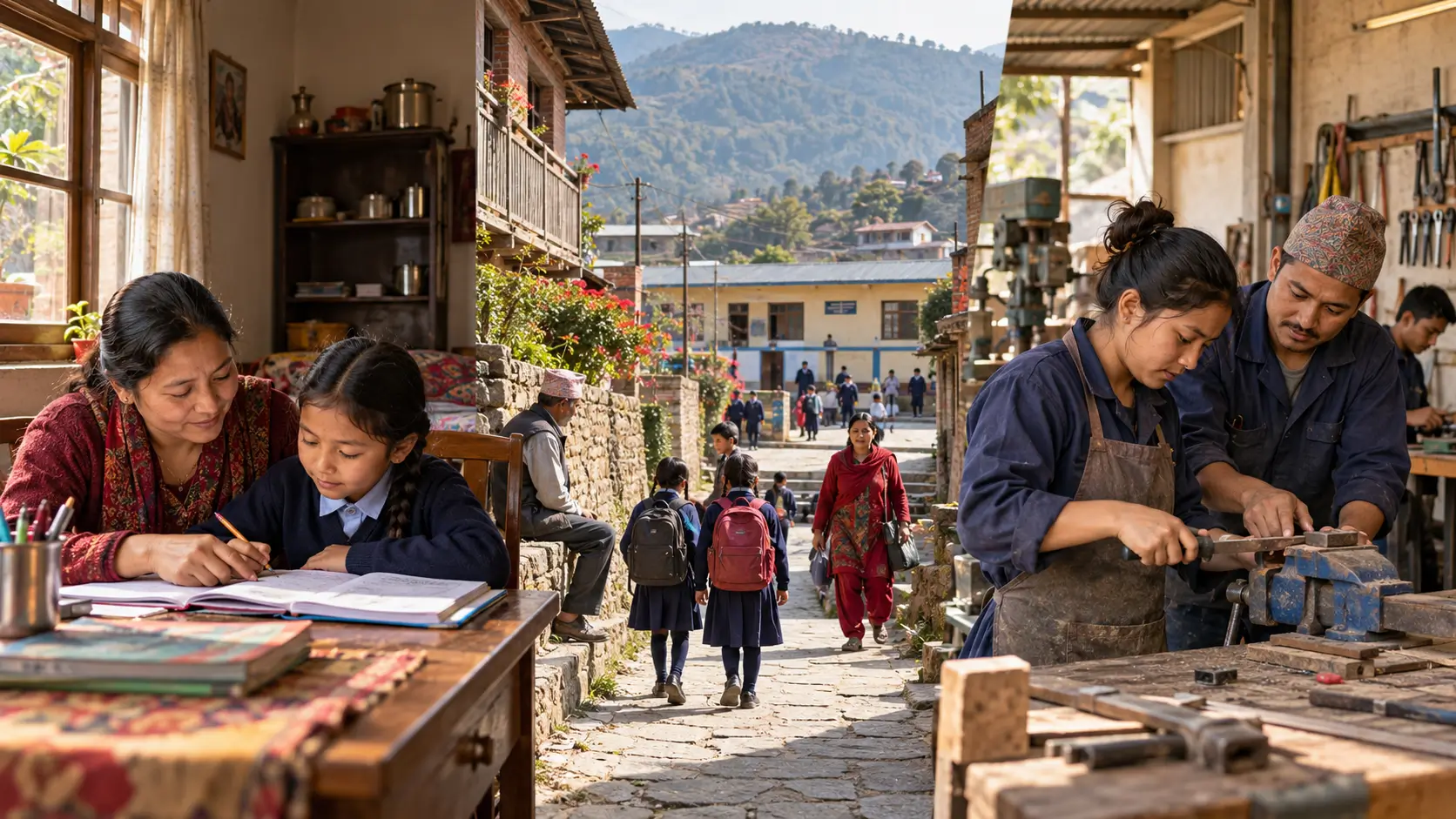
Studying in Nepal may be the better choice when the student’s goal, budget, and risk level match the local pathway.
Choose Nepal if:
-
Your family cannot safely afford overseas tuition and living costs.
-
Your abroad plan would require a heavy loan without a realistic repayment plan.
-
Your target career is mainly Nepal-based.
-
You can access a recognized Nepali university, college, or foreign-affiliated program with verified teaching quality, practical learning support, and a clear academic structure.
-
You need family support for health, emotional, financial, or personal reasons.
-
You want to build local internships, networks, and business connections early.
-
You are not yet ready for foreign study, independent living, strict work rules, and financial pressure.
-
You want to complete a bachelor’s degree in Nepal and consider a master’s degree abroad later.
A strong Nepal-based strategy is not passive. Students should choose a recognized program, build skills outside the syllabus, complete internships, improve English and digital skills, prepare a portfolio, and develop communication ability before graduation.
When Studying Abroad Makes More Sense

Studying abroad may be the better choice when the course and career pathway genuinely benefit from international exposure and the student is prepared for the cost and responsibility.
Choose abroad if:
-
Your course requires facilities, labs, clinical exposure, research networks, or industry access that are stronger abroad.
-
Your family can afford the full degree plan, including emergency money.
-
You meet academic, language, admission, and visa requirements honestly.
-
You understand the destination’s work, tax, accommodation, and compliance rules.
-
Your field has a realistic international career pathway after graduation.
-
You are mature enough to handle loneliness, budgeting, pressure, cooking, transport, and independent decision-making.
-
You have verified the institution, course recognition, refund policy, student support, and post-study options.
-
Your plan still makes sense even if migration or job rules change.
A strong abroad strategy starts with the course, then the institution, then the country. A weak course in a popular country is still a weak decision.
Middle Options: Not Only Nepal vs Abroad
Many students treat the decision as a simple choice between Nepal and abroad. In reality, there are middle options.
Foreign-Affiliated Programs in Nepal
Foreign-affiliated colleges may offer international curricula while allowing students to stay in Nepal. This can reduce settlement risk and family pressure. However, students must verify the awarding university, official affiliation, quality assurance, equivalence possibility, credit structure, assessment system, and total cost.
Credit Transfer or 2+2 Pathways
Some students study part of the degree in Nepal and complete the remaining part abroad. This can work, but only when the credit-transfer arrangement is official, the receiving institution accepts the credits, and the final cost is clearly calculated.
Bachelor’s in Nepal, Master’s Abroad
This is a practical route for many students. It allows students to reduce undergraduate cost, mature academically and emotionally, build a stronger profile, and move abroad later with clearer goals.
Short Exchange, Internship, or Training Abroad
Not every student needs a full foreign degree to gain international exposure. Short-term exchange, training, internship, research collaboration, or online international certification may support the same goal with lower risk.
Productive Gap Year
A gap year is useful only when it has a plan. Students can use it for English test preparation, entrance exams, skill-building, internships, documentation, financial planning, or career clarity. A gap year without structure can weaken motivation and delay progress.
Student Scenarios: Which Path Fits Better?
| Student Situation | Better Starting Point | Reason |
|---|---|---|
| Family budget is limited and loan risk is high | Nepal or middle path | Lower financial pressure and lower settlement risk |
| Student has strong academics, clear course choice, and full financial preparation | Abroad may fit | Higher exposure may be justified if recognition and career pathway are clear |
| Student wants Nepal government service or local career | Nepal may fit | Local recognition and Nepal-based preparation may be more practical |
| Student wants research, advanced labs, or global industry exposure | Abroad may fit | Some fields benefit from stronger research and industry systems |
| Student is unsure about course and career | Nepal, gap year, or counseling first | Abroad without clarity increases financial and academic risk |
| Student wants international curriculum but cannot move abroad now | Foreign-affiliated program in Nepal may fit | A middle path can reduce relocation and visa risk |
| Student wants migration only, not a course-based plan | Reconsider the plan | Migration rules can change; course value should stand independently |
Decision Scorecard for Students and Parents
Rate each item from 1 to 5. A score of 1 means weak. A score of 5 means strong.
| Question | Nepal Score | Abroad Score | Notes |
|---|---|---|---|
| Can my family afford the full cost safely? | |||
| Is the degree recognized for my future career? | |||
| Does the program have strong faculty and practical learning? | |||
| Does the location offer internships or industry exposure? | |||
| Can I manage the lifestyle and emotional pressure? | |||
| Do I have a backup plan if visa, job, or migration rules change? | |||
| Will this choice still make sense if I cannot migrate? | |||
| Do I know the exact admission and documentation steps? | |||
| Can I explain this decision without copying friends? |
If abroad scores high only because of social pressure or expected part-time income, pause. If Nepal scores high but the college quality is weak, compare better colleges or middle-path options.
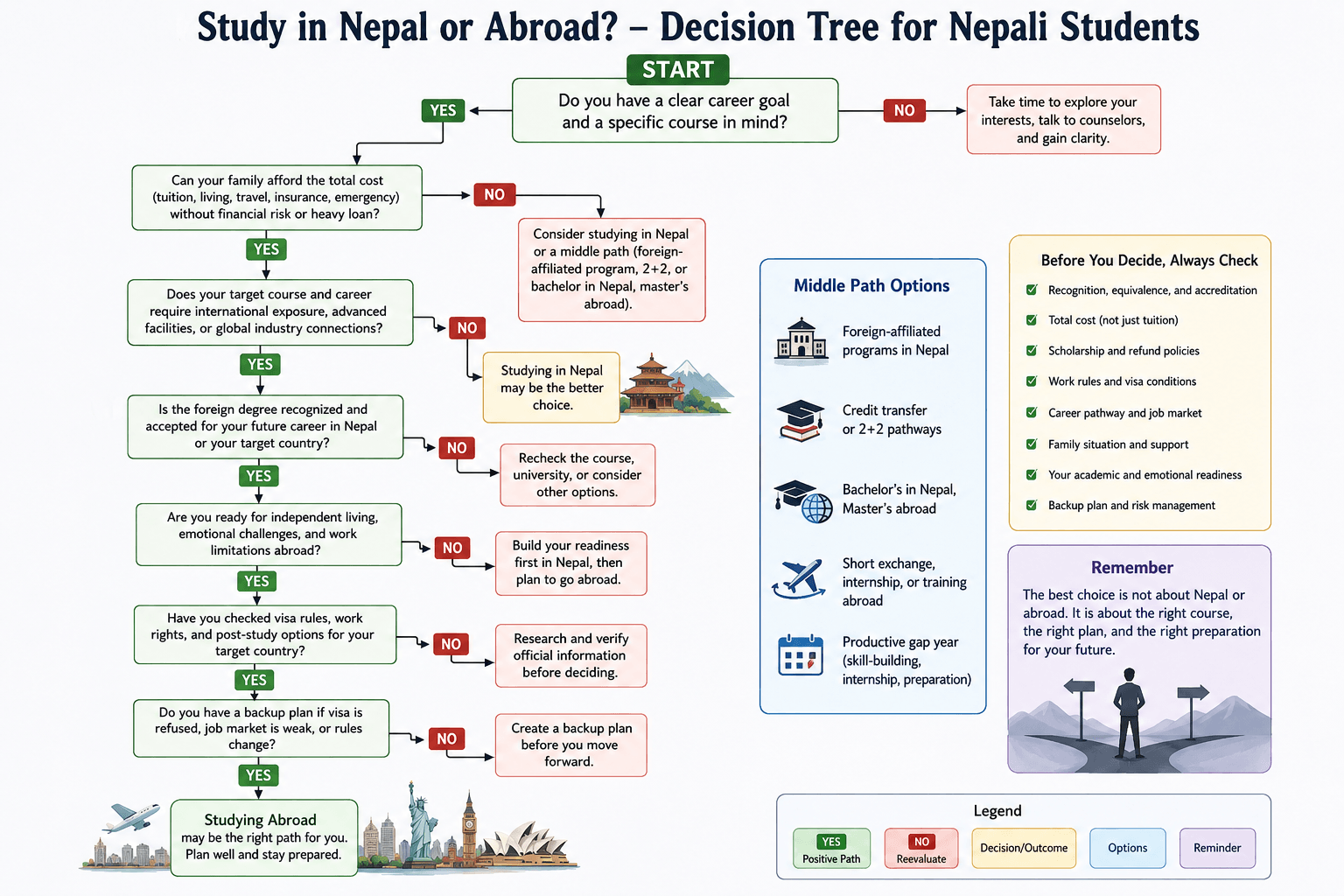
7-Step Checklist Before Deciding
-
Choose your target course and career first.
-
Make a total-cost sheet for Nepal, abroad, and middle-path options.
-
Verify recognition, equivalence, accreditation, and professional licensing.
-
Check official visa, work, and post-study rules for the destination.
-
Talk to current students or alumni, not only consultants or marketing teams.
-
Prepare a backup plan if visa is refused, the job market is weak, or family finances change.
-
Decide with your family using facts, not fear, pressure, or trend.
Common Mistakes to Avoid
-
Choosing a country before choosing the right course.
-
Believing that part-time work will cover all expenses abroad.
-
Ignoring degree recognition and professional licensing.
-
Taking a large loan without a repayment plan.
-
Trusting only social media, friends, or promotional counseling.
-
Choosing a college only because the fee is low.
-
Assuming every foreign degree is better than every Nepali degree.
-
Assuming every Nepali degree is automatically safe.
-
Ignoring emotional readiness, accommodation, food, climate, and cultural adjustment.
-
Paying fees without checking the refund policy.
Final Verdict
For most Nepali students, the best decision is not automatically “Nepal” or “abroad.” The better decision is the path where course quality, recognition, total cost, career outcome, family capacity, and personal readiness match.
Choose Nepal if your priority is affordability, family support, local career growth, or lower financial risk. Choose abroad if your target field genuinely benefits from international exposure and your family can afford the full plan without depending on risky assumptions. Consider a middle path if you want international curriculum or future mobility with lower immediate risk.
The honest answer is simple: do not choose the most popular option. Choose the option that remains useful even if trends, visa rules, job markets, or migration policies change.





Comments 0
No comments yet. Be the first to start the conversation.