



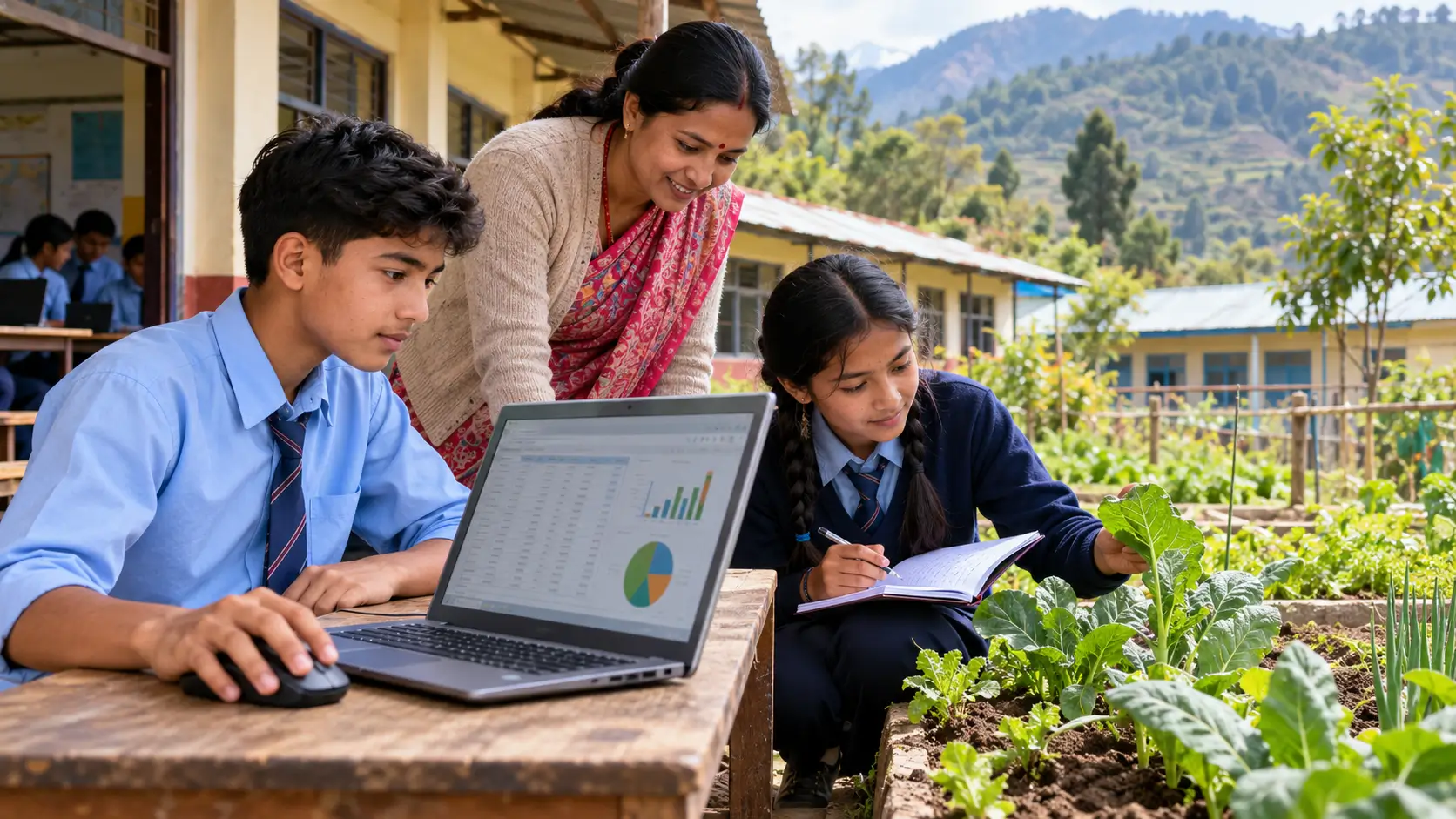
Computer education has once again become an important part of the debate on modernizing Nepal's school education system. With the expansion of information technology, artificial intelligence, and the digital economy, there is a growing need to provide students with practical computer knowledge from the school level.
In 2082 BS, then Minister for Education, Science and Technology Mahabir Pun proposed appointing computer teachers in community schools and making computer education a compulsory subject in Grades 9 and 10. Following his directive, the Curriculum Development Centre prepared a concept paper and initiated discussions on possible course content and implementation.
However, a gap remained between the proposal and its actual implementation. In Baisakh 2083 BS, former minister Pun publicly expressed dissatisfaction that his decision regarding compulsory computer education had not been implemented. More recent materials available from the Curriculum Development Centre also continue to list Computer Science as an optional subject for Grades 9 and 10.
These developments raise an important question about Nepal's education system. Is deciding to introduce a new subject in schools enough, or must we also ensure the availability of teachers, infrastructure, curricula, and a practical learning environment necessary to teach it effectively?
Another equally important question emerges. Should we teach students only how to use computers, or should we also teach them how to connect computer knowledge with their own communities, local economies, and production systems?
For a country like Nepal, which has deep connections with agriculture and rural life, this question provides a starting point for a broader discussion about the relationship between computer education and agriculture in schools.
Why Is Computer Education Necessary?
Today, computers are no longer limited to typing office documents or maintaining financial records. Digital technology is increasingly used in education, healthcare, agriculture, industry, commerce, public administration, and many aspects of everyday life.
For students, learning to use a computer means more than knowing how to open or close software applications. It also involves finding relevant information, evaluating its reliability, organizing data, solving problems, and using technology safely.
These skills can be developed from the school level.
For example, farmers in rural areas can use digital platforms to access weather information, agricultural market prices, government services, agricultural research, and technical advice. Students can help their families and communities find, understand, and use such information.
Similarly, local governments can use digital systems for data management, public services, and planning. Small businesses can use technology to maintain sales and expense records, communicate with customers, and access market information.
In this sense, digital literacy has become an important component of modern education.
However, an important distinction must be understood. Having computers available and developing students' digital competence are not the same thing.
Simply installing computers in schools does not ensure quality computer education. Schools also need qualified teachers, suitable curricula, sufficient practice time, maintenance arrangements, electricity, and internet access wherever possible.
Students must also learn about privacy, cybersecurity, misinformation, and the limitations of answers generated by artificial intelligence.
The purpose of school education should not be merely to turn students into consumers of technology. It should help them become responsible citizens who can use technology appropriately.
Why Should Agriculture and Technology Be Treated as Separate Subjects?
Agriculture occupies an important place in Nepal's social and economic life. Many families in rural areas depend on farming, livestock rearing, and agriculture-related activities for their livelihoods.
From school textbooks to public speeches, we have long described Nepal as an agricultural country.
However, the actual condition of the agricultural sector is complex.
Nepal produces various food grains, vegetables, fruits, and other agricultural commodities. At the same time, the country also imports certain agricultural and food products. Agricultural production, consumption, supply, and imports vary according to the commodity, region, and period.
For this reason, it would be inappropriate to conclude that Nepal's entire food security depends solely on imports. However, challenges involving agricultural productivity, production costs, irrigation, storage, transportation, market access, and fair prices for agricultural products cannot be ignored.
Technology alone cannot solve these problems. Agricultural research, infrastructure, access to finance, effective market systems, and farmer-friendly policies also have important roles.
Nevertheless, appropriate technology can help farmers access information, maintain records, make decisions, and manage production.
This is where school education has a role to play.
When students gain basic knowledge about local soil, climate, crops, food production, and the agricultural economy, they can connect computer applications with real-life situations.
Computer education and agriculture are not competing subjects. With appropriate teaching methods, they can complement each other.
How Can a School Project Transform Learning?
Imagine a group of Grade 9 students assigned a local agricultural study project by their school.
Under their teacher's guidance, the students observe the school garden or nearby farmland. They collect information about locally grown crops, soil conditions, irrigation sources, and common farming practices.
They then learn basic soil-testing methods with the assistance of a local agricultural technician.
Students can learn what soil pH means and how it indicates acidity or alkalinity. They can also understand that a single pH result cannot determine the levels of all essential nutrients in the soil.
Reliable information about nutrients such as nitrogen, phosphorus, and potassium may require appropriate testing and consultation with agricultural technicians.
In the next stage of the project, students use computers.
They examine weather information available from the Department of Hydrology and Meteorology. They search official agricultural and market information sources to learn about crops and prices.
They then organize the collected data in spreadsheets.
For example, students can study the estimated production cost of a particular vegetable crop. They can prepare a cost estimate by separating expenses for seeds, fertilizers, irrigation, labor, transportation, and other inputs.
They can also compare different production and potential selling-price scenarios to estimate possible profits or losses.
Through this process, students learn that market prices are not always stable, weather forecasts involve uncertainty, and wholesale market prices may differ from the prices farmers receive at the farm.
Such exercises help students understand the relationships among computers, mathematics, science, economics, and local agricultural systems.
More importantly, they learn to compare the results of information collection and analysis with actual conditions.
Students develop computer skills, acquire basic agricultural knowledge, and practice making decisions based on data.
This is one possible model of practical education that connects soil and mouse.
How Can Modern Agricultural Technology Create New Opportunities?
The potential applications of computers and digital technology in agriculture extend beyond basic recordkeeping and school projects.
Satellite imagery and data, weather information, geographic information systems, digital marketplaces, agricultural management software, and artificial intelligence-based tools have created new possibilities for agricultural research and management.
For example, when suitable data are available, agricultural researchers can study crop conditions. Digital records can help compare production costs, resource use, and sales information.
Some artificial intelligence-based tools can help identify possible crop diseases or pest problems using images of plants.
However, the results produced by such tools are not always accurate. Similar symptoms can arise from different causes. For this reason, recommendations from digital tools should not be treated as the sole basis for a final diagnosis or treatment.
Important decisions concerning crop diseases, fertilizers, and other agricultural management practices require reliable research and advice from qualified agricultural technicians.
Students should learn this distinction at school.
Understanding what technology can do, what it cannot do, and when expert assistance is necessary is also an important part of digital literacy.
This form of education can provide a foundation for students interested in agricultural research, agricultural engineering, information technology, agricultural entrepreneurship, and digital agricultural management.
However, its purpose should not be to encourage every student to pursue an agricultural career. Having basic knowledge of local production systems and choosing agriculture as a profession are two different things.
Agriculture Is Already in the Curriculum, but How Strong Is Its Practical Connection?
Agriculture-related subjects are not new to Nepal's school and technical education systems.
The Curriculum Development Centre has published agriculture-related curricula and learning materials for secondary education. An optional Agriculture Education curriculum is also available for Grade 9.
Similarly, the Council for Technical Education and Vocational Training (CTEVT) offers curricula for diploma programs in Plant Science, Animal Science, Agricultural Engineering, and other agriculture-related fields.
This indicates that a formal foundation for agricultural education already exists in Nepal.
However, the availability of an agriculture curriculum does not necessarily mean that every student receives practical knowledge of agriculture and local production.
The same question applies to Computer Science.
Even if students pass their computer examinations, what matters is how effectively they can organize real data, verify information, or explore solutions to local problems.
For this reason, discussions about introducing new compulsory subjects should also include a review of how existing subjects are taught and applied in practice.
Whether agriculture and digital literacy should become separate compulsory subjects or be taught through an integrated approach involving science, mathematics, social studies, computers, and local curricula should be decided through adequate study and consultation with relevant stakeholders.
Adding subjects without considering curriculum workload, teacher availability, school capacity, and students' learning needs may not produce the expected outcomes.
Let Schools Become Laboratories for Local Learning
Connecting schools with local production and research does not necessarily require extensive physical infrastructure.
Different activities can be introduced according to a school's location, available resources, and students' ages.
Schools with available land can establish small educational gardens. Schools with limited space can grow plants in pots and observe their development.
Schools without suitable growing space can organize study projects with support from local farmers, agricultural technicians, cooperatives, or agricultural research institutions.
Through such activities, students can collect information about crop growth, weather, water use, production costs, and markets.
They can enter the collected information into computers and prepare tables, graphs, and basic reports.
Even when schools do not have internet access, some activities can be completed using offline spreadsheets, local records, and previously provided educational materials.
However, these projects must ensure student safety, health, clear educational objectives, and equal opportunities for participation. The use of hazardous agricultural equipment or chemicals should not be part of students' practical activities.
Students need to understand the value of labor, but educational activities should not impose unnecessary production or commercial workloads on them.
The priority should not be how much produce a school garden generates. It should be what students learn, what questions they raise, and how they analyze the information they obtain.
This approach can help transform schools into learning centers connected with local life.
What Is Needed to Connect Computer Education with Agricultural Literacy?
Several basic requirements must be addressed to implement this concept effectively in school education.
The first requirement is teacher preparation. Computer teachers need opportunities to develop digital skills, along with knowledge of teaching methods based on local data and projects. Agriculture and science teachers should also be able to use relevant digital tools.
The second requirement is to implement programs according to the actual conditions of individual schools. Not all schools have the same infrastructure, student population, local economy, or geographical circumstances.
Agricultural studies appropriate for schools in mountain regions may differ from activities relevant to schools in the Terai. Urban schools can also study food supply, market management, rooftop farming, and agricultural value chains.
The third requirement is cooperation among local governments, schools, and technical institutions.
Local agricultural knowledge centers, technical institutions, research organizations, and experienced farmers can help students understand local conditions.
The fourth requirement is improvement in learning assessment. Instead of measuring achievement only through students' ability to memorize definitions, schools should also value their abilities to collect and analyze data, present findings, and solve problems.
Ultimately, efforts to connect computer and agriculture education should not remain limited to extracurricular activities in individual schools. Successful practices can be reviewed, and suitable methods can be incorporated into curricula and teaching processes.
Skilled Human Resources, Employment, and the Debate on Migration Abroad
The overseas education and employment of educated young Nepalis have been subjects of discussion for many years.
A student who learns computing at school may eventually become a software engineer, researcher, or another skilled professional and move abroad. However, this does not mean that computer education has failed.
Individuals have the right to pursue education and choose their professions and places of residence.
It would be inappropriate to view students' decisions to go abroad as the only problem. We must also examine domestic employment opportunities, research prospects, the environment for entrepreneurship, economic possibilities, and public policies.
Nepali students need knowledge and skills that meet global standards. At the same time, developing local opportunities where such knowledge can be applied is equally important.
The relationship between agriculture and technology can be useful in this context.
A student of Computer Science may develop software for agricultural businesses. A student of agriculture may use digital data. A management student may work on agricultural markets, production costs, and supply chains.
Such possibilities are not limited to agriculture. Knowledge from different disciplines can also be connected with technology in healthcare, tourism, education, industry, and public services.
School education should not restrict students to a narrow choice between studying computers and studying agriculture.
Instead, it should develop their understanding of how knowledge from one subject can be applied in another field.
Respecting the Soil and Using Technology
An important aspect of agricultural education also concerns social attitudes.
In our society, there is sometimes a tendency to regard office-based professions as more prestigious and farming-related work as less valuable.
School education can help change this perception.
When students understand the food production process, farmers' labor, production costs, weather-related risks, and market conditions, they can develop a clearer appreciation of the importance of agricultural professions.
However, respecting agriculture does not mean that every student must become a farmer.
Even citizens who are not directly involved in agricultural production can benefit from basic knowledge of food security, natural resources, local economies, and sustainable production.
Similarly, recognizing the importance of computer education does not mean that every student must become a programmer.
The real purpose of education is to develop students' knowledge, skills, thinking abilities, and capacity to make decisions.
This is also the central idea behind connecting soil and mouse.
We need students who know how to use computers. We also need students who can understand the meaning of information obtained through computers and compare it with the realities of their own communities.
Conclusion: Connect the Computer Screen with the Farmland
The debate about making computer education compulsory in Nepal's schools is important. However, the decision to make a subject compulsory should not be considered the final achievement of educational reform.
For computer education to produce meaningful outcomes, schools must have qualified teachers, infrastructure, practical curricula, and equitable access for all students.
At the same time, school education should provide basic knowledge about local life, agriculture, the environment, and production systems.
Students should understand the digital world without becoming disconnected from the social and economic realities around them.
They should learn to access weather information while also considering how that information may affect local farming.
They should learn to perform calculations in spreadsheets while also understanding the meaning of production costs and market-price data entered into them.
They should learn to use artificial intelligence while also developing the ability to question its answers and verify AI-generated information against reliable sources.
We need citizens with digital skills. We equally need citizens who understand the importance of local production, farmers' labor, food security, and natural resources.
These two objectives are not in conflict.
Let us expand effective computer education in schools. At the same time, let us ensure that every student has the opportunity to acquire basic practical knowledge about local soil, agricultural production, and food systems.
Education should not be limited to examinations and certificates. It should be connected with real life.
Let us connect computer screens with farmland, digital data with local production, and modern technology with the actual needs of Nepali society.
This connection between technology and the soil can help make Nepal's school education more practical, relevant, and useful in everyday life.Editorial Notes from the Original Source
The original source states that its editorial and factual review has been completed. It explains that the article's central argument, reasoning, and authorial style have been preserved while unverified claims, exaggerated expressions, technical ambiguities, and language errors have been corrected. In particular, the proposed compulsory computer education policy has not been presented as an already implemented policy.
The source identifies the article as suitable for publication as an opinion article, rather than a news report announcing that compulsory computer education has already been implemented.
The supplied fact-checking section identifies source organizations but does not provide complete, direct links to the underlying reports and publications. Those references should be checked before publication if the article is to include independently verifiable source citations.





Comments 0
No comments yet. Be the first to start the conversation.