




Nepal Education Roles: Federal to School Level
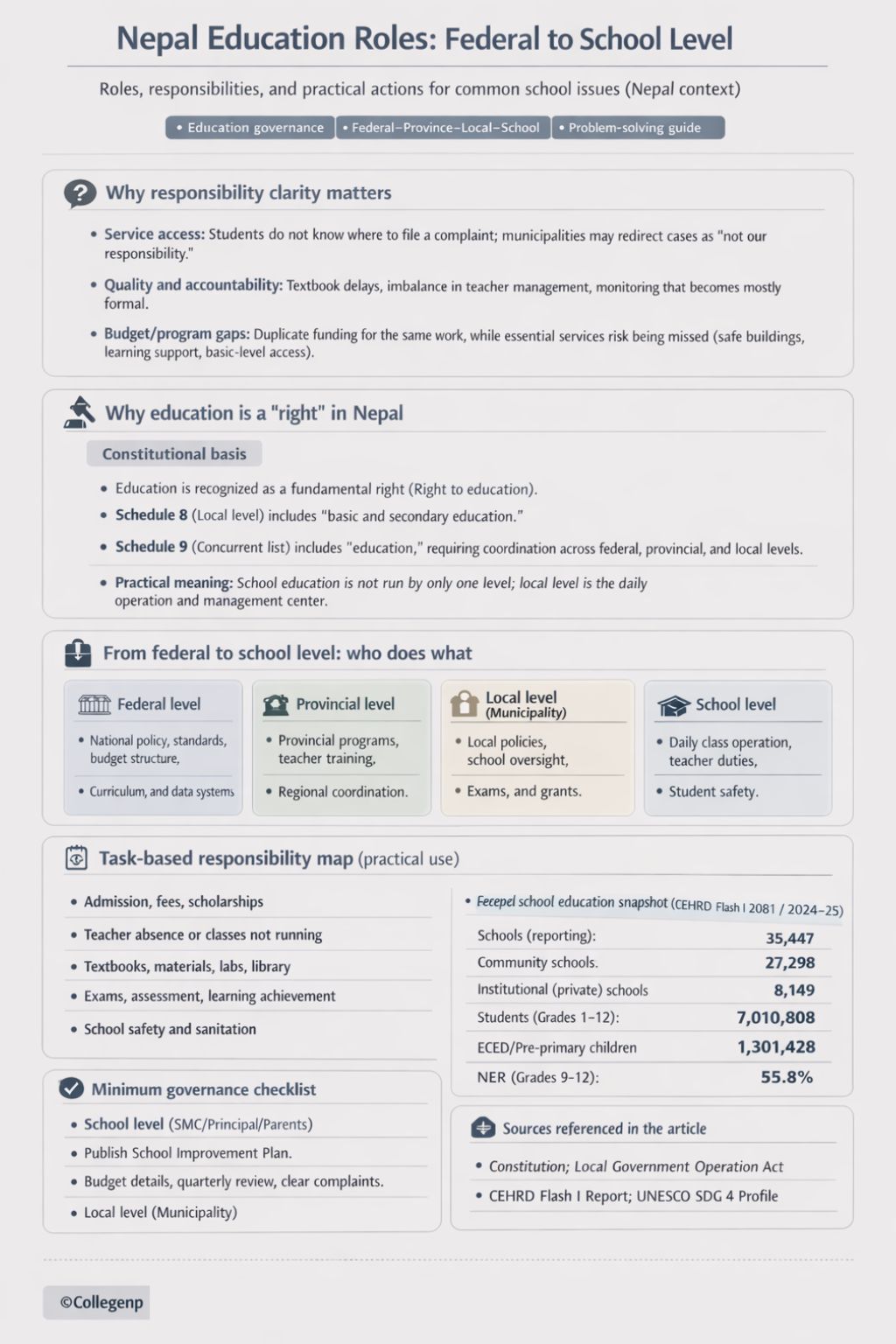
In Nepal, school education work (from Early Childhood Education/Pre-primary to Grade 12) is divided across multiple levels: federal, provincial, local, and school.
When responsibilities are unclear, three practical problems repeatedly appear.
-
Service access problem: Students do not know "where to file a complaint," and the municipality may send them back saying "this is not our responsibility."
-
Weak quality and accountability: Delayed textbooks, imbalance in teacher management, monitoring that remains mostly formal, and similar issues.
-
Duplicate or missing budget and programs: The same work is funded twice, while some essential services (such as quality access at the basic level, safe buildings, learning support) may be missed.
The aim of this article is to clearly explain, based on the Constitution and key legal provisions, who has what role in the education sector, and to provide a practical pathway for where and how to seek solutions when real-life problems arise.
Why education is education called a "right" in Nepal
Constitutional basis
The Constitution recognizes education as a fundamental right (Right to education).
In the division of powers, the local level list (Schedule 8) includes "basic and secondary education."
Because the concurrent list (Schedule 9) includes "education," there are also areas where coordination and shared responsibility apply among the federal, provincial, and local levels.
The practical meaning is that school education is not a subject run by only one level, but the local level is regarded as the daily operation and management center for school education.
From federal to school level: roles, powers, responsibilities
What the federal government does (Federal level)
The federal role generally focuses on "national policy, standards, coordination, and resource management." In practice, the federal government’s main work falls into the following areas.
National policy, law, and standards
-
Develop national policies and plans for school education, minimum standards for the education sector, and frameworks for system-level reform.
-
Because it is a concurrent area, develop legal and policy frameworks to be implemented jointly with provincial and local levels.
Macro arrangement of budget and resources
Develop the national budget and grant structure, including conditional and equalization grants, and the framework for resource flow to operate school education (the way funds reach local levels is also tied to this framework).
National curriculum, measurement, and data systems (coordination)
Maintain a coordination and standardization role in the national curriculum, learning targets, assessment frameworks, and education data systems (such as EMIS/Flash report systems).
Note: All aspects of the federal role may not appear as a single "listed" set in one law, but the Constitution’s concurrent and fundamental rights framework validates the federal policy and standards role.
What the provincial government does (Provincial level)
At the provincial level, the education role mainly revolves around "provincial policy and plans, capacity development, coordination, and provincial monitoring."
Because of the concurrent list, provinces can coordinate with the federal level and may be active in work such as:
-
Developing provincial education policies and programs
-
Teacher capacity development, training, and technical support
-
Cooperation to reduce inequalities among local levels
-
Strengthening data and monitoring mechanisms at the provincial level
The detailed list of responsibilities may differ across provinces depending on provincial laws and directives, so local readers should also review their province’s education ministry and relevant guidelines.
What the local level does (Rural municipality/Municipality): the main operational center of school education
The role of the local level is clearly defined by the Constitution and the Local Government Operation Act, 2017 (2074 BS).
Under "basic and secondary education," the Act provides a detailed description of local-level functions, ranging from making local policies, laws, and plans to school permission, management, monitoring, examinations, scholarships, teacher post balancing, infrastructure, grants, and tuition/coaching regulation.
Major local-level responsibilities (in simple terms)
Local levels generally manage these "10 groups" of work.
-
Planning and regulation
Local education policies, laws, standards, and plans; implementation; monitoring and evaluation; regulation. -
Regulation of school establishment, permission, and operation
Establishment, permission, operation, management, and regulation of community schools, institutional (private) schools, guthi schools, and cooperative schools. -
School management structures
Formation and management of rural/municipal education committees; formation and management of school management committees. -
School mapping, approval, and adjustment
School mapping, permission, approval, adjustment, and regulation. -
Teacher and staff management (a major local-level challenge area)
Balancing teacher and staff posts in community schools (deployment balance), and coordination for necessary training and capacity development. -
Examinations and assessment (at least up to the basic level)
Operation, monitoring, and management of basic-level examinations; management of student learning achievement testing. -
Scholarships, incentives, and management of free education
Management of free education, student incentives, and scholarships. -
Learning materials and quality
Improving school quality, distributing learning materials, and operating and managing local libraries/reading rooms. -
Infrastructure and assets
Construction, maintenance, and operation of educational infrastructure in community schools; asset records, protection, and management. -
Regulation of teaching services outside school
Permission and regulation of teaching services outside school, such as tuition/coaching.
Legal responsibility of the local level in issues such as "refusing admission" or "the school is far"
The law on "compulsory and free education" further clarifies rights and duties related to school access and admission.
-
Every child has the right to receive basic or secondary education from a convenient school near the guardian’s place of residence.
-
If there is no nearby school for children of basic-level school age, there is a provision for the local level to establish a school or arrange an alternative option.
-
The same law also sets the principle that a school cannot "arbitrarily" refuse admission at the basic level when a guardian requests enrollment (with some practical limits or standards-based exceptions).
This section is important for young readers because daily issues such as admission, distance, fees, and scholarships fall directly within the local level’s scope.
What the school level does (School level): the real field of policy implementation
At the school level, daily implementation matters more than "policy and law." The school role is easiest to understand through four centers.
Leadership and academic management
The principal and academic leadership prepare timetables, run classes, monitor teachers, support student learning, manage records, and develop learning achievement improvement plans.
Teachers’ professional responsibilities
Class teaching, homework and assessment, supporting students with learning difficulties, attendance and discipline, and regular communication with parents.
School Management Committee (SMC) and parent-teacher collaboration
Budget and work plans, coordination with the local level, social audit and public hearings, and setting priorities for school improvement.
Student safety, well-being, and environment
Safe premises, basic sanitation, emergency preparedness, and discipline and protection systems (a school may implement its own code of conduct and child protection guidelines, but minimum standards must align with local and federal directives).
Making "Who does what?" practical: a task-based map
Here, responsibility is understood by tasks rather than by levels. This approach is useful for young readers in real life.
Admission, fees, scholarships
School role
-
Make admission procedures transparent, avoid unnecessary barriers at the basic level, and clearly publish fees and charges.
-
Maintain recommendations and records according to the scholarship and incentive lists and criteria set by the local level.
Local level role
-
Ensure access to a nearby school; receive and investigate complaints if admission is refused, fees are excessive, or irregularities occur.
-
Manage scholarships and free education, and monitor school income-expenditure discipline.
Practical solution: what students and guardians can do
First step: Submit a written application or enrollment request at the school (include date, grade, and reason).
Second step: File a complaint at the ward office or education section (for admission refusal, excessive fees, or not receiving scholarships).
Third step: Approach the rural or municipal education committee or the local executive body (if unresolved).
Required evidence: school notice, fee list, written or message proof of admission refusal, and copies of citizenship or birth registration (as required by law).
Teacher shortage, teacher absence, classes not running
School role
-
Run classes on time, ensure teacher attendance, arrange substitution classes, and inform parents.
-
Plan remedial and support classes when learning achievement declines.
Local level role
Balance teacher and staff posts, provide capacity development and training, monitor, and follow necessary procedures for action.
Practical solution: what to do after the problem is seen
Student: If classes do not run regularly, submit a written complaint to the principal on "class operation and teaching."
Parents and SMC: Request the school’s monthly attendance and class operation report (pressure for it to be made public).
Local level: Send a monitoring team from the education section, manage teachers (post balancing and adjustment), and issue necessary instructions or actions.
Textbooks, materials, laboratories, libraries
This area is often linked to the issue "there is a program, but there are no materials."
School role
Prepare a needs list (book and material needs), keep distribution records transparent, and create a usage plan for laboratories and libraries.
Local level role
Management and coordination related to the distribution of learning materials and quality improvement.
Practical solution
If the school has not publicly shared a grade-wise distribution list for textbooks and materials, the SMC and parents should request it.
If delays or irregularities are seen in distribution, the local level should conduct audit and monitoring at the school level.
Examinations, assessment, and learning achievement
The Local Government Operation Act identifies operation and management of basic-level examinations and learning achievement testing as a local-level function.
School role
Regular assessment, parent reporting, and support plans for weaker students.
Fairness in exam operation, question security, and secure record-keeping of answer scripts.
Local level role
Monitoring basic-level exam and assessment processes and managing learning achievement testing.
Practical solution
If results are extremely weak, before asking "who is at fault," identify the cause chain: class operation, teacher attendance, practice and homework, support class arrangements, and home study time.
The school and the municipality can jointly develop a learning improvement plan:
-
Curriculum-based minimum learning targets
-
Weekly practice plan
-
A study-support agreement with parents
-
A 6 to 8-week remedial cycle
-
Re-test
School safety, building risk, sanitation
School safety is not only the building. It includes the building, sanitation, safe travel, emergency preparedness, and risk management.
The local level recognizes school infrastructure construction, maintenance, and operation as its work.
Practical solution: minimum safety checklist (School and SMC)
-
Annual check of roof and wall cracks in classrooms
-
Regular maintenance of toilets and water
-
Exit routes for risks such as fire, earthquake, and landslide
-
First-aid materials
-
A school premises risk map (on the school board)
Even if the local budget is limited, low-cost safety steps (exit signs, closing unsafe rooms, basic repairs) can be done immediately.
How many schools are there in Nepal? How many students study up to Grade 12?
Two points should be kept in mind when reading the figures.
-
Number of schools and number of students can differ by academic year, reporting schools, and level or grade definitions.
-
Indicators such as Net Enrolment Rate (NER), Gross Enrolment Rate (GER), and survival rate may differ somewhat between international and national definitions. UNESCO-UIS prepares country profiles based on ISCED classification.
Number of schools: what the latest CEHRD Flash I 2024 to 25 (2081 BS) says
According to the Center for Education and Human Resource Development (CEHRD) Flash I Report 2024 to 25 (2081 BS), the total number of schools that provided data is stated as 35,447.
Among them:
-
Community schools: 27,298
-
Institutional (private) schools: 8,149
This may be based on reporting schools (Flash reports are often based on administrative data collection), so other agencies or reports may present different numbers.
Number of students: how many students study up to Grade 12?
According to the same Flash I Report 2024 to 25 (2081 BS):
Total students in basic (Grades 1 to 8) and secondary (Grades 9 to 12)
-
Grades 1 to 8: 5,347,068 students
-
Grades 9 to 12: 1,663,740 students
-
Total Grades 1 to 12: 7,010,808 students
How many students are in Grades 11 and 12 (Higher secondary)?
-
Grade 11: 338,887 students
-
Grade 12: 334,968 students
-
Total Grades 11 to 12: 673,855 students
This is the most direct and useful answer to the question "How many students study up to Grade 12?", at least on the basis of administrative reporting.
How many children are in ECED and Pre-primary?
According to Flash I Report 2024 to 25 (2081 BS):
ECED and PPC (Early Childhood Education and Pre-primary classes): 1,301,428 children.
Note: ECED figures may differ across sources (sometimes number of centers, sometimes number of children, sometimes only reporting centers). Therefore, it is best to also check the report’s definitions and headings.
Net Enrolment Rate (NER) and why figures can differ
In Flash I Report 2024 to 25 (2081 BS), the NER for Grades 9 to 12 is stated as 55.8 percent (reported as having decreased from 56.8 percent in the previous year).
However, some non-government or secondary sources cite figures such as Primary (Grades 1 to 5) NER 96.9 percent, and Basic (Grades 1 to 8) NER 92.7 percent.
Why do these differences occur?
-
Different grade ranges: some define secondary as Grades 8 to 12, others as Grades 9 to 12.
-
Different years: Flash 2024 to 25 (2081 BS) versus older Flash or other reports.
-
Different data sources: administrative data versus survey data; organizations such as UNESCO-UIS may also use modeled data.
Problem-solving Action Guide
This section is prepared to be the most practically useful part of the article. Whether you are a student, guardian, SMC member, or a young volunteer, you can use the steps below.
If a school refuses to admit a student
Problem signs
-
Refusal saying "there is no seat" when seeking admission at the basic level (Grades 1 to 8)
-
Requesting unnecessary documents
-
Pressure to "pay fees first"
Why a solution is possible
The law on compulsory and free education clearly sets the right to receive basic and secondary education from a nearby school and the local level’s responsibility to arrange access.
Steps
-
Register a written application or request at the school (keep registration number and date).
-
If there is no response or admission is refused within 3 to 7 days, file a complaint at the ward office or education section.
-
The education section can proceed by checking school capacity and standards and arranging alternatives (a nearby school, class adjustment, or additional class and teacher management as needed).
If fees are unclear or keep increasing
Steps
-
Submit a written request to the school for the fee structure (to be posted on the notice board).
-
Request meeting minutes from the SMC or parent gathering decisions.
-
File a complaint at the local level education section regarding school income-expenditure discipline and monitoring.
-
The local level has authority and responsibility for school grants, budget management, accounting discipline, and monitoring and regulation.
If teachers do not attend regularly or classes do not run
Steps
-
Request the class diary and attendance list (maintained by the school).
-
Hold a written meeting with the principal (with a solution timeline).
-
If unresolved, request monitoring by the education section.
-
The local level’s authority for balancing teacher posts, capacity development, and monitoring and regulation is clear.
If the school building is risky or there are toilet and water issues
Steps
-
Provide risk evidence (photos and videos) and submit a school improvement request letter.
-
Request the local level to prioritize infrastructure maintenance and construction.
-
The local level’s responsibility for school infrastructure construction, maintenance, and operation is stated in the Act.
How to build good school governance
For young readers, the word "governance" may sound large. But the meaning is simple: how decisions are made, how money is spent, how quality improves, and how accountability works when something goes wrong.
Minimum governance practices at the school level (SMC, Principal, Parents)
-
Publicly share the annual School Improvement Plan
-
Publicly share budget and grant details (notice board and parent meeting)
-
Quarterly progress review (attendance, results, dropout signals, building maintenance)
-
Clear complaint-hearing process (to whom, how, and response timeline)
Minimum governance practices at the local level
-
Update school mapping (where schools are needed and where to merge)
-
Clear standards for teacher post balancing
-
Minimum standards for examinations and assessment
-
Transparency in scholarship distribution
-
Make school monitoring learning-focused rather than paper-focused
Summary: Who does what?
Key principle: School education is the main responsibility area of the local level, but coordination with the federal and provincial levels is mandatory.
Federal: National policy and standards, macro resource framework, system-level coordination.
Province: Provincial planning, coordination, capacity development, and technical support to local levels (may differ by provincial laws and directives).
Local level: Planning and regulation, school permission and adjustment, formation of education committees and SMC, basic exams and learning testing, scholarships and free education, teacher post balancing, infrastructure, grants, tuition and coaching regulation.
School: Class operation, learning improvement, leadership and records, transparency, student safety, collaboration with the community.
Fact-source verification
Verified sources used: Constitution (Article 31; Schedule 8 and Schedule 9); Local Government Operation Act, 2017 (2074 BS) (work list related to basic and secondary education); legal provisions on compulsory and free education (convenient school, guardian duty, local responsibility); CEHRD Flash I Report 2024 to 25 (2081 BS) school and student counts, Grades 11 and 12 data; UNESCO-UIS SDG 4 Nepal Country Profile (data type, ISCED mapping, SDG indicators reference); School Education Sector Plan (baseline and targets reference).
Numerical data QC
-
Schools: 35,447 (Flash 2024 to 25 (2081 BS), reporting schools)
-
Students (Grades 1 to 12): 7,010,808
-
Grade 12: 334,968
-
NER (Grades 9 to 12): 55.8 percent (Flash 2024 to 25 (2081 BS))
Disclaimer
This content is information-based. It is not a substitute for legal interpretation or advice. Before proceeding with policy and legal decisions or complaint processes, review the latest laws, regulations, and directives of the relevant authorities.





Comments 0
No comments yet. Be the first to start the conversation.