



Khas-Arya in Nepal: Demographics, History, Surnames
In Nepal, the term “Khas-Arya” is widely used in everyday social discourse. However, its meaning, scope, and historical interpretation can differ depending on context. For that reason, writing on this topic requires clear definitions, source-based statistics, and careful presentation of historical claims.
This article does not aim to label any community as superior or inferior. Instead, it seeks to help readers understand demographic indicators, historical debates, and general patterns in the evolution of surnames and names.
Use and scope of the term “Khas-Arya”
In practice, “Khas-Arya” is often used to refer to Hill Brahmin, Chhetri, Thakuri, Sanyasi/Dashnami, and some Hill Dalit communities that have historical links with the Khas linguistic and cultural region. However, the national census does not always place all such groups under a single combined heading called “Khas-Arya.”
Therefore, when someone claims “Khas-Arya totals X percent,” it is important to clarify exactly which categories have been included in that calculation.
In this context, it is more relevant and responsible to discuss the issue using data from separate categories in the 2068 (2011) census, rather than relying on an unspecified combined percentage.
Key indicators visible in the 2068 (2011) census
According to the 2068 (2011) census, Nepal shows the following:
-
The Chhetri population is 16.6 percent (around 4.4 million).
-
The Hill Brahmin population is 12.2 percent (around 3.2 million).
-
The Kami population is around 4.8 to 5 percent (around 1.2 to 1.3 million).
If these headings are presented as a single “group” without clearly defining the terms and calculation method, it can create confusion. For this reason, this article prioritizes category-wise figures over a combined total when drawing broader conclusions.
For a more recent nationwide count and related summaries, readers may also refer to the Nepal Census 2078 results.
Identity connected with language, culture, and tradition
Language, culture, rituals, and traditions shape identity. In Nepal’s hill societies, Vedic and Tantric traditions often coexist. In some places, Vedic practices are more prevalent; in others, Tantric or local practices are stronger.
However, presenting cultural practices as proof of “inherent” high or low status is scientifically, ethically, and socially problematic. For a broader perspective on Nepal’s diversity, see cultural diversity in Nepal.
Dashnami Sanyasi and social structure
Within this community, sanyasis with ten traditional “names/titles” are commonly referred to as Dashnami. The widely used ten names are:
-
Puri, Giri, Bharati, Van, Ashram
-
Tirtha, Aranya, Parvat, Sagar, Saraswati
Dashnami settlements are found across different parts of Nepal. In some areas, communities are concentrated; in others, they are dispersed. A key point is that “Dashnami” is a religious-sectarian terminology, and not every individual or family necessarily uses it in the same way.
Surname usage: many surnames, many backgrounds
Nepal has a large number of surnames associated with Brahmin, Chhetri, Thakuri, and Sanyasi/Dashnami communities. Examples include Awasthi, Acharya, Adhikari, Aryal, Upreti, Oli, Ojha, Basnet, Bisht, Karki, Kafle, Khadka, Khatiwada, Koirala, Kandel, Kattel, Khanal, Gaire, Gautam, Ghimire, Joshi, Jaisi, Dhakal, Dhungana, Tiwari, Tripathi, Thapa, Dahal, Devkota, Niroula, Nepal, Neupane, Pant, Parajuli, Pathak, Pandey, Pokhrel, Paudel, Prasai, Baral, Bhattarai, Bhandari, Bhusal, Mainali, Rijal, Rimal, Regmi, Lamichhane, Luintel, Wagle, Sapkota, Sitaula, Subedi, and others.
Another important point is this: a shared surname does not automatically mean the same lineage or the same ethnic origin. Historically, surnames may have developed due to occupation and rank, geography, local renaming practices, marriage and migration, and administrative systems.
Therefore, making firm claims about a community solely on the basis of surnames requires evidence such as records, genealogies, local histories, and documents.
Social superstition and discrimination: a critical but responsible view
Ironically, practices of untouchability and caste-based discrimination within many communities have historically weakened social unity. Such discrimination:
-
Violates human dignity and equality.
-
Obstructs social harmony and development.
-
Is unacceptable from both legal and ethical perspectives.
The tendency to justify discrimination as “tradition” or “religion” is harmful to society in the long term. The issue becomes even more serious when discrimination exists not only between communities, but also within the same group.
The core focus of solutions must be education, legal implementation, and equality in daily behavior. For a broader discussion of how discrimination has changed over time, see the evolution of discrimination in society. For an institutional reference point in Nepal’s context, see the Rastriya Dalit Aayog.
Historical background of the Khas: debates and limits
There is no full consensus among researchers regarding the origin, arrival, or earliest settlement of the Khas. Some writers and studies explain Khas settlement and state formation in connection with western Nepal, especially the Karnali region. Another approach attempts to link Khas origins to trans-Himalayan or Central Asian contexts.
When presenting such claims, two points are essential:
-
Clarify that it may be one interpretation among others.
-
Avoid writing unverified or disputed claims as definitive truth.
Accordingly, this article presents historical conclusions as possibilities or perspectives, not as final truth.
Etymology of surnames: two common patterns linked to posts and geography
No single rule applies everywhere regarding surname origins. However, many surnames associated with Khas-related regions often show two broad patterns.
Surnames formed from state posts and ranks
Some surnames are explained in relation to roles and responsibilities in older state systems or administrative and social structures. For example:
-
Adhikari: commonly interpreted as linked to administrative responsibility and leadership roles
-
Karki: commonly interpreted as linked to revenue or administrative roles
-
Bhatt/Bhandari/Mahat: commonly interpreted as linked to religious-state functions, treasury systems, or village leadership
-
Thapa, Khadka, Rana, Budha, Basnet: commonly interpreted as linked to military or state structures
The word “interpretation” is important here, because conclusive proof that every surname everywhere emerged from the same meaning at the same time is not always available. Where local records and historical documents confirm an origin, that evidence is more reliable.
Surnames formed from places of origin
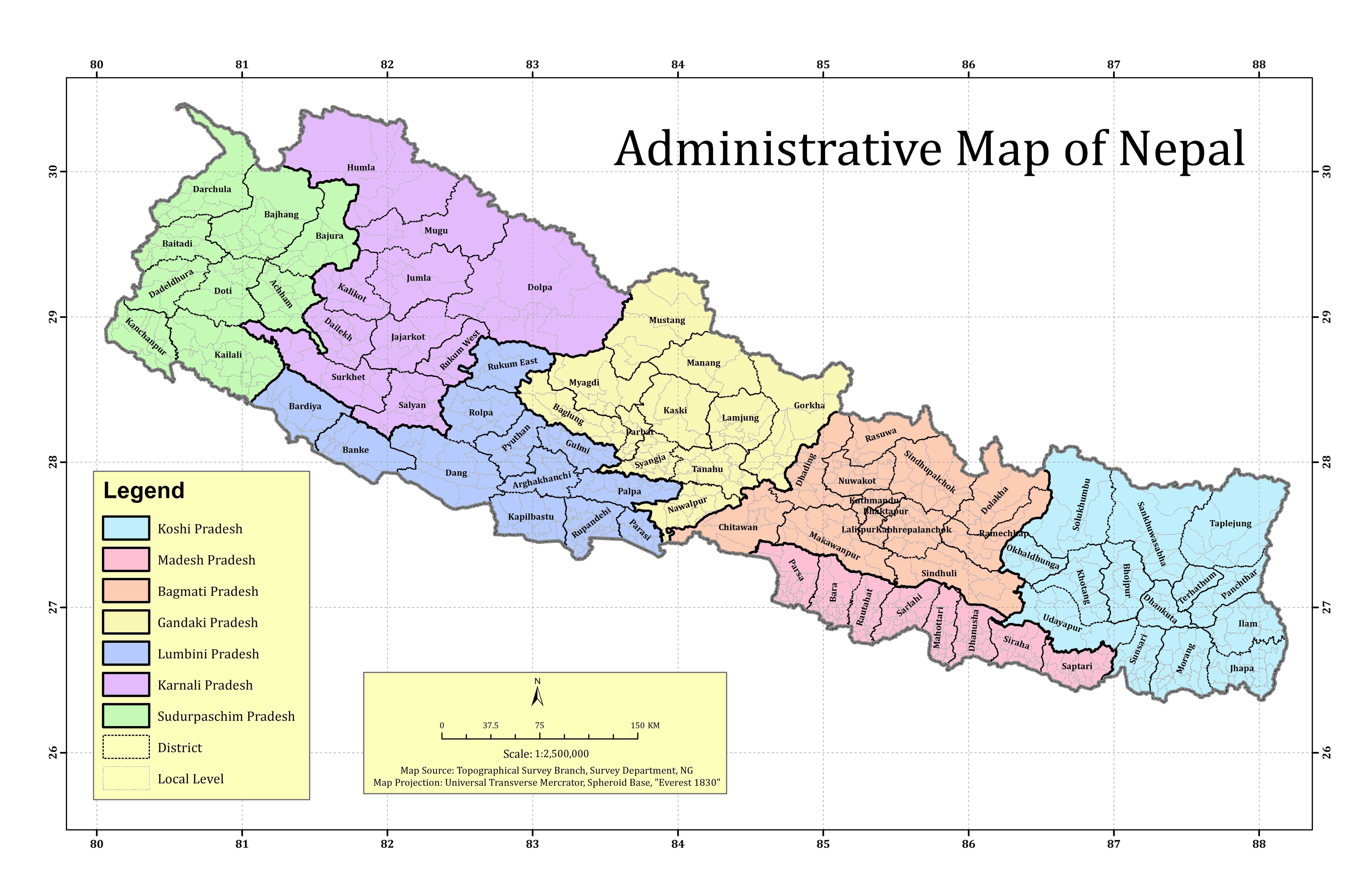
Place names are another strong basis for surname formation in Nepal. In Karnali and Sudurpashchim, many surnames have local etymologies connected with village names, streams, forts, and settlements. Examples like those reflected in drafts that include Jumla, Achham, Bajhang, Bajura, Baitadi, Doti, Mugu, Dailekh, Kalikot, Rukum, and others represent this pattern.
From an editorial perspective, two cautions are necessary:
-
The same surname may be associated with more than one place or story of origin.
-
Place-based etymology is often grounded in oral tradition or local history, so it is more responsible to write “according to local etymology” rather than presenting it as absolute certainty.
Conclusion
-
The term “Khas-Arya” can indicate a wide social and cultural scope in Nepal, but census headings are separate. Therefore, definitions and methods must be clear when drawing conclusions.
-
The 2068 (2011) census provides concrete numbers and percentages under headings such as Chhetri, Hill Brahmin, and Kami. It is appropriate to base debate on these category-wise figures to keep discussion fact-centered.
-
Because studies differ on Khas origin, arrival, and historical development, it is necessary to avoid treating unverified claims as truth and to encourage neutral, source-based research.
-
The most socially sensitive issue, untouchability and discrimination, is unacceptable for any civilized society. Strengthening a culture of equality, respect, and cooperation is the long-term solution.
This article is not targeted against anyone. It has been prepared to make it easier to understand Nepal’s diverse communities through facts and reason.







Comments 0
No comments yet. Be the first to start the conversation.