




Nepali Students’ “Job-Only” Mindset and Aversion to Self-Employment
Every year, around 500,000 young people enter Nepal’s labor market. For most of them, the first and final goal is to get a “job.” Either they are found in libraries preparing for the Public Service Commission, or at manpower company offices seeking foreign employment. But the number of students who think, “I will do something on my own,” or “I will turn what I learned into a business,” is negligible.
This raises a question—why? Is it because Nepali students lack capability? Or are our society and state mechanisms themselves preventing them from becoming “creative”? This article will explore this problem in depth.
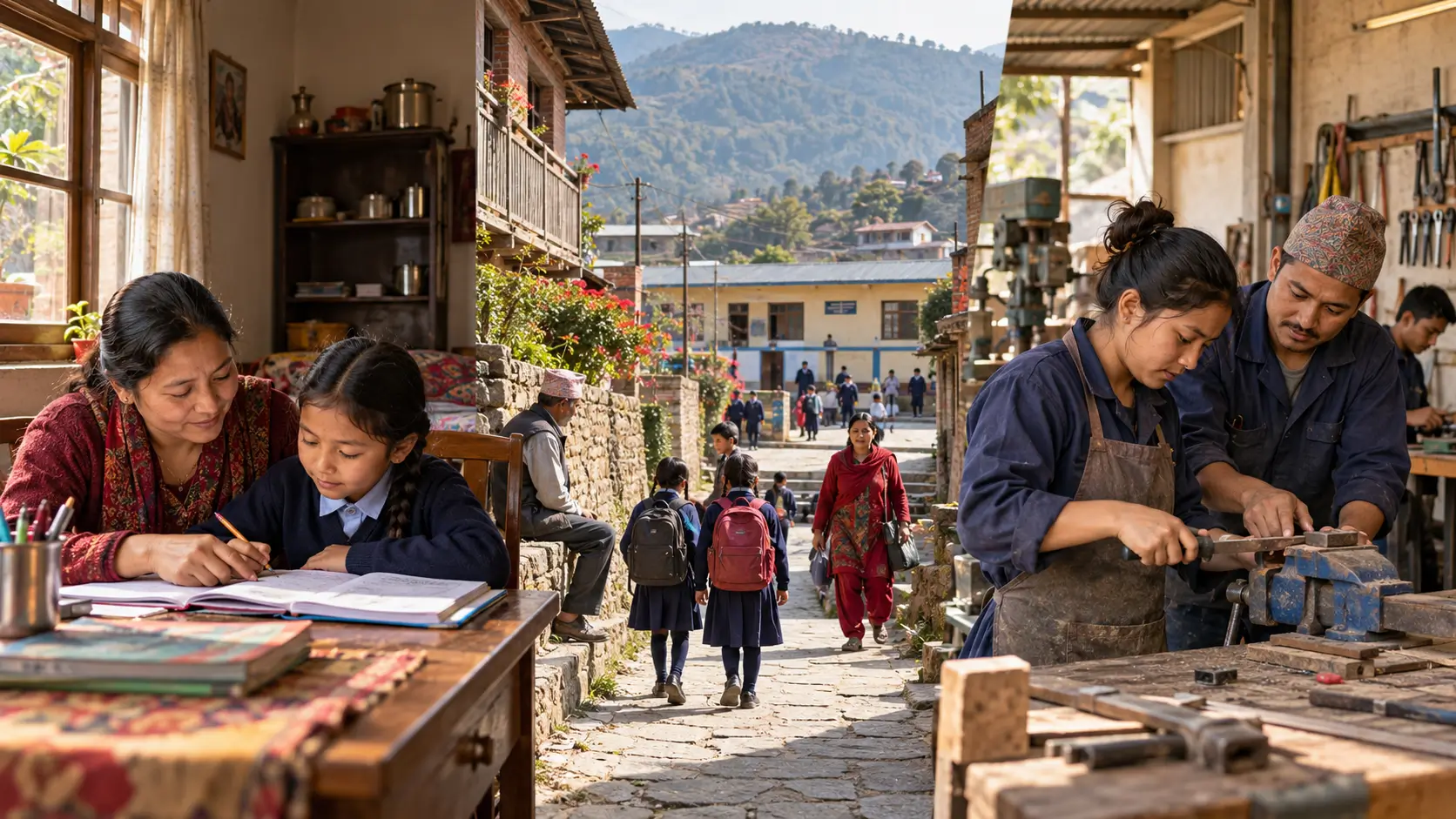
In Nepal, students running after jobs is not simply a personal preference. It is the outcome of compulsion and harmful social conditioning. Only when we connect education with skills, skills with capital, and capital with the market will Nepal’s streets be filled not with youth “searching for jobs,” but with youth “carrying ideas.” We must give students not only the dream of a “secure future,” but also the courage for a “creative future.”

Education System: A Factory That Produces Employees, Not Producers
When we examine the foundation of Nepal’s education system, it still appears to be based on the “assembly line” model of the industrial revolution era. Its core purpose is not to produce people with the ability to think, but to produce “obedient employees” who follow instructions without question.
A) The Legacy of the Macaulay Education Model and Theoretical Burden
If we look at the history of our education, it is influenced by the “Macaulay education model” introduced during the British era in India to produce clerks.
This model confines students to “what to think.” Memorizing textbook content word-for-word and reproducing it in exam papers is considered intellectual excellence.
There is no real place for “how to think,” meaning critical thinking. Unless the mind learns to question and search for new possibilities, it cannot take the risk of self-employment.
B) Mismatch Between Curriculum and the Current Market
University curricula in Nepal are often 10 to 15 years old. The world is discussing the Fourth Industrial Revolution, artificial intelligence, and the digital economy, but our students are still forced to study old theories and outdated technologies.
An agriculture student does not learn to test the actual pH level of soil or select crops based on market demand. A management student does not gain practical knowledge about how to run even a small shop profitably. When the gap between knowledge and market demand is this wide, the confidence to say “I can do something on my own” does not grow in students.
C) The Exam System and Obsession With Marks
Our evaluation system is centered on a three-hour written exam. It does not measure creativity, leadership, or problem-solving skills. The one who memorizes best gets the “A+.”
The “street smart” abilities and “failure handling” capacity needed to become an entrepreneur are not taught by our exam system. As a result, students may hold certificates in their hands, but they lack the courage to stand in the market and run a business.
Social Structure and Psychological Pressure: “Security” or “Success”?
In Nepali society, a young person’s success is measured not by income or impact, but by position and stability.
A) “Government Job” and Social Prestige
Even today, many people in our society consider getting a “government job” the ultimate success in life. Even if a successful entrepreneur has created jobs for 10 people, the social respect given to them is often vastly different from the respect given to a government employee with a small post.
Parents often say from childhood, “Son/daughter, study hard and get a good job.” Hardly anyone says, “Study, build a big business, and employ many people.” This conditioning leaves students believing that taking a job is the only respectable path.
B) Zero Tolerance to Failure
Entrepreneurship involves risk, and the possibility of failure is equally real. But Nepali society does not treat failure as “learning.” It treats it as “stigma.”
If a young person starts a business and fails, the mental pressure from family and society can be so intense that they lose the courage to try again. In search of this “social safety,” many young people abandon self-employment and are compelled to seek shelter in the perceived safety of a job.
C) Lack of Networking and Mentorship
For business, capital alone is not enough. Proper guidance and professional networking are essential. In Nepal, the distance between successful entrepreneurs and students is very large.
Students often see only big political leaders or respected job-holders as role models. Until “entrepreneurs” are established as heroes in society, young people will not choose this field as a career.
Economic and Policy Barriers
Even when a student breaks through social and educational barriers and tries to move forward saying, “I will do something,” the support they receive from the state is extremely disappointing.
A) Access to Capital and the Problem of Collateral
Nepal’s banking system is not based on “ideas.” It is based on “assets.” A young person may have a strong business plan, but if they do not have land or property to pledge as collateral, the bank sends them back from the door.
Terms like “venture capital” or “angel investment” may sound appealing, but in practical reality, they remain beyond the reach of ordinary students. Government announcements about collateral-free loans often remain limited to paperwork and complicated procedures.
B) The Bureaucratic Maze
Registering a business in Nepal is like winning a major battle. Moving from ward offices to cottage industry offices, the company registrar, PAN/VAT processes, and various departments drains half of a young person’s energy and enthusiasm.
Even if policies claim to provide benefits for “startups,” there is a serious lack of entrepreneurship-friendly behavior among officials at the implementation level.
C) Market Uncertainty and the Dominance of Middlemen
Nepali products are forced to compete with cheap, low-quality imported goods. On top of that, the network of middlemen from production to market is so strong that the actual producer does not receive a fair price.
In such an uncertain market, investing one’s future feels like a major risk for a student.
Lack of Respect for Labor
This is one problem that has pushed Nepal’s development back by decades.
A) “White-Collar” vs “Blue-Collar” Jobs
In our society, work that involves getting hands dirty or sweating is often viewed as “lower-level” work. A graduate feels embarrassed to do plumbing, electrical work, or professional farming.
But the irony is that the same student is ready to do similar work—or even harder work—after reaching Australia or Gulf countries. Behind this mindset is the lack of fair compensation for labor in Nepal and the humiliating treatment society gives such workers.
B) Academic Pride and Lack of Practicality
Our education made students “literate,” but not “capable.” After earning a degree, a harmful pride develops: “Now I should only sit on a chair and do pen-and-paper work.”
In entrepreneurship, at the beginning, you may have to do everything yourself—from cleaning floors to carrying goods. Nepali students’ “academic ego” often cannot accept this reality.
Practical Roadmap for Solutions: What Is the Way Forward?
After identifying the problem, solutions require concrete action, not just speeches.
A) Mandatory Integration of Entrepreneurship in Education
From school level, “financial literacy” should be taught. How to earn money, how to save, and how to invest should be part of the curriculum.
Universities should connect student projects to investors through “incubation centers” and help turn them into commercial forms. At graduation, students should not only hold a certificate, but also a small business plan or a prototype.
B) Policy Simplification and Seed Funding
The government should implement a “one-door system” and enable business registration and tax payment through digital platforms.
For new startups, there should be full tax exemption for at least five years and collateral-free loans at low interest rates. However, monitoring must be strict so that only genuine entrepreneurs receive benefits.
C) Respect for Labor and Social Awareness
The idea that no work is small or big must be established through schools and media.
A tradition should be built to honor successful farmers, technicians, and small entrepreneurs as “national heroes.”
Is Self-Employment for Everyone? A Realistic View
Based on my long experience, I can say that not everyone can become “Mark Zuckerberg” or “Binod Chaudhary.” Society also needs doctors, engineers, pilots, and government employees. But the key issue is the “availability of choices.”
The problem today is that in Nepal, students are forced to go abroad due to lack of jobs, or fall into depression, because they were never taught how to become self-employed. We need a workforce that does not sit and cry when a job is unavailable, but uses skills to start something of their own.
Entrepreneurship is not only about earning money. It is a mindset that makes a person self-reliant and creative.
Conclusion
The reason students wander searching for jobs in Nepal is not only their personal fault. It is the failure of our overall system. Until our education provides practical skills, until our banks invest in ideas, and until our society respects labor, young people will not want to take the risk of self-employment.
But time is changing. With technological development and growing awareness, interest in startups and small businesses is gradually increasing among youth. If we can address the problems mentioned above through policy and practical measures, Nepal will surely see more young people who “give jobs” than those who “search for jobs.”
The main point young students must understand is this: “A certificate is only a piece of paper, but your skills and your problem-solving ability are your real wealth.”
This article is based on various educational research, labor market data, and a deep study of Nepal’s socio-economic context over the past two decades. Its purpose is not to belittle anyone, but to identify real problems and show a path toward solutions.





Comments 0
No comments yet. Be the first to start the conversation.