



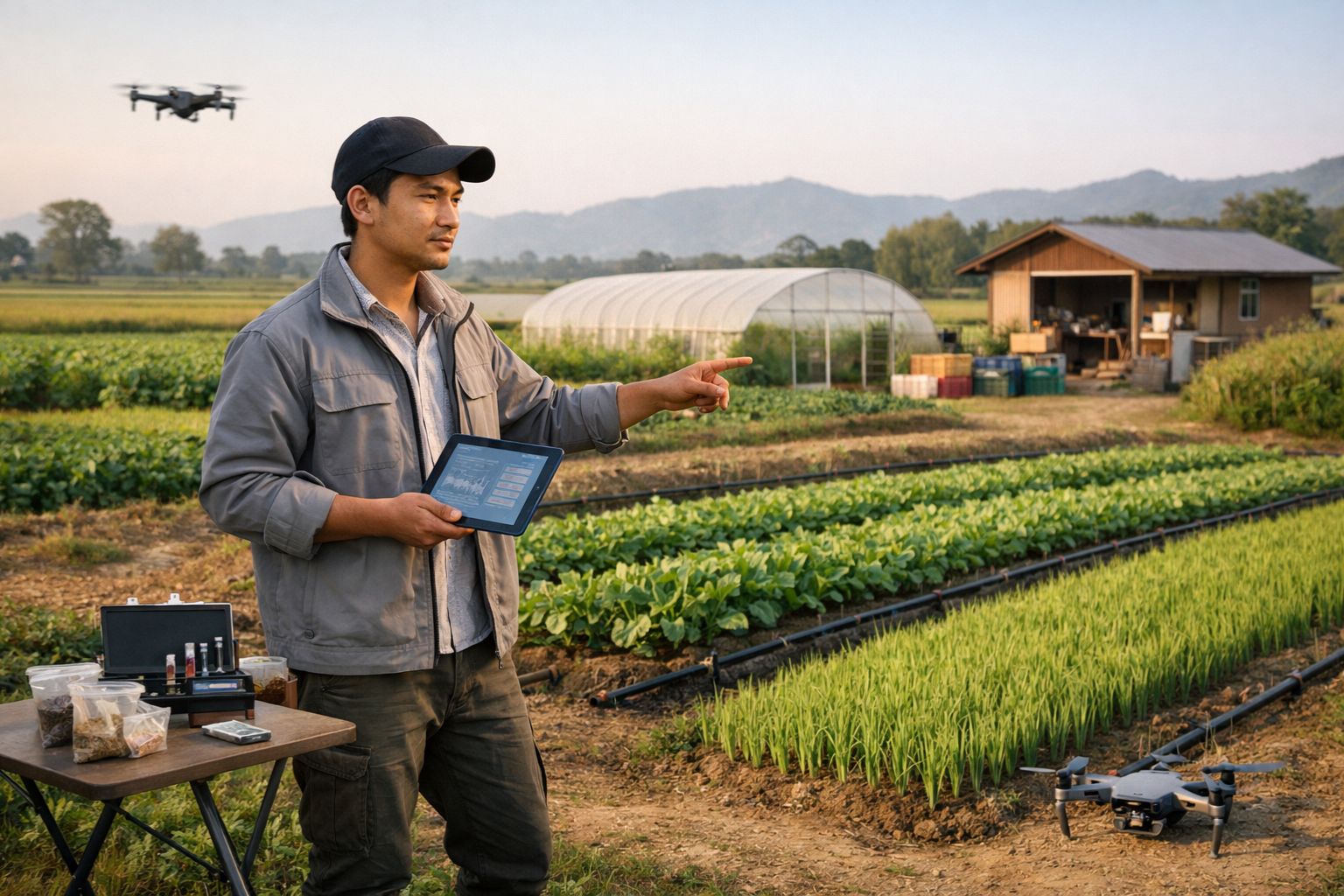
Current and Future Opportunities for Agriculture Students in Nepal
The agriculture sector, widely regarded as the backbone of Nepal’s economy, has been going through a serious transitional phase for the past few decades. While there are ongoing efforts to move from traditional subsistence farming to commercial agriculture, the shortage of skilled human resources and declining productivity remain major challenges.
In this context, the role of students who have completed a Bachelor’s degree in Agriculture (B.Sc. Ag) or higher from institutions such as Tribhuvan University, Agriculture and Forestry University (AFU), Far Western University, and Purbanchal University appears decisive.
This article attempts to address students’ core question—“What will I gain by studying agriculture?”—in a factual and practical way.
If you see Nepal’s agriculture only as limited to “plough and hoe,” that reflects a narrow understanding. For agriculture graduates, this is like an ocean where you can pursue government stability (“Security”), professional roles in the banking sector, entrepreneurial independence, or the modernity of technology—whatever path you choose.
There is only one key condition: you should not have only an academic certificate in your hand. You must also have “skills the market demands” in your mind and “the drive to solve problems” in your heart.
The Depth of the Problem: The Structural Gap Between Agricultural Education and the Market
The attraction of agriculture as an academic subject is increasing in Nepal. However, the irony is that there is a major “Mismatch” (gap) between academic certification and real workplace (Field) demand.
Study and Data Analysis
Each year, approximately 1,000 to 1,200 graduates come out of Tribhuvan University, Agriculture and Forestry University (AFU), and other affiliated colleges. However, among them, 70% choose either “civil service” (Lok Sewa) as their first preference or “foreign scholarships” (the USA, Australia, or Europe). The remaining 30% are seen struggling to sustain themselves in the private sector.
Three Main Pillars of Real Problems
Theory and modern practice are far apart (Academic Lag)
Our university curricula are still centered on technologies from the early phase of the Green Revolution. For example, while students are still studying “plough share” and “low-tech” irrigation, global markets have already adopted systems that use the “Internet of Things” (IoT) to measure leaf moisture and automate irrigation.
Due to the lack of “digital agriculture” and “Market Economics” in the curriculum, graduates become unable to analyze which crops are in demand and to what extent after entering the market.
Lack of social prestige and “glamorization”
In Nepali society, the word “farmer” is still commonly associated with a poor person wearing dirty clothes. There is also a wrong belief that agriculture graduates must “plough fields.”
Because of this, talented students are often more attracted to clean office jobs turning files than to labs or fieldwork. The inability to establish agriculture work as an “Enterprise” or a highly technical profession is one of the biggest failures of the education sector.
Policy confusion and weak implementation
Although the Government of Nepal introduced the “Agriculture Development Strategy” (ADS), it has not been able to include new graduates effectively. There is no strong mechanism to provide large investments to agriculture graduates without collateral or through simplified interest arrangements.
A student may have knowledge and a plan, but without capital and market certainty, they hesitate to take risks.
Current Government Sector Opportunities
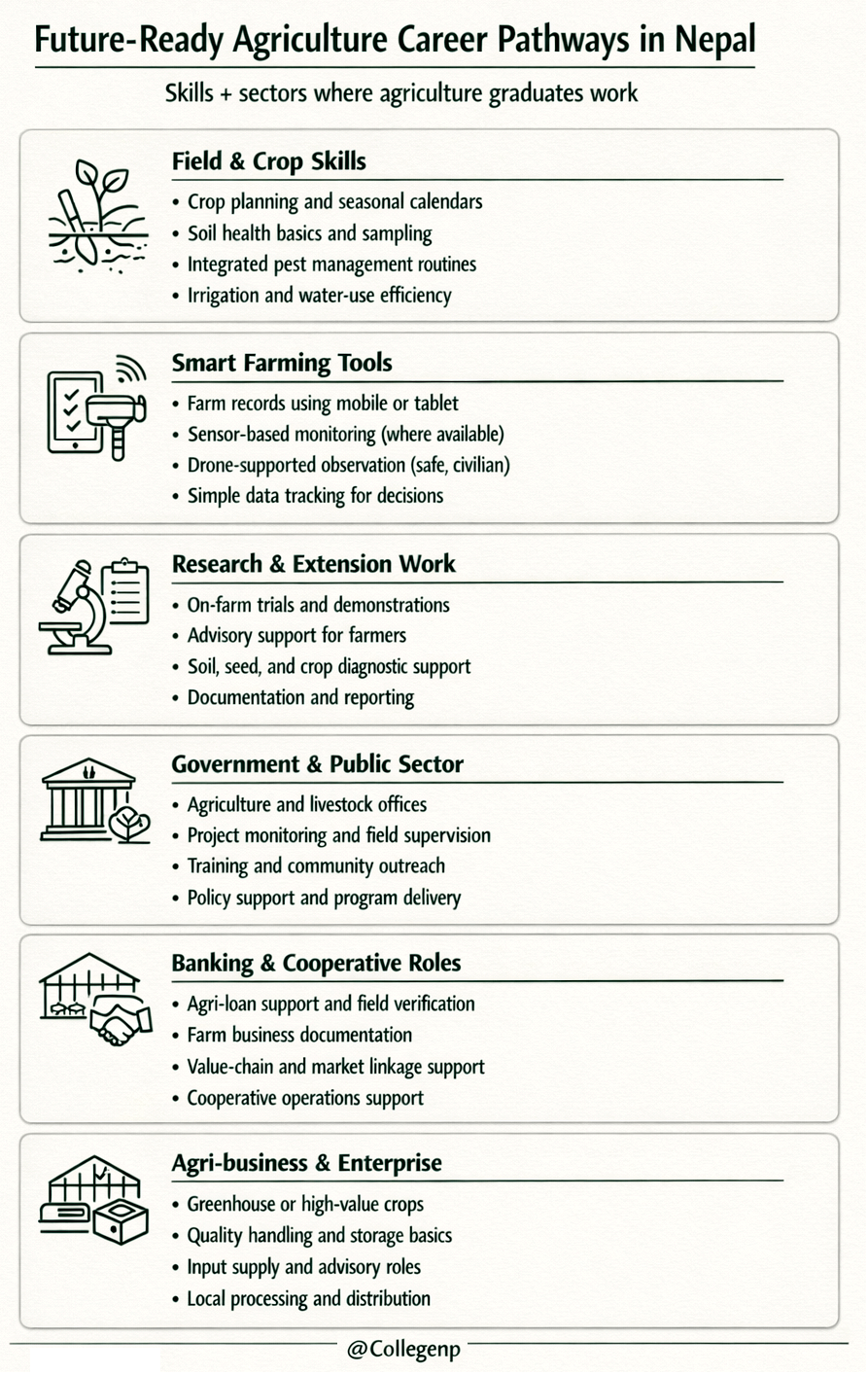
In Nepal’s current administrative structure, government service still remains the backbone for agriculture graduates. With the implementation of federalism, its scope has expanded further.
A. Three Levels of Government and the Staffing Mechanism
Federal Level
Under the Ministry of Agriculture and Livestock Development, technical officers play roles in policy formulation, quality control, and international coordination. At this level, the work is mainly focused on strategy and planning.
Provincial Level
Direct service delivery takes place through Provincial Agriculture Directorates and Agri Knowledge Centers. Here, there are opportunities to work as specialists in crop development, fisheries development, or as laboratory heads.
Local Level (Local Level – 753 bodies)
Nepal’s Constitution has assigned major agricultural authority to local governments. Currently, each rural municipality and municipality is required to have at least one Agriculture Officer (Level 7) position. In many places, these posts are vacant or managed through contract appointments.
By working at this level, graduates gain strong opportunities to connect directly with farmers, implement budgets, and mobilize local resources effectively.
B. Nepal Agricultural Research Council (NARC)
If your interest is in research (R&D), NARC is Nepal’s single most distinguished institution in this field. By entering service as a “scientist,” you have many opportunities to demonstrate expertise.
There is especially high demand for agricultural scientists to reduce the impact of climate change on agriculture, develop drought-tolerant crop varieties, and conserve the genes of local varieties. Since research conducted at NARC directly affects national food security, this position is considered highly respectable.
Financial and Banking Sector
In recent years, Nepal’s commercial banks, development banks, and microfinance institutions have been actively hiring agriculture graduates. Behind this is a strong policy direction from Nepal Rastra Bank.
Key Areas of Work
Loan disbursement and risk analysis
Since banks are required to invest in the agriculture sector, an “Agricultural Loan Officer” has become essential to identify which projects are safe for lending and which may fail. Only an agriculture graduate can properly understand the technology costs proposed by farmers, potential outputs, and market risks.
Valuation and insurance expertise
Agriculture and livestock insurance has expanded widely in recent years. When crops are destroyed or livestock die, technical knowledge is required to assess compensation. Agriculture students are working in insurance companies as “Claim Investigators” with attractive salaries.
Cooperatives and investment boards
Large cooperative institutions have now started collective farming (Cooperative Farming). The managerial responsibility of such farms is increasingly falling on the shoulders of agriculture experts.
Private Sector and Entrepreneurship Development
Nepal’s real prosperity is tied to the commercialization of agriculture through the private sector. This area is for students who can take risks and think creatively.
High-Potential Paths
Seed industry
Nepal still imports more than 80% of its hybrid seeds. Agriculture graduates can specialize in “Seed Tech” and start their own seed production firms. The government also provides subsidies in this area.
Being able to develop a region-suitable “hybrid” is like entering a business worth billions.
Nursery and high-value crops
Establishing nurseries for dragon fruit, avocado, kiwi, or off-season vegetables in modern tunnels can yield high returns with relatively low initial investment. For example, one cutting of quality dragon fruit can be sold for NPR 100 to NPR 300.
Agro-vet 2.0 (digital and scientific advisory)
Traditional agro-vets used to sell only “vitamins” and “pesticides.” The current need is a “Service Driven” agro-vet where agriculture graduates test soil, correctly identify diseases, and recommend only necessary treatments.
Paid consultancy provided through mobile apps and WhatsApp is a major business possibility.
I/NGOs and Development Partners
International non-government organizations (I/NGOs) are investing large amounts of capital in Nepal’s agriculture sector. Building a career here is not only about earning a good salary, but also gaining international exposure.
Major Focus Areas
Food security and hunger prevention
Organizations such as WFP and FAO demand “Project Officers” and “Subject Matter Specialists” in large numbers to support food supply and boost production in remote areas.
Sustainable and organic farming
European Union projects are working on alternatives to chemical fertilizers in Nepal. If your expertise is in organic agriculture, you may find opportunities as a technical expert in organizations like Helvetas and other donor agencies.
Value chain development
There is strong demand for experts who can increase product value from farm to kitchen through processing, packaging, and marketing.
Future Opportunities: Tech-Driven Agriculture
The coming decade will be defined by “Smart Agriculture.” If students invest in these skills today, they will become “In-demand” specialists anywhere in the world.
Emerging Skill Areas
GIS and precision farming
Agriculture is no longer about farming based on guesswork. Using GIS, nutrient deficiencies in soil can be mapped. Satellites can even detect which plot has a disease. This area is only beginning in Nepal, and its future is very bright.
Drone technology in agriculture
Within the next 10 years, using drones for pesticide spraying and monitoring plant health on large farms will become common in Nepal. Agriculture graduates will be needed as drone operators and data analysis specialists.
Hydroponics and aeroponics (Soil-less Farming)
Due to rising urbanization, cities like Kathmandu and Pokhara face land shortages. Soil-less farming on rooftops or in limited spaces is growing as a commercial demand for urban “Elite” consumers. There is a large market for experts who can manage technical setups in cities.
Climate-smart agriculture (CSA)
Climate change is no longer only a threat—it is also a field of study. Agriculture experts who can identify and teach adaptation methods will be tomorrow’s “Hero.”
Strategic Ways to Overcome Unemployment and Uncertainty
After holding an academic certificate, many agriculture graduates fall into a deep uncertainty of “What now?” This is less about fear of unemployment and more about directionlessness—“Where do I start?” To solve this, waiting only for a government job is not enough.
A. The Strong Impact of the “Learn and Earn” Model
In developed countries, students do part-time work while studying. In Nepal, this can be one of the most effective models for agriculture students.
Practical experience (The Ground Reality)
There is often a big difference between “Fusarium Wilt” (a wilting disease) studied in books and diseases seen in the field. From the second or third year of college, renting a small plot of land (1–2 ropani) and starting high-value crops (such as off-season tomatoes, mushrooms, or tunnel-based vegetable farming) helps you learn not only farming, but also understand the “agriculture economy.”
Investment cost and profit analysis
While farming yourself, keep records of seed selection, fertilizer balance, irrigation management, and all related expenses. This later makes you capable of doing strong “Cost-Benefit Analysis” as a bank loan officer or a large farm manager.
Confidence and real market exposure
When you take your own produce to market, you learn about middlemen manipulation and real consumer demand—knowledge that no university teaches.
B. Strengthening Digital and Technical Skills (Tech-Integration)
The agriculture expert of the future is not only someone who understands soil structure, but someone who can work with data.
Data science and agriculture (Data in Agriculture)
If you want to join international research institutions (such as IRRI or CIMMYT), learning languages like R-programming or Python has become essential. Nepal has an extreme shortage of skilled people who can analyze large datasets and predict production patterns.
Mapping and GIS (ArcGIS/QGIS)
Creating digital soil maps through remote sensing and GIS, and monitoring crop health through drones, will become common in Nepal within the next five years. Students with these skills can receive high pay from private projects and NGOs.
C. Building Networks (Networking beyond Classroom)
In Nepal’s context, connections and relationships often open doors to opportunities. Do not limit yourself within the four walls of college.
Participate in seminars organized by the Department of Agriculture (DoA), NARC, and various farmer groups.
Stay active on platforms like LinkedIn and connect with agriculture scientists worldwide. Developing the habit of reading their research papers and communicating with them prepares you for global platforms.
International Academic Opportunities and Scholarships: Global Access
For Nepali agriculture students, studying abroad is not simply leaving the country. It is a golden opportunity to bring advanced technology and knowledge back to Nepal.
Agriculture is a field where developed countries invest heavily and offer significant scholarships. The selection rate of students with agriculture backgrounds is high in scholarships such as America’s Fulbright, Europe’s Erasmus Mundus, Australia’s Australia Awards, and Japan’s MEXT.
This is because the world is facing a serious crisis of “Climate Change” and “Food Security,” and agriculture experts are needed for solutions.
Key Academic Directions
MBA in Agri-business
If you have managerial capability, consider this after your agriculture degree. Large multinational companies (such as Monsanto, Syngenta, and PepsiCo) need managers who understand both the technical side of farming and the commercial side of markets. This is a field with a major shortage of “Middle Management” in Nepal.
Plant biotechnology and gene editing
Due to climate change, older seeds can no longer cope with new conditions. Seeds that can tolerate severe drought or flooding are needed. Specialists in gene editing are in very high demand in research laboratories.
Some Unexpected but Important Areas
Many students in Nepal do not see or consider these areas, but they hold immense potential:
Agro-tourism
Nepal is a tourism country, and the concept of “Farm Stay” is expanding. You can create packages that take urban school students or foreign tourists to farms, teach them how farming works, provide organic food, and sell experiences. This is a blend of agriculture and hospitality, where profit margins are very high.
Post-harvest management
Nepal’s harsh reality is that 30% to 40% of production is lost between the farm and the market during transportation before reaching kitchens.
There is a major opportunity for agriculture graduates here: how to package fruits properly, how to scientifically manage cold storage centers, and how to operate grading and processing units. If you can reduce this loss by even 10%, you can become a major contributor to Nepal’s economy.
Supply chain expert
The distance between farmers and consumers is currently very large. E-commerce platforms based on the “Farm to Fork” concept can be developed. In startups that collect directly from farmers, check quality, and deliver fresh vegetables to urban consumers, the presence of agriculture experts increases trust. This helps reduce middlemen exploitation and supports fair prices for farmers and healthier products for consumers.
Organic certification expert
Demand for “organic” food is high globally and in Nepal’s urban areas. However, there are limited scientific methods and laboratories to verify what is truly organic. Opportunities exist for technical consultants in this field, though only a small number of graduates are currently noticing it.
Conclusion and Advice
Saying that agriculture students have no opportunities in Nepal is baseless. The reality is that the nature of opportunities has changed. If you think in traditional ways, you will see unemployment. But if you embrace the challenges and technologies of the new era, agriculture can become one of the strongest fields for earning and creating social change.
Do not become only a graduate searching for a “Job Card.” Build the capacity to become a “Job Creator.” Nepal’s geographic diversity is not a weakness—it is a laboratory, full of possibilities from Himalayan honey to Terai maize.
Connect your education to solving farmers’ problems. When farmers start earning profits through your advice, your professional success becomes naturally ensured. Successful students in agriculture are those who focused not on “What will I get?” but on “Which problem will I solve?”
Do not become just another number standing in line to fill Lok Sewa forms or apply abroad. Nepal’s geographic diversity and biological wealth are rare in the world. Whether you build the value chain of Mustang apples or improve the productivity of Terai rice—your contribution is needed everywhere.
Make your studies not just a desire, but a mission. Opportunities are not hidden in your certificate, but in how you think and how you work. The future belongs to agriculture, and that agriculture is in your hands.






Comments 0
No comments yet. Be the first to start the conversation.