



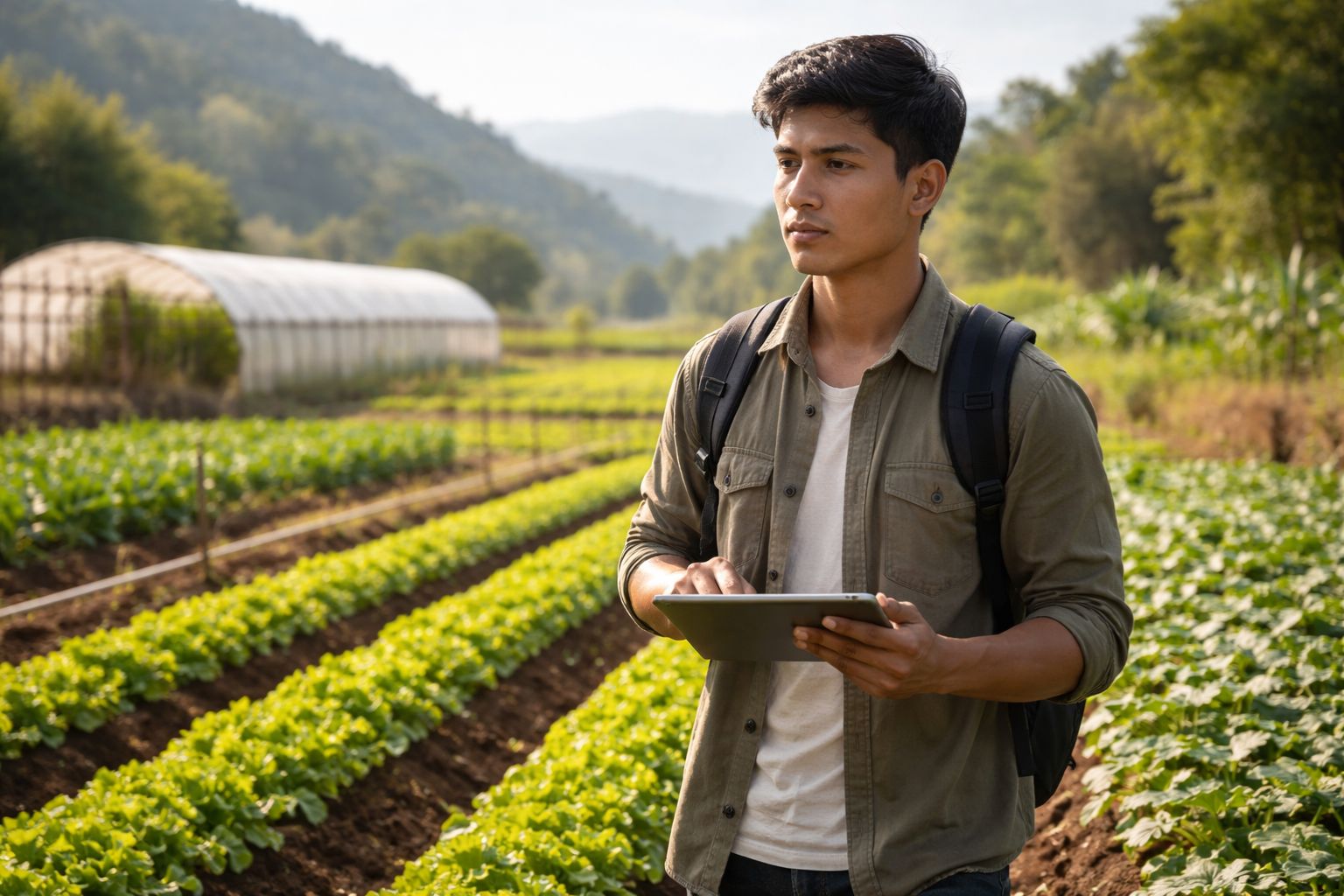
Nepal’s Agricultural Transformation and Workforce Challenge
Nepal is taught as an agriculture-based country from school days. Yet the reality is troubling: thousands of students who have completed undergraduate and postgraduate degrees in agriculture are either facing unemployment or moving into fields unrelated to what they studied. Although government figures show agriculture contributes around 24 percent to the gross domestic product, the sector remains largely subsistence-based.
In the 21st century, agriculture is no longer only about the “spade and plough.” It is a blend of science, technology, management, and economics.
Nepal’s agricultural universities are providing theoretical knowledge, but there is a major gap in practical skills needed to solve real field problems and meet market demand. Based on more than two decades of experience as an editor and agriculture expert, it must be said clearly: if Nepali agriculture students do not update themselves with time-relevant skills, a degree alone will not secure their future.
This blog discusses, in detail, the foundational and advanced skills that agriculture students in Nepal must learn. These skills will help them become professionals who do not only “search for jobs,” but also “create opportunities.”
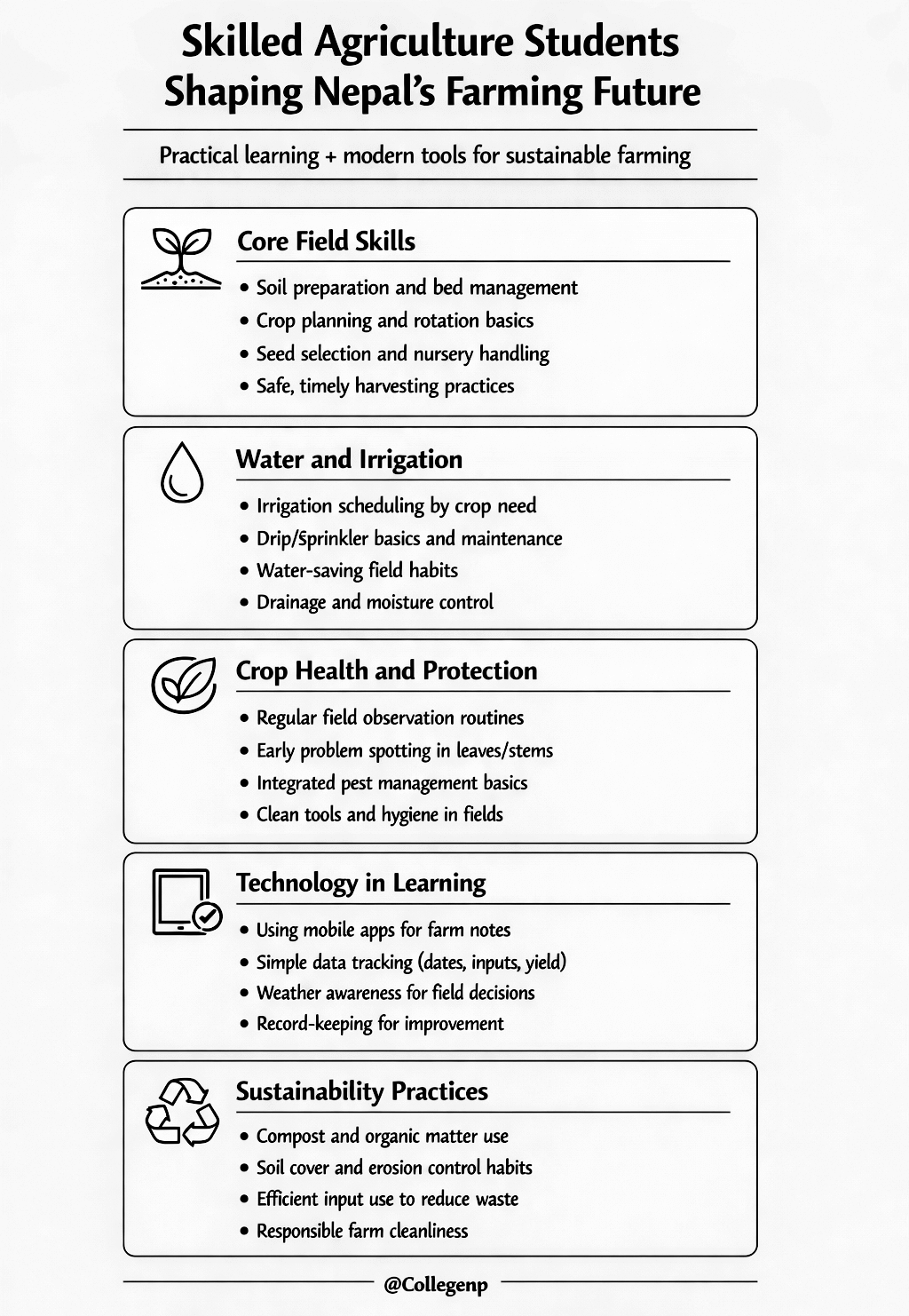
Eight Must-Learn Skills for Nepal’s Agriculture Students
Nepal’s agricultural sector is at a historic turning point. The country is trying to move from traditional subsistence farming to commercial and technology-friendly agriculture.
However, the key drivers of this transformation—agriculture students—are often burdened with theory and weak in practical competence. Even after completing a Bachelor’s in Agriculture (B.Sc. Ag), when a student cannot confidently say “how much fertilizer this soil needs” or “what exactly this plant disease is,” it reveals a serious challenge in our education system.
Below are the eight major skills that every Nepali agriculture student must learn during their academic years and continue developing afterward.
1. Practical Soil Management and Diagnostic Skills
Soil is the foundation of agriculture, but in Nepal, soil is often treated as an “object,” not as a “living system.”
Depth of the problem: Many agriculture graduates in Nepal can perform NPK titration in the lab, but hesitate in the field to tell a farmer, “Your soil has a zinc deficiency, and that is why the leaves look like this.” Soil acidity is increasing, and organic matter is dropping below 1 percent.
Deep skills to learn:
-
Accuracy in sample collection: Convert the theoretical knowledge of digging a “V-shaped” pit and taking soil from nine points into real field skill—collect correct samples while avoiding bunds, the base of trees, and waterlogged spots.
-
Digital and portable tools: The time is no longer to sit and wait for lab reports. Learning to operate, calibrate, and interpret results from handheld soil testers and digital NPK kits is essential.
-
Identifying micronutrient deficiencies: Beyond N, P, and K, Nepal’s soils commonly lack boron, zinc, and molybdenum. Students must develop the clinical skill to diagnose these deficiencies and understand their yield impacts.
-
Physical soil health: Be able to observe bulk density, infiltration rate, and texture, and use these to design irrigation schedules.
2. Protected Cultivation and High Technology
Due to climate change, untimely rainfall, hailstorms, and rising temperatures are making open-field farming increasingly risky. Therefore, protected structures are becoming a future necessity.
Real challenge: Many plastic tunnels distributed in Nepal fail because temperature management inside is weak, causing plants to die from heat stress. Students may know how to build tunnels, but they often cannot manage the microclimate inside.
Skills to master:
-
Basic structural engineering knowledge: The skill to design greenhouses using local materials (bamboo) and GI pipes with proper ventilation and airflow.
-
Hydroponics and substrate culture: With rapid urbanization, soilless farming using cocopeat, perlite, or direct water-based cultivation is becoming important. The most critical skill here is maintaining nutrient solution EC (Electrical Conductivity) and pH balance.
-
Sensor installation: Install sensors to measure humidity and temperature inside tunnels and operate cooling pads or exhaust fans based on data.
3. Smart Farming and Digital Literacy (Precision & Digital Agriculture)
Digital literacy is not using Facebook. In agriculture, it means using data to reduce costs and increase productivity.
Current situation: Nepal lacks a strong agricultural database. Decisions about which crops grow best in which areas are still often based on guesswork.
Essential digital skills:
-
GIS and remote sensing: Use software like QGIS or ArcGIS to map land use, and interpret satellite images to identify weak crop health areas through indices such as NDVI.
-
Drone operation: Drone-based pesticide spraying and crop monitoring have already entered Nepal. Understanding operation and legal procedures is necessary.
-
Agri-software and apps: Develop and use systems that analyze market prices and provide farmers advice through SMS or apps based on accurate weather forecasts.
-
Data analysis (Data Science): Use Excel or R programming to store multi-year production data and conduct trend analysis to forecast future production.
4. Integrated Pest Management
Pesticide use in Nepal is rising in alarming ways. Students should not become “agents who sell pesticides,” but experts who protect health and the environment.
Problem: Many agriculture technicians, when they reach farmers’ fields, immediately recommend strong chemical pesticides. They are often not confident about biological alternatives themselves.
Advanced competencies:
-
Accurate disease identification: Distinguish subtle differences between symptoms caused by fungi, bacteria, and viruses (for example, the difference between wilting disease and root rot).
-
Biological control laboratory skills: Practical knowledge of producing and using beneficial fungi such as Trichoderma and Beaveria bassiana.
-
Pheromone and light traps: Understand pest life cycles and control them through natural enemies or trapping methods.
-
Safe use of pesticides: If chemical pesticides must be used, the ability to instruct farmers clearly about waiting periods (how many days after spraying the crop becomes safe to consume).
5. Post-Harvest Technology and Value Addition
The weakest link in Nepal’s agriculture is post-production management.
Fact: In Nepal, post-harvest losses for oranges, apples, and vegetables exceed 30 percent. This means 30 percent of a farmer’s effort and investment rots away before reaching the market.
Required skills:
-
Cold chain management: Technical understanding of pre-cooling, cold storage, and maintaining temperature during transportation.
-
Grading and packaging: Separate produce by size, color, and quality according to market demand and develop international-standard packaging skills.
-
Processing: From primary processing (washing, drying, cutting) to secondary processing (such as tomato sauce, ginger candy, and titauriya).
-
Food hygiene standards: Knowledge of DFTQC rules, labeling, and procedures for obtaining food safety certifications.
6. Agribusiness and Entrepreneurship
Many agriculture graduates spend years preparing for public service exams. However, Nepal’s private sector and self-run agribusiness have vast potential.
Problem: Even technically capable students often do not know how to create a profit and loss account or submit a loan file to a bank.
Business skills to learn:
-
Bankable business plan: The ability to write a plan strong enough to convince banks and secure investment.
-
Value chain analysis: Analyze where costs occur from production to the consumer’s kitchen and where profit can be increased.
-
Market research: Study which vegetables sell at higher prices in which months (off-season mapping) and identify gaps where the market lacks supply.
-
Digital marketing: Use Facebook, Instagram, and websites to sell products directly to consumers (D2C – Direct to Consumer).
7. Climate Adaptation and Sustainable Agriculture
Future agriculture must not be done by “fighting nature,” but by “working with nature.”
Challenge: Rising temperatures and irregular rainfall are making old seeds and traditional practices less effective.
Essential skills:
-
Conservation agriculture: Protect soil fertility through zero tillage, crop rotation, and intercropping systems.
-
Climate-smart varieties: Knowledge of rice varieties that tolerate drought or flooding.
-
Rainwater harvesting: Design systems to collect rainwater and use it for winter irrigation.
-
Carbon farming: In the future, farmers will earn money for storing carbon in soil. Understanding carbon credits and related standards is a major opportunity for today’s students.
8. Communication, Extension, and Advisory Skills
An agriculture technician is a farmer’s “doctor.” Even if a doctor has the highest degree, they fail if they cannot communicate with patients.
Problem: Students study in English in college, but in the field, they feel shy or afraid to talk to farmers in local languages.
Must-have skills:
-
Psychology of farmers: Understand farmers’ thinking. Why do they fear adopting new technologies? How can they be built into trust?
-
Extension materials: Create effective brochures, video tutorials, and radio messages.
-
Facilitation: Lead farmer group meetings and help communities reach collective decisions.
-
Technical writing: The capability to write research papers for international journals and policy briefs for the government.
Being an agriculture student in Nepal is not only about getting a job—it is a national responsibility. The eight skills above are not fully taught by any single curriculum. To gain them, students must become proactive learners.
Hill Agriculture and Mechanization
Around 70 percent of Nepal’s land is hilly. Large tractors used in the Terai do not work effectively here. Therefore, Nepali students must focus on smart mechanization.
Learning to operate and perform basic maintenance on hand tractors (power tillers), mini tillers, and small hill-suitable farm tools will become a major asset.
Conclusion
For agriculture students in Nepal, there is no shortage of opportunities. The shortage is in capable human resources. Whether you go to Israel or do something within Nepal, certificates alone do not make anyone successful.
Suggestions:
-
During your undergraduate years, gain specialization in at least one area (such as mushroom farming, beekeeping, or nursery management).
-
Stay updated on government policies and foreign grant programs.
-
Do not fear technology and software; make them your tools.
-
Use internships wisely: Use final-year OJT or internships not only for certificates, but to understand real problems.
-
Build networks: Create relationships with successful farmers, agro-vet operators, and entrepreneurs.
-
Keep updating yourself: Agricultural science changes every day. Develop the habit of reading international websites for new research and technologies.
If you have these skills, you will not need to search for a job; jobs and opportunities will search for you. Nepal’s fallow land and discouraged farmers are waiting for capable and skilled agriculture experts like you.
In the end, agriculture is not only about working soil with your hands. It is the science that strengthens the backbone of the national economy. You are not only a student—you are the future of Nepal’s food security. Never delay learning skills.







Comments 0
No comments yet. Be the first to start the conversation.