



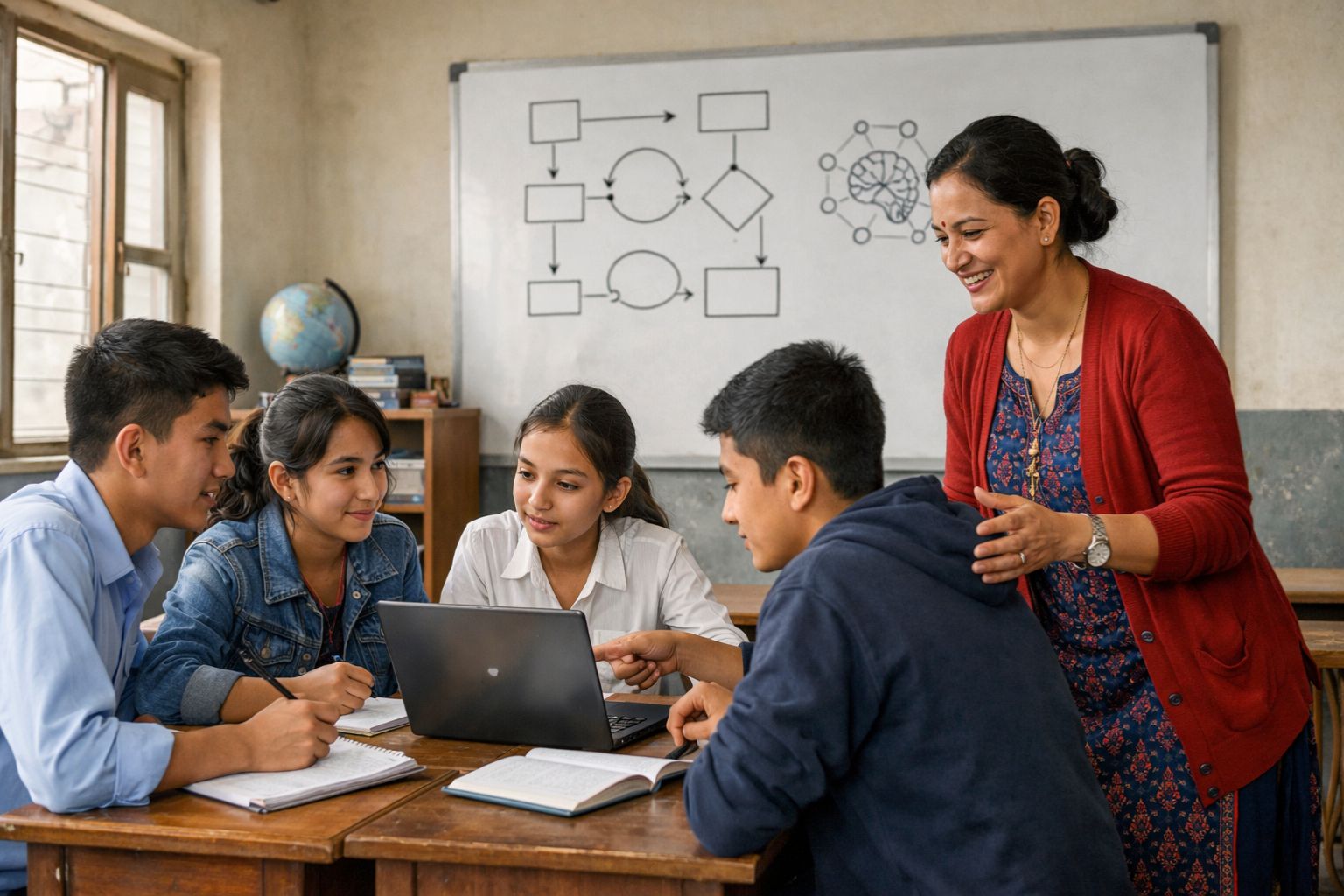
AI and Nepal’s Education: Challenges and Roadmap
Today’s world is standing at the biggest technological leap since the Industrial Revolution. When we talk about Artificial Intelligence (AI), it is not just a tool for running computers or searching the internet; it has already become a core system for supporting the human mind and for collecting and analyzing information.
The United States, European countries, and China have already integrated AI starting from the school level. But in Nepal’s context, we are still stuck in the old mindset of “rote learning” and mark sheets. Across the world, the definition of the labour market is changing. Mechanical work is being handled by robots and AI, while human demand is rising in “Critical Thinking” and “Complex Problem Solving.”
In such a situation, Nepal’s outdated education model increases the risk of producing a workforce that will remain unemployed in the future.
Deep Research on Existing Problems in Nepal’s Education System
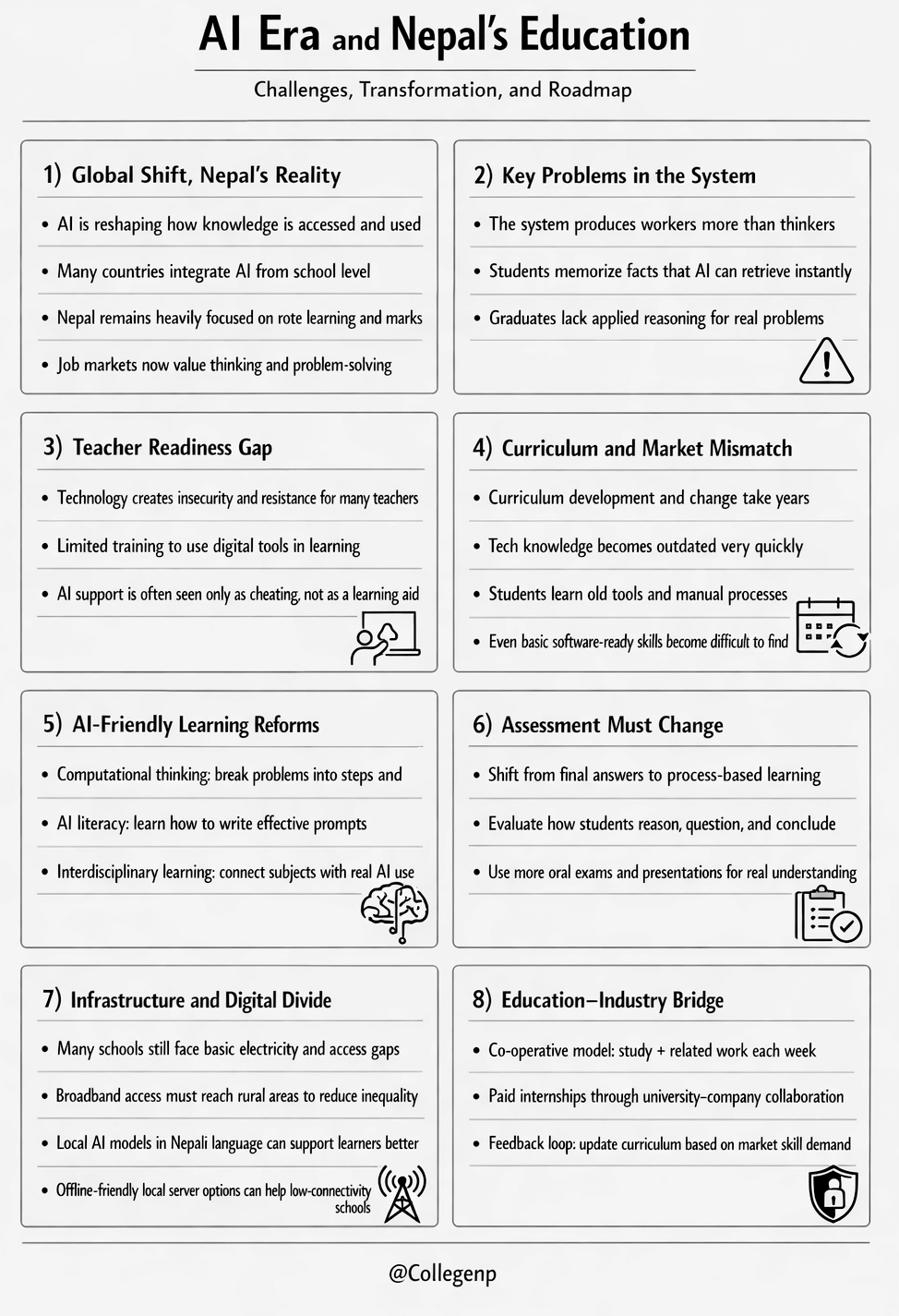
Our current academic structure is producing “workers,” not “thinkers.” This is not a problem of a single school or university; it is a weakness of the overall national system.
Theoretical Burden and Practical Emptiness (Rote Learning vs. AI Capabilities)
Traditionally, Nepali students were pushed to become “warehouses” of information. Memorizing scientific formulas, historical dates, and grammar rules was treated as “knowledge.” But today, AI takes only milliseconds to find any “fact.”
When AI can deliver the knowledge of millions of books in moments, what is the meaning of a student spending 10 years “storing” the same information in the brain? Our education system is forcing students to spend time on work that machines can do better and faster.
As a result, when our graduates enter the job market with degrees, they may carry information, but they lack the logical capacity to apply that information to solve real problems.
Teachers’ Psychological and Practical Barriers Toward Technology
Most teachers in Nepal were born and raised in the “Analog” era. For them, a classroom means a blackboard and chalk. With the entry of AI, a sense of insecurity has appeared among teachers. Many feel that technology will take away their jobs.
On the other hand, teachers in rural areas may have smartphones, but they do not have training on how to integrate them into teaching and learning. When tools like ChatGPT help students with homework, many teachers see it only as “cheating” or “laziness,” and they do not know how to use it creatively.
Because of this resistant mindset toward technology, the “digital gap” between students and teachers is increasing.
Slow Curriculum Change and Irrelevance to the Market
In Nepal, it takes years to develop a curriculum, and decades to change it. Technology is a field where knowledge becomes outdated every six months. Even today, many students are learning outdated computer software or manual processes from the 2000s.
This is not preparation for the future; it is being trapped in the past. Because of this, not only are “data scientists” or “AI engineers” far out of reach, but even skilled manpower capable of operating basic software is difficult to find.
AI-Friendly Education System: Practical and Long-Term Solutions
Surface-level changes will not be enough. We must redesign both the way we teach and the way we learn.
Fundamental Curriculum Restructuring (The Power of “How to Think”)
In the coming world, the value of “facts” will decrease, and the value of “reasoning” will increase. Therefore, the curriculum must include the following:
Computational Thinking
This does not mean every student must become a programmer. It means learning how to break complex problems into smaller parts, recognize patterns, and solve them step by step. This skill can be taught from primary level through games or stories.
AI Literacy and Prompt Engineering
Teaching students how to write a “prompt” will become an essential language of the future. Giving correct instructions to AI is one of the biggest employable skills of the next era.
Interdisciplinary Approach
While teaching mathematics, link how it applies to AI modelling; while teaching psychology, connect how AI imitates human behaviour.
Rebirth of the “Teacher” (From Information Source to Human Mentor)
AI can provide information, but it cannot provide values, motivation, and empathy. The teacher of the future must become a “facilitator.”
Curation
Out of millions of online materials, selecting the most accurate and useful content for students will be the teacher’s role.
Fact-checking
AI can sometimes spread misinformation (Hallucinations). Teachers must develop students’ ability to verify what is true and what is not.
Replacing Artificial Output With Real Thinking
Instead of awarding marks for an essay written using AI, teachers should create classroom discussions focused on what reasoning the student used while writing.
A “Revolution” in the Assessment System
As long as we chase mark sheets and “GPA,” AI will remain only a tool for cheating. To improve this:
Process-Based Learning
Instead of grading only the final answer, marks should be given for the “process”—how the student struggled, how they questioned AI, and how they reached the final conclusion.
Oral and Presentation-Based Exams
AI support is easier in written exams. Therefore, greater focus should be given to live interaction and presentations, so that students’ real confidence and understanding can be seen clearly.
Digital Divide and the Infrastructure Challenge
In Nepal, talking about “AI education” feels like searching for a “silver lining in dark clouds,” because many schools still do not even have electricity.
Broadband as a Human Right
If we cannot deliver high-speed internet to rural areas, “Technical Casteism” will begin in the future. Rich students will learn AI and enter the global market, while poor students will remain limited to traditional farming or labour. To prevent this, the government must declare internet not as a “luxury,” but as a “fundamental right.”
Development of Local AI Models
AI systems built around English often make Nepali students feel like outsiders. Nepal needs Nepali-language, locally relevant “local server AI” models aligned with culture and geography, which can also run in schools without internet through a pen drive or local server.
Coordination Between Education and Industry
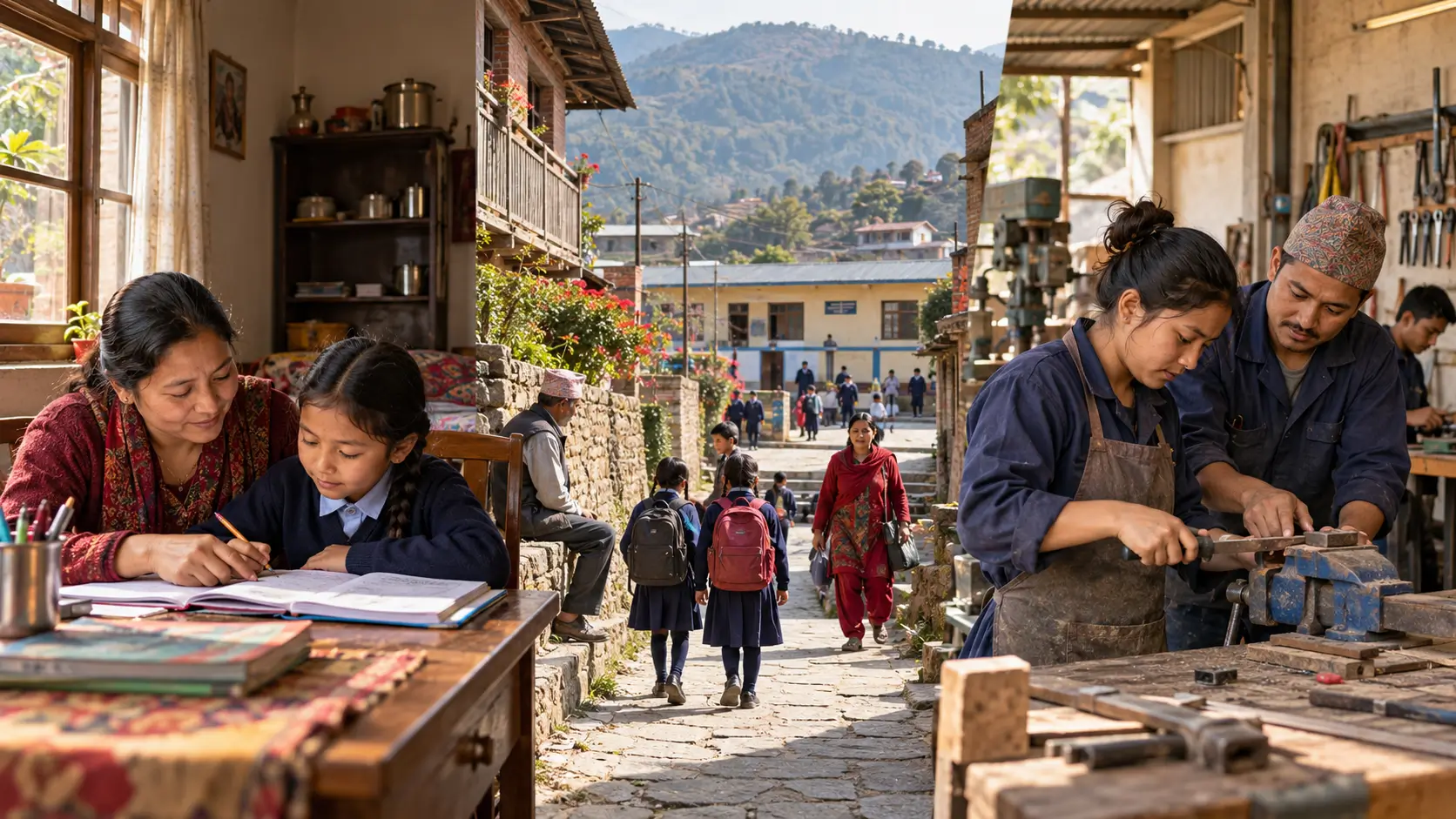
Between today’s education system and the job market, there is a huge ocean. When students leave university, they come out as “graduates who know nothing.”
Co-operative Model
Universities must collaborate with software companies to provide students with “paying internship” (Pying Internship). A system where students study three days a week and work two days in a related field is necessary to meet the new era’s demands.
Feedback Loop
Based on which new skills AI demands in the market, the curriculum must be updated every semester with flexibility. Bureaucratic delays destroy the relevance of technology.
Policy Reform
Not from two years, but from twenty years of educational experience and the study of successful models from developed countries (such as Finland or Singapore), one thing becomes clear: without vision in leadership, resources are only misused.
Expertise in Leadership
In places where the Ministry of Education makes plans, there should be councils of technical experts and educationists, not party workers. This is a YMYL (Your Money Your Life) sector, because one small policy mistake can push an entire generation into unemployment and the darkness of depression.
Identifying Investment Priorities
Instead of investing only in large buildings, the state must focus budgets on digital devices for students and quality training for teachers. There is a major opportunity to uplift community schools through AI, because AI can provide a rural student with the same quality of learning materials that students in the world’s most expensive colleges receive.
AI Ethics and Privacy
The most important but least discussed issue is the “shadow” side of AI.
Artificial Intelligence and Ethics
Should students leave every assignment entirely to AI? If so, will their creativity (Creativity) die? The education system must explain that AI is like a “car”—it helps you reach faster, but your ability to “walk” and your wisdom to “choose the road” remain the final decision-makers.
Privacy Risks
Which AI company is using students’ educational data, and how? Nepal needs strong laws and academic policies on this. To protect children from getting trapped in the “algorithm” net at an early age, “digital discipline” must also become part of the curriculum.
We keep calling AI the future, but the truth is AI has already become the present. Even small children in Nepal’s cities have started talking with ChatGPT. Meanwhile, our old-style schools are still obsessed with “mobile bans” and “copy checks.”
If we do not start structural reform in education immediately, our future labour force will become nothing more than cheap workers doing “data entry” for other countries. But if we teach our youth the skills to control and operate AI now, we can compete with the world’s biggest tech giants while living on our own soil.
Education is not only about learning letters. Education is about building the ability to walk with time. In this ocean of AI, we do not only need people who can float—we need sailors who can steer the waves in the right direction.
Conclusion and Future Outlook
In the end, we are at a turning point in history where “those who cannot change fall behind.” Nepal cannot move forward by applying only a “bandage” to its education system; it needs an “organ transplant.” It is already too late to accept AI as an enemy or an alternative. We must accept it as a strong “partner” and transform both the curriculum and mindset without delay.
Today’s youth are not only asking for a job; they are asking for the ability to compete in the global market. The only path to that is a modern, practical, and skill-based Nepali education system suited to the AI era.
The issues raised in this article are research-based and free from any commercial bias. Education is not only a human right; it is the foundation pillar of civilization. The reforms we make today will decide the picture of Nepal in 2050.




Comments 0
No comments yet. Be the first to start the conversation.