



The Valuable Time After SEE: Essential Skills, Academic Options, and the Right Roadmap
In Nepal’s educational context, the Secondary Education Examination (SEE) is regarded as an important milestone. Although, after the amendment to the education regulations, Classes 1 to 12 have been integrated under the school level, the psychological, academic, and technical difference between the end of Class 10 and the beginning of Class 11 is still quite large.
For years, students remain confined within a fixed school structure, curriculum, and daily schedule. As soon as SEE ends, they suddenly enter a much wider space of freedom. The nearly three months of free time they get while waiting for the results is a golden and decisive opportunity to shape the direction of their future.
It is a serious mistake to think of this period only as a time for traveling or sleeping away the days. On the other hand, the tendency to rush blindly into various commercial educational institutions in the name of a bridge course is equally risky.
The time after SEE is the time to understand oneself, learn new skills needed for practical life, test one’s abilities, and draw a clear roadmap for tomorrow.
This article presents a factual and detailed analysis of the skills a student must learn after SEE, how to choose a future subject and college, and what role parents should play at this serious turning point. Students looking for broader guidance may also read what to do after SEE.
Curriculum Gap and Mental Preparation
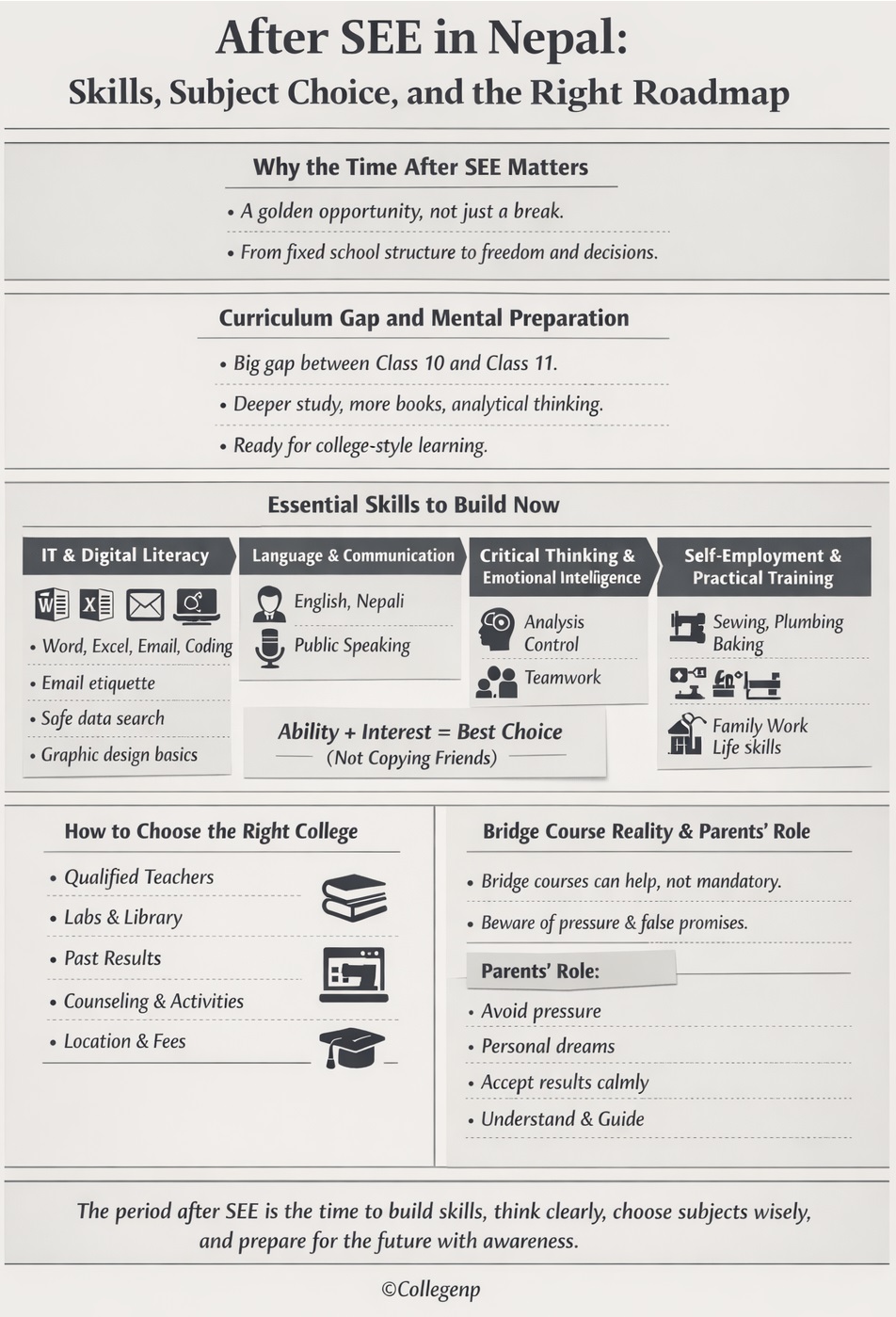
From a policy perspective, moving from Class 10 to Class 11 may be considered as ordinary as moving from Class 5 to Class 6, but the reality is different. In Nepal’s context, education experts point out that there is a major curriculum gap between the depth of study up to Class 10 and the breadth of study after entering Class 11.
In Classes 11 and 12, the theories students need to understand, the volume of books they need to study, and the analytical style expected in answers all change drastically. Because this transition can be mentally difficult for students to handle suddenly, they need to use this free time to prepare themselves for the college-level learning system. Rather than only memorizing, students should build the mental foundation to analyze the causes and effects of what they study during this very period.
Essential Life and Practical Skills Students Must Learn After SEE
Today’s global labor market has already proven that textbook knowledge alone is not a sign of success. The free time after SEE should be used productively by learning life-oriented hard and soft skills.
a. Information Technology (IT) and Digital Literacy
In today’s age, not being technology-friendly is almost equal to being illiterate. No matter which faculty a student chooses, whether science, humanities, or management, IT skills are essential. Students need to develop themselves beyond basic computer operation.
This is a good time to learn Microsoft Office tools such as Word, Excel, and PowerPoint, formal email communication etiquette, safe ways to search for data, the basics of graphic design, and introductory coding and programming. Courses in mobile and laptop repairing, networking, and computer hardware can make students technically self-reliant.
Students interested in this area may also explore essential computer skills every student should learn.
b. Language Proficiency and Communication Skills
Especially for higher education, the ability to express oneself clearly in both English and Nepali is a prerequisite. Students who are weak in English should give special attention to it during this free time, because English is the medium of instruction in higher classes in science and many other faculties.
Language learning is not only about grammar. It is also necessary to develop public speaking, presentation skills, and the ability to engage in logical discussion.
c. Critical Thinking and Emotional Intelligence
College life demands that students develop the critical awareness needed to distinguish right from wrong. To build analytical ability, they should develop the habit of reading books beyond the curriculum, including literature, autobiographies, world history, and philosophy.
Likewise, practice in emotional intelligence, meaning the ability to manage one’s emotions, learn from failure, and work cooperatively in groups, should begin from this stage.
d. Self-Employment and Practical Training
No skill is small or big. It is highly beneficial to take short-term training based on one’s interests, household economic condition, and market demand. Examples include sewing and knitting, plumbing and wiring, beautician training, bakery and cook training, barista training, gift item making, or driving.
These skills can also provide students with self-reliance during higher studies by enabling them to work part-time and cover their own expenses.
e. Exposure to the Outside World and Family Interaction
Learning does not happen only inside the classroom. Traveling and observing the society and culture of new places broadens a student’s thinking. Helping with the family’s profession or agriculture, spending time with grandparents, and listening to their experiences can provide deep knowledge about life and society.
3. Subject Selection: First, Try to Understand Yourself
As soon as the results are published, the biggest confusion becomes: “What should I study now?” This is not merely the process of moving to another class. It is a point where the foundation of a long-term career is laid. Therefore, students should not make decisions under pressure or imitation.
A student must ask these three questions:
-
Which subject can I study without feeling exhausted, and which one feels easier for me to understand?
-
What kind of work interests me? Scientific experiments, social work, accounting, literature, or technical work?
-
What are my long-term goals and my family’s capacity?
If a student has ability but no interest, study may later become a burden. The best decision is to choose a subject where both ability and interest are aligned.
In Nepal, the following major faculties are generally available in Classes 11 and 12:
-
Science: For students who have both the dream and ability to enter higher fields such as medicine, engineering, piloting, or information technology. However, the old mentality that “only the smartest students study science” is wrong.
-
Management: For those interested in becoming entrepreneurs, entering banking, creating business plans, taking corporate leadership roles, or working in hotel management.
-
Humanities: For analytically minded students who want deeper study in sociology, journalism, politics, psychology, law, or literature.
-
Education: For students who want to improve the country’s education sector, contribute to policy-making, and build a career in teaching.
-
Technical Education (CTEVT Programs): If the aim is to connect directly to employment, students may choose shorter and skill-based technical courses such as Health Assistant, ANM, diploma engineering, veterinary studies, and similar programs.
-
International Courses: Research-oriented programs recognized globally, such as A Level or IB.
The tendency to choose the same subject as friends can destroy a student’s future. Choosing a subject against one’s own interest and ability just because it is seen as an easy route to going abroad can later create extreme disappointment.
Students going through this stage may also find choosing the right subject after SEE in Nepal and choosing the right stream for Class 11 students useful for further reflection.
How to Choose the Right School or College: Ways to Avoid False Illusions
Choosing a college is a decisive turning point in life. Selecting a college only on the basis of flashy advertisements on television and social media is like jumping into a river with closed eyes. The belief that famous and expensive colleges are always good, and cheap colleges are always low-quality, is wrong.
Students should personally visit and investigate the following matters while choosing a college:
-
Permanent and qualified teachers or professors: Some commercial colleges attract students by displaying well-known “brand face” teachers on hoarding boards. But a few months after admission, those faces disappear from the college. Students should quietly ask seniors studying there about whether such a deceptive trend exists.
-
Infrastructure and laboratories: What is the lab like for the subject you want to study? Do the computers work properly? Does the library have enough books?
-
Academic environment and results: What has been the college’s past performance? What kind of academic discipline does it maintain? Is the environment focused on learning or on fashion and appearance?
-
Counseling and extracurricular activities: How active are sports, debates, and research-based projects? Is personality development prioritized, or is the college limited only to rote learning?
-
Access and fees: Is it easy to travel there daily from home? Are the fees transparent? Students must consult former students to know whether the college charges hidden fees or deceives students in the name of scholarships.
The Bridge Course Market and the Reality
As soon as SEE ends, towns and cities across Nepal are flooded with posters advertising bridge courses. The bitter reality is that many of these mushrooming institutes coordinate with teachers and administrators from community and institutional schools and even purchase students’ phone numbers. They call SEE graduates and parents every day, making promises and trying to attract them.
Bridge courses certainly help to some extent in reducing the gap between curricula. However, there remains a high risk that large institutes may sell confusion and unrealistic dreams to young minds. A child may believe the false promises shown by teachers during two or three months of bridge course training and then choose a college beyond the family’s economic means or develop unrealistic foreign ambitions.
At the same time, the narrative that a bridge course is compulsory for career development is false. Students who study independently according to their interests, make free use of online educational resources, or gain creative knowledge while staying in their own village do not need to invest in the expensive bridge course business. This is entirely a voluntary and personal decision.
Result Pressure and the Decisive Role of Parents
Since students themselves are still immature at the time of making decisions after SEE, the role of parents must be the deepest and most meaningful.
At present, a harmful practice is growing in society where parents create unnecessary mental pressure by setting “result conditions” for their children. Statements such as, “If you get an A+ GPA, I will buy you a mobile phone or motorcycle,” are dangerous inducements. If the results do not come as expected, young students may panic, suffer stress, fall into depression, and at times face serious harmful outcomes.
After the exam is over, the result cannot be changed. It is the responsibility of parents to prepare their children mentally to accept whatever result comes with calmness. There are many examples of students who achieved only average results in Class 10 but later performed excellently in Classes 11 and 12 after finding the right subject aligned with their interests.
Parents must understand this clearly: they should not impose their own unfulfilled dreams on their children. Rather, it is wiser to understand the child’s nature, what the child wants, the reality of the market, and the family’s financial condition, and then show an appropriate path through dialogue. Instead of investing in social comparison and imitation based on which city or expensive college other children choose, the need today is to think, “How can I understand my child’s ability and provide the right environment?”
Conclusion
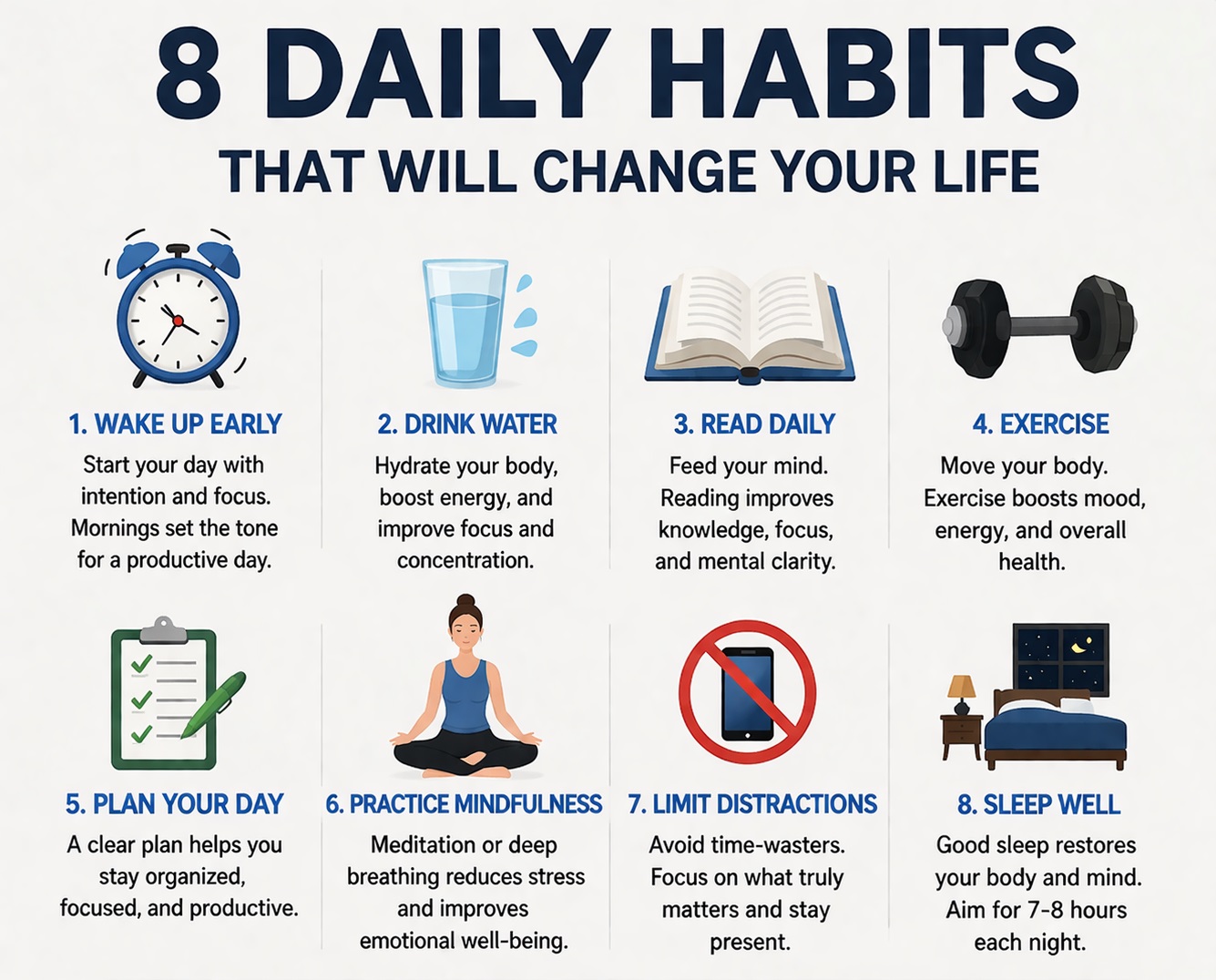
The period after SEE is not an age for sitting in isolation, remaining inactive, or wasting time on television and social media. It is the time to build one of life’s most important foundations. At this stage, learning information technology, taking vocational and technical training, and making objective choices about subjects and institutions shape the foundation of an entire life.
Only when both students and parents move forward with awareness, without falling into social pressure, unnecessary confusion, false prestige, and the trap of commercial institutions, can a beautiful and strong future truly be secured.







Comments 0
No comments yet. Be the first to start the conversation.