




Table of Content
- The State of Internships for IT Students in Nepal: An Analysis of Reality, Opportunities, and Challenges
- The Gap Between Education and Industry and the Importance of Internships
- Mandatory Internship Provisions in Universities and Colleges and Changing Practices
- The Ground Reality of Internships in Nepal’s IT Market: Stipends and Opportunities
- Major Challenges Faced by Students and Colleges
- Preparation Students Must Make to Gain Internship Opportunities
- Is Internship Alone the Final Solution to All Problems?
- Conclusion
The State of Internships for IT Students in Nepal: An Analysis of Reality, Opportunities, and Challenges
In recent years, student interest in information technology (IT)-related academic programs in Nepal has been rising rapidly. Along with the global wave of science and technology advancement, Nepali universities have also given this field special importance by designing and running various new courses. At present, the number of students studying subjects such as BSc CSIT, BCA, and BIT in Nepal, along with BITM and other programs, is significant.
Likewise, in line with the development and growing need for technology, Nepal has seen the emergence of businesses ranging from IT service startups to multinational companies. This environment clearly shows that the scope of the IT sector in Nepal is expanding. As the market grows, the industry needs a steady supply of skilled manpower, while thousands of students graduating from colleges seek secure employment opportunities. To meet both needs, a deep and productive relationship between industry and educational institutions is essential.
However, stakeholders acknowledge the reality that the relationship between our academic system and industry is still not strong enough, and that a large skills gap continues to exist. In this context, internships have emerged as an important bridge that connects students’ theoretical knowledge with the practical needs of the market.
This article provides a detailed analysis of the current state of internships within Nepal for students who have studied IT, how internships benefit both students and industry, and what challenges still remain.
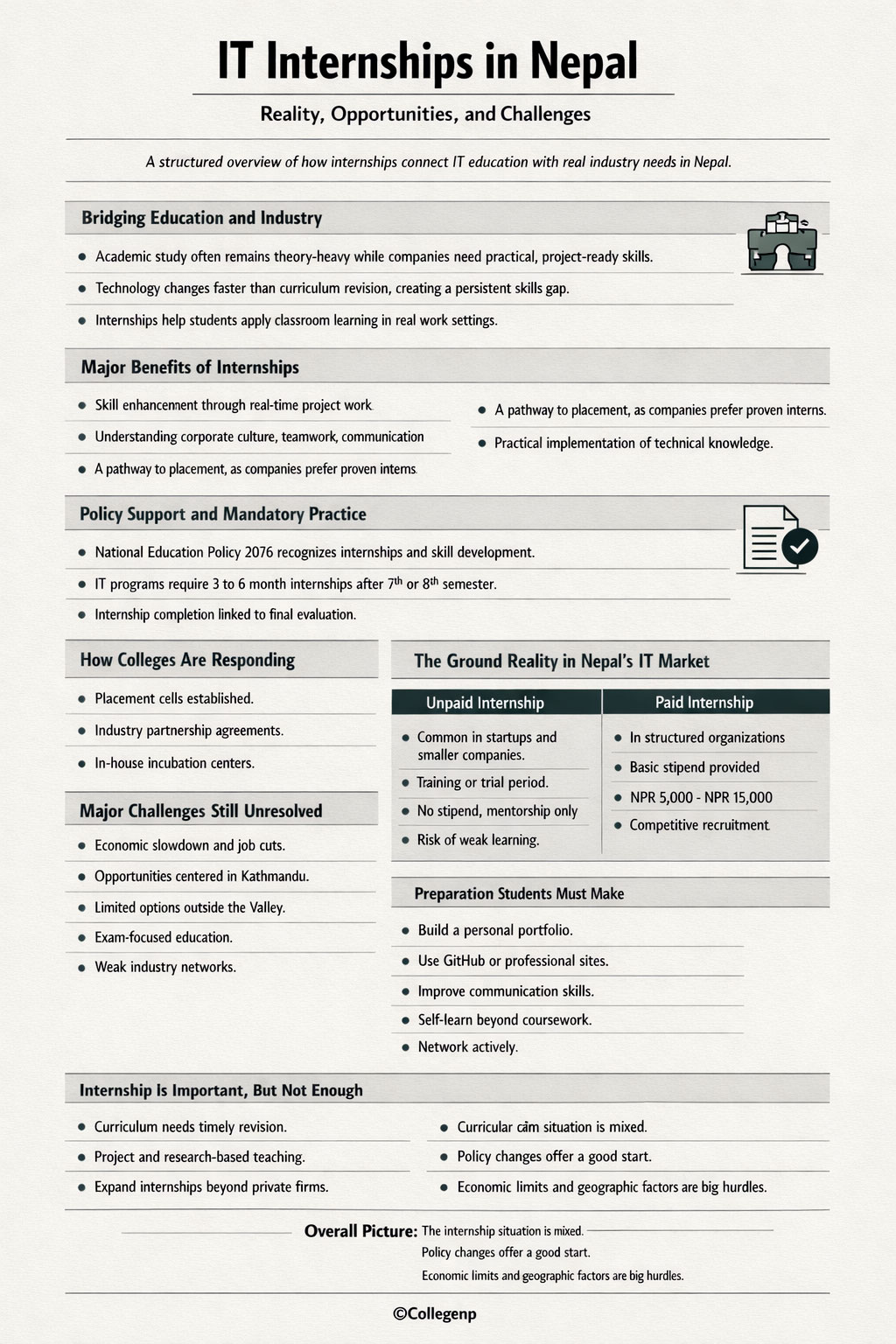
The Gap Between Education and Industry and the Importance of Internships
By the time students complete a four-year university or college course, they have studied thousands of pages of books and passed dozens of examinations. But industry looks not for students who only score high marks in exams; it looks for people who can work on real projects according to client demands. This is where the gap between education and the market is created.
In Nepal, it often takes years for university curricula to be revised in line with the times, but technology moves so fast that even a skill learned six months ago can start to feel outdated. Therefore, students who enter the job market relying only on theoretical knowledge are likely to face challenges. The strongest and most effective tool to overcome this situation is the internship.
Major Benefits of Internships
-
Skill Enhancement: An opportunity to apply coding or design knowledge learned in the classroom to real-time projects.
-
Understanding Corporate Culture: Students learn practical habits such as arriving at the office on time, working in teams, communicating effectively, and solving problems when they arise.
-
Path to Placement: Many companies give first priority in hiring to interns who have already been learning, building skills, and proving themselves within the company rather than recruiting entirely from outside.
-
Practical Implementation: The study of technology does not remain limited to textbook pages; students learn how to use that knowledge to build productive systems.
Recognizing this importance, the Government of Nepal also made special provision in the National Education Policy, 2076. The policy clearly mentions operating industrial skill development programs, internships, and on-the-job training in partnership with private-sector employers and institutions. Not only that, but under the student evaluation system, practical exams, hands-on practice, and internships are also taken as a basis for assessment.
Mandatory Internship Provisions in Universities and Colleges and Changing Practices
In recent years, universities and technical colleges in Nepal have begun revising their curricula to include internships as a credit-bearing course. This is a highly positive step.
Internship as a Mandatory Requirement
Under revised university rules, students in most four-year undergraduate programs are required to complete an internship of 3 to 6 months (generally 90 days or more) in an IT or technology-based organization after reaching the seventh or eighth semester. Only after completing this requirement, and on the basis of the recommendation given by the host institution and the internship report submitted by the student, are certification or final grading processes completed.
Colleges’ Own Efforts
To ensure that internships do not become a mere formality, good colleges are now establishing separate placement cells or units dedicated to internship facilitation within their institutions. According to officials from university engineering and technology faculties, a growing trend has emerged in which colleges and IT companies sign Memorandums of Understanding (MoUs) and regularly send students for training.
In-House Incubation Centers
It is not easy for all students to enter the market and secure internships at the same time. In particular, for students preparing to go abroad, those unable to join industry placements, or those studying in colleges affiliated with foreign universities where internships are not mandatory in the curriculum, some colleges have established in-house incubation centers. During long breaks or at the end of the course, such centers assign projects based on industry models within the college premises themselves. This gives students a chance to learn company-style workflows even without physically going to a company.

The Ground Reality of Internships in Nepal’s IT Market: Stipends and Opportunities
Although colleges have made internships mandatory, the market is not yet fully favorable for students to easily find placements. For industry, providing internships is not an act of charity; it also requires investment. In IT companies, two common practices can be seen in the management of interns.
1. Unpaid Internship
Some startups and small companies in Nepal offer unpaid internships. In such cases, companies follow the policy that they will teach students, provide mentorship, and in return neither charge nor pay them. To train a beginner, a company often has to use the valuable time of its senior developers. As a result, there is a market practice of keeping the first 2 to 3 months as a trial period without pay. However, there is also a risk of student exploitation and of not receiving meaningful learning in such arrangements.
2. Paid Internship
In well-established corporate houses, large IT companies, and institutions with stronger organizational structures, students doing internships are often provided with a basic stipend or minimum pay. After interns work for the period defined by the company, there is a growing practice of offering allowances ranging from around NPR 5,000 to NPR 15,000, enough to cover food and transportation costs. Paid internships are often more common when companies issue open calls rather than recruiting only through college placement channels.
Major Challenges Faced by Students and Colleges
Although the internship system appears highly effective in principle, many practical problems and challenges in Nepal still remain unresolved.
Impact of Economic Slowdown and Job Cuts
The economic slowdown has had a direct effect on the IT industry as well. University officials are also aware of this situation. There is even a common saying: “The size of the industry is small, and some of the industries that exist are facing economic crisis.” As industries cut costs, companies are increasingly hesitant to take in new and unskilled interns, reluctant to provide training, or unwilling to open vacancies at all.
Imbalanced Geographic Distribution
More than 90 percent of established IT companies in Nepal are concentrated in the Kathmandu Valley. Meanwhile, IT colleges under universities such as Tribhuvan, Purbanchal, and Pokhara are spread across the country. Students studying IT outside the Valley have very limited chances of finding quality and relevant internships in their own cities. Many students also cannot afford to come to Kathmandu only for an internship.
Exam-Centered Student Mindset
Stakeholders repeatedly raise the same concern: students study only to pass exams. Because they focus mainly on textbook memorization to secure good marks, their soft skills and even their foundational programming or technical knowledge often remain weak. Industry does not want to bring technically weak students into its systems.
Lack of Reliable Institutional Agreements Between Industry and Colleges
Just because universities have made internships mandatory does not mean companies will automatically open their doors. Unless these two sectors are institutionally connected, students applying on their own often face only rejection. Not all colleges yet have strong networks with quality industries.
Preparation Students Must Make to Gain Internship Opportunities
Simply saying “I have studied IT” is not enough for companies to take students in as interns. The market is small, and competition is extremely high. Securing an internship has now become similar to a competitive examination. Students who are studying in college and looking for internships must mainly prepare in the following ways.
Build a Personal Portfolio
Before applying for a job or internship, students should have already built at least some personal projects of their own. It does not matter whether it is a web page, a small mobile app, or a simple piece of software. While looking for opportunities, students must be able to show a GitHub link or an online professional portfolio and say, “I built this.”
Develop Soft Skills and Communication
Companies look not only for technical knowledge but also for people with strong communication ability. Students who can present themselves in interviews, write emails, and clearly understand and explain things are more likely to be selected quickly.
Continue Self-Learning
The education provided by universities is only a foundation. Only students who keep themselves updated with new frameworks, tools, and technologies can secure internships and the jobs that follow.
Use Networking Effectively
Students should build the habit of participating in technical seminars, hackathons, boot camps, and IT fairs, and of connecting with people in the industry through professional platforms such as LinkedIn.
Is Internship Alone the Final Solution to All Problems?
Experts and stakeholders in Nepal say that making internships mandatory alone cannot guarantee the production of a fully skilled workforce. If students spend a few months in internships merely passing time, the effect can become even more negative for education. According to one university dean, the solution does not lie in internships alone. Curricula must also be updated in line with the times, and project-based teaching and learning systems grounded in research and experimentation must be developed in educational institutions.
Opportunities for IT internships should not be limited to the private sector, such as corporate houses and banks. With federalism, a gradual wave of system digitization has also begun in Nepal’s 753 local levels, government bodies, and other non-profit institutions. Stakeholders suggest that these places, too, could produce good results by engaging local students with fixed remuneration.
Conclusion
Overall, the state of internships for IT students in Nepal is mixed. On one hand, policy provisions and curriculum reforms have made it mandatory for students to enter the market for practical exposure while still studying, which is an extremely productive beginning. From universities to college management committees, efforts are continuing through practices such as placement cells and incubation centers to connect students with industry.
On the other hand, problems such as economic challenges, the limited capacity of industries and companies, lack of preparation among beginner-level students, and geographic concentration still remain. This has created a situation in which students must work very hard to secure internships. However, it cannot be denied that students who have managed to gain internship opportunities in good institutions through excellence and hard work have built a strong career foundation not only for Nepal but also for competing in the global market.
The way forward is for students themselves to strengthen their practical skills, for companies to give space to beginner-level talent with a sense of social responsibility, and for educational institutions to accelerate curriculum revision. Only then will Nepal’s IT education be able to build a truly strong connection with industry and prepare the country’s graduates for the global market.







Comments 0
No comments yet. Be the first to start the conversation.