




Choosing the Right Subjects for Class 11 After SEE
Choosing subjects for Class 11 is an important academic decision for students after SEE. It can influence higher education options, entrance requirements, skill development, and future career pathways. The decision should be based on verified information, not pressure, assumptions, or promotional claims.
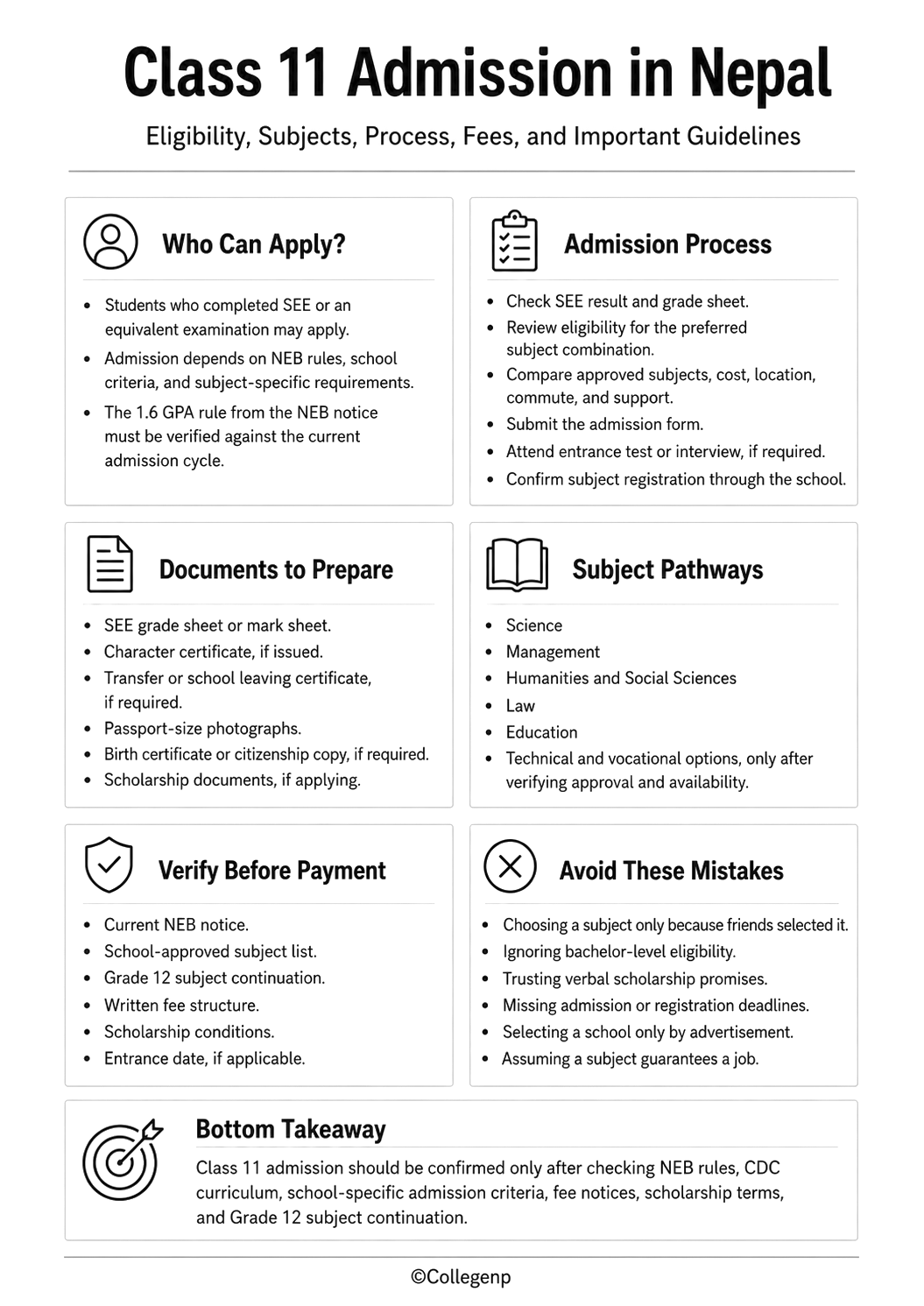
Students and parents should check the latest subject structure, curriculum, examination notices, and registration requirements through official sources such as the Curriculum Development Centre and the National Examinations Board. CDC’s e-library lists Grade 11 curriculum and specification-grid materials, while NEB publishes notices related to Grade 11 and 12 examination and subject registration matters.
Why Subject Selection Matters
Class 11 subject selection should not be treated as a choice between “good” and “weak” streams. Each subject group can lead to meaningful study and career options if it matches the student’s interest, ability, and long-term plan.
A student interested in medicine, engineering, agriculture, health science, information technology, business, law, education, social science, public service, or entrepreneurship may need different subject combinations. Before choosing any course or stream, students should confirm whether the selected subjects meet the eligibility requirements for their preferred higher education program.
Main Subject Areas in Class 11
Schools commonly offer subject combinations under areas such as science, management, humanities, law, and education. However, students should review the actual subjects offered by each institution rather than relying only on stream names.
Science-Related Subjects
Science-related combinations may include subjects such as physics, chemistry, biology, mathematics, or computer science, depending on the school’s approved offering.
These subjects may be suitable for students who are interested in experiments, mathematics, logical reasoning, technology, health science, engineering, agriculture, research, or applied science. However, students should check whether the specific combination they choose meets the entry requirements for future programs such as medicine, engineering, nursing, agriculture, or computer science.
Management and Commerce-Related Subjects
Management-related combinations may include subjects such as accounting, economics, business studies, finance, or marketing, depending on the institution.
These subjects may support further study in management, business administration, finance, economics, accounting, entrepreneurship, and related fields. Students should verify the syllabus, practical requirements, and future course eligibility before enrollment.
Humanities, Social Sciences, Law, and Education
Humanities, social science, law, and education-related combinations may include subjects such as sociology, psychology, political science, history, culture, law, education, or mass communication, depending on availability.
These subjects may be suitable for students interested in society, communication, teaching, governance, public service, legal studies, research, policy, or community work. Students should check the institution’s subject approval and the requirements of universities or professional programs they may want to join later.
What Students Should Check Before Choosing
Students and parents should verify the following details before admission:
| Area to Check | Why It Matters |
|---|---|
| Eligibility | Some subjects or future programs may require specific grades or subject backgrounds. |
| Syllabus | The actual course content may differ from what students expect based on the stream name. |
| Fees | Admission, monthly, laboratory, examination, transportation, and other charges should be clearly confirmed. |
| Recognition | The school or college should be authorized to offer the chosen subjects. |
| Career scope | Career options should be understood as possible pathways, not guaranteed outcomes. |
| Further study requirements | Universities and professional councils may have specific subject requirements. |
Students should be careful with vague claims such as “high job demand,” “guaranteed career,” “best stream,” or “easy path to success.” Such statements are not useful unless they are supported by reliable data, official eligibility rules, or clear evidence.
How Students Can Identify Their Interests
Many students do not have a fixed career plan at the age of 15 or 16. That is normal. Instead of making a decision based on pressure, students should review their academic habits, strengths, and interests.
They can ask themselves:
-
Which subjects do I enjoy studying regularly?
-
Do I perform better in numerical, practical, analytical, reading-based, or discussion-based subjects?
-
What type of work can I imagine doing in the future?
-
Which subjects are required for the higher studies I may want to pursue?
-
Am I choosing this subject because I understand it, or because others expect me to choose it?
Teachers, parents, and counselors can help by observing the student’s academic performance, classroom participation, project work, consistency, and learning style.
What Parents Should Avoid
Parents should guide students with patience, not pressure. A student should not be pushed into science only because they received good grades. Similarly, students should not be discouraged from management, humanities, law, or education because of outdated ideas about status.
Parents should avoid:
-
Comparing the student with relatives, friends, or neighbors
-
Treating one stream as superior to another
-
Choosing subjects only because of social pressure
-
Believing college advertisements without checking facts
-
Ignoring the student’s interest, ability, and future goals
Every subject group requires discipline and effort. A subject choice is useful only when it fits the student’s academic ability and future plan.
Choosing the Right Institution
Before selecting a school or college, students and parents should verify the institution’s subject offerings, fee structure, academic support, laboratory and library facilities, teaching staff, counseling support, and examination record.
They should also ask clear questions before admission:
-
Is the selected subject combination officially offered?
-
What are the eligibility requirements?
-
What is the full fee structure?
-
Are there separate charges for practicals, exams, transportation, or uniforms?
-
What syllabus and evaluation system will be followed?
-
What support is available for students who struggle academically?
-
What further study options are available after completing this combination?
Students should not rely only on brochures, social media posts, or verbal promises. Important information should be checked through official notices, written documents, and direct communication with the institution.
Conclusion
Choosing subjects for Class 11 after SEE is a major decision, but it should not be driven by fear, pressure, or promotional claims. Students should compare their interests, academic strengths, future study requirements, course content, eligibility rules, fees, and institutional credibility before making a final decision.
The right subject choice is not the one that sounds the most prestigious. It is the one that gives the student a realistic, verified, and suitable path for further study and personal growth.





Comments 0
No comments yet. Be the first to start the conversation.