



Table of Content
- Class 11 Admission in Nepal: Eligibility, Subjects, Process, Fees, and Important Guidelines
- Overview of Class 11 Admission in Nepal
- Who Can Apply for Class 11 Admission?
- Class 11 Admission Process in Nepal
- Required Documents for Class 11 Admission
- Class 11 Subject Groups and Course Choices
- How to Choose the Right Subject Combination
- Entrance Exams, Fees, Scholarships, and Seats
- Questions to Ask Before Admission
- Common Mistakes Students Should Avoid
- Class 11 Admission Checklist
- Conclusion
Class 11 Admission in Nepal: Eligibility, Subjects, Process, Fees, and Important Guidelines
Class 11 Admission in Nepal is the next academic decision for students after the Secondary Education Examination (SEE). It is not only about joining a school or college. It also affects subject registration, Grade 12 continuity, bachelor-level eligibility, entrance preparation, daily commute, and total study cost.
Class 11 is the first year of the Grade 11–12 secondary level pathway. Students and guardians often use terms such as “Plus Two,” “Grade 11,” and “Class 11” for this stage.
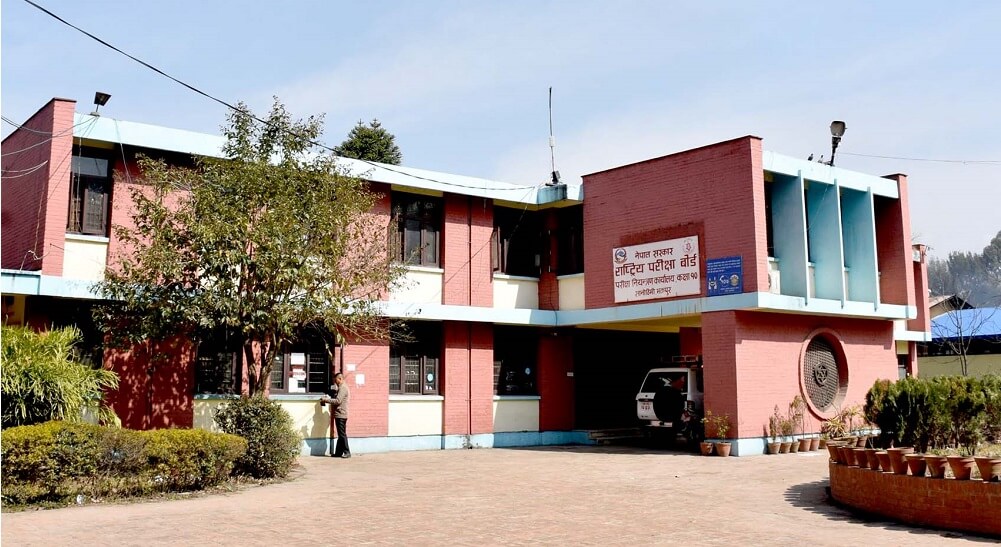
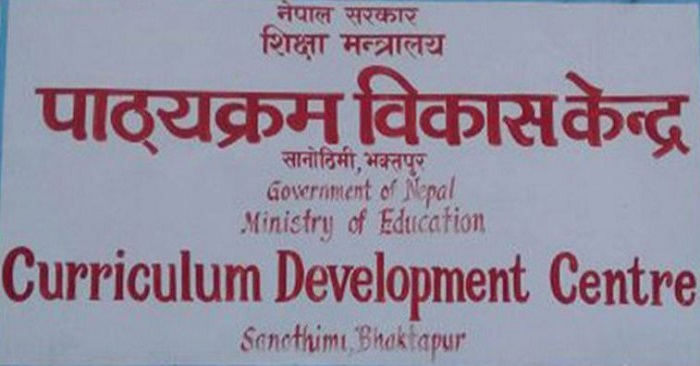
The National Examinations Board (NEB) manages examination and subject registration notices, while the Curriculum Development Centre (CDC) publishes curriculum records for compulsory and elective subjects.
CDC catalogue pages list Grade 11–12 compulsory and elective curriculum documents, including English, Mathematics, Nepali, Social Studies and Life Skills Education, and optional subject records.
Admission usually begins after SEE results, but exact dates, entrance exams, fee deadlines, scholarship rules, and seat availability are decided by schools, colleges, local bodies, and official notices. Students should verify changeable details from the official notice, campus, or concerned office before admission.
Summary
Class 11 admission in Nepal generally applies to students who have completed SEE or an equivalent examination, subject to NEB rules, school criteria, and subject-specific requirements. NEB’s subject registration notice required at least 1.6 GPA in SEE for Class 11 subject registration, but this rule must be rechecked against the current admission-cycle notice before publication or admission.
Key Takeaways
-
Check the current NEB notice before relying on GPA rules.
-
Treat Science, Management, Humanities, Law, and Education as subject pathways, not universal fixed streams.
-
Verify whether the school is approved to offer the chosen subjects.
-
Entrance exams, interviews, and merit lists differ by institution.
-
Do not rely on verbal scholarship or fee promises.
-
Check Grade 12 continuity before choosing optional subjects.
-
Keep receipts, admission confirmation, and subject registration details.
Overview of Class 11 Admission in Nepal
Class 11 admission is the entry point into Grade 11–12 after SEE or an equivalent examination. The process connects national-level registration rules with school-level admission decisions.
The uploaded editorial blueprint warns against one major error: treating every school’s admission rule as a national rule. It separates board-level requirements, CDC curriculum and subject structure, school-specific entrance, fees, quotas, scholarships, deadlines, and student decision guidance.
NEB subject registration is not the same as school admission. A student may meet a national registration condition but still need to satisfy a school’s entrance exam, internal merit list, fee deadline, or subject availability rule. Similarly, a school may advertise a subject group, but students should verify whether those subjects continue in Grade 12 and match the intended bachelor-level pathway.
Who Can Apply for Class 11 Admission?
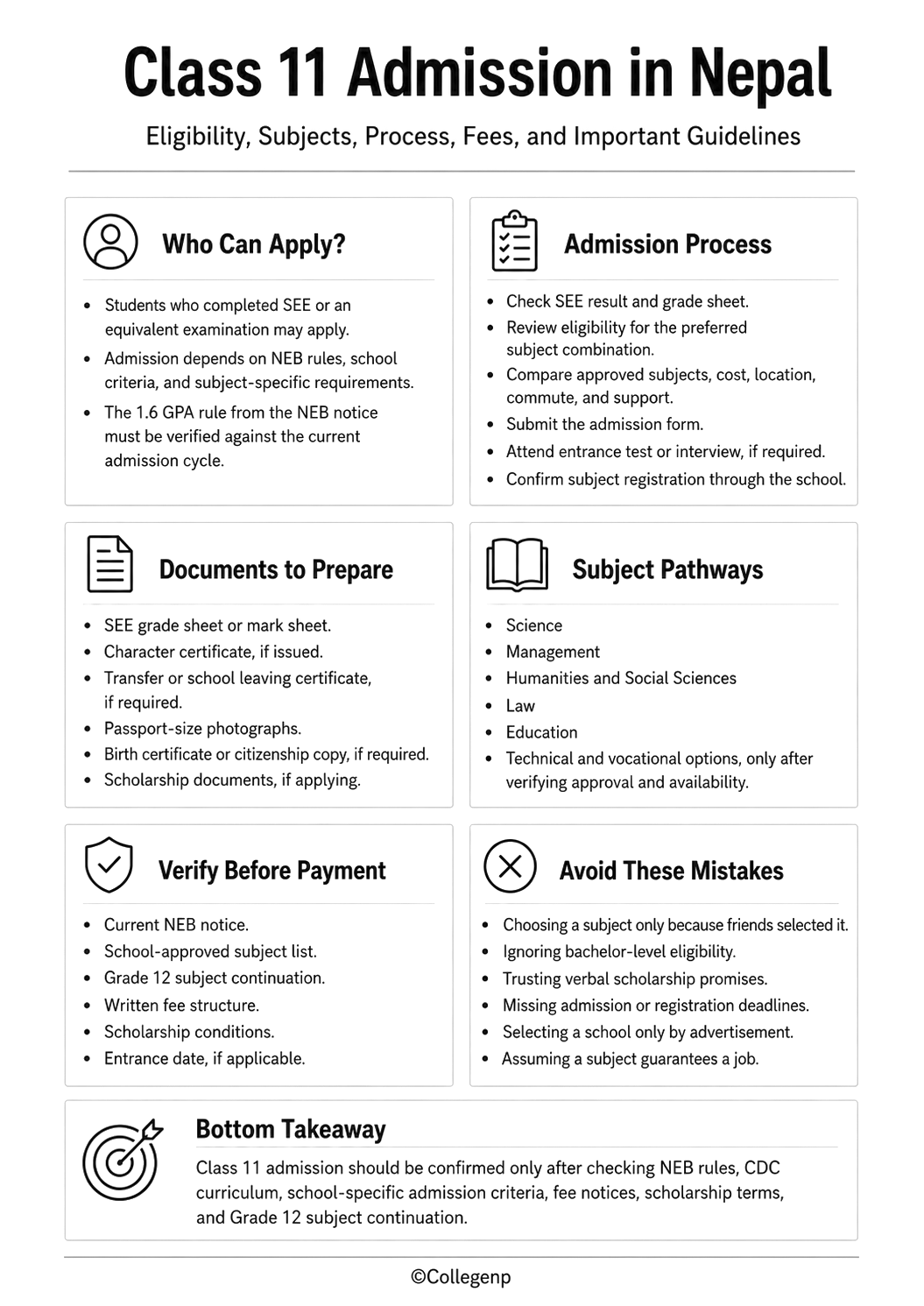
Students who have completed SEE or an equivalent examination may apply for Class 11 admission, subject to NEB rules, school criteria, and subject-specific requirements.
NEB’s Class 11 subject registration notice stated that only students who obtained at least 1.6 GPA in SEE should fill the Class 11 subject registration application form. The same notice also required a certified copy of the SEE Grade 10 grade sheet with the subject registration application.
For a current-cycle article or admission decision, do not present the 2082/83 GPA rule as the automatic rule for 2083/84 or later. Verify the newest NEB notice, the school’s admission notice, and the concerned office before publication or payment.
Class 11 Admission Process in Nepal
The Class 11 admission process usually starts with SEE result checking and ends with admission confirmation and subject registration. The exact order can differ by school.
A practical process is:
-
Check SEE result and grade sheet.
-
Review eligibility for the preferred subject combination.
-
Compare schools or colleges by approved subjects, cost, location, commute, and academic support.
-
Collect or submit the admission form.
-
Attend entrance test or interview, if required.
-
Submit documents requested by the institution.
-
Pay fees only after checking the written fee notice.
-
Confirm subject registration through the school.
-
Keep copies of receipts, admission confirmation, and subject details.The
Required Documents for Class 11 Admission
Documents differ by institution, but students are commonly asked to prepare school-level academic and identity records. Do not claim that every school requires the same documents.
Common documents may include:
-
SEE grade sheet or mark sheet
-
SEE character certificate, if issued
-
transfer certificate or school leaving certificate, if required
-
passport-size photographs
-
birth certificate or citizenship copy, if required
-
entrance exam admit card or entrance result, if applicable
-
scholarship-related documents, if applying for financial aid
-
payment receipt after admission
NEB’s 2082/83 subject registration notice specifically referred to attaching a certified copy of the SEE Grade 10 grade sheet with the subject registration application. Other documents should be verified from the school notice, campus office, or concerned office.
Class 11 Subject Groups and Course Choices
Class 11 subject choices should be discussed as subject groups or subject combinations. Labels such as Science, Management, Humanities, Law, and Education are common, but they should not be treated as the same in every institution.
CDC catalogue records show Grade 11–12 compulsory curriculum entries and elective subject entries. These records support a cautious approach: students should check both CDC curriculum documents and the school’s approved subject offering before choosing a group.
Science
Science may suit students interested in medicine, engineering, agriculture, health sciences, technology, pure science, or related fields. Students should check whether the school offers the required science subjects, lab-based learning support, and Grade 12 continuation.
Science should not be described as a path that guarantees income, admission, or career results. Later entry into medicine, engineering, agriculture, or health-related programs depends on Grade 11–12 subjects, Grade 12 performance, entrance exams, institutional criteria, and other official rules.
Management
Management may suit students interested in accounting, finance, business, hotel management, entrepreneurship, banking, administration, or related fields. It should not be described as an easy option.
Students planning BBA, BIM, BHM, economics, accounting, CA-related preparation, or public administration should verify bachelor-level eligibility and subject expectations. Optional subjects can matter later, especially when a bachelor program asks for mathematics, accountancy, economics, or other related subjects.
Humanities and Social Sciences
Humanities and Social Sciences may suit students interested in social work, journalism, sociology, psychology, public policy, development studies, languages, teaching, or civil service preparation.
This pathway should not be framed as only for weak students. It requires reading, writing, analysis, argument, and social understanding. Students should check whether the school offers the specific subjects they need because optional subject availability differs across institutions.
Law
Law may suit students interested in legal studies, public policy, governance, human rights, advocacy, or public affairs. Completing Class 12 with law-related subjects does not directly make a student a lawyer.
Students interested in law should verify the school’s Grade 11 and Grade 12 law subjects, later bachelor-level law admission criteria, and any entrance requirements after Grade 12. CDC catalogue records include law-related elective entries such as Jurisprudence and Legal Theories for Grade 11 and Nepali Legal System for Grade 12.
Education
Education may suit students interested in teaching, pedagogy, education planning, community education, or school-level academic work. It should not be described as a limited pathway without verified evidence.
Students should check whether the subject combination supports the later degree or training they plan to pursue. Those interested in teaching should also verify current teacher licensing, degree, and subject requirements from the concerned authorities when they reach that stage.
Technical and Vocational Options
Technical and vocational options should be mentioned only after verifying program approval, school eligibility, and current availability. The uploaded blueprint advises mentioning technical and vocational options only when available programs, school approval, and eligibility have been separately verified.
Students interested in technical programs should ask the school or concerned office whether the program is approved, whether seats are open, which documents are required, and how the program connects to later study.
How to Choose the Right Subject Combination
The right Class 11 subject combination depends on interest, ability, later study requirements, cost, and school-specific availability. No subject group is suitable for every student.
Students should compare:
-
interest and learning ability
-
SEE performance in related subjects
-
future bachelor’s degree requirements
-
entrance exam requirements after Grade 12
-
teacher availability
-
lab, library, and computer access where relevant
-
location and commute
-
total cost across the year
-
scholarship availability and renewal rules
-
guardian and student discussion
-
backup subject option
For example, a student planning engineering may need a different subject route from a student planning law, hotel management, journalism, social work, or education. Students should verify bachelor-level requirements early so they do not choose an optional subject that limits later admission choices.
Entrance Exams, Fees, Scholarships, and Seats
Entrance exams, fees, scholarships, and seats are mostly school-specific. Students should verify each detail from official notices or the concerned office.
Class 11 Entrance Exam in Nepal
Many schools and colleges conduct entrance tests for Grade 11 admission, especially in high-demand subject groups. Entrance format, syllabus, pass mark, interview system, and merit list rules differ by institution.
Do not publish a universal entrance syllabus unless a national or school-level official notice supports it. Students should ask which subjects are tested, whether an interview is included, how merit is calculated, and whether scholarship selection uses the entrance result.
Fees for Class 11 Admission
Class 11 fees vary by institution, location, subject group, facilities, and scholarship policy. Students should verify admission fee, monthly fee, lab fee, exam fee, transportation, hostel, uniform, books, and refundable deposits before admission.
Do not publish fee ranges unless they come from verified notices from multiple institutions. The safer editorial approach is to explain fee categories and advise students to get a written fee structure before payment.
Scholarships for Class 11 Students
Scholarships may be merit-based, need-based, school-specific, local-government based, or targeted to marginalized or disadvantaged groups when officially announced. Students should verify scholarship notices and conditions before admission.
Key questions include: Does the scholarship cover admission fee, monthly fee, or both? Is it for one term or a full academic year? Does renewal depend on attendance, internal exam marks, or board results? Is the scholarship written in the admission record?
Quota and Seat Availability
Seat availability depends on the school, subject combination, classroom capacity, lab capacity, and admission policy. Some institutions may publish merit lists or quota-based notices.
Do not mention exact quotas unless they are sourced from a school, campus, local government, or official notice. A verbal seat promise should not be treated as confirmation.
Questions to Ask Before Admission
Students and guardians should ask direct questions before paying fees or confirming subjects.
Useful questions include:
-
Is the school officially approved to run Grade 11 in the chosen subjects?
-
Which subjects are available in Grade 11 and continued in Grade 12?
-
What is the total first-year cost?
-
Are lab, library, computer, and counseling facilities available where needed?
-
What is the scholarship process?
-
What are the attendance and internal exam rules?
-
What documents are required for subject registration?
-
Can students change subjects after admission? Under what rule?
-
What happens if the student misses the registration deadline?
-
Are all promises written in the admission notice or receipt?
Common Mistakes Students Should Avoid
Students often make admission decisions under time pressure after SEE results. The main risk is choosing a school or subject without checking long-term academic fit.
Avoid these mistakes:
-
choosing a subject only because friends selected it
-
ignoring bachelor-level eligibility
-
not checking total fees
-
trusting verbal scholarship promises
-
missing admission or registration deadlines
-
selecting a school only by advertisement
-
ignoring commute time
-
not checking optional subject availability
-
assuming every school has the same entrance rule
-
assuming a subject guarantees a job
The uploaded editorial blueprint specifically warns against claims such as universal entrance exams, universal fee amounts, “Science is the best stream,” and job guarantees.
Class 11 Admission Checklist
Use this checklist before confirming admission:
-
SEE grade sheet checked
-
eligibility verified from the current notice
-
preferred subject combination selected
-
Grade 12 subject continuation checked
-
school notice reviewed
-
entrance date checked, if applicable
-
documents prepared
-
total fee structure verified in writing
-
scholarship form and conditions checked
-
admission receipt kept
-
subject registration process confirmed
-
official NEB notice reviewed
Conclusion
Class 11 admission in Nepal should be handled as a practical decision with several layers: NEB rules, CDC curriculum, school-specific admission criteria, fee notices, scholarship conditions, and the student’s study plan.
Students should first verify eligibility and subject registration rules from the latest NEB notice. Then they should check the school’s approved subject list, total cost, entrance process, scholarship conditions, and Grade 12 subject continuation. A careful decision can reduce later problems with subject mismatch, fees, missed deadlines, and bachelor-level eligibility.



Join
Join