



Table of Content
- Summary
- Key Takeaways
- What Is BCSIT?
- BCSIT Quick Facts
- BCSIT Full Form and Affiliation
- Is BCSIT the Same as BCIS?
- BCSIT Eligibility Criteria in Nepal
- BCSIT Admission Process
- BCSIT Entrance Exam in Nepal
- BCSIT Scholarship and Quota
- BCSIT Fee Structure in Nepal
- BCSIT Syllabus and Course Structure
- BCSIT Colleges in Nepal
- How to Choose a BCSIT College
- BCSIT vs BSc CSIT, BCA, BIT, and BCIS
- BCSIT Career Scope in Nepal
- Higher Study Options After BCSIT
- Skills Students Should Build During BCSIT
- Who Should Study BCSIT?
- Advantages of Studying BCSIT
- Limitations and Precautions Before Admission
- Final Admission Checklist
- Conclusion
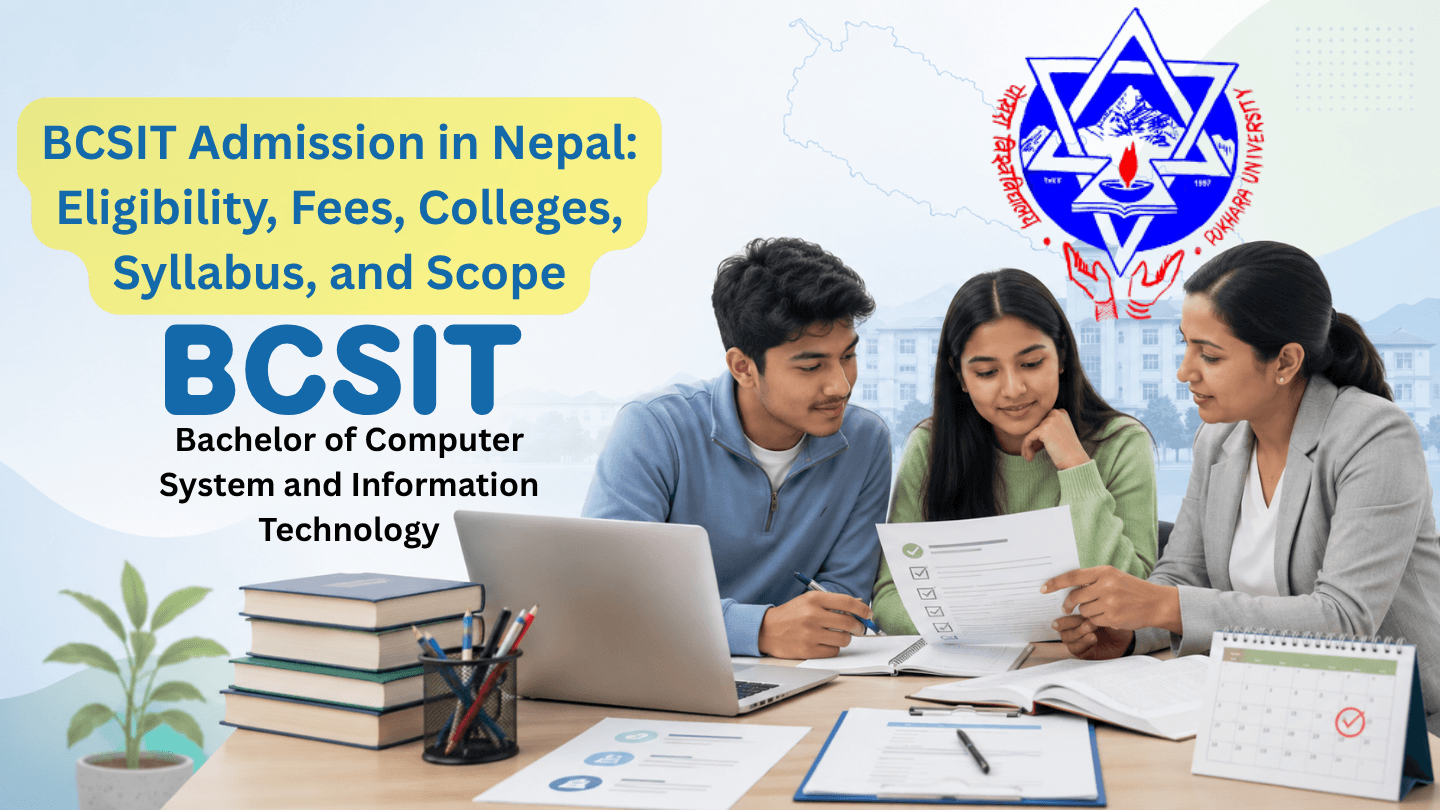
BCSIT Admission in Nepal is a common search for students who want an undergraduate IT degree but are still comparing BCSIT, BSc CSIT, BCA, BIT, and BCIS. The decision needs care because these programs differ in affiliation, eligibility, academic focus, entrance process, and career direction.
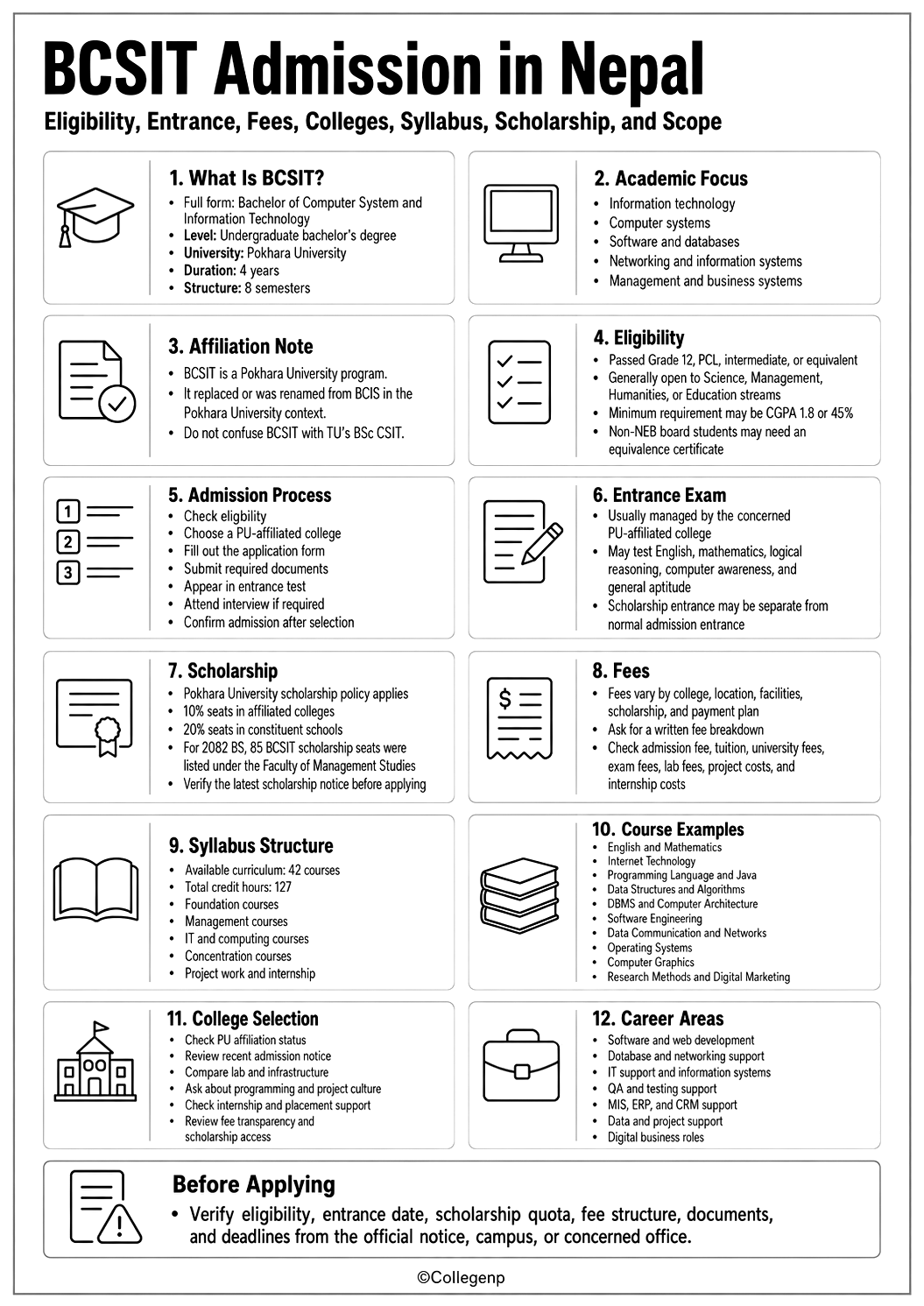
BCSIT stands for Bachelor of Computer System and Information Technology. It is a four-year bachelor’s degree under Pokhara University (PoU). The program has eight semesters and is linked to the earlier BCIS name in the Pokhara University context, where BCIS is now referred to as BCSIT.
BCSIT combines information technology, computer systems, software, databases, networking, information systems, and management. It is not the same as TU’s BSc CSIT. BCSIT is a Pokhara University program with an IT-and-management orientation, while BSc CSIT is a science faculty program under Tribhuvan University.
Summary
BCSIT is a four-year, eight-semester undergraduate program under Pokhara University. It covers computer systems, information technology, software, database, networking, information systems, and management. Admission generally requires +2/PCL/intermediate/equivalent completion, entrance or college-level selection, possible interview, merit list, and document verification. Students should verify current eligibility, fees, scholarship quota, and deadlines from the official notice, campus, or concerned office.
Key Takeaways
-
BCSIT means Bachelor of Computer System and Information Technology.
-
It is a Pokhara University bachelor’s program.
-
The program runs for 4 years across 8 semesters.
-
The available curriculum lists 127 credit hours.
-
Eligibility generally starts from +2/PCL/intermediate/equivalent.
-
Entrance and interview rules may differ by college notice.
-
Fees, scholarship quota, and deadlines must be verified before applying.
What Is BCSIT?
BCSIT is an undergraduate IT degree with both technical and management subjects. It is designed for students who want to study computing along with business information systems.
The program covers areas such as programming, database systems, networking, operating systems, software engineering, web technologies, information systems, and management. Since many students confuse BCSIT with BSc CSIT, BIT, BCA, and BCIS, the first point to check is affiliation. BCSIT is offered under Pokhara University.
A bachelor’s degree is different from a short certificate. A certificate may focus on one tool, topic, or skill area. A bachelor’s degree has a longer academic structure, semester-based assessment, university rules, project work, and broader subject coverage.
BCSIT Quick Facts
BCSIT quick facts help students check the basics before comparing colleges or filling out admission forms.
| Topic | Details |
|---|---|
| Full Form | Bachelor of Computer System and Information Technology |
| Short Form | BCSIT |
| University | Pokhara University |
| Faculty | Faculty of Management Studies |
| Level | Undergraduate |
| Duration | 4 years |
| Semesters | 8 semesters |
| Total Credit Hours | 127 credit hours according to the available PU BCSIT curriculum and several college pages |
| Eligibility | +2/PCL/equivalent, generally any stream, with minimum requirement as specified by PU or college |
| Entrance | Usually conducted by the concerned college; interview may also be used |
| Scholarship | PU scholarship policy applies; 10% seats in affiliated colleges and 20% in constituent schools are covered |
| Career Areas | Software, database, networking, IT support, information systems, business systems, data, project support, and digital business roles |
BCSIT Full Form and Affiliation
BCSIT means Bachelor of Computer System and Information Technology. In Nepal, BCSIT is a Pokhara University program.
This affiliation detail matters because students sometimes mix BCSIT with TU’s BSc CSIT. BCSIT is commonly offered through PoU-affiliated colleges. It belongs to the Pokhara University context and has a stronger mix of information technology and management-related subjects than a purely science-oriented route.
Students should verify the affiliation of any college before admission. A college name alone is not enough. Check the latest admission notice, affiliation status, program title, and the office responsible for admission.
Is BCSIT the Same as BCIS?
BCSIT is related to BCIS in the Pokhara University context. Pokhara University’s program information lists BCSIT as replacing BCIS, and education portals also note that the program was formerly known as BCIS.
This is why students may see both names during research. Older references may use BCIS, while current admission pages may use BCSIT. Before applying, confirm the exact program name, batch, curriculum, and university affiliation from the selected college or concerned office.
BCSIT Eligibility Criteria in Nepal
BCSIT eligibility generally requires completion of Grade 12, PCL, intermediate level, or an equivalent qualification. The minimum grade or marks requirement should be checked from the latest admission notice.
Available BCSIT program information states that applicants should have completed 10+2/PCL/intermediate level or equivalent. PoU lists eligibility as any stream, including Management, Science, Humanities, or Education, with at least CGPA 1.8 or 45%. SAIM College states that students need intermediate, higher secondary, or PCL with second division or equivalent recognized by Pokhara University and must pass the entrance test conducted by the concerned college.
Students should check these points before applying:
-
Passed Grade 12, PCL, intermediate, or equivalent.
-
Usually open to Science, Management, Humanities, or Education streams, depending on notice.
-
Minimum grade or marks requirement should be checked from the latest admission notice.
-
Non-NEB board students may need an equivalence certificate.
-
Final admission depends on application review, entrance test, interview if applicable, merit list, and document verification.
Because eligibility wording may vary slightly by admission year and college notice, students should verify the latest requirement from Pokhara University or the selected PoU-affiliated college before applying.
BCSIT Admission Process
BCSIT admission usually follows a practical sequence: eligibility check, college selection, application, documents, entrance, interview if required, merit list, and final admission.
Step 1: Check Eligibility
Students should first confirm that their +2/PCL/equivalent qualification meets the minimum requirement. Do not rely only on old notices, social media posts, or informal claims.
Step 2: Choose a PoU-affiliated College
Students should compare location, fee structure, lab access, teaching support, project culture, internship support, placement support, and scholarship access. PU affiliation status should be verified before payment.
Step 3: Fill Out the Application Form
The application form is usually available from the concerned college or an online admission portal. Students should use the same name, date of birth, and academic details shown in their official records.
Step 4: Submit Required Documents
Common documents include SEE/SLC mark sheet and character certificate, Grade 11 and 12 transcript or mark sheet, Grade 12 character certificate, migration certificate if required, citizenship certificate or birth certificate, passport-size photos, and equivalence certificate for foreign boards if applicable.
Step 5: Appear in Entrance Test
Eligible applicants may be asked to take an entrance test. SAIM College notes that eligible applicants are informed about the entrance test and that the concerned college provides the test date and time.
Step 6: Interview and Merit List
Some colleges may conduct an interview or counseling session before final selection. Selection may depend on entrance performance, interview if applicable, academic records, seat availability, and document verification.
Step 7: Final Admission
Selected students confirm admission by paying the required fees and completing formalities. Students should request official receipts and written fee details.
BCSIT Entrance Exam in Nepal
BCSIT entrance is generally managed by the concerned PoU-affiliated college. Pokhara University’s general undergraduate admission information states that entrance examinations may be conducted by the university or affiliated colleges and that admission is generally merit-based.
The entrance may test English, mathematics, logical reasoning, computer awareness, and general aptitude. Some colleges may include interview or counseling.
Students should keep one distinction clear: scholarship entrance and normal college admission entrance may be separate. Scholarship applicants should check the latest PU scholarship notice for the required form, exam, documents, quota, and deadline.
BCSIT Scholarship and Quota
BCSIT students may look at two scholarship routes: Pokhara University scholarship and college-level scholarship. Both should be verified before admission.
Pokhara University scholarship policy covers 10% of seats in affiliated colleges and 20% in constituent schools. Selection may consider credentials, economic background, selection exam, and interview. For 2082 BS scholarship information, PoU listed 85 scholarship seats for BCSIT under the Faculty of Management Studies.
Students should check the following before applying for scholarship:
-
PU scholarship portal or official notice.
-
Annual scholarship quota.
-
Scholarship selection exam.
-
Required documents.
-
Merit, inclusion, or need-based categories.
-
College-level merit scholarship rules.
-
Renewal conditions for each semester or academic year.
Scholarship quota, eligibility, and deadlines change by year. Students should check the latest Pokhara University scholarship notice before applying.
BCSIT Fee Structure in Nepal
BCSIT fees vary by college, location, facilities, scholarship, and payment plan. A single fixed fee should not be assumed unless the selected college provides a current written fee structure.
Possible fee components include admission fee, semester tuition fee, university registration fee, examination fee, library or lab fee, internal exam or project fee, and internship or project-related cost.
Before paying, students should ask:
-
Is the quoted fee total or tuition-only?
-
Are university exam fees included?
-
Are project and internship costs included?
-
Is the scholarship renewable every semester?
-
What happens if a student’s SGPA drops?
-
Are there late payment fines?
-
Is there a written refund or withdrawal rule?
Fee details may change by college and intake. Students should verify from the campus accounts section or concerned office.
BCSIT Syllabus and Course Structure
The available BCSIT curriculum for Pokhara University lists 42 courses and 127 credit hours. The structure includes foundation courses, management courses, IT and computing courses, concentration courses, projects, and internship.
Foundation Courses
Foundation courses build academic and analytical basics. They include areas such as English, mathematics, communication, and related analytical subjects. Early semesters include English, Mathematics, Internet Technology, Fundamentals of Computer Systems, and Programming Language.
Management Courses
Management courses help students understand how information systems work inside organizations. The program includes management, finance, marketing, organizational behavior, entrepreneurship, and related business subjects.
IT and Computing Courses
IT and computing courses form the technical part of BCSIT. Course examples include Programming Language, Java, Data Structures and Algorithms, DBMS, Computer Architecture, Software Engineering, Data Communication and Networks, Operating Systems, Computer Graphics, Research Methods, and Digital Marketing.
Projects and Internship
Project work gives students a chance to apply technical and information-system knowledge. Internship provides workplace exposure and applied learning. Students should ask colleges how projects are supervised, how internships are arranged, and what support is available.
Concentration and Elective Courses
Concentration courses allow students to study specialized IT or business information systems areas. The exact options may differ by curriculum update or college offering, so students should check the latest syllabus.
BCSIT Colleges in Nepal
BCSIT is commonly offered through PoU-affiliated colleges. PoU lists institutions such as Ace Institute of Management, Uniglobe College, SAIM College, Quest International College, Apollo International College, Rajdhani Model College, Shubhashree College of Management, Liberty College, Nobel College, Boston International College, Excel Business College, Malpi International College, Pokhara College of Management, Shramik Shanti Campus, Crimson College of Technology, Apex College, and Medhavi College as BCSIT-offering institutions under Pokhara University.
Students should not treat a college list as final admission proof. Before applying, verify current affiliation, intake status, scholarship access, admission deadline, entrance process, and fee structure from the selected college or concerned office.
How to Choose a BCSIT College
A BCSIT college should be evaluated through academic support, practical learning, and fee clarity. Students should avoid choosing only by location, discount, or promotional claims.
Key points to compare include PU affiliation status, recent admission notice, lab and infrastructure, programming and project culture, faculty experience, internship and placement support, fee transparency, scholarship availability, student support, counseling, location, transport, examination support, and alumni outcomes.
Students can also ask practical questions: How often are lab sessions held? Are students required to build projects? Does the college support internships? Are internal assessments explained clearly? Can students see a written fee structure?
BCSIT vs BSc CSIT, BCA, BIT, and BCIS
BCSIT should be compared with similar programs by affiliation, eligibility, subject focus, and career fit.
| Program | Best For | Main Difference |
|---|---|---|
| BCSIT | Students wanting IT plus business information systems | Combines computing, information systems, and management |
| BSc CSIT | Students wanting a stronger science or computer science route | A science faculty program under Tribhuvan University with stricter science-stream orientation |
| BCA | Students wanting application development and software basics | Usually more application-focused and accessible to wider streams |
| BIT | Students wanting pure IT or technology orientation | More IT-focused, depending on university |
| BBIS/ BCIS | Students interested in business information systems | BCIS is the earlier or related PU naming context; BCSIT is the updated program name |
No program is better for every student. BCSIT may fit students who want technical study with management and information systems. BSc CSIT may fit students who want a more science-oriented computer science path. BCA may suit students focused on application development. BIT may suit students seeking a broader IT route, depending on the university.
BCSIT Career Scope in Nepal
BCSIT can lead to entry-level roles in software, database, networking, IT support, information systems, and digital business. It does not guarantee a job, salary, or promotion.
Possible roles include software developer, junior programmer, web developer, database assistant, database administrator trainee, system analyst assistant, IT support officer, network support technician, information systems officer, QA/testing assistant, digital business analyst assistant, MIS officer, ERP/CRM support staff, data analyst assistant, project coordinator in IT companies, and IT officer in banks, businesses, NGOs/INGOs, and corporate offices.
PoU notes expected roles such as programmer, system analyst, information analyst, database manager, network administrator, and trainer-cum-instructor.
Higher Study Options After BCSIT
BCSIT graduates may consider IT, information systems, computer science, or management-related master’s programs, depending on university eligibility.
Possible options include MIT, MSc IT, MSc Computer Science where accepted, MIS, MCIS, MCA where accepted, MBA, MBS, and specializations in data science, cybersecurity, software engineering, cloud computing, and information systems.
Students should verify master’s eligibility from the university where they plan to apply. Subject prerequisites, credit requirements, entrance rules, and equivalence rules may differ.
Skills Students Should Build During BCSIT
BCSIT students should build practical skills alongside coursework. A degree provides structure, but projects and practice often matter during entry-level screening.
Useful skill areas include programming, database design, web development, networking basics, operating systems, software testing, documentation, presentation, teamwork, version control, and project reporting. Students should keep records of course projects, internship work where allowed, technical reports, database designs, and web or software projects.
Who Should Study BCSIT?
BCSIT may suit students who want both IT and management knowledge. It may also suit students interested in software, databases, networking, business systems, IT departments, software companies, banks, startups, and digital businesses.
BCSIT may not suit students who want a heavily theoretical computer science degree, engineering licensure-oriented study, or only business and management without technical subjects. Students who do not want programming, mathematics, databases, or technical projects should review the syllabus before admission.
Advantages of Studying BCSIT
BCSIT gives students exposure to both technology and management subjects. This can help students understand how software, databases, networks, and information systems are used in organizations.
The program also includes projects and internship in the available curriculum structure. These can help students connect classroom learning with applied work, depending on college support and student effort.
Limitations and Precautions Before Admission
BCSIT students should check practical limits before admission. College quality, lab access, teaching support, project supervision, internship access, and fee transparency may differ across colleges.
Students should avoid these mistakes:
-
Confusing BCSIT with BSc CSIT.
-
Choosing a college only because of low fees.
-
Not checking PU affiliation and latest admission notice.
-
Ignoring scholarship deadlines.
-
Not asking for a written fee structure.
-
Assuming all colleges have the same entrance process.
-
Ignoring lab quality and project culture.
-
Not verifying internship support.
-
Depending only on promotional claims.
-
Not checking whether coding is taught practically.
Final Admission Checklist
Before applying for BCSIT, students should confirm eligibility, PU affiliation, latest admission notice, application deadline, entrance process, required documents, written fee structure, scholarship quota, scholarship deadline, renewal condition, lab access, project support, internship process, examination support, and admission confirmation process.
Students should also keep copies of application forms, payment receipts, scholarship applications, and official notices. Any changing detail should be verified from the official notice, campus, or concerned office.
Conclusion
BCSIT Admission in Nepal should be reviewed through eligibility, affiliation, entrance process, scholarship access, fee clarity, syllabus structure, and college support. BCSIT is a four-year, eight-semester Pokhara University program with computing, information systems, and management subjects. It is related to the earlier BCIS name in the PU context but should not be confused with TU’s BSc CSIT.
Before applying, students should verify the current admission notice, eligibility, entrance date, scholarship quota, fee structure, and document requirements from Pokhara University, the selected PoU-affiliated college, or the concerned office.

Comments 0
No comments yet. Be the first to start the conversation.