




Table of Content
- BBIS Admission in Nepal: Eligibility, Fees, Syllabus, and Career Scope
- What is BBIS?
- BBIS at a Glance
- BBIS Affiliation and Colleges in Nepal
- BBIS Eligibility Criteria in Nepal
- BBIS Entrance Exam and Selection Process
- BBIS Admission Timeline in Nepal
- Documents Required for BBIS Admission
- BBIS Fees in Nepal
- BBIS Course Structure and Subjects
- BBIS Quota, Seats, and Scholarships
- BBIS Admission Process Step by Step
- How to Prepare for the BBIS Entrance Exam
- BBIS vs BBA vs BIM vs BIT vs BCA
- Who Should Study BBIS?
- Career Scope After BBIS in Nepal
- Higher Study Options After BBIS
- Common Mistakes Students Should Avoid
- Final Checklist Before Applying for BBIS
- Conclusion
BBIS Admission in Nepal: Eligibility, Fees, Syllabus, and Career Scope
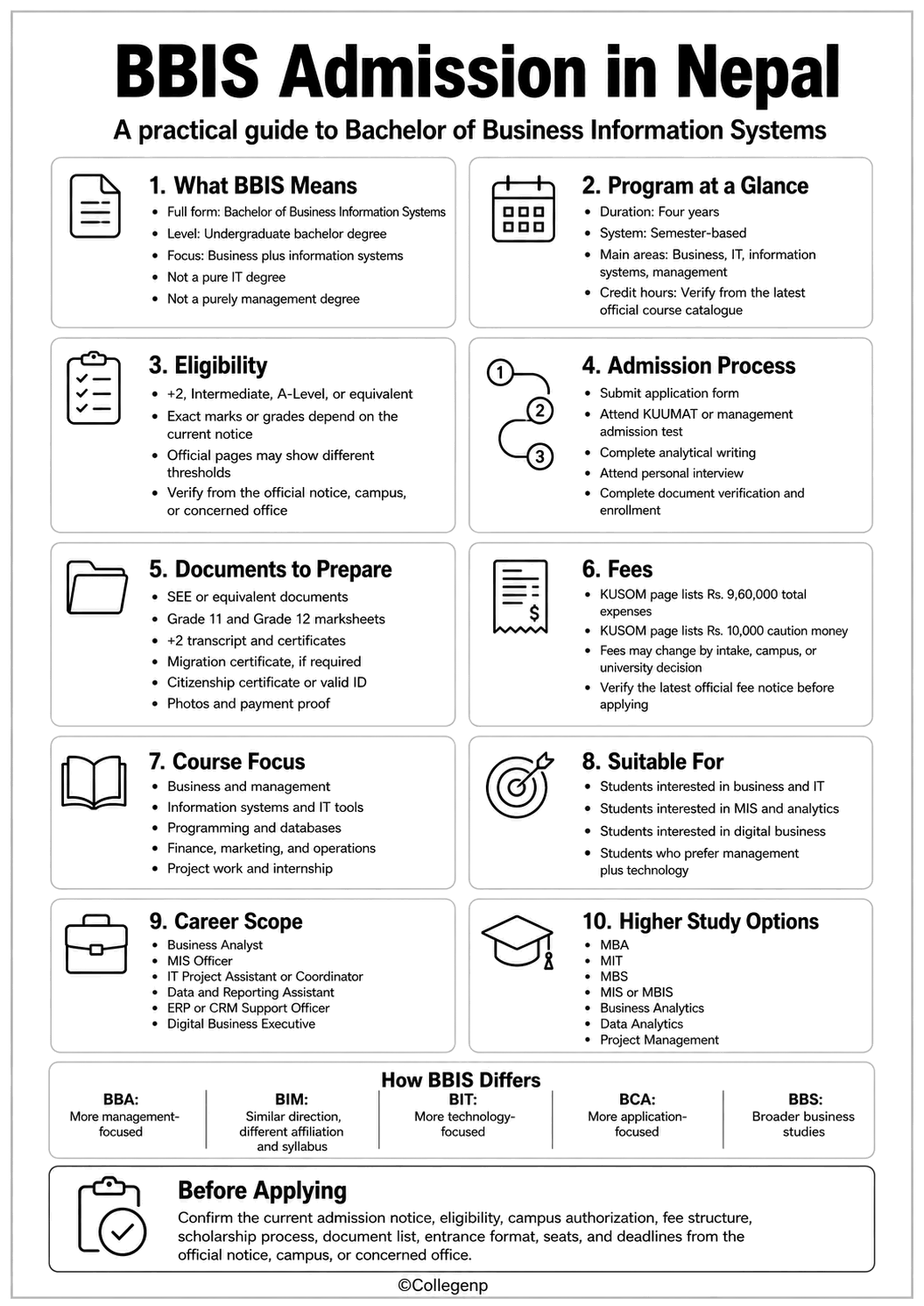
BBIS Admission in Nepal is searched mostly by +2 graduates, A-Level students, parents, and applicants comparing management and technology-related bachelor programs. The full form of BBIS is Bachelor of Business Information Systems.
BBIS is a bachelor-level program that connects business management with information systems and information technology. It is not a purely technical IT degree like BSc CSIT, BIT, or BCA. It is also not a purely management degree like BBA, BBS, or a general business program. The better way to understand BBIS is as a business-plus-information-systems degree.
This matters because many students choose a bachelor program by looking only at the name. A student who wants only coding or technical computing may not find BBIS technical enough. A student who wants only accounting, marketing, or general management may find the information systems side demanding. BBIS is more suitable for students who want to understand how technology supports business decisions, data, operations, finance, marketing, management systems, and organizational work.
This guide covers eligibility, entrance exam, admission process, timeline, documents, fees, syllabus, scholarships, comparison with similar programs, career scope, and higher study options. Details such as grade thresholds, deadlines, seats, fee amounts, campus authorization, and scholarship rules may change by intake. Students should verify from the latest official notice, campus, or concerned office before applying.
Summary
BBIS is a four-year undergraduate program in business information systems, mainly linked with Kathmandu University and KU School of Management context in Nepal. It combines business management, information systems, IT tools, programming, data, finance, marketing, project work, and internship. Admission usually includes eligibility review, KUUMAT or management admission test, analytical writing, interview, document verification, and enrollment. Applicants should verify current eligibility, fees, seats, deadlines, and scholarships from the official notice or concerned office.
Key Takeaways
-
BBIS means Bachelor of Business Information Systems.
-
It combines business management with information systems and IT.
-
Kathmandu University is the main verified university context for BBIS in Nepal.
-
Eligibility details should be checked from the latest official notice.
-
KUUMAT, analytical writing, and interview may be part of admission.
-
Fees, seats, quotas, and scholarships may change by intake.
-
BBIS can support business-technology roles, but it does not guarantee a job.
What is BBIS?
BBIS is an undergraduate degree for students interested in the connection between business and technology. It focuses on how information systems help organizations manage data, operations, finance, marketing, communication, projects, and decisions.
The program includes both management and technology-related learning. Students may study accounting, economics, finance, marketing, business law, organizational behavior, communication, management information systems, programming, database systems, networks, web technology, information security, cloud computing, project management, and internship-related work.
The term “information systems” is important. It does not mean only coding or computer hardware. It covers the use of people, processes, software, data, and technology inside an organization. For example, a bank may use information systems for customer records, digital transactions, reporting, compliance work, and branch-level data. A business may use systems for sales tracking, inventory, finance, customer support, or digital marketing.
BBIS students are expected to understand both the business problem and the system used to solve or manage that problem. This makes the program different from courses that focus mainly on programming or mainly on management theory.
BBIS at a Glance
BBIS is a four-year bachelor degree and follows a semester-based academic system. Students should check the current course catalogue and admission notice before relying on credit-hour figures.
| Particular | Details |
|---|---|
| Program Name | Bachelor of Business Information Systems |
| Abbreviation | BBIS |
| Level | Undergraduate bachelor degree |
| Duration | Four years |
| Academic System | Semester-based |
| Main Area | Business, IT, information systems, management |
| Admission Basis | Academic record, entrance test, analytical writing, interview |
| Suitable For | Students interested in MIS, analytics, digital business, IT management, and business systems |
| Higher Study Options | MBA, MIT, MIS/MBIS, MBS, business analytics, project management |
A careful note is needed on credit hours. KU’s main program page describes BBIS as a four-year, 120-credit-hour program, while KU MIC’s 2021–present course catalogue states 141 credits for intakes after 2020. Students should verify the latest admission notice and course catalogue before publication or application.
BBIS Affiliation and Colleges in Nepal
BBIS in Nepal should be discussed mainly in the Kathmandu University and KU School of Management context unless another current official notice confirms additional providers. Students should not assume that every management or IT college can run BBIS.
A practical verification step is to ask whether the campus is officially authorized to run BBIS for the active intake. Students should also confirm whether admission is handled by the university, the school, the department, the campus, or a shared process.
Before applying to any campus, verify these points:
-
Current university affiliation or authorization
-
Active admission notice for BBIS
-
Seat availability
-
Fee structure
-
Scholarship or financial assistance process
-
Document submission process
-
Entrance test and interview schedule
-
Official contact office
Campus names, seat numbers, and admission deadlines should not be copied from old notices without current confirmation.
BBIS Eligibility Criteria in Nepal
BBIS eligibility usually includes +2, Intermediate, A-Level, or equivalent education. The exact marks, grades, and subject requirements depend on the current admission notice.
A careful article should state that official KU-related pages may show different eligibility thresholds. One source context lists 10+2, Intermediate, or equivalent study of at least two years in any discipline, with minimum 50% aggregate or CGPA 2.0 on a 4.0 scale and minimum C grade in each subject. Another KUSOM admission context mentions minimum 40% aggregate or CGPA 1.6 and D+ in each subject.
Because of this difference, applicants should not rely on a single old figure. They should verify the latest BBIS admission notice for the active intake before applying.
For A-Level or equivalent applicants, the same rule applies. Equivalence, grade conversion, required documents, and final eligibility decision should be verified from the official admission office.
BBIS Entrance Exam and Selection Process
BBIS admission commonly includes an entrance test, analytical writing, and personal interview. KUUMAT or a management admission test is the key admission test context.
The selection process may include:
-
Checking the official BBIS admission notice
-
Reviewing eligibility
-
Filling out the application form
-
Paying the application fee
-
Attending KUUMAT or entrance test
-
Completing analytical writing, if required
-
Attending personal interview
-
Checking the merit list or admission result
-
Completing document verification
-
Paying the required admission or semester fee
-
Completing enrollment
KUSOM admission information includes academic records, statement of objectives, recommendations, entrance test scores, and personal interview performance as admission-related factors. The entrance test areas include verbal reasoning, quantitative reasoning, data interpretation, and English proficiency.
Students should prepare for both test and interview. Entrance preparation should include basic quantitative practice, reading and vocabulary, data interpretation, grammar, short writing, and clear answers about why they want to study BBIS.
BBIS Admission Timeline in Nepal
BBIS admission timeline changes by intake. Students should check the current notice for form opening date, application deadline, admit card date, entrance exam date, interview date, result date, admission deadline, and class start information.
A past example can help students understand the pattern, but it should not be treated as a current deadline. For Fall 2025, BBA/BBIS admission was opened through a notice published on June 12, 2025. The form deadline was later extended to August 13, 2025, with admit card distribution on August 14 and KUMAT examination on August 15, 2025.
This example shows why students should keep checking official notices. Deadlines can be revised, and missed dates can affect eligibility for that intake.
Documents Required for BBIS Admission
BBIS applicants should prepare academic, identity, and application-related documents early. The final checklist should be taken from the active admission notice.
A practical checklist may include:
-
SEE or equivalent marksheet
-
SEE character certificate
-
Grade 11 marksheet
-
Grade 12 marksheet
-
+2 transcript
-
Provisional certificate
-
Character certificate
-
Migration certificate
-
Citizenship certificate or valid ID
-
Recent passport-size photos
-
Entrance admit card
-
Application fee voucher or payment proof
-
Other documents required by the current notice
Students who have not received final Grade 12 documents should ask whether provisional application is allowed. They should also check whether original documents must be submitted, shown for verification, or only copied.
BBIS Fees in Nepal
BBIS fees may change by intake, campus, and university decision. Students should not rely only on old online figures.
KUSOM’s BBIS admission page lists total expenses of Rs. 9,60,000 and Rs. 10,000 caution money. This figure should be presented with a clear verification note because fee structures can change and may differ by fiscal year, campus, or official decision.
Before applying, students should ask about:
-
Application fee
-
Admission fee
-
Semester or annual tuition fee
-
University or examination fee
-
Caution deposit
-
Internship or project-related costs
-
Payment schedule
-
Refund rules
-
Late payment rules
-
Scholarship or fee waiver process
Families should calculate total cost, not only first-semester cost. They should also ask whether payment is made semester-wise, annually, or through another schedule.
BBIS Course Structure and Subjects
BBIS course structure combines three main areas: Business/Management, Information Systems, and Foundation/Allied courses. This mix is the main reason BBIS should be understood as business plus information systems.
Subjects may include English, Mathematics, Microeconomics, Macroeconomics, Financial Accountancy, Information Systems Technology, Structured Programming, Object-Oriented Programming, Digital Logic, Business Management, Sociology for Business, Statistics, Business Law, Managerial Communication, Data Structures and Algorithms, Operating Systems, Marketing, Database Management Systems, Computer Networks, Project Work, Digital Marketing, Organizational Behavior, Finance, MIS, Web Technology, Cloud Computing, Operations Management, Artificial Intelligence, Human Resource Management, Entrepreneurship, International Business, Project Management, Research Methodology, Information Security, System Analysis and Design, Strategic Management, Software Engineering, Internship, and electives.
This subject mix means students should be ready for both business reading and technical practice. A student who wants no programming at all may find parts of the course difficult. A student who wants only programming may find the management subjects too broad.
Semester-Wise Syllabus Snapshot
| Semester | Main Focus |
|---|---|
| Semester I | English, mathematics, economics, accounting, information systems, programming |
| Semester II | English, mathematics, macroeconomics, OOP, digital logic, business management |
| Semester III | Sociology, statistics, business law, communication, data structures, operating systems |
| Semester IV | Critical thinking, marketing, business statistics, DBMS, networks, project work |
| Semester V | Quantitative techniques, digital marketing, organizational behavior, finance, MIS, web technology |
| Semester VI | Cloud computing, operations, finance, HRM, Artificial Intelligence, project work |
| Semester VII | Entrepreneurship, international business, project management, research, information security, system analysis |
| Semester VIII | Strategic management, software engineering, elective, project work, internship |
BBIS Quota, Seats, and Scholarships
BBIS seat numbers, quotas, and category-wise distribution should be taken only from the current admission notice or the official campus/university admission office. If the latest notice does not clearly state quota details, no article should invent figures.
Students may need to check:
-
Total seats
-
Open category seats
-
Reserved category seats, if stated
-
Foreign student provision, if stated
-
Scholarship seats, if stated
-
Campus-wise seat distribution, if applicable
Scholarship and financial assistance details also need official confirmation. KU-related information refers to partial scholarships or tuition fee waiver for needy and deserving students accepted into the program. Applicants should ask whether there is a separate scholarship form, required documents, income or need-based evidence, academic criteria, interview, deadline, and renewal condition.
BBIS Admission Process Step by Step
BBIS admission is easier to manage when students follow a clear process. The process should begin with official verification, not informal advice.
Step 1: Check the official BBIS admission notice.
Step 2: Review eligibility and grade requirements.
Step 3: Verify campus authorization.
Step 4: Collect academic and identity documents.
Step 5: Fill out the application form.
Step 6: Pay the application fee and keep proof.
Step 7: Prepare for KUUMAT or entrance test.
Step 8: Attend analytical writing and interview, if required.
Step 9: Check admission result or merit list.
Step 10: Complete document verification.
Step 11: Pay admission or semester fee.
Step 12: Attend orientation and begin classes.
Students should keep copies of submitted forms, payment slips, admit cards, and official messages.
How to Prepare for the BBIS Entrance Exam
BBIS entrance preparation should match the tested areas. Students should avoid relying on unsourced sample questions or rumors about the exam.
Focus areas may include verbal reasoning, quantitative reasoning, data interpretation, English proficiency, analytical writing, and interview readiness.
For verbal reasoning and English, practice reading short passages, identifying main ideas, grammar, vocabulary, and sentence clarity. For quantitative reasoning, revise school-level arithmetic, percentage, ratio, average, basic algebra, and logical numerical problems. For data interpretation, practice reading tables, charts, and simple business data.
For analytical writing, practice writing short, clear paragraphs on education, business, technology, and social topics. For interview preparation, students should be able to explain why they chose BBIS, what they understand by information systems, and how their interests connect with the program.
BBIS vs BBA vs BIM vs BIT vs BCA
BBIS should be compared by fit, not by a blanket ranking. Each program has a different focus.
| Program | Best For | Main Difference |
|---|---|---|
| BBIS | Business plus information systems | Combines business management with IT and information systems |
| BBA | Business and management | Less technical than BBIS |
| BIM | Management plus IT | Similar direction, but affiliation and syllabus differ |
| BIT | IT and computing | More technology-focused and less business-heavy |
| BCA | Computer applications | More software or application-focused |
| BBS | General business studies | Broader management degree, usually less IT-focused |
A student interested in management, systems, data, and technology-enabled business may compare BBIS and BIM closely. A student focused on software and computing may compare BBIS with BIT or BCA. A student focused on general business may compare BBIS with BBA or BBS.
Who Should Study BBIS?
BBIS is suitable for students who want both business and IT knowledge. It may fit students interested in MIS, business analytics, ERP, digital business, fintech, IT project roles, data, systems, business operations, and problem-solving.
It may also suit students who prefer management plus technology rather than a pure coding route. Since the course includes accounting, economics, finance, marketing, communication, programming, database, systems, and project work, students should be comfortable with a mixed syllabus.
Students should review the semester-wise subjects before applying. A program name alone is not enough for decision-making.
Career Scope After BBIS in Nepal
BBIS can support entry-level roles at the intersection of business and technology. Possible roles include Business Analyst, MIS Officer, IT Project Assistant, IT Project Coordinator, Data and Reporting Assistant, ERP/CRM Support Officer, Digital Business Executive, Banking IT/MIS Assistant, Fintech Operations Assistant, System Support Executive, E-commerce Operations Officer, Business Development Executive in technology firms, Junior Product or Operations Analyst, and startup/business technology roles.
These are possible pathways, not guarantees. Employers may evaluate academic record, communication, technical familiarity, internship work, business understanding, reporting skills, interview performance, and role-specific ability.
Students can use project work and internship to show practical understanding. For example, a project related to sales reporting, customer records, database use, digital marketing performance, or business process analysis may help explain their fit for MIS, reporting, or operations roles.
Higher Study Options After BBIS
BBIS can support further study in both management and information systems-related areas. Possible higher study options include MBA, MIT, MBS, Master in Information Systems, MBIS/MIS, Master in Business Analytics, Master in Data Analytics, Project Management, Digital Business, E-commerce, and other postgraduate routes depending on university rules.
For international study, students should check university equivalence, credit requirements, transcript standards, English language test requirements, and course prerequisites. These requirements differ by country and institution.
Common Mistakes Students Should Avoid
Students should avoid treating BBIS as pure IT. They should also avoid treating it as only another management degree. Its mixed nature is the main point.
Common mistakes include:
-
Applying without checking the latest eligibility notice
-
Depending on old fee figures
-
Ignoring KUUMAT or entrance test format
-
Not preparing for analytical writing and interview
-
Choosing a campus without verifying affiliation
-
Missing document deadlines
-
Ignoring project and internship components
-
Selecting BBIS only because it includes IT
-
Comparing programs without reading the syllabus
Final Checklist Before Applying for BBIS
Before submitting the application, students should confirm the current admission notice, eligibility requirement, campus authorization, total fee, payment schedule, entrance format, document list, scholarship process, semester syllabus, seat availability, and admission deadline.
They should also compare BBIS with BIM, BBA, BIT, BCA, and BBS. The right choice should match interest, study ability, family budget, location, higher-study plan, and realistic career direction.
Conclusion
BBIS Admission in Nepal should be approached with two priorities: understand the program correctly and verify current admission details. BBIS is a business-plus-information-systems degree. It includes management, information systems, IT tools, programming, data, finance, marketing, project work, and internship.
Before applying, students should verify eligibility, fees, deadlines, seats, quotas, scholarship rules, campus authorization, and required documents from the latest official notice or concerned office. BBIS can be a suitable path for students interested in business technology and information systems, but it should be chosen after comparing syllabus, cost, entrance process, and career fit.


Comments 0
No comments yet. Be the first to start the conversation.