




Table of Content
- BBS Admission in Nepal: Practical Guide for Students
- What is BBS?
- BBS Admission in Nepal: Quick Facts
- Universities Offering BBS in Nepal
- BBS Eligibility Criteria in Nepal
- Is Entrance Exam Required for BBS?
- BBS Admission Process
- Documents Required for BBS Admission
- BBS Duration and Academic System
- BBS Syllabus and Subjects
- BBS Specialization Areas
- Attendance and Examination Rules
- BBS Fees in Nepal
- BBS Seats, Quota, and Scholarships
- How to Choose a BBS College in Nepal
- BBS vs BBA vs BBM
- Career Scope After BBS in Nepal
- Higher Studies After BBS
- Common Admission Mistakes
- Final Checklist Before Admission
- Conclusion
BBS Admission in Nepal: Practical Guide for Students
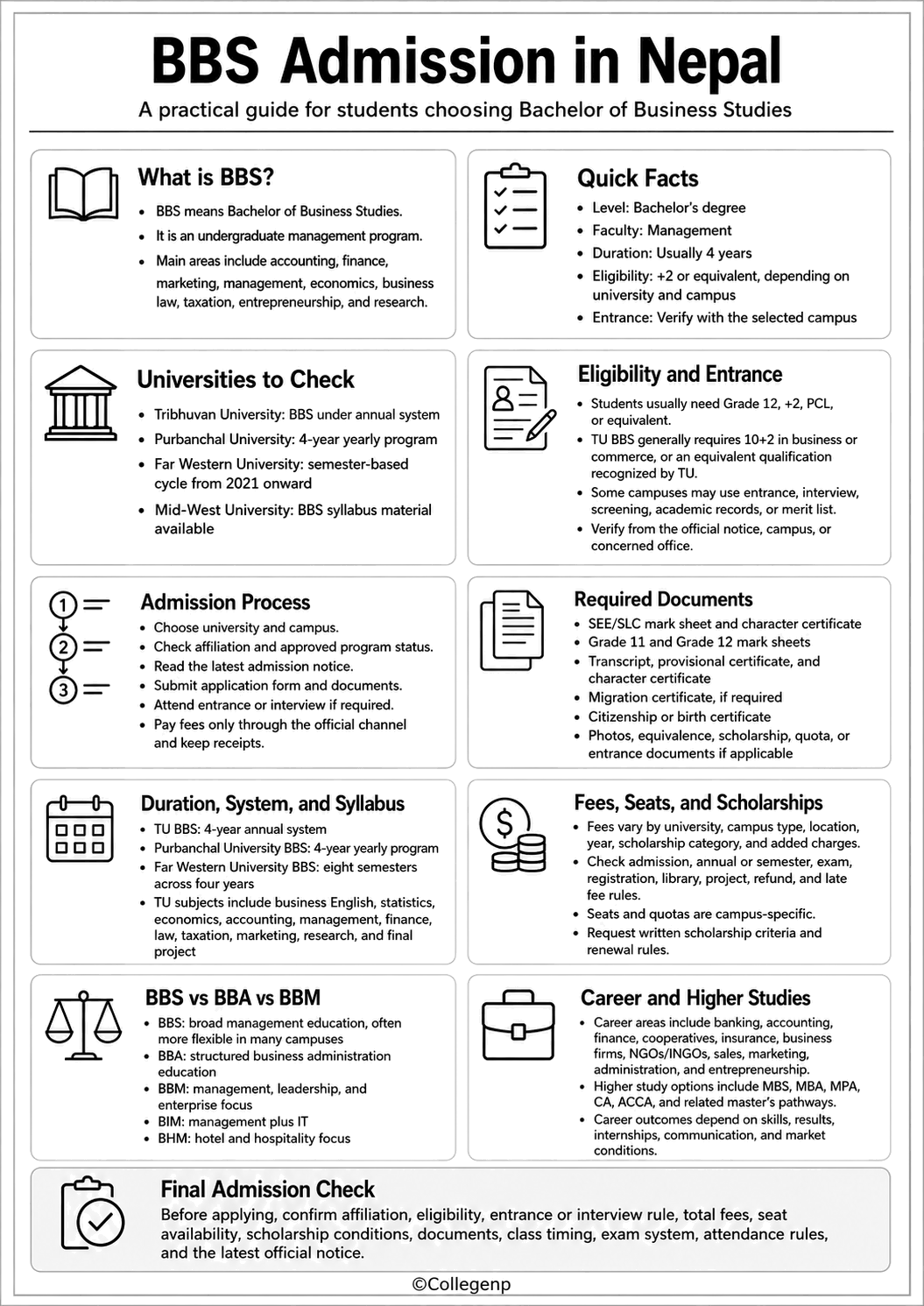
BBS Admission in Nepal is an important option for students who want to study management after Grade 12 or an equivalent level. BBS means Bachelor of Business Studies. It is an undergraduate management program for students interested in accounting, finance, marketing, management, business law, economics, taxation, entrepreneurship, and research.
Students often compare BBS with BBA, BBM, BIM, BHM, and BTTM. The comparison matters because these programs may differ in fee structure, academic system, class style, entrance process, and campus availability. BBS is usually selected by students who want a broad management degree and relatively affordable fees compared with many professional management programs.
This guide helps students evaluate BBS eligibility, admission process, entrance requirements, documents, duration, syllabus, specialization, fees, seats, scholarships, college selection, career scope, and higher study options. Because admission rules can change by university, campus, and academic year, students should verify all changeable details from the latest official notice, selected campus, or concerned office before submitting forms or paying fees.
Summary
BBS Admission in Nepal usually requires +2, PCL, or an equivalent qualification, but the exact eligibility, entrance system, fees, seats, and scholarship rules depend on the university and campus. BBS may suit students interested in accounting, finance, business management, entrepreneurship, public-sector preparation, banking, MBS, MBA, CA, ACCA, or related higher studies. Students should verify current details before applying.
Key Takeaways
-
BBS means Bachelor of Business Studies.
-
It is a bachelor-level management program.
-
Eligibility may vary by university and campus.
-
Entrance may be campus-based or merit-based.
-
TU BBS is generally annual system.
-
Some universities follow yearly or semester structures.
-
Fees, seats, and scholarships must be verified before admission.
What is BBS?
BBS is a bachelor-level management degree for students who want a broad foundation in business studies. It covers core areas such as accounting, finance, marketing, management, business law, economics, taxation, entrepreneurship, and research.
BBS is different from a short certificate or training course. A certificate may teach a specific skill, such as accounting software or office tools. BBS is a full undergraduate degree with university rules, examinations, and academic requirements.
Students usually choose BBS when they want a management degree that can support career paths in banking and finance, accounting and taxation, business management, entrepreneurship, government and public-sector exams, and higher studies such as MBS, MBA, CA, ACCA, or other management-related programs.
BBS Admission in Nepal: Quick Facts
BBS Admission in Nepal should be checked by university and campus. The program is usually four years, but the academic system and admission process may differ.
| Particular | Details |
|---|---|
| Full Form | Bachelor of Business Studies |
| Level | Undergraduate bachelor’s degree |
| Main Faculty | Management |
| Duration | Usually 4 years; structure depends on university |
| System | Annual system in TU and Purbanchal University; semester system in some universities |
| Eligibility | +2 or equivalent, usually management/commerce or accepted equivalent depending on university |
| Entrance | Usually campus- or university-based; verify with the selected campus |
| Main Subjects | Accounting, finance, economics, marketing, management, business law, taxation, research |
| Specialization | Accounting, finance, management, or marketing, depending on university |
| Higher Study Options | MBS, MBA, MPA, CA, ACCA, and later research pathways where applicable |
| Career Areas | Banks, business firms, NGOs/INGOs, government preparation, accounting firms, entrepreneurship |
 Universities Offering BBS in Nepal
BBS is available through different universities and affiliated campuses in Nepal. Students should confirm the university, campus affiliation, approved program status, and current admission notice before applying.
Tribhuvan University BBS
Tribhuvan University Faculty of Management lists Bachelor of Business Studies under bachelor-level annual system programs. TU also lists BBA, BIM, BBM, BTTM, BHM, BPA, and other programs separately under the semester system, so students should understand that BBS is generally different from semester-based professional management programs under TU.
TU’s BBS curriculum was revised and implemented from 2019, according to the source plan. Students applying to TU-affiliated or constituent campuses should check the latest campus notice for eligibility, form dates, fee details, class timing, and admission process.
Purbanchal University BBS
Purbanchal University lists Bachelor of Business Studies as a 4-year yearly program under its Faculty of Management. The source plan also notes that Purbanchal University shows approved BBS quotas for different affiliated campuses.
This means students should not assume that every campus has the same seat capacity. Verify seat availability, admission deadline, eligibility, fee structure, and scholarship conditions from the selected campus or concerned office.
Far Western University BBS
Far Western University’s Faculty of Management curriculum information lists BBS as a semester-based program cycle from 2021 onward. The program is arranged across eight semesters over four years.
Students who prefer semester-wise study should compare the structure, assessment style, course load, and campus availability before choosing. Semester systems may involve more frequent assessments than annual systems, so applicants should check academic rules before admission.
Mid-West University BBS
Mid-West University has BBS syllabus material listed under its academic repository for the Graduate School of Management or bachelor-level collection. The source plan identifies Bachelor in Business Studies syllabus 2025 as available in the university’s eLibrary.
Students interested in Mid-West University BBS should verify current admission rules, syllabus, fee structure, and campus-level requirements from official notices or the concerned academic office.
BBS Eligibility Criteria in Nepal
BBS eligibility usually begins with completion of Grade 12, +2, PCL, or an equivalent qualification. The exact rule may differ by university, campus, and admission year.
For TU BBS, the source plan states that candidates should have completed 10+2 in business or commerce, or an equivalent course from a board or university recognized by TU. Candidates must also satisfy other entry requirements prescribed by the Faculty Board or campus.
A student should usually have passed Grade 12, +2, PCL, or equivalent level; studied management, commerce, or an accepted equivalent stream; met the minimum grade or percentage rule; submitted required documents; and fulfilled any campus-specific entrance, interview, or merit requirement.
Do not use one fixed eligibility rule for every university. Check the latest admission notice from the university or selected campus before applying.
Is Entrance Exam Required for BBS?
BBS entrance requirements in Nepal may vary. Admission is often more campus-based than centralized professional programs such as BBA, BBM, BIM, BHM, or BTTM.
Some campuses may admit students based on academic records. Others may conduct an entrance test, interview, orientation screening, or merit list. For TU BBS, the source plan notes that the official curriculum eligibility section refers to completion of the required +2 or equivalent qualification and other criteria prescribed by the Faculty Board or campus.
Before applying, ask the campus these questions: Is there an entrance exam? Is there an interview? Is admission based on Grade 12 marks? Is there a merit list? What is the application deadline? What is the admission fee and annual fee? How many seats are available?
BBS Admission Process
The BBS admission process usually starts with choosing the university and campus. Students should first decide whether they want to study under TU, Purbanchal University, Mid-West University, Far Western University, or another recognized university.
After choosing a campus, check affiliation and approval. The campus should be officially affiliated with the concerned university. For public or community campuses, students should also check whether the campus has the required recognition where applicable.
Read the admission notice carefully. It usually includes the application opening date, last date to apply, eligibility, required documents, entrance or interview details, fee structure, scholarship information, and class start date.
Students then submit the application form online or directly at the campus admission section. If entrance, interview, or screening is required, attend it as instructed. The campus may publish a merit list or confirm admission after document verification. After fee payment, collect an official receipt and keep all records. Orientation usually explains attendance, exam rules, internal assessment, project work, and academic calendar.
Documents Required for BBS Admission
BBS admission documents help the campus verify academic history, identity, and category claims. Exact requirements may differ by campus.
Commonly required documents include SEE or SLC mark sheet and character certificate, Grade 11 and Grade 12 mark sheets, Grade 12 transcript, provisional certificate, character certificate, migration certificate if required, citizenship certificate or birth certificate, passport-size photos, equivalence certificate for students from foreign boards, scholarship documents if applying for scholarship, reservation or quota documents if applicable, and entrance admit card or score sheet if applicable.
Students should keep photocopies, scanned copies, and payment records. Verify whether originals are needed only for checking or must be submitted for a specific period.
BBS Duration and Academic System
BBS is usually a 4-year bachelor’s degree. The academic system depends on the university.
TU BBS is a 4-year annual system program under the Faculty of Management. TU’s program structure includes first, second, third, and fourth year components with annual examinations.
Purbanchal University lists BBS as a 4-year yearly program under its Faculty of Management. Far Western University’s BBS course cycle is arranged semester-wise from 2021 onward, covering eight semesters across four years.
Students should check whether the chosen program follows annual or semester evaluation. Annual systems may place more weight on yearly examinations, while semester systems usually divide the program into shorter academic terms. The exact assessment method should be verified from the campus or concerned office.
BBS Syllabus and Subjects
BBS syllabus covers core business and management subjects. The subject sequence depends on the university, but TU BBS provides a common reference point for many students.
First Year
TU BBS first year includes Business English, Business Statistics, Microeconomics for Business, Financial Accounting and Analysis, and Principles of Management.
These subjects help students build a base in communication, quantitative reasoning, economics, accounting, and management.
Second Year
TU BBS second year includes Business Communication, Macroeconomics for Business, Cost and Management Accounting, Organizational Behavior and Human Resource Management, and Fundamentals of Financial Management.
This year develops understanding of communication, macroeconomic context, cost control, people management, and finance.
Third Year
TU BBS third year includes Business Law, Foundation of Financial Systems, Business Environment and Strategy, Taxation in Nepal, and Fundamentals of Marketing.
Students begin to connect business decisions with law, taxation, financial systems, strategy, and market-related work.
Fourth Year
TU BBS fourth year includes Entrepreneurship, Concentration I, Concentration II, Concentration III, Business Research Methods, and Final Project.
The final year is important for specialization, research skills, and project work. Students should select concentration subjects after considering career goals and higher study plans.
BBS Specialization Areas
BBS specialization or concentration areas allow students to focus on a functional area of business. Available options may depend on the university and campus.
TU BBS fourth year allows students to focus on a functional concentration area. The listed concentration streams include accounting, finance, management, and marketing.
Students should not choose a concentration only because classmates choose it. Accounting may suit students interested in accounting, audit, taxation, or CA/ACCA-related paths. Finance may suit students interested in banks, financial institutions, and investment-related roles. Marketing may suit students interested in sales, communication, market work, and business development. Management may suit students interested in administration, HR, operations, and enterprise management.
Attendance and Examination Rules
Attendance and exam rules affect whether students can appear in final examinations. Many students focus only on admission and ignore these requirements.
The source plan states that TU’s BBS curriculum requires at least 70% attendance in classes actually held to qualify for the annual examination. It also states that students are not allowed to appear in the second-year final examination without first appearing in the first-year final examination.
Students should verify the latest exam rules, attendance policy, registration deadline, and exam form dates from the campus or concerned office.
BBS Fees in Nepal
BBS fees in Nepal vary by university, campus type, location, admission year, scholarship category, and additional charges. Do not rely on one fixed fee unless it comes from a current official campus notice.
Fee differences may depend on whether the campus is constituent, community, or private. Other charges may include examination fees, registration fees, library fees, internal fees, project/report fees, late fees, and other campus charges.
Before admission, verify admission fee, annual or semester fee, exam fee, registration fee, library or lab fee, project/report fee, scholarship deduction, refund policy, and late fee rules. Keep official receipts for every payment.
BBS Seats, Quota, and Scholarships
BBS seats and quotas are usually campus-specific. Purbanchal University’s Faculty of Management page shows approved BBS quotas for different affiliated campuses, which means students should check the exact seat number for the campus they are applying to.
Scholarships may include merit-based scholarship, need-based scholarship, community campus scholarship, quota or reservation-based support, local government or institutional support, and support for marginalized, disadvantaged, or financially weak students where available.
Students should not rely on verbal scholarship claims. Ask for written scholarship criteria, required documents, renewal rules, minimum performance conditions, and whether the scholarship applies to admission fees, annual fees, exam fees, or only selected charges.
How to Choose a BBS College in Nepal
A suitable BBS college should match the student’s academic needs, budget, location, and study plan. Do not choose a campus only because the fee is low or because friends are joining.
Check academic quality through regular classes, qualified faculty, updated course delivery, internal assessments, feedback, and exam preparation support. Check affiliation and approval through official university affiliation, approved program status, seat capacity, and valid admission notice.
Students should also review past exam performance where available, library access, research or project guidance, career counseling, internship or job placement support if available, travel time, total four-year cost, hidden fees, hostel or transportation needs, and class timing for working students.
A disciplined campus environment also matters. Check attendance monitoring, notice communication, student clubs, administration response, and access to exam information.
BBS vs BBA vs BBM
BBS is not automatically better or weaker than BBA or BBM. The better choice depends on the student’s budget, study preference, campus access, and career direction.
BBS may suit students seeking affordable, broad management education. It is more theoretical and flexible in many campuses. BBA may suit students seeking structured business administration education with a more professional and semester-based format. BBM may suit students interested in management, leadership, and enterprise. BIM may suit students interested in management plus IT. BHM may suit students interested in hotel and hospitality.
Students who prefer structured presentations, projects, and internal evaluation may compare BBA or BBM carefully. Students who want a broad management base with cost flexibility may consider BBS, after checking the campus quality and academic system.
Career Scope After BBS in Nepal
BBS graduates can apply for entry-level roles in business, finance, accounting, administration, and related areas. Career outcomes depend on skill, campus quality, academic performance, internships, communication ability, accounting or software skills, and job market conditions.
Possible career areas include banking and financial institutions, accounting firms, business houses, insurance companies, cooperatives, NGOs and INGOs, sales and marketing departments, human resource departments, administrative roles, government and public service preparation, entrepreneurship, and family business.
Possible job roles include accountant, junior officer, finance assistant, marketing assistant, sales executive, administrative assistant, banking trainee, customer service officer, business development assistant, tax or accounting assistant, and entrepreneur.
Avoid assuming fixed salary or job guarantee. Students should build practical skills along with academic study.
Higher Studies After BBS
BBS can support several higher study pathways if the student meets the admission rules of the concerned institution or professional body.
Possible options include MBS, MBA, MPA, CA, ACCA, CPA pathway if applicable and verified, master’s in finance, accounting, marketing, HRM, economics, or management, government service preparation, banking preparation, and entrepreneurship training.
Students planning professional qualifications should check entry rules, exemptions, registration requirements, and exam structures from the concerned office before making a long-term plan.
Common Admission Mistakes
Many students face problems because they apply without checking details. Common mistakes include joining a campus without verifying affiliation, assuming BBS admission rules are the same in every university, ignoring annual versus semester systems, and not checking the total four-year cost.
Other mistakes include choosing only the cheapest campus without checking class regularity, not verifying scholarship renewal rules, ignoring attendance requirements, not collecting official payment receipts, missing registration or exam form deadlines, and choosing specialization without understanding career goals.
A careful student compares campuses, reads notices, asks written questions, and keeps copies of all documents and payment records.
Final Checklist Before Admission
Before applying, confirm university affiliation, check eligibility, read the latest admission notice, ask about entrance or interview, verify total fees, check scholarship options, confirm seat availability, prepare all documents, ask about class timing, check the exam system, and review campus results and teaching quality where available.
After admission, attend orientation, track attendance, keep receipts and admission records, follow university exam notices, prepare early for annual or semester exams, and build practical skills such as Excel, accounting software, communication, and report writing.
Conclusion
BBS Admission in Nepal should be planned with careful verification. The program may suit students who want a broad management degree in accounting, finance, marketing, management, business law, taxation, entrepreneurship, and research. It can also support preparation for business careers, public-sector exams, entrepreneurship, and higher studies.
Before admission, students should check the latest notice, eligibility, entrance or interview rule, total fees, seat availability, scholarship conditions, affiliation, attendance policy, exam system, and syllabus. Details may change, so verify from the official notice, campus, or concerned office before applying.


Comments 0
No comments yet. Be the first to start the conversation.