



Table of Content
- BTTM Admission in Nepal: Eligibility, CMAT, Fees, Colleges, Syllabus, and Scope
- Quick Facts About BTTM in Nepal
- What Is BTTM?
- BTTM Admission in Nepal: How the System Works
- BTTM Eligibility in Nepal
- CMAT for BTTM Admission
- Step-by-Step BTTM Admission Process
- Documents Required for BTTM Admission
- BTTM Seats, Quota, and Scholarship
- BTTM Fee Structure in Nepal
- BTTM Curriculum and Subjects
- Practical Learning, Industrial Exposure, and Field Visits
- Evaluation, Attendance, and Graduation Rules
- How to Choose the Right BTTM College
- BTTM vs BHM, BBA, BBM, BBS, and Tourism Diploma
- BTTM Entrance Preparation Tips
- Common Mistakes Students Should Avoid
- Career Scope After BTTM
- Conclusion
- Final Checklist Before Applying
BTTM Admission in Nepal: Eligibility, CMAT, Fees, Colleges, Syllabus, and Scope
Overview
BTTM admission in Nepal is for students who want a bachelor-level academic route into travel and tourism management. BTTM means Bachelor of Travel and Tourism Management. It is different from BHM, BBA, BBM, BBS, short tourism training, trekking-guide training, air ticketing courses, and hospitality diplomas.
BTTM focuses on tourism business, travel operations, tour planning, ticketing, destination management, tourism geography, tourism marketing, hospitality-linked service, tourism policy, customer service, and tourism entrepreneurship. It is more travel-and-tourism focused than BHM, which is more connected with hotel, food service, accommodation, and hospitality operations.
In Nepal, the main university focus for BTTM is Tribhuvan University, Faculty of Management. TU Faculty of Management lists Bachelor of Travel and Tourism Management among its bachelor-level programs. The BTTM program is semester-based and completed over eight semesters.
This guide helps students check eligibility, understand CMAT, compare BTTM with related programs, prepare documents, ask the right fee and scholarship questions, and choose a college with fewer assumptions. Details such as admission dates, seats, fees, scholarship rules, and entrance arrangements may change, so students should verify them from the latest official notice, campus, or concerned office.
Summary
BTTM in Nepal is a bachelor-level travel and tourism management degree. TU-linked BTTM admission uses CMAT, followed by second-stage selection where required. Students should check eligibility, current notice, documents, fees, seats, scholarship terms, practical costs, and industrial exposure policy before applying.
Key Takeaways
-
BTTM means Bachelor of Travel and Tourism Management.
-
It is a bachelor-level degree, not a short ticketing or tourism training course.
-
TU-linked BTTM admission uses CMAT.
-
NATHM’s BTTM information describes the program as eight semesters.
-
Fees, seats, scholarships, and deadlines must be checked from current notices.
-
BTTM includes practical learning such as ticketing, tour work, field visits, and industrial exposure.
-
Career outcomes depend on skills, practical exposure, language ability, and industry learning.
Quick Facts About BTTM in Nepal
BTTM is an undergraduate program for students interested in travel and tourism management. Under TU-linked BTTM, the program is usually described as four years and eight semesters.
| Topic | What Students Should Know |
|---|---|
| Full Form | Bachelor of Travel and Tourism Management |
| Level | Undergraduate / Bachelor |
| Main University Focus | Tribhuvan University, Faculty of Management |
| Duration | Usually 4 years |
| Semester | 8 semesters under TU-linked BTTM |
| Admission Route | CMAT under TU Faculty of Management for TU BTTM |
| Entrance Areas | Verbal ability, quantitative ability, logical reasoning, general awareness |
| Core Areas | Travel operations, tourism management, air ticketing, tour guiding, tourism geography, destination planning, hospitality, marketing, entrepreneurship |
| Practical Component | Field visit, ticketing practical, tour commentary, travel blog/vlog, project work, industrial exposure |
| Best For | Students interested in travel, tourism, trekking, airlines, tour operations, destination management, and tourism business |
| Key Caution | Admission dates, seats, fees, scholarships, and entrance rules must be verified from the current notice |
What Is BTTM?
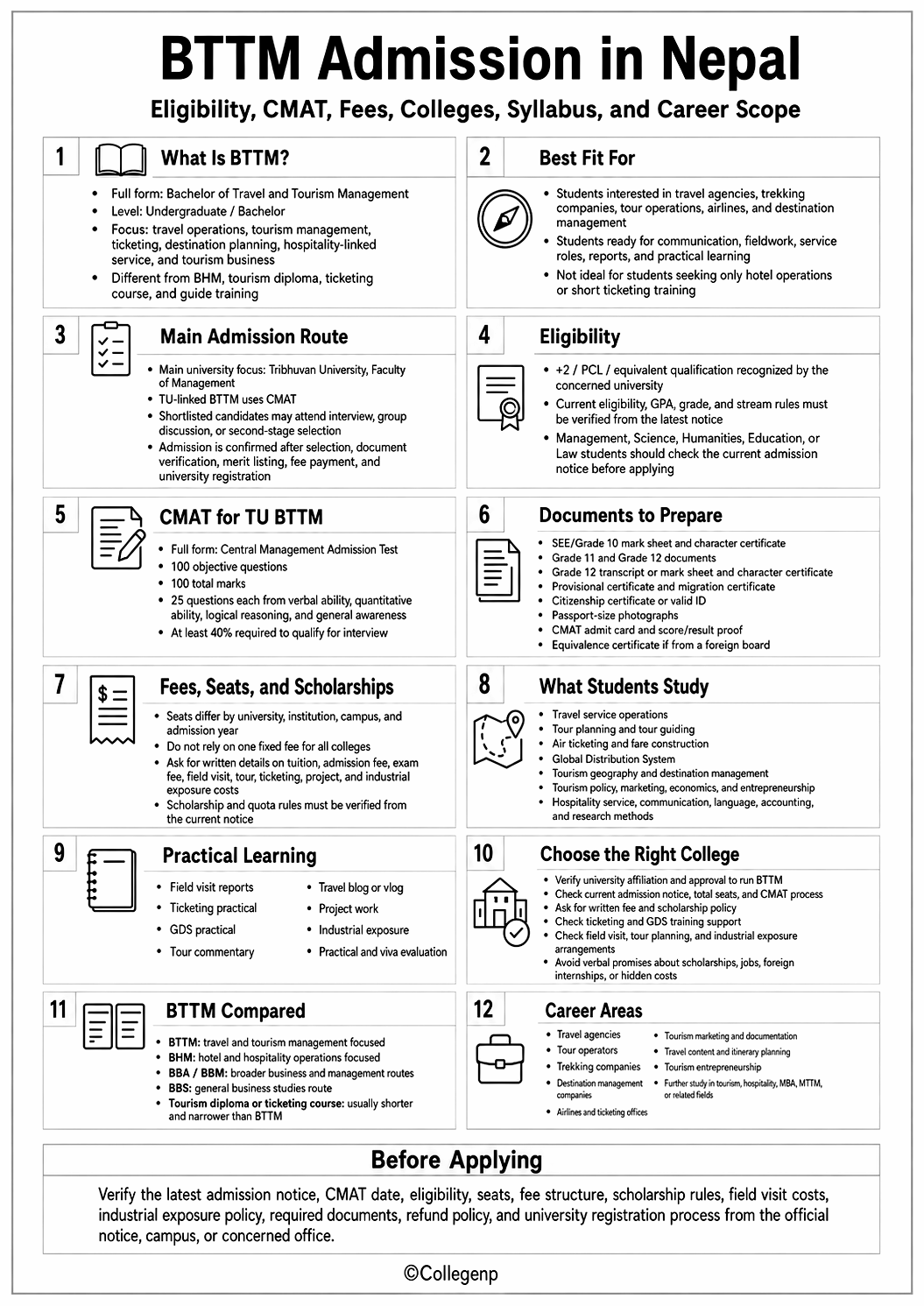
BTTM is a bachelor-level academic program in travel and tourism management. It prepares students to study tourism as a business and service field through travel operations, tourism planning, ticketing, destination management, hospitality-linked service, and management subjects.
BTTM is not the same as BHM. BHM is more focused on hotel and hospitality operations. BTTM is more focused on travel agencies, tour operations, trekking companies, airlines, destination management, tourism planning, tourism marketing, and tourism entrepreneurship.
BTTM is also not the same as a short tourism course. A ticketing course may focus mainly on air ticketing. A guide training course may focus on guiding skills. A diploma may be shorter or narrower. BTTM is a bachelor-level program with academic subjects, practical components, evaluation rules, and university requirements.
Who Should Study BTTM?
BTTM is suitable for students who want to work in travel agencies, trekking companies, tour operations, airlines, destination management, tourism planning, hospitality-linked services, event and MICE tourism support, tourism marketing, travel content, itinerary planning, or tourism entrepreneurship.
Students who enjoy communication, destination knowledge, fieldwork, service roles, writing, presentations, and planning may find BTTM relevant. Interest in travel alone is not enough. Students should also be ready for business subjects, reports, practical work, and regular evaluation.
Who Should Avoid BTTM?
Students should avoid BTTM if they want only a quick ticketing course, only hotel operations, or a general business degree with less tourism-specific fieldwork. BTTM may also be unsuitable for students who do not want communication-heavy work, field visits, tour planning, customer service, practical evaluation, or industry exposure.
Students should not choose BTTM only because Nepal has a tourism industry. They should choose it if they are interested in travel operations, tourism service, destination knowledge, communication, fieldwork, and tourism business.
BTTM Admission in Nepal: How the System Works
BTTM admission depends on the university, institution, intake year, and admission notice. Students should first confirm the exact degree title and affiliation, then check the current entrance process and admission requirements.
For TU-linked BTTM, admission is connected with CMAT under Tribhuvan University Faculty of Management. After the written entrance process, shortlisted students may need to attend a second-stage selection process such as group discussion or personal interview, depending on the institution and current notice.
Students should remember that submitting an application form does not confirm admission. Admission is normally confirmed only after entrance or selection, document verification, merit listing, fee payment, and university registration.
BTTM Under Tribhuvan University
Tribhuvan University Faculty of Management lists Bachelor of Travel and Tourism Management among its bachelor-level programs. TU BTTM is a bachelor-level travel and tourism management program under the semester system.
For TU-linked BTTM, students should expect CMAT as the entrance route, possible interview or second-stage selection after CMAT, practical and field-based learning, industrial exposure, and end-semester examinations by the Faculty of Management. College-wise seats and fees may vary, so students should verify them from the current notice or concerned campus.
BTTM at NATHM
NATHM is a major tourism and hotel management institution in Nepal. According to the NATHM, the BTTM admission route uses CMAT conducted by Tribhuvan University Faculty of Management.
The applicants shortlisted from CMAT attend the second-stage admission process. Students must submit original certificates or testimonials during admission. Students should check NATHM’s current notice for application dates, required documents, entrance process, fee structure, seats, and scholarship rules.
Mid-West University BTTM
The Mid-West University lists the Bachelor of Travel and Tourism Management among the programs under its management school. However, admission rules, eligibility, seats, entrance format, fee details, and scholarship rules should be verified from the current Mid-West University or school-level notice before publication or application.
Students comparing TU and Mid-West University BTTM should not assume both use the same admission process. Each university may have its own academic calendar, entrance rule, fee structure, and evaluation system.
Foreign-Affiliated and Similar Tourism Degrees
Some colleges may advertise travel, tourism, hospitality, or aviation-related degrees under different names. Students should verify the awarding university, official approval, exact degree title, duration, credit system, internship or industrial placement model, total fee, assessment method, equivalence process in Nepal, refund policy, and written scholarship terms.
Students should not mix Nepali university BTTM and foreign-affiliated tourism degrees unless the degree title and awarding body are clear. A program may relate to tourism or hospitality without being BTTM.
BTTM Eligibility in Nepal
For TU-oriented BTTM, eligibility usually starts with +2, PCL, or equivalent academic qualification recognized by the concerned university. Students must also complete the required application process and meet the entrance and selection requirements stated in the current notice.
For TU BTTM, CMAT is required. After CMAT, shortlisted candidates may need to attend an interview, group discussion, or other second-stage selection. Final admission generally requires document verification.
Students should not rely on old eligibility information. Exact GPA, grade, subject, or stream requirements should be taken from the current admission notice.
Management students may apply if they meet current university eligibility and entrance requirements. They may find accounting, marketing, economics, business communication, and management-related subjects familiar.
Science students may apply if they meet the eligibility criteria. They should check whether they are interested in tourism, travel operations, communication, service work, and business management.
Humanities, Education, or Law students may be eligible where the university accepts +2 or equivalent from any stream, but they must verify this from the latest admission notice before applying.
Mathematics should not be treated as a single yes-or-no issue. CMAT includes quantitative ability, and the course may include business, accounting, statistics, ticketing, fare, or operational calculations. Subject-specific entry requirements should be verified from the latest notice.
CMAT for BTTM Admission
CMAT means Central Management Admission Test. For TU BTTM admission, CMAT is conducted by Tribhuvan University Faculty of Management.
According to the NATHM’s BTTM admission details, state that CMAT has 100 objective questions and 100 total marks. It includes four areas: verbal ability, quantitative ability, logical reasoning, and general awareness. Each area has 25 questions. Students must secure at least 40% in CMAT to qualify for interview.
Students should prepare for all four areas instead of focusing only on general knowledge or English. Verbal ability may involve grammar, vocabulary, and reading comprehension. Quantitative ability may involve basic numerical reasoning. Logical reasoning checks problem-solving patterns. General awareness may include current issues and basic business or social awareness.
Second-Stage Selection
For BTTM admission, the shortlisted candidates attend an interview, and the second stage includes group discussion and a personal interview. It also states that merit may combine 10+2 score, CMAT score, and group discussion or personal interview components.
Students should verify whether the same model applies to their chosen institution in the current year. The interview or group discussion may test communication, motivation, awareness of tourism, and fit for the program.
Step-by-Step BTTM Admission Process
BTTM admission should be handled in sequence. Students should not pay or confirm admission before checking the current official notice and written fee details.
-
Confirm that BTTM matches your academic and career goal.
-
Choose the preferred university or institution.
-
Check whether the college currently offers BTTM.
-
Read the latest admission or CMAT notice.
-
Confirm eligibility criteria.
-
Fill out the application form.
-
Pay the entrance or application fee.
-
Submit required documents.
-
Collect or download the admit card.
-
Sit for CMAT or the prescribed entrance exam.
-
Attend group discussion, interview, or second-stage selection if required.
-
Check the merit list or admission list.
-
Confirm the seat within the deadline.
-
Submit original documents if required.
-
Pay admission and semester fee.
-
Complete university registration.
-
Attend orientation and begin classes.
Submitting the form does not confirm admission. Admission is normally confirmed only after entrance or selection, document verification, merit listing, fee payment, and university registration.
Documents Required for BTTM Admission
Students should prepare documents early because incomplete files may delay admission. Requirements may differ by institution, so the current notice should be checked before submission.
Commonly required documents include:
-
SEE/Grade 10 mark sheet
-
SEE/Grade 10 character certificate
-
Grade 11 mark sheet
-
Grade 12 transcript or mark sheet
-
Grade 12 character certificate
-
Provisional certificate
-
Migration certificate
-
Citizenship certificate or valid ID
-
Passport-size photographs
-
CMAT or entrance admit card
-
CMAT or entrance score/result proof
-
College or institution application form
-
Payment receipt
-
Equivalence certificate, if from a foreign board
-
Scholarship or quota documents, if applying
-
Recommendation letter, if required
-
Digital scans and photocopies of all documents
BTTM Seats, Quota, and Scholarship
BTTM seats differ by university, institution, campus, and admission year. Not every management or hospitality college offers BTTM. Practical tourism exposure and industrial-placement capacity may also affect intake.
Admission may be based on CMAT score, +2 score, interview or group discussion, and merit list. Students should check the current notice for the exact model.
Scholarship and quota rules may differ by institution and notice. Students should ask whether scholarships are merit-based, entrance-score-based, need-based, inclusive/quota-based, institution-level, semester-performance-based, or partial tuition waivers.
Before accepting a scholarship, students should ask:
-
Does it cover tuition only?
-
Does it include admission, exam, field visit, tour, ticketing, or industrial exposure costs?
-
Is it valid for one semester, one year, or the full program?
-
What GPA, attendance, or discipline rule must be maintained?
-
Is the scholarship written in the admission document?
-
Can the scholarship be cancelled?
-
Are field visits, tours, internship, or industrial exposure costs separate?
Students should avoid relying on verbal scholarship promises.
BTTM Fee Structure in Nepal
There is no single BTTM fee that applies to every institution and admission year. Students should ask for a written fee structure before admission.
| Cost Type | What Students Should Ask |
|---|---|
| Application/Entrance Fee | Paid to university, institution, or online system? |
| Admission Fee | One-time or recurring? |
| Tuition Fee | Monthly, semester-wise, yearly, or package? |
| University Registration Fee | Included or separate? |
| Exam Fee | Included or paid every semester? |
| Practical/Ticketing Fee | Included or separate? |
| Field Visit/Tour Fee | Included or charged separately? |
| Industrial Exposure Fee | Included or separate? |
| Uniform/Grooming Cost | Required or optional? |
| Project/Report Fee | Included or separate? |
| Back Paper/Retake Fee | Charged separately? |
| Refund Policy | Written or verbal? |
BTTM may include field visits, tour work, ticketing practicals, project work, and industrial exposure costs. Students should ask for a written total-cost estimate before admission.
BTTM Curriculum and Subjects
BTTM subjects combine tourism operations, management, hospitality-linked service, communication, and practical learning. Exact syllabus details should be checked from the current university or institution syllabus.
Travel and Tourism Operations
Students may study travel service operations, tour planning, tour guiding, ticketing and fare construction, Global Distribution System, air cargo management, tourism geography, destination management, adventure tourism, and trekking or tour operations.
Tourism Management and Policy
Students may study tourism principles, tourism planning, sustainable tourism, tourism policy, tourism marketing, entrepreneurship in tourism, tourism development, tourism economics, and service quality.
Hospitality and Service Skills
BTTM may include hospitality operations, customer service, communication, language learning, values and spirituality in tourism, professional writing, guest handling, and service etiquette.
Business and Management
The program may include organizational behavior, human resource management, accounting, economics, marketing, business communication, research methods, entrepreneurship, and management principles.
Practical and Field-Based Learning
Practical components may include a field visit report, tour commentary, travel blog/vlog, ticketing practical, GDS practical, project work, and industrial exposure.
The practical evaluation areas include Travel Service Operations and Management, Airlines Ticketing and Fare Construction, French/Chinese language viva, Global Distribution System, Tour Guiding and Interpretation, Electronic Tourism, Air Cargo Management, Tourism Geography, and Travel Photography and Videography.
Practical Learning, Industrial Exposure, and Field Visits
BTTM is not only classroom-based. Practical learning helps students connect tourism concepts with travel operations, ticketing, destination study, guest handling, and reporting.
Practical learning may include travel agency simulation, tour-planning assignments, ticketing practical, field visit reports, tour commentary, travel photography and videography, travel blog/vlog, destination study, GDS practical, industrial exposure, project work, and presentations.
The evaluation details include field visit reports, practical examinations, viva voce, tour commentary, project work, travel blog/vlog, and external practical evaluation conducted jointly by internal and external examiners.
Industrial exposure is a major practical component. Students should ask where placement happens, whether the institution arranges placement or only assists, how attendance is tracked, who evaluates performance, and whether extra costs apply.
The industrial exposure evaluation is conducted by the university, college, and industry, with 80% evaluation by industry and 20% jointly by university and college. It also states that 80% attendance is required during eighth-semester industrial exposure.
Evaluation, Attendance, and Graduation Rules
BTTM evaluation includes internal evaluation, external end-semester examinations, practical examinations, assignments, unit tests, mid-terminal tests, project work, field reports, practical/viva evaluation, and industrial exposure evaluation.
The theory-based courses as 40% internal evaluation and 60% external end-semester examination. Practical-based courses are described as 20% internal, 30% external end-semester, and 50% external practical examination.
Attendance is also important. It requires a minimum 80% attendance in theory and practical classes to qualify for the end-semester examination and 80% attendance during industrial exposure in the eighth semester.
For graduation, it requires successful completion of 126 credit hours, successful completion of industrial exposure with minimum grade B, and completion of course requirements within seven years from initial registration. Students should verify current graduation and attendance rules from the concerned institution.
How to Choose the Right BTTM College
Students should choose a BTTM college after checking academic approval, practical support, fee clarity, and admission transparency. A college should be able to clearly explain its affiliation, admission process, practical learning model, and cost structure.
Students should verify:
-
University affiliation
-
Approval to run BTTM
-
Total seats
-
Current admission notice
-
CMAT or entrance process
-
Written fee structure
-
Scholarship policy
-
Faculty experience in tourism/travel
-
Field visit and tour planning support
-
Air ticketing and GDS training facility
-
Travel agency or tour operator linkage
-
Industry exposure placement support
-
Internship or industrial exposure partners
-
Language training
-
Communication and presentation support
-
Project supervision
-
Tourism library or resources
-
Alumni outcomes
-
Location and transport
-
Hostel availability, if needed
-
Refund policy
-
University registration process
Red Flags Before Admission
Students should be careful if a college cannot clearly show affiliation or approval, does not provide written fee details, gives only verbal scholarship promises, hides field-visit costs, makes unsupported job or foreign internship claims, gives vague industrial exposure information, lacks a clear faculty profile, lacks a written refund policy, or pressures students to pay immediately.
Another warning sign is when admission staff confuse BTTM with BHM, a tourism diploma, or ticketing training. These programs may relate to travel or hospitality, but they are not the same.
BTTM vs BHM, BBA, BBM, BBS, and Tourism Diploma
Students should compare BTTM with related programs before applying. The right choice depends on the student’s interest, academic goal, preferred work setting, and willingness to join field-based tourism learning.
| Program | Best For | Main Difference |
|---|---|---|
| BTTM | Students interested in travel, tourism, tour operations, ticketing, destination management, trekking, and tourism business | Travel and tourism management focused |
| BHM | Students interested in hotel, food service, accommodation, and hospitality operations | Hotel and hospitality operations focused |
| BBA | Students interested in general business administration | Broader business administration route |
| BBM | Students interested in business management and enterprise operations | Business management focused |
| BBS | Students seeking broader and often more accessible management education | General business studies route |
| Tourism Diploma | Students seeking shorter skill-based tourism training | Usually not equal to a bachelor degree |
| Ticketing Course | Students focused mainly on air ticketing skills | Narrower than BTTM |
BTTM should be selected by students who are interested in tourism operations, destination knowledge, communication, service work, field assignments, and tourism business.
BTTM Entrance Preparation Tips
BTTM CMAT preparation should focus on verbal ability, quantitative ability, logical reasoning, and general awareness. Students should also prepare for interview or group discussion if required by the institution.
Useful preparation areas include English grammar, vocabulary, reading comprehension, basic mathematics, logic, current affairs, tourism awareness, and basic business awareness.
Students can prepare by practicing objective questions, improving English speaking and writing, reading travel, tourism, aviation, and hospitality news, and learning basic terms such as itinerary, destination, package tour, ticketing, GDS, trekking, sustainable tourism, and ecotourism.
Students should also prepare a clear answer to why they want to study BTTM. A strong answer should connect personal interest with tourism operations, communication, destination knowledge, field learning, and long-term learning goals.
Common Mistakes Students Should Avoid
Students often confuse BTTM with BHM or with short tourism and ticketing training. This can lead to wrong expectations about subjects, practical work, and career direction.
Other common mistakes include choosing BTTM only to go abroad, applying without checking the current CMAT or admission notice, not checking affiliation, not asking about field visit and industrial exposure costs, not verifying ticketing or GDS practical support, believing guaranteed job or internship claims, ignoring communication and language requirements, not checking scholarship conditions, submitting incomplete documents, missing entrance deadlines, choosing a college only by advertisement, ignoring daily transport cost, and assuming admission is confirmed after filling out the form.
Career Scope After BTTM
BTTM gives students a foundation in travel and tourism management. It does not guarantee a job. Career outcomes depend on communication ability, destination knowledge, practical exposure, ticketing/GDS skills, language skills, internship performance, professionalism, and continuous industry learning.
Possible work areas include travel agencies, tour operators, trekking companies, destination management companies, airlines and ticketing offices, airport or travel-service support roles, hotels and resorts in tourism-linked departments, event and MICE tourism support, tourism marketing, tourism research and documentation, travel content and itinerary planning, adventure tourism companies, hospitality and service organizations, and tourism entrepreneurship.
BTTM graduates may also consider further study in tourism management, hospitality management, MBA, MTTM, or related fields, depending on eligibility and university rules.
Conclusion
BTTM admission in Nepal should be approached as an academic and practical decision. Students should first understand that BTTM is a bachelor-level travel and tourism management program, not a short tourism or ticketing course.
Before applying, students should verify the latest admission notice, CMAT requirement, eligibility, seats, fee structure, scholarship terms, field visit cost, industrial exposure policy, required documents, and university registration process. BTTM may be a suitable choice for students interested in tourism operations, destination work, travel planning, ticketing, communication, and tourism business. It is less suitable for students who want only hotel operations, a short skill course, or an admission decision based on advertisement alone.
Final Checklist Before Applying
Before applying for BTTM, verify:
-
Latest TU Faculty of Management CMAT notice
-
BTTM admission form deadline
-
Entrance fee
-
CMAT exam date
-
Test center
-
Institutions currently offering BTTM
-
Institution-wise seats
-
Scholarship and quota rules
-
Total fee structure
-
Field visit and tour costs
-
Ticketing/GDS practical facility
-
Industrial exposure policy
-
Required documents
-
Group discussion or interview process
-
Current BTTM syllabus
-
University registration process
-
Refund policy
-
Class start date


Comments 0
No comments yet. Be the first to start the conversation.