




Table of Content
- BPA Admission in Nepal: Eligibility, CMAT, Fees and Scope
- Quick Facts About BPA in Nepal
- What Is BPA?
- How BPA Admission in Nepal Works
- BPA Under Tribhuvan University
- BPA Eligibility in Nepal
- CMAT for BPA Admission
- Admission Process for BPA in Nepal
- Documents Required for BPA Admission
- BPA Seats, Quota, Scholarships, and Fees
- BPA Curriculum and Subjects
- Practical Learning, Evaluation, and Attendance
- How to Choose the Right BPA Campus
- BPA vs BBA vs BBS vs BA Political Science vs BSW
- BPA Entrance Preparation Tips
- Career Scope After BPA
- Conclusion
- Final Checklist Before Applying
BPA Admission in Nepal: Eligibility, CMAT, Fees and Scope
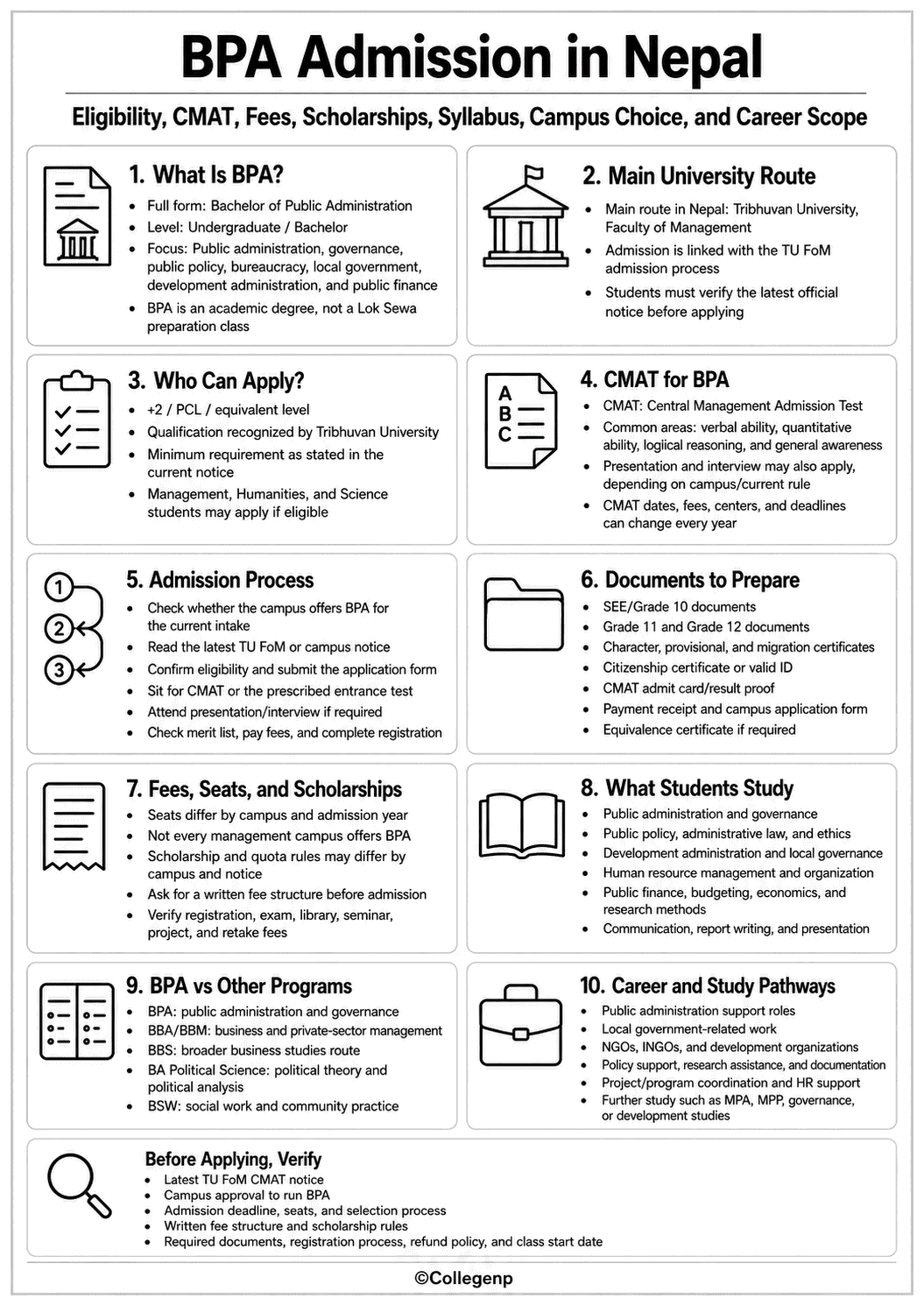
BPA admission in Nepal is for students who want a bachelor-level academic route in public administration, governance, public policy, bureaucracy, development administration, public finance, local government, and public-sector management. BPA means Bachelor of Public Administration.
The main decision for students is whether BPA matches their study interest better than BBA, BBM, BBS, BA Political Science, BSW, or a Lok Sewa preparation class. BPA is not a coaching course. It can help students understand public institutions and administrative systems, but competitive exams require separate preparation.
In Nepal, the main BPA reference route is Tribhuvan University’s Faculty of Management. TU lists Bachelor of Public Administration under its semester bachelor programmes, along with BBA, BBA-F, BIM, BTTM, BHM, BBM, BMS, and PGDPS.
Summary
BPA admission in Nepal is mainly linked with Tribhuvan University’s Faculty of Management and the CMAT-based admission route. Eligible +2, PCL, or equivalent graduates may apply if they meet the current notice requirements. BPA suits students interested in governance, public administration, public policy, local government, NGOs/INGOs, public finance, and further study such as MPA. Students should verify campus approval, seats, fees, scholarships, and deadlines before paying.
Key Takeaways
-
BPA means Bachelor of Public Administration.
-
TU Faculty of Management lists BPA as a semester bachelor programme.
-
CMAT is commonly part of the TU FoM admission route.
-
Selection may include CMAT, academic record, presentation, interview, and merit list.
-
Fees, seats, scholarships, and deadlines can change by campus and intake.
-
BPA can support public-sector understanding but is not Lok Sewa coaching.
Quick Facts About BPA in Nepal
BPA is an undergraduate public administration degree for students interested in governance, public-sector systems, and administrative work.
| Topic | Details |
|---|---|
| Full Form | Bachelor of Public Administration |
| Level | Undergraduate / Bachelor |
| Main University Focus | Tribhuvan University, Faculty of Management |
| Admission Route | CMAT and campus admission process under TU FoM |
| Eligibility | +2 / PCL / equivalent recognized by TU, as per current notice |
| Selection Basis | CMAT, academic record, presentation/interview, and merit list, depending on campus/current notice |
| Core Areas | Public administration, governance, public policy, development administration, public finance, administrative law, HRM, organization, ethics, research |
| Best For | Students interested in government, administration, public policy, local governance, development sector, NGOs/INGOs, and MPA pathway |
| Key Caution | Admission dates, seats, fees, scholarship rules, and campus-wise processes may change every intake |
What Is BPA?
BPA is a bachelor-level academic programme focused on public administration, government organizations, public policy, public finance, law, ethics, organization, and governance. A TU constituent campus page describes BPA as an undergraduate programme focused on public administration, government organizations, and public policy.
Public administration is different from business administration. Business administration mainly studies private-sector business systems, markets, customers, finance, and enterprise management. Public administration studies how public offices, policies, resources, citizens, laws, and service systems operate.
BPA Degree vs Certificate or Coaching Class
A BPA degree is a university bachelor programme. A certificate or short course may teach a limited skill, while a coaching class may focus on exam practice.
BPA is also different from Lok Sewa preparation. BPA may help students understand governance, bureaucracy, public policy, and public finance, but Lok Sewa success depends on separate exam preparation, current affairs, writing practice, legal awareness, and regular study.
Who Should Study BPA?
BPA is suitable for students interested in public service, governance, administration, public policy, local government, NGOs/INGOs, development organizations, research support, and administrative careers.
Management students may find economics, accounting, finance, organization, and management subjects familiar. Humanities students may connect with governance, society, law, policy, and development. Science students may apply if they meet eligibility, but they should be ready for social science, writing, administration, and policy-oriented study.
Who Should Avoid BPA?
Students should avoid BPA if they want a mainly corporate business route, a technical science route, or a short exam-preparation course. Students should also avoid choosing BPA only because they want to sit for Lok Sewa.
How BPA Admission in Nepal Works
BPA admission usually begins with the latest TU FoM or campus notice, followed by eligibility checking, CMAT or entrance application, campus-level selection, document verification, fee payment, and registration.
A TU campus page for Mahendra Morang Adarsh Multiple Campus states that BPA selection includes written CMAT, individual presentation, interview, and merit listing. The same page describes a merit model using CMAT, +2/equivalent marks, and presentation/interview.
Submitting an application form does not confirm admission. Admission is normally confirmed after selection, document verification, fee payment, and university registration.
BPA Under Tribhuvan University
Tribhuvan University is the main reference point for BPA admission in Nepal because TU Faculty of Management lists BPA under semester bachelor programmes. TU also lists Public Administration among its subject committees and Master of Public Administration among its master programmes.
Students should check whether a preferred campus currently offers BPA. Public Administration Campus, Balkhu lists BPA and MPA among its courses, which shows why campus-level verification matters.
Other universities or institutions may offer governance, public policy, development studies, political science, or social work under different names. These should not be treated as BPA unless the degree name, university affiliation, curriculum, and award title are confirmed from the official source.
BPA Eligibility in Nepal
For a TU-oriented BPA route, students generally need +2, PCL, or equivalent education recognized by Tribhuvan University and must meet the current admission notice.
Mahendra Morang’s BPA page states that candidates should have completed +2 or an equivalent level from a board, institution, or university recognized by TU, attained at least second division at proficiency or intermediate level, and completed application requirements for the entrance examination.
A TU 2081 CMAT re-entrance notice listed eligibility routes based on Grade 11 and 12 grades or second division in 10+2, PCL, or equivalent. Students should check the current notice because eligibility wording can change.
Mathematics should not be assumed as a fixed entry rule unless the current notice says so. BPA and CMAT preparation may involve quantitative ability, public finance, budgeting, statistics, economics, and research methods.
CMAT for BPA Admission
CMAT means Central Management Admission Test in the TU Faculty of Management admission context. It is commonly used for FoM bachelor-level admission, including BPA.
Mahendra Morang’s BPA page states that CMAT assesses verbal ability, quantitative techniques, logical reasoning, and general awareness. A FoM syllabus document for BBM describes the CMAT written test areas as verbal ability, quantitative ability, logical reasoning, and general awareness.
CMAT notices, form deadlines, test centers, application fees, result dates, and re-CMAT arrangements can change every year. A TU 2081 notice and a 2082 re-CMAT notice page show different dates and schedules for different cycles. Students should verify from the latest TU FoM notice, the campus, or the concerned office.
Admission Process for BPA in Nepal
The admission process should be followed in order so that students do not miss eligibility, CMAT, document, or payment requirements.
-
Confirm that BPA matches your academic and career goal.
-
Check whether your preferred campus offers BPA for the current intake.
-
Read the latest TU FoM or campus admission notice.
-
Confirm eligibility criteria.
-
Fill out the application form.
-
Pay the entrance or application fee through the stated method.
-
Submit required documents.
-
Collect or download the admit card.
-
Sit for CMAT or the prescribed entrance test.
-
Attend presentation or interview if required.
-
Check the merit list or admission list.
-
Confirm your seat within the deadline.
-
Submit original documents if required.
-
Pay admission and first-semester/year fee.
-
Complete university registration through the campus.
-
Attend orientation and begin classes.
Documents Required for BPA Admission
Students should keep photocopies and scanned copies of every document before submitting originals.
Commonly required documents include SEE/Grade 10 mark sheet, SEE/Grade 10 character certificate, Grade 11 mark sheet, Grade 12 transcript or mark sheet, Grade 12 character certificate, provisional certificate, migration certificate, citizenship certificate or valid ID, passport-size photographs, CMAT/entrance admit card, CMAT/entrance result proof, campus application form, payment receipt, equivalence certificate for foreign-board students, scholarship/quota documents where applicable, and recommendation letter if required by the campus.
The campus admission office should provide the final document checklist for the current intake.
BPA Seats, Quota, Scholarships, and Fees
BPA seats, quota, scholarship rules, and fees should be checked campus-wise because these details may change each admission year.
Not every management campus offers BPA. Selection may combine CMAT score, +2/equivalent marks, presentation, interview, and merit list. Mahendra Morang’s BPA page gives one campus-level example of selection components.
Scholarships may be merit-based, entrance-score-based, need-based, inclusive/quota-based, or campus-level, if officially available. FoM’s document section lists a scholarship process and procedure document, which is a signal that students should confirm the current rule instead of relying on verbal claims. (Fomecd)
| Cost Type | What Students Should Ask |
|---|---|
| Application/Entrance Fee | Paid to TU/FoM or campus? |
| Admission Fee | One-time or recurring? |
| Tuition Fee | Monthly, semester-wise, yearly, or package? |
| University Registration Fee | Included or separate? |
| Exam Fee | Included or paid separately? |
| Library/Student Welfare Fee | Included or additional? |
| Field Visit/Seminar Fee | Required or optional? |
| Project/Research Fee | Included or separate? |
| Back Paper/Retake Fee | Charged separately? |
| Refund Policy | Written or verbal? |
Students should ask for a written fee structure before admission. A verbal fee quotation is not enough.
BPA Curriculum and Subjects
BPA subjects focus on public administration, governance, public policy, law, ethics, organization, public finance, research, and communication.
Mahendra Morang’s BPA page describes coursework in areas such as public policy analysis, organizational behavior, public budgeting and finance, HRM, public law, ethics in public administration, and research methods. TU FoM’s BPA second-semester syllabus includes English for Public Administration-II, which covers public administration/management language, reading comprehension, writing, analysis, and discussion. The same syllabus includes Development Administration, covering development, development administration, institutions, development partners, and development issues.
Learning areas may include public administration and governance, development administration, local governance, bureaucracy, public service delivery, administrative reform, public policy, public law, ethics, organizational behavior, HRM, public budgeting, economics, research methods, statistics, report writing, and presentation.
Practical Learning, Evaluation, and Attendance
BPA learning may include presentations, seminars, report writing, case study, group discussion, policy analysis exercises, public institution observation, field visits, and research or project work, depending on campus practice.
Mahendra Morang’s BPA page states that students develop critical thinking, problem-solving, policy analysis, communication, and management skills through coursework and practical experiences.
Evaluation may include internal assessment, written examination, assignments, case analysis, presentation, project/research work, attendance, viva, or field/seminar reports. Students should not assume a fixed evaluation weight unless the current BPA syllabus or campus regulation confirms it.
Attendance matters because public administration courses often involve discussion, presentation, and analytical assignments. Minimum attendance for exam eligibility should be verified from the campus or current TU/FoM regulation.
How to Choose the Right BPA Campus
A suitable BPA campus decision starts with verification. Students should check TU affiliation or constituent campus status, approval to run BPA, total seats, admission deadline, CMAT process, written fee structure, scholarship policy, faculty profile, class timing, library resources, research/seminar culture, field exposure, MPA pathway support, exam record, academic calendar discipline, location, transport, hostel option, refund policy, and university registration process.
Red flags include unclear BPA affiliation, no written fee structure, only verbal scholarship promises, job-result promises, unclear faculty profile, weak library or research support, unclear registration process, pressure to pay immediately, or admission staff confusing BPA with BBA, BBS, or BA Political Science.
Quality signals include official affiliation, clear curriculum, assessment rigor, transparent admission process, accessible academic staff, written fee policy, current syllabus access, regular internal evaluation, and campus-level academic records that can be verified from the campus.
BPA vs BBA vs BBS vs BA Political Science vs BSW
BPA is public-sector and governance-focused. The other programmes may be suitable for different goals.
| Programme | Best For | Main Difference |
|---|---|---|
| BPA | Public administration, governance, bureaucracy, public policy, public-sector management | Public-sector and governance focus |
| BBA | Business administration and corporate management | Business and private-sector administration focus |
| BBM | Business management and enterprise operations | Business management and operations focus |
| BBS | Broader management education, often more widely available | General business studies route |
| BA Political Science | Political theory, state, government, institutions, political analysis | Political science and theory focus |
| BSW | Social work, community service, social welfare, field practice | Social-work and community-intervention focus |
Students should not choose BPA only because they want to prepare for Lok Sewa. BPA can support public-sector understanding, but competitive exams require separate preparation.
BPA Entrance Preparation Tips
BPA entrance preparation should focus on CMAT areas and public affairs awareness. Students should practice verbal ability, English grammar, reading comprehension, vocabulary, quantitative ability, logical reasoning, and general awareness.
Students should also read national news and government-related updates, review basic mathematics and reasoning, improve English reading and writing, learn terms such as governance, bureaucracy, federalism, public policy, local government, public service, and development administration, and prepare a short presentation on why they want to study BPA.
Common mistakes include confusing BPA with BBA, treating BPA as only Lok Sewa preparation, applying without checking whether the campus currently offers BPA, ignoring eligibility criteria, missing deadlines, not asking for written fees, believing job-result promises, ignoring presentation/interview preparation, losing payment receipts, submitting incomplete documents, and assuming admission is confirmed after form submission.
Career Scope After BPA
BPA can lead to administrative, public-sector, development-sector, policy-support, and further-study routes, but outcomes depend on the student’s skills and preparation.
Possible areas include public administration support roles, local-government-related work, public-sector organizations, NGOs/INGOs, development organizations, policy support, research assistance, project/program coordination, HR support, public relations, community development, public finance/budget support, research and documentation, and further study in MPA, MPP, management, governance, or development studies.
Mahendra Morang’s lists possible paths such as government agencies, nonprofit organizations, public-sector entities, policy analyst, program manager, public relations specialist, HR officer, budget analyst, community development coordinator, MPA, and MPP. TU’s Faculty of Management page also lists Master of Public Administration under master programmes.
BPA gives students a foundation in public administration and governance, but career outcomes depend on academic performance, communication skills, writing ability, policy awareness, computer skills, internships or field exposure, and separate preparation for competitive exams where required.
Conclusion
BPA admission in Nepal is suitable for students who want to study public administration, governance, public policy, bureaucracy, development administration, public finance, and public-sector management. The main TU route is linked with Faculty of Management admission processes and CMAT, but every intake should be checked through the latest official notice.
Before applying, students should verify eligibility, campus approval, seats, deadlines, fee structure, scholarship rules, documents, presentation/interview process, and university registration. BPA should be chosen as an academic degree in public administration, not as a substitute for Lok Sewa preparation.
Final Checklist Before Applying
Before applying, verify the latest TU Faculty of Management CMAT notice, BPA admission form deadline, entrance fee, CMAT exam date, test center, campuses currently offering BPA, campus-wise seats, scholarship/quota rules, total fee structure, required documents, presentation/interview process, current BPA syllabus, university registration process, refund policy, and class start date.



Comments 0
No comments yet. Be the first to start the conversation.