



Table of Content
- BHM Admission in Nepal: Complete Guide to Eligibility, Entrance Exams, Fees, Seats, Scholarships, Colleges, Syllabus, and Career Scope
- Quick Facts About BHM in Nepal
- What Is BHM?
- Who Should Study BHM?
- BHM Admission in Nepal: How the System Works
- University-Wise BHM Admission in Nepal
- BHM Eligibility in Nepal
- Can Science Students Study BHM?
- Can Management Students Study BHM?
- Can Humanities, Education, or Law Students Study BHM?
- Is Mathematics Required for BHM?
- BHM Entrance Exams in Nepal
- Step-by-Step BHM Admission Process in Nepal
- Documents Required for BHM Admission
- BHM Seats, Quota, and Scholarship
- BHM Fee Structure in Nepal
- BHM Curriculum and Subjects
- Practical Training, Labs, and Internship
- BHM Evaluation and Attendance
- How to Choose the Right BHM College
- Red Flags Before BHM Admission
- BHM vs BTTM vs BBA vs BBM vs Hospitality Diploma
- BHM Entrance Preparation Tips
- Common Mistakes Students Should Avoid
- Career Scope After BHM
- Final Checklist Before Applying
BHM Admission in Nepal: Complete Guide to Eligibility, Entrance Exams, Fees, Seats, Scholarships, Colleges, Syllabus, and Career Scope
BHM admission in Nepal is an important decision for students who want to study hotel management at the bachelor level. BHM stands for Bachelor of Hotel Management. It is an undergraduate academic program focused on hotel operations, hospitality service, food production, food and beverage service, front office, housekeeping, tourism, events, hospitality accounting, marketing, human resources, communication, customer service, and hotel business management.
BHM is different from short hotel training courses. A BHM program is a bachelor-level degree with academic study, practical learning, examinations, and internship exposure. Short hotel training courses are usually skill-based certificates or diplomas. Students comparing BHM with BTTM, BBA, BBM, BBS, culinary arts, hospitality diplomas, or foreign-affiliated hospitality degrees should understand the eligibility, entrance exam, admission route, fees, seats, scholarships, syllabus, internship model, and career scope before applying.
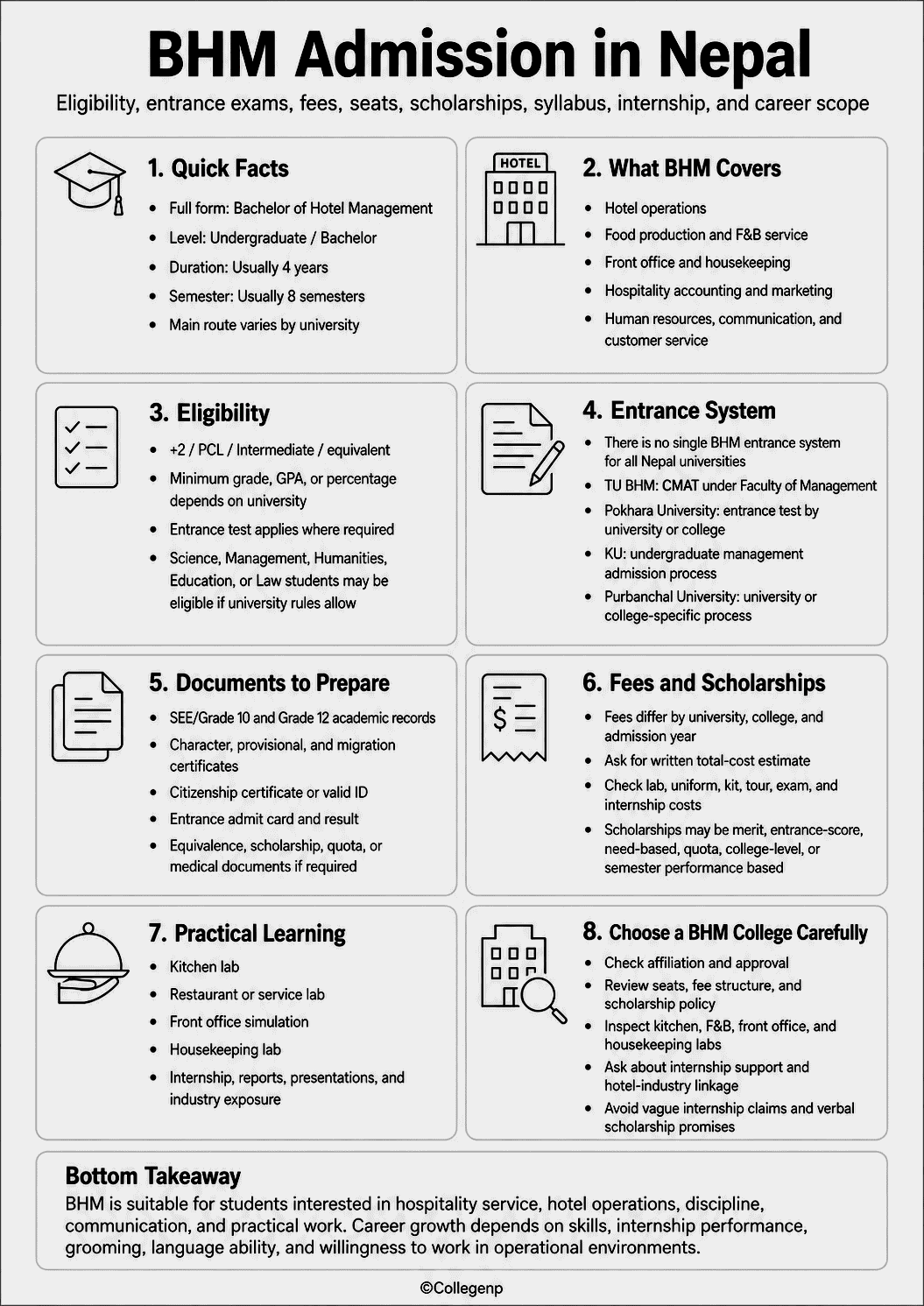
Quick Facts About BHM in Nepal
| Topic | Details |
|---|---|
| Full Form | Bachelor of Hotel Management |
| Level | Undergraduate / Bachelor |
| Duration | Usually 4 years |
| Semester | Usually 8 semesters |
| Main Universities | Tribhuvan University, Pokhara University, Kathmandu University, Purbanchal University, and some foreign-affiliated institutions |
| TU Admission Route | CMAT under Faculty of Management |
| Eligibility | +2 / PCL / Intermediate / equivalent, depending on university |
| Core Areas | Food production, food and beverage service, front office, housekeeping, hospitality accounting, tourism, marketing, human resource management, and hotel operations |
| Practical Component | Lab work, practical classes, internship, and industrial exposure |
| Best For | Students interested in hotel, hospitality, tourism, service operations, events, and customer-facing management careers |
| Key Caution | Admission rules, fees, seats, scholarships, and entrance systems differ by university and college |
What Is BHM?
BHM means Bachelor of Hotel Management. It is a bachelor-level course for students interested in hospitality education and hotel management. The program combines theoretical study with practical training in hotel departments and service operations.
BHM covers areas such as food production, food and beverage service, front office operations, housekeeping operations, hospitality accounting, tourism, event management, communication, customer service, marketing, human resources, and hotel business management. The course is designed for students who want academic knowledge as well as practical exposure in the hospitality sector.
A BHM course is not the same as a short hotel training course. Short training courses may focus on a specific skill such as cooking, bakery, barista training, service, or housekeeping. BHM is broader because it is an undergraduate academic program with semester-wise study, examinations, practical classes, and internship exposure.
BHM is also different from BTTM. BHM focuses more on hotels, food service, accommodation, hospitality operations, and service management. BTTM is more connected with travel, tourism, tour operations, destination services, and travel-industry management.
Who Should Study BHM?
BHM is suitable for students who want to build a career in hotel operations, hospitality management, food and beverage service, accommodation management, customer service, tourism-linked business, events, and service-industry leadership.
Students who enjoy practical work, communication, discipline, teamwork, grooming, presentation, and customer-facing service may find BHM relevant. The course may also suit students who want to work in hotels, resorts, restaurants, catering services, lodges, event operations, guest relations, or tourism-linked hospitality businesses.
BHM may not suit students who want a course based only on classroom learning. It may also be less suitable for students who are not comfortable with practical service work, grooming standards, operational discipline, shift-based environments, or regular communication with guests and customers.
Students should not choose BHM only because they want to go abroad. Hospitality careers depend on practical skills, internship performance, communication ability, work discipline, grooming, language ability, and industry exposure.
BHM Admission in Nepal: How the System Works
BHM admission in Nepal differs by university and college. There is no single BHM entrance system for all universities in Nepal. Students should first identify the university, check the current eligibility requirement, read the admission or entrance notice, confirm the college affiliation, and understand the selection process.
Tribhuvan University BHM admission is linked with CMAT under the Faculty of Management. Pokhara University requires applicants to pass an entrance test conducted by Pokhara University and its constituent or affiliated colleges. Kathmandu University follows its own undergraduate management admission process. Purbanchal University lists BHM under its Faculty of Management programs, but its current admission procedure should be followed separately.
Foreign-affiliated hospitality degrees in Nepal may follow different admission systems. Students should clearly check whether the program is BHM, BA Hospitality Management, BSc Hospitality, or another degree title.
University-Wise BHM Admission in Nepal
Tribhuvan University BHM
Tribhuvan University offers Bachelor of Hotel Management under the Faculty of Management. TU Faculty of Management lists BHM as an active bachelor-level, self-sustaining, semester-based program with 8 semesters.
TU BHM admission is through CMAT under the Faculty of Management. TU publishes CMAT-related notices for bachelor-level management programs, including BHM. The CMAT route is used for shortlisting and selection in TU management bachelor programs.
The TU BHM process may also involve interview or group discussion if required by the current notice or college process. Students should follow the latest TU Faculty of Management notice for application deadline, CMAT fee, exam date, exam center, eligibility, admit card, result, and admission schedule.
TU BHM includes practical hospitality learning, semester-end examinations, internship or practical exposure, and semester-wise academic study. College-wise seats and fees vary.
Students applying for TU BHM should check:
-
Latest CMAT notice
-
Application deadline
-
CMAT fee
-
Exam date and center
-
Current BHM college list
-
College-wise seats
-
Scholarship or quota rules
-
Interview or group discussion rules
-
Fee structure
-
Internship requirement
-
Current syllabus
Pokhara University BHM
Pokhara University BHM follows a four-year structure under its management program admission framework. For management program admission, applicants need Intermediate, Higher Secondary Level, PCL, or equivalent from a recognized institution.
The minimum academic requirement includes at least D+ in each subject or 45% aggregate / 1.8 CGPA. Applicants must pass the entrance test conducted by Pokhara University and its constituent or affiliated colleges.
The Pokhara University entrance test evaluates verbal and quantitative reasoning, data interpretation, and English proficiency. College-level selection may include interview or related admission procedures.
Pokhara University BHM includes practical hospitality learning. Fee, scholarship, and seat details differ by college.
Kathmandu University BHM
Kathmandu University offers BHM through the KU School of Management undergraduate route. Nepali and non-Nepali nationals with a 10+2 or Intermediate Degree or equivalent of at least two years in any discipline, with the required aggregate or CGPA from boards recognized by Kathmandu University, are eligible to apply for the four-year management undergraduate program.
KU BHM admission may involve application screening, an entrance process, and a selection procedure. Students should follow the current KU BHM admission process for application deadlines, required documents, admission method, and selection steps.
Purbanchal University BHM
Purbanchal University lists Bachelor of Hotel Management, B.H.M., and BHM under its Faculty of Management programs. Admission details should be followed through the current university or affiliated college process.
Students should not assume that TU CMAT applies to Purbanchal University BHM. Eligibility, entrance format, fee, seats, scholarship, and admission deadlines may differ.
Foreign-Affiliated BHM and Hospitality Degrees
Some institutions in Nepal offer foreign-affiliated hospitality-related degrees. These programs may not always use the BHM title. They may be called BA Hospitality Management, BSc Hospitality, or another hospitality-related degree.
Students should check:
-
Awarding university
-
MoEST approval or permission
-
Degree title
-
Whether the program is BHM, BA Hospitality Management, BSc Hospitality, or another title
-
Duration and credit system
-
Internship model
-
Total fee
-
Assessment method
-
Transfer possibility
-
Equivalence process in Nepal
-
Refund policy
-
Written scholarship terms
Nepali university BHM programs and foreign-affiliated hospitality degrees should not be mixed in one comparison unless the degree title, approval status, duration, and academic structure are clearly separated.
BHM Eligibility in Nepal
BHM eligibility in Nepal varies by university. Most BHM programs require +2, PCL, Intermediate, or equivalent qualification recognized by the concerned university. Students may also need to meet minimum GPA, grade, or percentage requirements.
Entrance tests apply where required. Students should also be ready for English communication, practical hospitality learning, and service-based work.
| University | General Eligibility Focus | Entrance Requirement |
|---|---|---|
| Tribhuvan University | +2/PCL/equivalent as per TU Faculty of Management notice | CMAT under Faculty of Management |
| Pokhara University | +2/PCL/equivalent with minimum grade or percentage criteria | Entrance test by university/college |
| Kathmandu University | +2/Intermediate/equivalent in any discipline with KU-recognized board and minimum requirement | KU admission process |
| Purbanchal University | Current university or affiliated college requirement | University or college-specific |
| Foreign-Affiliated | Awarding university and approval status | Institution-specific |
Can Science Students Study BHM?
Science students can study BHM if they meet the eligibility and admission requirements of the concerned university. They should be ready to study hospitality, service, communication, and management-related subjects.
Can Management Students Study BHM?
Management students can study BHM. It is a relevant option for students interested in hospitality, hotel operations, service management, and customer-facing business environments.
Can Humanities, Education, or Law Students Study BHM?
Students from Humanities, Education, or Law backgrounds may be eligible where the university allows applicants from any discipline. Kathmandu University’s BHM eligibility includes 10+2 or Intermediate Degree or equivalent of at least two years in any discipline, with the required academic criteria from boards recognized by KU.
Is Mathematics Required for BHM?
A blanket claim should not be made about mathematics as a BHM entry requirement. BHM includes hospitality accounting, cost control, statistics, and management-related quantitative topics, but subject-specific entry requirements depend on the university and current admission notice.
BHM Entrance Exams in Nepal
BHM entrance exams in Nepal depend on the university. Students should not assume that one entrance exam applies to all BHM programs.
TU BHM CMAT
For Tribhuvan University BHM, CMAT is conducted by the Faculty of Management. CMAT applies to BHM along with other TU management bachelor programs. It is used for shortlisting and selection.
Students applying for TU BHM should follow the latest CMAT notice for eligibility, application form, fee, exam date, admit card, exam center, result process, and admission deadline. Interview or group discussion may apply depending on the current rules and college process.
Pokhara University BHM Entrance
Pokhara University management program applicants must pass the entrance test conducted by Pokhara University and its constituent or affiliated colleges. The test evaluates verbal and quantitative reasoning, data interpretation, and English proficiency.
Students should check the admission notice and college requirements for application, documents, selection, scholarship, and admission deadlines.
Kathmandu University BHM Admission
Kathmandu University has its own undergraduate management admission process for BHM. KU BHM eligibility includes 10+2, Intermediate, or equivalent qualification of at least two years in any discipline, with the required aggregate or CGPA from boards recognized by KU.
Students should follow the current KU BHM admission process for application deadline, admission method, required documents, and selection procedure.
Purbanchal University BHM Admission
Purbanchal University BHM applicants should not assume TU CMAT applies. The entrance or admission process depends on current university or affiliated college rules.
Step-by-Step BHM Admission Process in Nepal
-
Confirm that BHM matches the career goal.
-
Choose preferred university options.
-
Check current eligibility criteria.
-
Read the latest admission or entrance notice.
-
Confirm college affiliation and approval.
-
Fill out the application form.
-
Pay the entrance or application fee.
-
Submit required documents.
-
Collect or download the admit card.
-
Sit for the entrance exam.
-
Attend interview, group discussion, or practical screening if required.
-
Check the merit list or admission list.
-
Confirm the seat within the deadline.
-
Submit original documents if required.
-
Pay admission and first-semester fee.
-
Complete university registration.
-
Attend orientation and start classes.
Filling out the form does not mean admission is confirmed. Admission is normally confirmed only after entrance or selection, document checking, fee payment, and university registration.
Documents Required for BHM Admission
Students applying for BHM admission in Nepal should prepare academic documents and identification records before the admission deadline. Requirements may differ by university and college.
Common documents include:
-
SEE/Grade 10 mark sheet
-
SEE/Grade 10 character certificate
-
Grade 11 mark sheet
-
Grade 12 transcript or mark sheet
-
Grade 12 character certificate
-
Provisional certificate
-
Migration certificate
-
Citizenship certificate or valid ID
-
Passport-size photographs
-
Entrance admit card
-
Entrance score sheet or result
-
College application form
-
Payment receipt
-
Equivalence certificate, if from a foreign board
-
Scholarship or quota documents, if applying
-
Medical or fitness certificate, if required by college
-
Recommendation letter, if required
-
Digital scans of academic documents
Students should also ask whether the college requires uniforms, grooming standards, kitchen or lab dress, and hospitality practical kits during admission.
BHM Seats, Quota, and Scholarship
BHM seats differ by university, college, and intake year. Some BHM colleges may have limited intake because practical labs and training facilities restrict class size. Students should check current seat details for the relevant university, college, and admission year.
Quota and scholarship rules may differ by university. Admission may be based on entrance score, interview, merit list, inclusive quota, scholarship quota, or full-fee category.
BHM scholarships in Nepal may include:
-
Merit scholarship
-
Entrance-score-based scholarship
-
Need-based scholarship
-
Quota or inclusive scholarship
-
College-level scholarship
-
Semester performance scholarship
-
Partial tuition waiver
Before accepting a scholarship, students should ask whether it covers only tuition or also admission, lab, practical, uniform, tour, examination, and internship costs. They should also understand whether the scholarship is for one semester, one year, or the full program.
Students should ask whether GPA, attendance, or academic performance is required to continue the scholarship. Scholarship promises should be written clearly, including cancellation conditions.
BHM Fee Structure in Nepal
BHM fee structure in Nepal should be checked college-wise and admission-year-wise. A single fixed fee should not be assumed for all universities or all colleges.
| Cost Type | What Students Should Ask |
|---|---|
| Application/Entrance Fee | Paid to university or college? |
| Admission Fee | One-time or recurring? |
| Tuition Fee | Monthly, semester-wise, yearly, or package? |
| Practical/Lab Fee | Included or separate? |
| Uniform and Grooming Kit | Compulsory or optional? |
| Kitchen/F&B Practical Materials | Included or student-paid? |
| Exam Fee | Included or paid each semester? |
| Internship Fee | Included or separate? |
| Industrial Visit/Tour Fee | Included or separate? |
| University Registration Fee | Included or separate? |
| Back Paper/Retake Fee | Charged separately? |
| Refund Policy | Written or verbal? |
BHM can include practical costs that are not obvious in a normal tuition quotation. Students should ask for a written total-cost estimate before admission.
BHM Curriculum and Subjects
BHM curriculum includes both hotel operations and management subjects. The exact syllabus differs by university, but BHM commonly includes the following learning areas.
Hotel Operations
-
Food production
-
Food and beverage service
-
Front office operations
-
Housekeeping operations
-
Facility planning and management
-
Accommodation management
-
Hospitality service operations
Management and Business
-
Principles of management
-
Hospitality accounting
-
Cost control
-
Marketing
-
Human resource management
-
Financial management
-
Entrepreneurship
-
Strategic management
-
Business communication
Tourism and Hospitality Context
-
Tourism studies
-
Hospitality law
-
Event management
-
Customer service
-
Service quality
-
Hospitality industry trends
Practical and Professional Skills
-
Kitchen practical
-
Restaurant service practical
-
Front office practical
-
Housekeeping practical
-
Grooming and etiquette
-
Communication skills
-
Presentation skills
-
Internship or project work
TU Faculty of Management’s syllabus listing includes multiple BHM semester syllabuses, including first, second, third, fourth, fifth, and eighth semester materials, showing that BHM is handled as a semester-wise academic program under the Faculty of Management.
Practical Training, Labs, and Internship
BHM is not only classroom-based. Practical learning is a central part of hotel management education. Students may take part in kitchen lab work, restaurant or service lab training, housekeeping lab practice, front office simulation, food production practical, food and beverage practical, customer service practice, report writing, presentations, internship, hotel visits, and industry exposure.
Students should ask colleges:
-
Which hotels or hospitality organizations accept interns?
-
Is internship arranged by the college or student?
-
Is internship local, national, or international?
-
Is internship paid or unpaid?
-
What support is provided for placement?
-
Is internship compulsory?
-
How is internship evaluated?
International internship claims should be checked carefully. Students should ask for written details about cost, visa responsibility, insurance, placement partner, refund policy, and whether the internship is guaranteed or only assisted.
BHM Evaluation and Attendance
BHM students are evaluated through written exams and practical performance. Evaluation may include internal assessment, semester-end examination, practical examination, lab performance, assignments, attendance, presentations, viva, internship report, and project work.
Practical subjects require regular attendance. Missing practical sessions can affect internal marks. Universities and colleges may enforce minimum attendance for exam eligibility. Students should understand the attendance rule before classes begin.
How to Choose the Right BHM College
Choosing a BHM college requires more than comparing advertisements or fee ranges. Students should check academic, practical, financial, and administrative details before admission.
A BHM college selection checklist should include:
-
University affiliation
-
Approval to run BHM
-
Total seats
-
Written fee structure
-
Scholarship policy
-
Kitchen lab quality
-
Food and beverage service lab
-
Front office lab
-
Housekeeping lab
-
Training restaurant or simulation setup
-
Internship support
-
Hotel industry network
-
Faculty experience
-
Practical class frequency
-
Grooming and professional training
-
Language and communication support
-
Placement or career counseling
-
Alumni outcomes
-
Transport and hostel availability
-
Location and cost of living
-
Academic calendar discipline
-
Refund policy
-
University registration process
A careful BHM decision should consider admission transparency, practical facilities, written costs, internship support, and the student’s interest in hospitality work.
Red Flags Before BHM Admission
Students should be careful if a college:
-
Cannot show valid affiliation
-
Gives unclear fee details
-
Does not disclose practical or lab costs
-
Makes vague internship claims
-
Overpromises international placement
-
Gives scholarship promises only verbally
-
Has weak or inaccessible labs
-
Provides no clear faculty profile
-
Has no clear hotel-industry linkage
-
Has no written refund policy
-
Pressures students to pay immediately
-
Confuses BHM with diploma or short training
BHM is a bachelor-level academic program. Students should clearly understand whether they are applying for BHM, a foreign-affiliated hospitality degree, a diploma, or a short-term skill course.
BHM vs BTTM vs BBA vs BBM vs Hospitality Diploma
| Program | Best For | Main Difference |
|---|---|---|
| BHM | Students interested in hotel operations and hospitality management | Focuses on hotel, food service, accommodation, and hospitality operations |
| BTTM | Students interested in travel, tourism, tour operations, and destination services | More tourism and travel-industry focused |
| BBA | Students interested in general business administration | Broader business degree, less hospitality-practical |
| BBM | Students interested in business management and enterprise operations | Management-focused, not hotel-practical |
| Hospitality Diploma | Students seeking shorter skill-based training | Usually not equal to a bachelor degree |
| Culinary Arts Course | Students focused mainly on cooking and kitchen skills | More specialized than BHM |
Students should not choose BHM only because they want to go abroad. They should choose BHM if they are genuinely interested in hospitality service, operations, discipline, communication, and practical work.
BHM Entrance Preparation Tips
BHM entrance preparation should focus on English grammar, vocabulary, reading comprehension, quantitative ability, logical reasoning, general awareness, hospitality awareness, basic business awareness, current affairs, interview preparation, and communication skills.
Practical preparation tips include:
-
Practice objective questions.
-
Improve spoken and written English.
-
Read hospitality and tourism-related news.
-
Learn basic hotel departments.
-
Understand why BHM is the preferred course.
-
Prepare for interview questions.
-
Work on grooming and presentation.
-
Compare colleges before entrance results.
Possible interview questions include:
-
Why do you want to study BHM?
-
What do you understand by hospitality?
-
Which hotel department interests you most?
-
Are you comfortable with practical and service-based work?
-
What are your career goals after BHM?
-
Are you willing to work in shifts or service environments?
Common Mistakes Students Should Avoid
Common mistakes during BHM admission include:
-
Confusing BHM with short hotel training
-
Choosing BHM only for foreign employment expectations
-
Not checking university affiliation
-
Ignoring practical lab quality
-
Not asking about internship support
-
Believing guaranteed job abroad claims
-
Not checking total cost
-
Ignoring uniform, lab, tour, and internship costs
-
Not checking scholarship conditions
-
Submitting incomplete documents
-
Missing entrance deadlines
-
Choosing a college only by advertisement
-
Not checking college location and daily transport cost
-
Ignoring English and communication requirements
-
Assuming BHM is easy because it is practical
-
Not understanding hotel work discipline and service culture
Career Scope After BHM
BHM can support hospitality and service-industry pathways. Possible areas include:
-
Hotel operations
-
Food and beverage service
-
Food production
-
Front office
-
Housekeeping
-
Guest relations
-
Banquet and event operations
-
Sales and marketing in hotels
-
Hospitality HR support
-
Hotel accounting or cost control support
-
Travel and tourism services
-
Restaurants and catering
-
Resorts and lodges
-
Airlines and service industries
-
Cruise or hospitality sector, where eligible
-
Entrepreneurship in food, café, restaurant, catering, or hospitality services
-
Further study in hospitality management, tourism, MBA, or related fields
BHM can open hospitality and service-industry pathways, but career growth depends on practical skills, internship performance, communication, grooming, discipline, language ability, and willingness to work in operational environments.
Final Checklist Before Applying
Before applying for BHM admission in Nepal, students should check:
-
Latest TU CMAT notice
-
Pokhara University entrance or admission notice
-
KU BHM admission page
-
Purbanchal University BHM notice
-
Current college list
-
College-wise seats
-
Application deadline
-
Entrance fee
-
Entrance exam date
-
Interview or group discussion rules
-
Total fee structure
-
Practical or lab charges
-
Uniform and kit cost
-
Scholarship or quota rules
-
Internship policy
-
Hotel-industry partners
-
Required documents
-
Refund policy
-
University registration process
-
Class start date

Comments 0
No comments yet. Be the first to start the conversation.