



BITM Admission in Nepal: Eligibility, TU CMAT, Fees, Seats, Scholarships, Colleges, Syllabus, and Admission Process
BITM admission in Nepal is for students who want a bachelor’s degree combining information technology and management. BITM stands for Bachelor of Information Technology Management.
Under Tribhuvan University’s Faculty of Management, BITM is a four-year, eight-semester program offering integrated Information Technology and Management courses. The official curriculum describes the program as covering computing, informatics, business fundamentals, and analytical decision-making.
BITM should be understood as a degree, not a short certificate. A certificate usually focuses on a limited skill or topic, while a degree follows a university-approved curriculum, semester system, credit-hour structure, examinations, project work, and internship. This distinction matters because students are not only choosing a subject; they are choosing an academic pathway that affects time, cost, transfer options, further study, and career direction.
This guide explains eligibility, TU CMAT, admission steps, documents, fees, scholarships, curriculum, internship, evaluation, college selection, and common mistakes. It also compares BITM with BIM, BIT, BCA, BSc CSIT, BBA, and BBM so students can judge whether the program fits their goals.
Summary
BITM in Nepal is a four-year undergraduate degree for students interested in IT systems, programming, business processes, data, and management decision-making. TU BITM admission requires eligibility, the Central Management Admission Test (CMAT), interview, and final selection. Students should verify the latest TU notice, college approval, seats, fees, scholarship rules, and syllabus before applying.
Key Takeaways
-
BITM means Bachelor of Information Technology Management.
-
TU BITM runs for four years across eight semesters.
-
TU BITM carries 126 credit hours.
-
CMAT is required for eligible TU BITM applicants.
-
Students need at least 40% in CMAT to qualify for interview.
-
Fees, seats, scholarships, and deadlines should be verified every intake year.
-
BITM is different from BIT, BIM, BCA, BSc CSIT, BBA, and BBM.
Quick Facts About BITM in Nepal
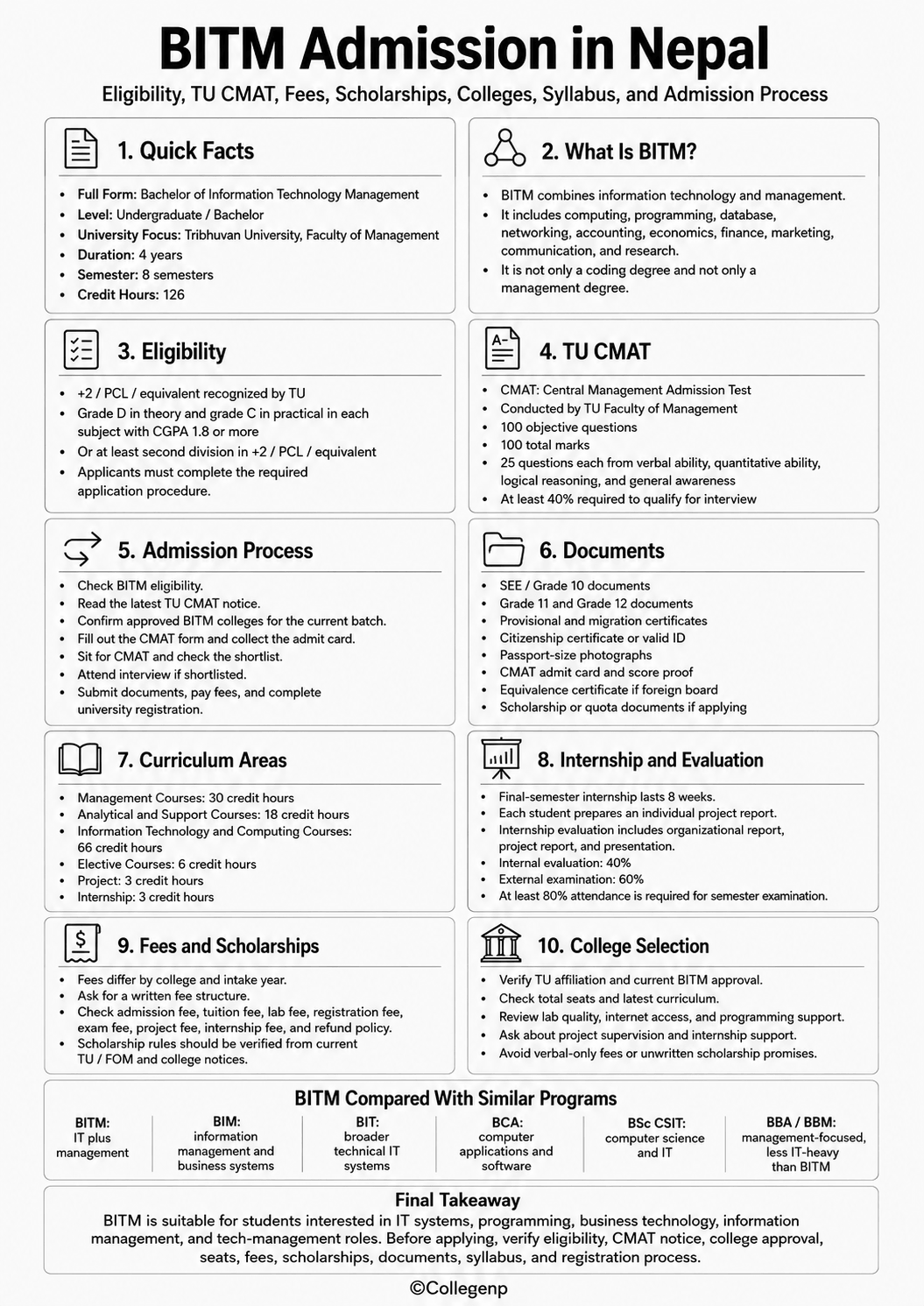
BITM can be understood quickly through its level, duration, university focus, entrance test, and course structure. The core facts below are based on TU Faculty of Management’s BITM curriculum.
| Topic | Details |
|---|---|
| Full Form | Bachelor of Information Technology Management |
| Level | Undergraduate / Bachelor |
| Main University Focus | Tribhuvan University, Faculty of Management |
| Duration | 4 years |
| Semester | 8 semesters |
| Credit Hours | 126 credit hours under TU BITM |
| Entrance Exam | CMAT conducted by TU Faculty of Management |
| Eligibility | +2 / PCL / equivalent recognized by TU |
| Minimum Academic Requirement | Grade D in theory and grade C in practical in each subject with CGPA 1.8 or more, or second division in +2/PCL/equivalent |
| Admission Basis | CMAT, interview, merit/selection process |
| Core Areas | IT, computing, programming, database, networking, management, accounting, economics, finance, marketing, research |
| Internship | 8-week internship in final semester |
| Suitable For | Students interested in IT systems, programming, business technology, information management, and tech-management roles |
What Is BITM?
BITM is an undergraduate degree that connects technology study with business and management study. It includes programming, database systems, networking, computing, accounting, economics, finance, marketing, communication, research, and management.
The management side is included because many technology roles require more than writing code. Graduates may need to understand users, budgets, workflows, teams, customers, data, and organizational decisions. TU’s BITM curriculum says the program is designed to develop information technology and management professionals and prepare students to apply IT and management knowledge in organizational settings.
Who Should Study BITM?
BITM suits students who want to work where IT systems and organizations meet. It can fit students interested in programming plus business systems, digital services, information management, data handling, MIS-related work, IT coordination, or technology-supported business operations.
A management student may choose BITM to move toward technology and systems roles. A science student may choose it to add accounting, finance, marketing, communication, and management knowledge to technical study. The right fit is a student willing to study both code and business subjects.
Who Should Avoid BITM?
BITM may not suit students who want a purely technical computer science path, a purely business degree, or a program with no mathematics, programming, or lab-based work. Students who dislike logical problem-solving, quantitative study, structured assignments, and technical practice should review the syllabus before applying.
BITM Admission in Nepal: How the System Works
BITM admission in Nepal depends on the university, current intake notice, and college approval. For TU BITM, the main route includes eligibility screening, CMAT, interview, and final selection.
BITM Under Tribhuvan University
TU BITM is offered under the Faculty of Management. The official FOM syllabus page lists “Course Structure of BITM program.pdf” and “BITM 1st Semester Syllabus 2025.pdf” under BITM.
The TU curriculum states that BITM extends across eight semesters and requires 126 credit hours. It also includes project and internship components and completion requirements within the prescribed academic period.
BITM vs BIM: Important Difference
BITM and BIM should not be treated as identical unless the university or college confirms the exact current program title, curriculum, and admission batch. This matters because degree title, transcript wording, course structure, and admission batch may differ.
Students should ask the college to show the current TU approval, latest syllabus, admission notice, and exact program title before paying admission fees. This is especially important if a college page or admission staff uses BITM and BIM labels together.
BITM vs BIT and Similar Degrees
BITM combines IT and management. BIT is usually more technology-focused, although the exact structure depends on the university and curriculum. BITM includes business, accounting, finance, marketing, economics, and management courses along with computing and IT courses.
Foreign-affiliated or similar IT-management degrees should be checked separately. Students should verify the awarding university, approval status, degree title, total credits, curriculum, equivalence process, fee structure, internship requirement, and project requirement. Do not assume that BITM, BIT, BIM, BSc IT, BCA, BSc CSIT, or another title follows the same admission rules.
BITM Eligibility in Nepal
For TU BITM, applicants must have completed twelve-year schooling or an equivalent qualification from a university, board, or institution recognized by Tribhuvan University. TU’s curriculum states that students must have grade D in theory and grade C in practical examination in each subject with CGPA 1.8 or more, or at least second division in +2, PCL, or an equivalent program, and they must complete the application procedure.
Management students can apply if they meet the eligibility criteria and admission process. They should be ready for programming, mathematics, database, networking, and computing courses. Science students can also apply if they meet TU’s eligibility and CMAT requirements.
Students from humanities, education, law, or other streams should verify eligibility from the latest TU CMAT notice or the college admission office. The first-semester TU BITM syllabus includes Introduction to Computing and Information Technology, Structured Programming in C, English I, Foundation of Business Management, and Basic Mathematics.
TU CMAT for BITM Admission
TU CMAT stands for Central Management Admission Test. Eligible TU BITM applicants must appear in CMAT conducted by the Faculty of Management.
The official BITM curriculum states that CMAT includes verbal ability, quantitative ability, logical reasoning, and general awareness. It has 100 objective questions, with 25 questions from each area, carrying 100 marks in total. Students must secure at least 40% in CMAT to qualify for interview.
CMAT qualification does not automatically guarantee admission. Applicants who meet the cut-off are shortlisted, and only shortlisted candidates are interviewed and selected for admission according to the admission process.
Step-by-Step BITM Admission Process
The BITM admission process should be followed through official notices and college documents. The FOM notice board lists bachelor-level forms and documents, including an exam form for BITM I Semester and a Bachelor CMAT notice file.
-
Check whether you meet BITM eligibility.
-
Read the latest TU Faculty of Management CMAT notice.
-
Confirm which colleges are approved to run BITM for the current batch.
-
Fill out the CMAT application form.
-
Pay the required entrance or application fee.
-
Collect or download the admit card.
-
Sit for the CMAT exam.
-
Check the CMAT result or shortlist.
-
Apply to preferred BITM colleges.
-
Attend interview if shortlisted.
-
Check the merit or admission list.
-
Submit required documents.
-
Pay admission and semester fees after receiving written details.
-
Complete university registration through the college.
-
Attend orientation and begin classes.
Verification Needed: Admission dates, CMAT form deadlines, exam centers, CMAT fee, scholarship process, fee details, and college-wise seats may change every intake year. Students should verify the latest TU/FOM and college notices before applying.
Documents Required for BITM Admission
BITM applicants should prepare academic, identity, entrance, and payment documents before the deadline. A missing document can delay college admission or university registration.
The usual checklist includes SEE/Grade 10 mark sheet, SEE/Grade 10 character certificate, Grade 11 mark sheet, Grade 12 mark sheet or transcript, Grade 12 character certificate, provisional certificate, migration certificate, citizenship certificate or valid ID, passport-size photographs, CMAT admit card, CMAT score or result proof, college application form, payment receipt, equivalence certificate if the student studied under a foreign board, scholarship or quota documents if applying, recommendation letter if required by the college, and scanned copies of academic documents.
Students should keep photocopies and scanned copies of all documents before submitting originals to any college.
BITM Seats, Quota, and Scholarship
BITM seats and scholarship rules should be checked for the current admission year. Seat availability may differ by college and intake year, and newer programs may have limited seats.
Scholarships may be merit-based, entrance-score-based, need-based, quota-based if officially available, college-level, semester-performance-based, or partial tuition waivers. The TU FOM notice board lists a scholarship process and procedure file, but students should still verify the current intake’s rule and whether it applies to BITM and the selected college.
Before accepting a scholarship, students should ask whether it covers admission fee, tuition, exam fee, or only part of tuition. They should also ask whether it applies for one semester, one year, or the full program; what GPA or CGPA must be maintained; whether attendance affects renewal; and whether cancellation rules are written.
BITM Fee Structure in Nepal
A single fixed BITM fee should not be published unless it is verified college-wise for the current intake. Students should ask each college for a written fee breakdown before admission.
| Cost Type | What Students Should Ask |
|---|---|
| CMAT/Application Fee | Paid to TU, college, or online system? |
| Admission Fee | One-time or recurring? |
| Tuition Fee | Monthly, semester-wise, or package? |
| Lab/IT Fee | Included in tuition or separate? |
| University Registration Fee | Paid once or separately? |
| Exam Fee | Included or paid every semester? |
| Project Fee | Included or separate? |
| Internship Fee | Included or separate? |
| Retake/Back Paper Fee | Charged separately? |
| Software/Materials | Any added cost? |
| Refund Policy | Written or verbal? |
BITM includes IT and computing work, so students should ask whether computer lab access, software tools, project supervision, programming support, and practical sessions are included in the fee.
BITM Curriculum and Subjects
TU BITM requires 126 credit hours. The official structure includes 30 credits of management courses, 18 credits of analytical and support courses, 66 credits of information technology and computing courses, 6 elective credits, 3 project credits, and 3 internship credits.
IT and Computing Courses in BITM
The IT and computing area carries the largest credit share in TU BITM. Listed courses include Introduction to Computing and Information Technology, Structured Programming in C, Digital Logic, Object-Oriented Programming in Java, Discrete Structure, Microprocessor and Computer Architecture, Web Programming I, Database Management System, Web Programming II, Data Structure and Algorithms, Computer Networking, Programming with Python, Operating System, Information System for Business Management, Artificial Intelligence, Cyber Security, Data Warehousing and Mining, Software Engineering and System Analysis, IT Innovation and Entrepreneurship, Business Data Analytics, Cloud Computing, and E-Commerce and Digital Marketing.
Management and Analytical Courses in BITM
Management courses include Foundation of Business Management, Organizational Behavior and Human Resource Management, Financial Accounting and Analysis, Economics for Business, Cost and Management Accounting, Fundamentals of Marketing, Fundamentals of Corporate Finance, Business Environment, Operations Management, and Strategic Management.
Analytical and support courses include English I, Business Communications, Basic Mathematics, Business Statistics, Sociology for Business Management, and Business Research Methods.
Project Work and Internship
BITM includes project work and internship to connect classroom study with applied learning. Project work should help students apply IT, systems, data, software, or business-technology concepts.
TU’s curriculum states that final-semester students are attached to organizations for eight weeks. Each student prepares an individual project report, and internship evaluation is based on the organization’s confidential report, the project report, and presentation. The internship carries 3 credit hours, and students must secure at least grade C in internship.
Students should ask colleges about project supervision, lab access, report format, presentation support, internship coordination, and evaluation process.
Evaluation, Attendance, and Graduation Rules
BITM uses the semester system with internal and external evaluation. TU’s BITM regulation states that internal ongoing evaluation carries 40% weightage and external end-semester examination carries 60% weightage.
Attendance is also part of academic eligibility. Students must attend theory and practical classes, assignments, study tours, field trips, seminars, and presentations as required. TU requires at least 80% attendance to qualify for semester examination.
For graduation, TU states that BITM extends over eight semesters and requires successful completion of 126 credit hours, passing grades in all courses, aggregate CGPA of 3.00, minimum grade B in the project, and completion within seven years from registration.
How to Choose the Right BITM College
A BITM college should be evaluated through documents, facilities, academic systems, and student support. Do not rely only on advertisements or verbal promises.
Students should verify TU affiliation, approval to run BITM for the current batch, total BITM seats, current curriculum, CMAT admission process, written fee structure, scholarship policy, IT lab quality, computer-to-student ratio, internet access, lab hours, programming support, project supervision, internship support, faculty profile, industry exposure, career counseling, academic calendar discipline, exam result history, library resources, location, transport, refund policy, and university registration process.
Red Flags Before Admission
Warning signs include unclear affiliation, unclear BITM vs BIM wording, verbal fee details only, scholarship promises without written terms, weak computer labs, limited programming support, no clear internship plan, job promises that sound unrealistic, pressure to pay immediately, unclear registration process, and no written refund policy.
BITM vs BIM vs BIT vs BCA vs BSc CSIT
Students should compare programs by syllabus, admission system, programming load, mathematics/statistics content, lab facilities, internship support, and career goals. A similar name does not mean the same curriculum.
| Program | Suitable For | Main Difference |
|---|---|---|
| BITM | IT plus management | Combines computing, business, management, and decision-making |
| BIM | Information management and business systems | Verify current title, admission batch, and syllabus |
| BIT | Broader technical IT systems | Usually more technology-focused, depending on university |
| BCA | Computer applications and software | More application/software-oriented |
| BSc CSIT | Computer science and IT | More technical and science-oriented |
| BBA | Business administration | Management-focused and less technical than BITM |
| BBM | Business management | Management-focused and less IT-heavy than BITM |
BITM can be a good fit for students who want a mixed pathway. It may not be the right fit for students seeking only software engineering depth or only business administration.
BITM Entrance Preparation Tips
CMAT preparation should match the four test areas: verbal ability, quantitative ability, logical reasoning, and general awareness. TU’s BITM regulation confirms these four CMAT areas and the 25-question distribution.
Students should practice objective questions, revise Grade 10–12 mathematics basics, improve English grammar and reading, solve reasoning sets, read business and technology updates, take timed mock tests, prepare for interview questions, and learn basic computer, programming, internet, database, and digital business concepts.
A useful interview answer should explain why BITM fits the student’s academic background, skills, and career direction.
Common Mistakes Students Should Avoid
Students often confuse BITM with BIT, BIM, BCA, or BSc CSIT. They may apply without reading the latest CMAT notice, ignore eligibility details, assume all IT degrees lead to the same career path, or choose a college only by advertisement.
Other mistakes include not checking TU affiliation, not confirming whether the college follows the current BITM curriculum, ignoring lab quality, not asking about programming support, not asking about internship support, trusting verbal scholarship promises, not requesting written fee details, missing deadlines, submitting incomplete documents, assuming CMAT qualification guarantees admission, and choosing a college without considering commute, cost, and academic discipline.
Career Scope After BITM
BITM can support entry into IT support and coordination, software development support, web development, database support, systems analysis, business analysis, IT project coordination, digital business support, MIS-related roles, data handling and reporting, networking support, e-commerce support, fintech and digital service companies, banking IT support, business technology operations, entrepreneurship, and further study in IT, management, information systems, or MBA-related pathways.
Career outcomes depend on programming ability, project portfolio, internship experience, communication skills, problem-solving ability, and continued technical learning. A degree gives the structure, but students still need practice, projects, and work-ready skills.
Final Checklist Before Applying
Before applying, verify the latest TU CMAT notice, BITM admission form deadline, CMAT fee, CMAT exam date, CMAT exam center, approved BITM college list, college-wise seats, scholarship/quota rules, admission fee, semester fee, lab and IT facility details, required documents, interview process, current syllabus, university registration process, refund policy, and class start date.
Conclusion
BITM admission in Nepal should be handled as an academic decision, not only as a form submission. TU BITM combines IT and management across eight semesters, 126 credit hours, CMAT-based admission, interview, project work, internship, internal evaluation, external exams, and attendance rules.
Students should verify official notices, compare BITM with similar degrees, check college approval, review fee and scholarship terms in writing, inspect lab and project support, and decide whether the program matches their interest in both technology and management.

Comments 0
No comments yet. Be the first to start the conversation.