



Introduction
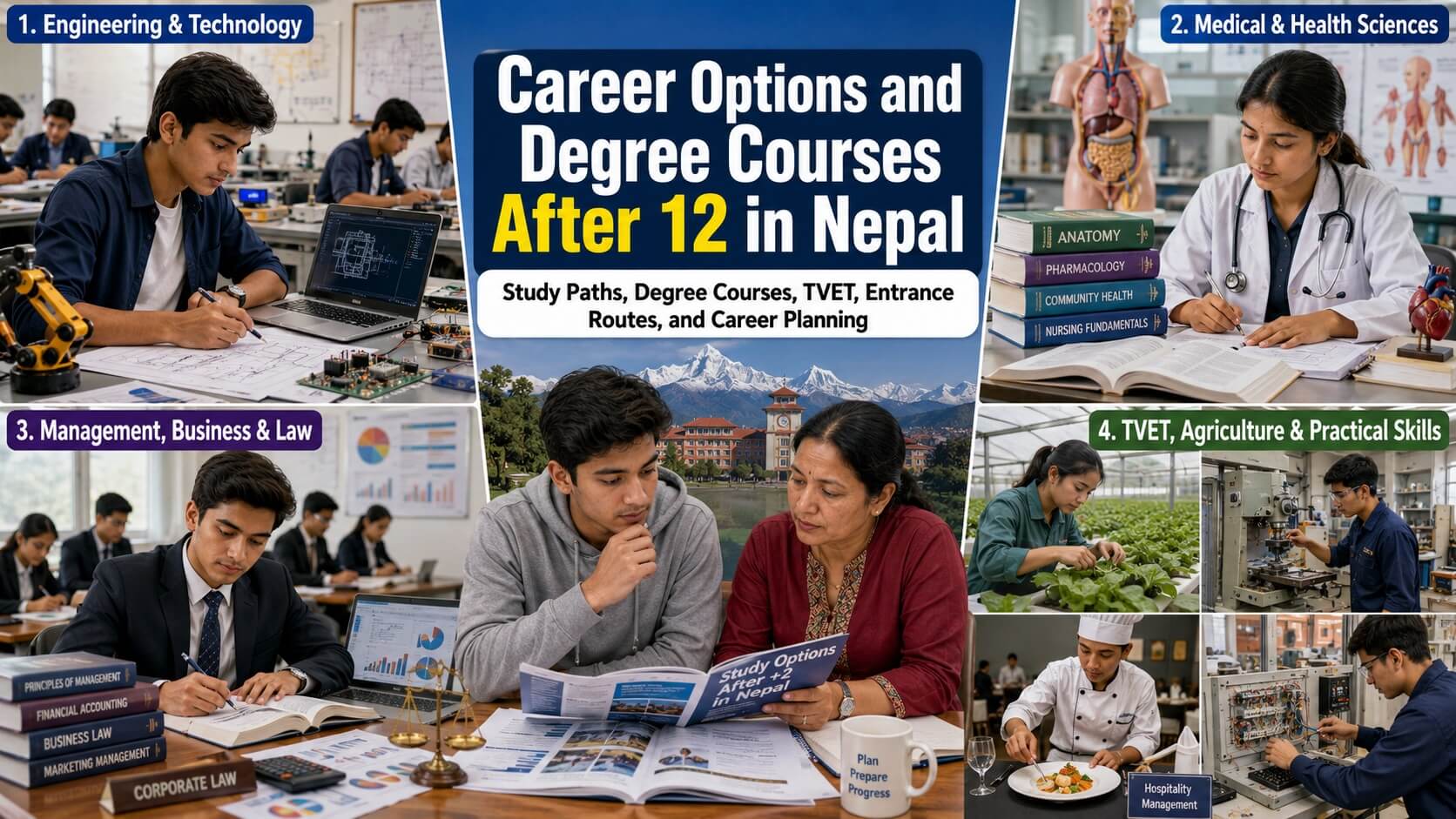
Choosing what to study after Grade 12 in Nepal is a decision about eligibility, recognition, learning style, cost, time, family situation, and career direction. A student is not choosing only a course name; the student is choosing a route that may lead to university study, technical training, professional licensing, public service preparation, entrepreneurship, further study, or direct entry into work.
Nepali students often ask, “Which course has scope?” That question is too broad by itself. A better question is: “Which recognized route matches my subjects, ability, resources, and the evidence I can build during study?” The same course can suit one student and create pressure for another when interest, finances, location, or academic preparation do not match the program.
Grade 12 is a major transition point because the National Examinations Board publishes Class 12 notices and examination information, while bachelor’s degrees, technical diplomas, and professional routes are handled by universities, councils, commissions, and education bodies.
This guide explains career options after 12 in Nepal, including bachelor’s degrees, TVET routes, regulated fields, management, humanities, law, agriculture, hospitality, and skill-building options. It avoids universal rankings because course choice should depend on fit and verification, not promotion.
Summary
Career options after 12 in Nepal include bachelor’s degrees, TVET diplomas, professional accounting, law, engineering, medical and health sciences, agriculture, forestry, hospitality, humanities, education, IT, and skill-based routes. Science, management, humanities, and education students have different eligibility patterns. The right choice depends on recognized affiliation, entrance exams, regulator requirements, cost, learning style, family constraints, and the student’s ability to build evidence such as projects, internships, fieldwork, writing, or licensing preparation.
Table of Content
- Introduction
- What Should Students Decide After Grade 12?
- Main Career Options and Degree Courses After 12 in Nepal
- Stream-Wise Course Options After 12 in Nepal
- How Do Entrance Exams and Regulators Affect Course Choice?
- Comparison Table: Routes, Evidence, and Limits
- How Can Students and Parents Check Course Quality?
- How to Choose a Course After 12 in Nepal
- Common Mistakes to Avoid After +2
- Verification Notes for Changing Details
- Conclusion
Key Takeaways
-
Start with eligibility, recognition, and student fit.
-
Bachelor’s degrees give academic depth and later study options.
-
TVET diplomas can suit practical and technical learners.
-
Regulated fields need official entrance and licensing checks.
-
Parents should compare affordability, location, pressure, and backup routes.
-
Career outcomes depend on learning evidence, not only course names.
-
Avoid salary promises, vague “scope” claims, and unverified college claims.
What Should Students Decide After Grade 12?
Students should first decide the type of route they need: academic degree, technical diploma, regulated profession, professional qualification, or skill-building route. This decision should come before choosing a college.
After +2, many students compare courses by social reputation. That can misguide the decision. A course with high social status may not fit the student’s strengths, finances, entrance readiness, or daily learning style. A less discussed course may suit a student when it is recognized, taught well, and linked to clear evidence.
A practical decision has four layers:
-
Eligibility: Does the student’s Grade 11 and 12 subject combination allow entry?
-
Recognition: Is the program approved by a university, CTEVT, or relevant regulator?
-
Learning fit: Does the student prefer theory, lab work, fieldwork, numbers, writing, design, service work, or practical tasks?
-
Outcome evidence: What will the student have after graduation beyond marks?
Nepal’s formal routes are not limited to one stream. Science students may choose engineering, IT, health science, agriculture, forestry, pure science, or management. Management students may choose business, accounting, IT-related management, hospitality, entrepreneurship, or professional accounting. Humanities and education students may choose law, social science, media, teaching, development work, public administration, psychology, language, or research-related routes.
Parents should treat this as a planning discussion, not a pressure test. A student who enters a demanding program only because of family pressure may struggle even when the program is recognized. A student who chooses a practical and recognized route with discipline may build a stronger base.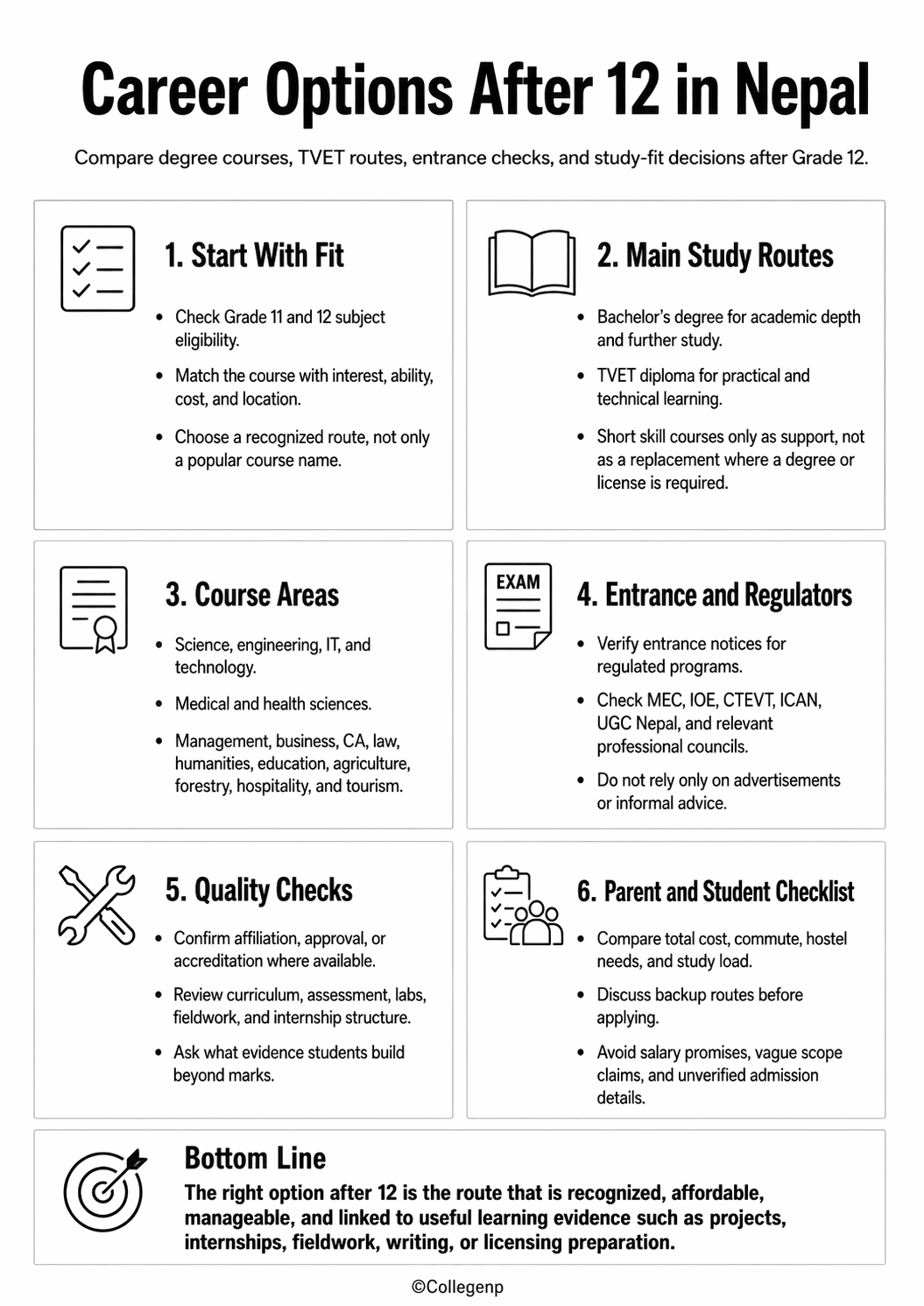 Certificate, Diploma, and Degree: What Is the Difference?
A certificate, diploma, and degree are different credentials. They differ in depth, duration, recognition, assessment, and what they allow the student to do next.
Certificate and short training routes
A certificate usually focuses on a specific skill. Examples include accounting software, language training, coding basics, graphic design, office administration, barista training, hospitality basics, public speaking, writing, research tools, or computer applications.
Certificates can help when they support a larger plan. A BBS student may add spreadsheet and accounting software skills. A humanities student may add research, writing, translation, or media production. An IT student may add small software projects. A hospitality student may add food production, front-office, or communication practice.
The limit is recognition. A certificate may support employability, but it does not replace a recognized bachelor’s degree, CTEVT diploma, council-approved health qualification, or professional license where those are required. Students should check the provider, curriculum, assessment, trainer background, project work, and recognition before paying.
TVET diploma and PCL routes
TVET stands for Technical and Vocational Education and Training. CTEVT lists certificate/diploma-level programs in agriculture, engineering, health/medical science, hospitality, social work, and forestry. It also states that the entry requirement for three-year certificate/diploma-level programs is SEE passed, so students should not assume every CTEVT route begins after Grade 12. (CTEVT)
This matters for +2 graduates. Some students may still choose a TVET route after Grade 12, but they should verify entry level, equivalence, curriculum, and later study options for the exact program. CTEVT’s course list includes diploma programs such as agriculture, engineering, health/medical science, hospitality, social work, forestry, and other trades. (CTEVT)
A TVET route may suit students who prefer practical training and occupational focus. It may also suit students who want a technical route before considering further study. The limit is that recognition, equivalence, and later degree routes may vary by program and institution.
Bachelor’s degree routes
A bachelor’s degree is a university-level academic qualification. It usually provides broader theory, subject depth, assessment, and a route toward postgraduate study. Bachelor’s routes after +2 in Nepal include engineering, architecture, IT, science, management, humanities, education, law, agriculture, forestry, hospitality, and health sciences.
The student should check affiliation, admission rules, curriculum, assessment system, and regulator requirements. UGC Nepal’s QAA list is one quality signal because it lists higher education institutions that have received Quality Assurance and Accreditation status. QAA should be read as one signal, not the only basis for admission.
Main Career Options and Degree Courses After 12 in Nepal
Career options after 12 in Nepal can be grouped by subject background, admission route, regulator requirements, and evidence needed after study. The aim is not to declare one course suitable for every student.
Science, engineering, and technology
Science students often consider engineering, architecture, computer engineering, information technology, computer science, cybersecurity, biotechnology, environmental science, mathematics, physics, chemistry, and related programs. Tribhuvan University’s Institute of Engineering states that IOE conducts an entrance examination each year for admission to Bachelor of Engineering and Bachelor of Architecture programs.
Technology-related degrees should be compared by curriculum depth. Students should look for programming, systems, databases, mathematics, networking, projects, labs, and internship exposure where relevant. Short IT training may help build skills, but it should not be confused with a full degree.
Practical insight: A student interested in software work should combine formal study with projects, code samples, documentation, and internship attempts.
Outcome and limitation: Engineering and technology routes can lead to technical roles, but marks alone may not be enough. Employers may assess projects, problem-solving, communication, and practical ability.
Medical and health science pathways
Medical and health science routes include medicine, dentistry, nursing, pharmacy, public health, medical laboratory technology, radiography, physiotherapy, optometry, and related fields. These routes need extra caution because admission, seats, institutions, and licensing are regulated.
The Medical Education Commission entrance portal publishes MECEE-BL notices for bachelor-level medical education. Nepal Medical Council states that its role includes registering qualified doctors and conducting licensing examination before registration. Nepal Nursing Council says it grants recognition of nursing qualifications, accredits nursing schools, administers the Nursing Licensing Exam, and maintains the registration of registered nurses in Nepal.
For other health profession routes, students should check the relevant regulator named in the official admission notice. Nepal Health Professional Council states that it registers health professionals other than medical doctors, nurses, pharmacists, and Ayurveda practitioners according to qualification.
Practical insight: Before choosing a health science course, verify the current official entrance notice, institution approval, subject eligibility, practical training structure, and licensing route.
Outcome and limitation: Health professions involve public responsibility. Students should not choose them only for status, family pressure, or unverified income claims.
Management, business, and accounting
Management students often compare BBA, BBS, BBM, BIM, BHM, BTTM, business analytics-related programs, finance, marketing, public administration, entrepreneurship, and accounting. These courses differ in academic style. Some are broader and theory-heavy, while others include more applied projects, hospitality practice, information systems, or business cases.
Professional accounting is a separate route. ICAN states that CAP-I is for students willing to enter the professional Chartered Accountancy course immediately after completing higher secondary education or equivalent.
Practical insight: A student interested in accounting, auditing, finance, or business operations should compare bachelor’s degrees with the CA route and assess workload honestly.
Outcome and limitation: Management degrees are broad. Students should build evidence through internships, accounting tools, presentations, writing, case analysis, market research, and basic data skills.
Humanities, social sciences, media, and education
Humanities and social science routes include sociology, psychology, social work, economics, English, Nepali, political science, development studies, media studies, journalism, public administration, and education. These fields develop reading, writing, analysis, communication, research, teaching, and community-facing skills.
Students sometimes dismiss these fields because the job path is less fixed than medicine or engineering. That is not a fair way to judge them. The better question is whether the student can build evidence: research reports, writing samples, teaching practice, fieldwork, media work, translation, survey work, or project coordination experience.
Practical insight: A humanities student interested in development work may combine a degree with fieldwork, research methods, proposal writing, statistics basics, and internships.
Outcome and limitation: These fields can support varied careers, but students need intentional skill-building because employers may ask for writing, field experience, data handling, language, or project evidence.
Law, agriculture, forestry, hospitality, and tourism
Law is a professional academic route. Nepal Law Campus states that B.A.LL.B. is a ten-semester, five-year program and that applicants, except foreigners, should face an entrance exam conducted by the Office of the Dean, Faculty of Law, TU. TU Faculty of Law states that the B.A.LL.B. entrance exam has full marks of 100 and pass marks of 40.
Agriculture, veterinary science, fisheries, and forestry suit students interested in biological science, rural systems, food, natural resources, and fieldwork. Agriculture and Forestry University lists bachelor-level programs in B.Sc. Agriculture, B.V.Sc. & A.H., B.Sc. Fisheries, and B.Sc. Forestry.
Hospitality and tourism routes may suit students interested in hotels, food production, service operations, travel, events, and guest-facing roles. Students should check whether they want a university degree, CTEVT diploma, or short training route, because each has a different depth and recognition pattern.
Stream-Wise Course Options After 12 in Nepal
Students usually begin from their +2 stream, but the stream should not be used as a rigid box. Some programs allow cross-stream entry, while others require specific subjects or entrance exams.
Options after +2 Science
Science students may consider:
-
MBBS, BDS, BSc Nursing, BPH, BPharm, BMLT, radiography, physiotherapy, optometry, and related health science routes.
-
BE, B.Arch, computer engineering, civil, electrical, electronics, mechanical, geomatics, hydropower, and related engineering fields.
-
BSc in physics, chemistry, mathematics, biology, environmental science, biotechnology, or related science fields.
-
IT, computer science, cybersecurity, software-related study, or information systems programs.
-
Agriculture, forestry, veterinary science, animal science, fisheries, and food-related study.
-
Management or business programs where the university allows entry.
The key check for science students is whether the route requires biology, mathematics, or both. Medical, engineering, and agriculture-related routes can have specific subject and entrance rules, so students should verify the current official notice before applying.
Options after +2 Management
Management students may consider:
-
BBS, BBA, BBM, BIM, BHM, BTTM, finance, marketing, entrepreneurship, public administration, and business-related degrees.
-
CA through ICAN’s professional route after higher secondary education or equivalent.
-
Information management or business technology programs where eligibility allows.
-
Hospitality and tourism degrees or diplomas.
-
Humanities, law, education, social science, and media programs where eligible.
The key check for management students is whether they prefer accounting, people management, entrepreneurship, finance, hospitality operations, information systems, or general business. Broad programs need extra skill-building through internships and projects.
Options after +2 Humanities, Education, and Law
Humanities, education, and law students may consider:
-
BA in sociology, psychology, English, Nepali, economics, political science, social work, development studies, or related fields.
-
Bachelor of Education routes for teaching and education-related work.
-
B.A.LL.B. where entrance and eligibility rules are met.
-
Journalism, media studies, communication, public administration, and language-related programs.
-
Management or social science programs where the institution allows entry.
-
Skill-based routes in writing, research, language, design, media production, office administration, and community work.
The key check is evidence. These fields reward students who can write, speak, research, analyze, present, teach, or work with communities.
Options through TVET and skill-based routes
TVET and skill routes may suit students who want practical training, trade skills, technical occupations, or applied learning. CTEVT lists certificate/diploma programs across agriculture, engineering, health/medical science, hospitality, social work, forestry, and other trades. UNESCO’s Nepal TVET policy dialogue in 2024 discussed Nepal’s TVET sector with attention to greening TVET, private sector engagement, and system development.
Students considering TVET should check:
-
Program approval.
-
Curriculum and duration.
-
Entry qualification.
-
Equipment and labs.
-
Practical training.
-
Assessment system.
-
Equivalence or route for further study.
-
Local employment relevance.
How Do Entrance Exams and Regulators Affect Course Choice?
Entrance exams and regulators can decide whether a student is eligible to enter, study, graduate, register, or practice. Students should verify current official rules before relying on college brochures, social media posts, or informal advice.
Medical, nursing, and health professions
Medical education requires checking the Medical Education Commission for current entrance notices and admission information. MEC’s portal publishes MECEE-BL notices for bachelor-level medical education.
For practice after study, students should check the relevant council. Nepal Medical Council handles doctor registration and licensing examination before registration, while Nepal Nursing Council administers nursing licensing and maintains registration of registered nurses. For other health profession routes, students should check the relevant professional council or regulator named in the official admission notice.
Engineering and architecture
Engineering and architecture students should check the university entrance route and later professional recognition. IOE states that it conducts an entrance examination each year for BE and B.Arch admission. Nepal Engineering Council states that it is a statutory body established to regulate and promote the engineering profession in Nepal, and its site provides registered engineer status checking.
Students should verify affiliation, entrance notice, subject eligibility, labs, assessment, and recognition before admission.
Law and professional accounting
Law and accounting have separate structures. Nepal Law Campus describes B.A.LL.B. as a five-year, ten-semester route with an entrance exam for applicants except foreigners. ICAN states that CAP-I is for students willing to enter the CA course immediately after higher secondary education or equivalent.
Students should decide whether they want a university degree, a professional qualification, or a combination. The workload can be demanding, so students should assess time, study habits, and family support.
Comparison Table: Routes, Evidence, and Limits
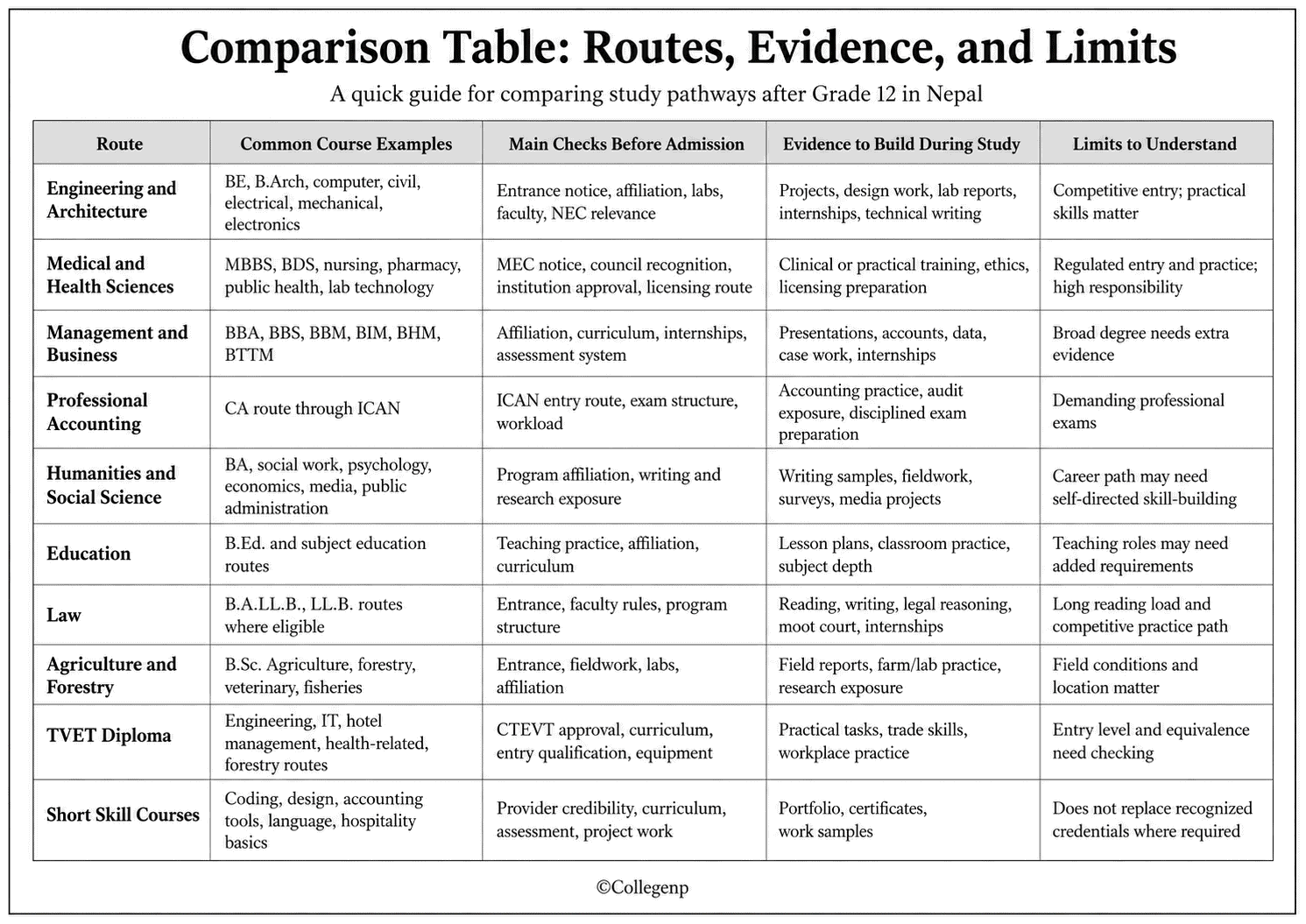
This table helps students and parents compare routes without treating any single course as suitable for all students.
| Route | Common course examples | Main checks before admission | Evidence to build during study | Limits to understand |
|---|---|---|---|---|
| Engineering and architecture | BE, B.Arch, computer, civil, electrical, mechanical, electronics | Entrance notice, affiliation, labs, faculty, NEC relevance | Projects, design work, lab reports, internships, technical writing | Competitive entry; practical skills matter |
| Medical and health sciences | MBBS, BDS, nursing, pharmacy, public health, lab technology | MEC notice, council recognition, institution approval, licensing route | Clinical or practical training, ethics, licensing preparation | Regulated entry and practice; high responsibility |
| Management and business | BBA, BBS, BBM, BIM, BHM, BTTM | Affiliation, curriculum, internships, assessment system | Presentations, accounts, data, case work, internships | Broad degree needs extra evidence |
| Professional accounting | CA route through ICAN | ICAN entry route, exam structure, workload | Accounting practice, audit exposure, disciplined exam preparation | Demanding professional exams |
| Humanities and social science | BA, social work, psychology, economics, media, public administration | Program affiliation, writing and research exposure | Writing samples, fieldwork, surveys, media projects | Career path may need self-directed skill-building |
| Education | B.Ed. and subject education routes | Teaching practice, affiliation, curriculum | Lesson plans, classroom practice, subject depth | Teaching roles may need added requirements |
| Law | B.A.LL.B., LL.B. routes where eligible | Entrance, faculty rules, program structure | Reading, writing, legal reasoning, moot court, internships | Long reading load and competitive practice path |
| Agriculture and forestry | B.Sc. Agriculture, forestry, veterinary, fisheries | Entrance, fieldwork, labs, affiliation | Field reports, farm/lab practice, research exposure | Field conditions and location matter |
| TVET diploma | Engineering, IT, hotel management, health-related, forestry routes | CTEVT approval, curriculum, entry qualification, equipment | Practical tasks, trade skills, workplace practice | Entry level and equivalence need checking |
| Short skill courses | Coding, design, accounting tools, language, hospitality basics | Provider credibility, curriculum, assessment, project work | Portfolio, certificates, work samples | Does not replace recognized credentials where required |
 How Can Students and Parents Check Course Quality?
Students and parents should check quality through recognition, accreditation, curriculum, faculty, assessment, practical exposure, and evidence from current students or graduates. A college claim should be treated as a claim until verified.
Recognition and accreditation
Recognition means the program is accepted by the relevant authority. Accreditation is a quality signal. UGC Nepal’s QAA page lists higher education institutions that have received Quality Assurance and Accreditation status.
Check these points:
-
University affiliation or CTEVT approval.
-
Professional council approval where the field is regulated.
-
QAA status where available.
-
Official admission notice.
-
Current entrance and eligibility rules.
-
Whether the advertised program name matches the approved program name.
-
Equivalence rules for foreign-affiliated programs.
Curriculum depth and assessment
A course should be judged by what it teaches and how it assesses learning. Students should ask for the syllabus before admission. A serious curriculum should show core subjects, electives, labs, fieldwork, projects, internships, internal assessment, and final assessment.
Ask:
-
Does the curriculum match the intended career path?
-
Are practical components clearly listed?
-
Does assessment include projects, lab work, fieldwork, case work, or writing?
-
Are digital, communication, quantitative, and ethical skills included where relevant?
-
Are syllabi and academic calendars available?
Labs, fieldwork, internships, and portfolio evidence
Practical evidence matters because employers and graduate schools may look beyond marks. Engineering and IT students may need projects and technical portfolios. Health and agriculture students may need approved practical exposure. Management students may need internships, presentations, accounting tools, and business cases. Humanities students may need writing samples, research reports, media work, or field reports.
The ILO defines skills mismatch as a discrepancy between skills sought by employers and skills possessed by individuals. Students should build skills and evidence during the course rather than wait until graduation.
How to Choose a Course After 12 in Nepal
Students should choose a course by matching interest, eligibility, learning style, recognition, cost, location, and career evidence. Parents should support the decision with practical checks rather than fear-based pressure.
Student self-check framework
Before choosing, answer these questions:
-
Which subjects did I handle well in Grade 11 and 12?
-
Do I prefer theory, lab work, fieldwork, writing, numbers, service work, design, or practical tasks?
-
Is my preferred field regulated by an entrance exam, council, commission, or license?
-
Can I manage the study load for the full duration?
-
Can my family afford the course without unsafe financial pressure?
-
What evidence will I build during study besides marks?
-
What is my backup route if I do not get admission in my first choice?
-
Can this course support further study in Nepal or abroad if I choose that path later?
Parent and guardian discussion checklist
Parents and guardians can help by asking specific questions:
-
Is the course recognized?
-
Is the college officially affiliated or approved?
-
What is the total cost, including tuition, exams, materials, transport, hostel, and living expenses?
-
Does the student have interest and readiness for the subject?
-
Is the commute safe and manageable?
-
What are the entrance exam dates and official notices?
-
What are the realistic backup options?
-
What practical evidence will the student build each semester?
A parent’s role is not to force a course with a famous name. A parent’s role is to help the student choose a verified, manageable, and purposeful route.
Backup planning without panic
Backup planning is not failure planning. It is a safety plan. A student preparing for medicine may also compare public health, pharmacy, lab technology, nursing, or science routes where eligible. A student preparing for engineering may compare science, IT, CTEVT diploma, or applied technology routes. A student considering CA may also compare BBS, BBA, finance, or accounting-related work.
A good backup plan has three features:
-
It is recognized.
-
It fits the student’s subjects and ability.
-
It still supports a useful next step.
Common Mistakes to Avoid After +2
Students and parents can reduce risk by avoiding common decision errors.
-
Choosing a course only because friends selected it.
-
Trusting salary claims without evidence.
-
Confusing a short certificate with a recognized degree or license.
-
Ignoring entrance exam and regulator requirements.
-
Selecting a college without checking affiliation or approval.
-
Focusing only on the course name and ignoring curriculum.
-
Taking loans or financial risk without a realistic plan.
-
Choosing a field only because of family pressure.
-
Waiting until final year to build skills and evidence.
-
Ignoring backup options.
Admission decisions should be made with official notices, written program details, and family-level cost planning.
Verification Notes for Changing Details
Admission details change by year, institution, regulator, and program. Students should verify current notices before applying.
Do not treat this article as a source for:
-
Current fee structures.
-
Seat numbers.
-
Scholarship quotas.
-
Entrance exam dates.
-
Application deadlines.
-
Minimum GPA or grade requirements.
-
Hostel costs.
-
Transport costs.
-
Salary expectations.
-
Migration or foreign-study equivalence.
For these details, check the latest official notice from the concerned university, CTEVT, Medical Education Commission, professional council, campus, or institution.
Conclusion
Career options after 12 in Nepal should be evaluated through fit, eligibility, recognition, cost, quality, and evidence. Bachelor’s degrees, TVET diplomas, professional accounting, law, health science, engineering, agriculture, humanities, education, hospitality, and skill routes can all be valid when they match the student’s situation and are verified through official sources.
Students should avoid choosing a course only because it sounds popular. Parents should avoid pushing a route without checking the student’s readiness and the family’s practical constraints. A better decision comes from comparing recognized routes, understanding entrance and licensing rules, reviewing curriculum depth, and planning what evidence the student will build during study.







Comments 0
No comments yet. Be the first to start the conversation.