



Nepal Higher Education Quality: UGC QAA Guide
Nepal’s higher education sector is currently passing through a historic phase of transformation. In past decades, we prioritized the numerical growth of academic institutions, but today, “quality” has become the primary basis of academic survival.
As an academic researcher and an expert engaged in the education sector for the past three decades, one major challenge I have consistently observed is this: campuses often manage to build physical infrastructure, but they become confused when they reach the complex process of “Quality Assurance and Accreditation” (QAA).
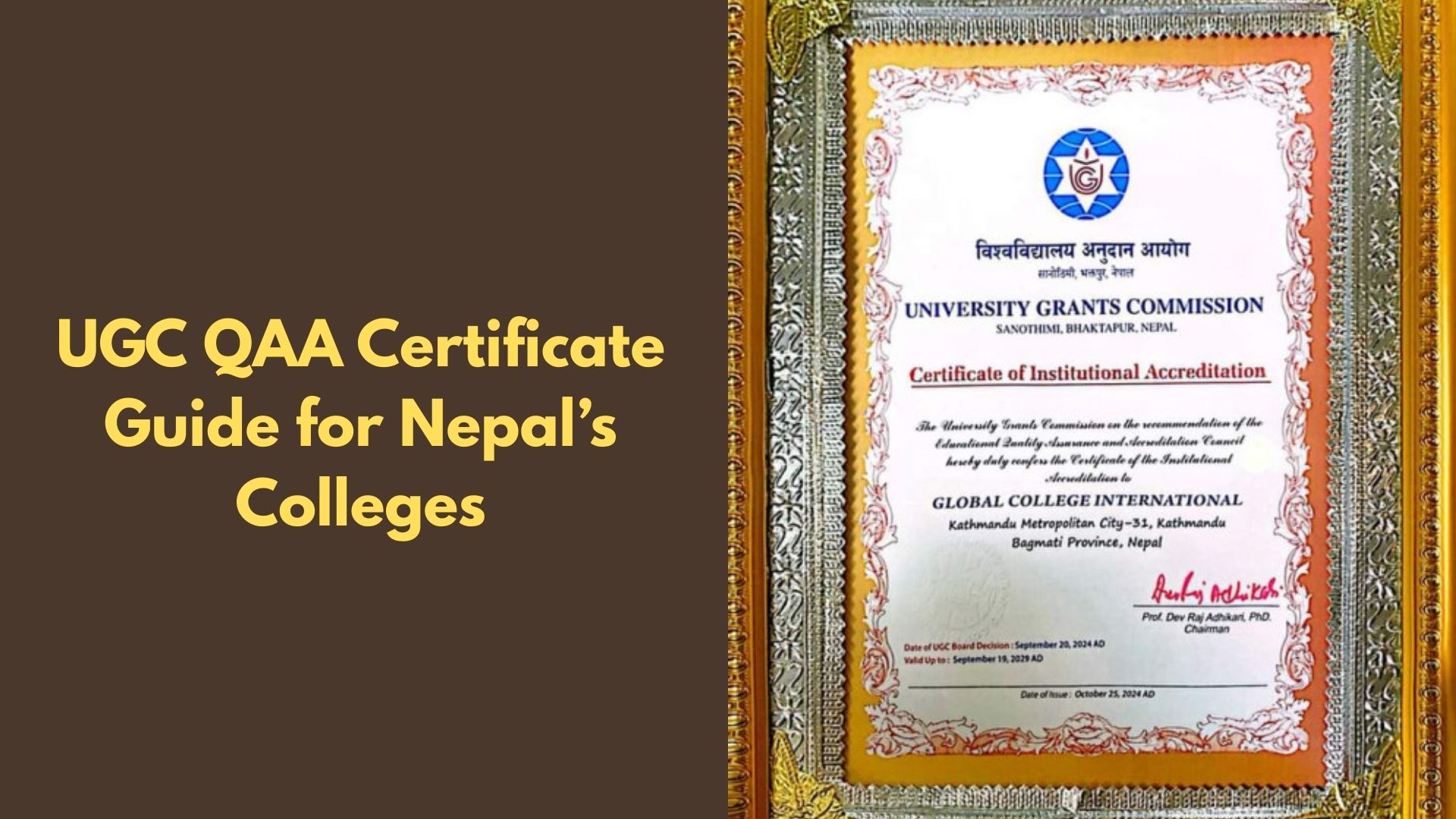
The QAA certificate provided by the University Grants Commission (UGC) Nepal is not merely a piece of paper. It is an international-level validation of an institution’s academic excellence, administrative transparency, and social responsibility.
In this article, we will present an in-depth, factual, and practical analysis of how any college or academic institution can obtain QAA in a scientific and systematic way.
-Banner.png)
Table of Content
- Nepal Higher Education Quality: UGC QAA Guide
- What is QAA, and why is it necessary?
- The 8 key indicators/clusters for QAA
- Step-by-step roadmap to obtain QAA
- Practical problems colleges face and solutions
- Research and references
- Conclusion
What is QAA, and why is it necessary?
With the globalization of higher education, the numerical growth of academic institutions is no longer sufficient. For a developing country like Nepal, the quality of higher education has become both a serious challenge and an opportunity.
In this context, “Quality Assurance and Accreditation” (QAA) is a strict but scientific process that verifies an academic institution by testing it against the standards of academic excellence.
According to UGC Nepal’s definition, QAA is not only an administrative process; it is also a benchmark of institutional good governance. It helps bridge the gap between an institution’s educational goals and the skilled workforce that society seeks.
This system is fundamentally based on “Peer Review,” where informed experts in relevant fields closely observe the institution and provide assurance of its quality.
Why QAA is essential and multidimensional
Why has obtaining QAA become necessary for Nepal’s higher education institutions? This can be understood through the following four pillars.
1. International equivalence and students’ future
In today’s era, education has no geographic boundary. Our students compete for opportunities at leading universities around the world.
When a college obtains QAA, it establishes an international-level benchmark. Universities in developed countries, when admitting foreign students, often prioritize whether the student’s institution is accredited by an official authority in its home country.
Students from QAA-accredited colleges receive added ease in credit transfer and scholarship processes. This makes Nepali qualifications more acceptable and sustainable in the global market.
2. Institutional sustainability and government grants
UGC has changed its policy and now ties financial support to “quality.”
Under the concept of “performance-based funding,” institutions that participate in the QAA process and obtain certification can receive larger development grants, lab improvement funds, and substantial research budgets.
In my experience, some campuses have shrunk due to limited resources. However, once they choose the QAA path, doors often begin to open for them—both from government grants and external donor agencies.
This becomes a backbone for financial autonomy and infrastructure development.
3. Rigorous self-review and continuous improvement (The SWOC Cycle)
One of the strongest aspects of the QAA process is the “Self-Study Report” (SSR). It functions like a mirror for the institution.
The institution must conduct a deep analysis of its strengths, weaknesses, opportunities, and challenges. When the Peer Review Team identifies gaps in academic practices, the institution gains an opportunity to correct errors and adopt newer approaches.
This helps end ad-hoc practices and builds systems.
4. Social credibility and public accountability (Public Trust & Accountability)
Education is not only a service; it is also a social responsibility. Parents invest their life’s earnings, and students entrust their future to a college.
A QAA certificate helps ensure that investing in that institution is safer. It signals transparent administration, qualified faculty, and a stronger learning environment.
In a crowded market of newly opened institutions, QAA-accredited institutions carry a visible “quality stamp,” and this often influences students’ and parents’ first preference during admission.
Therefore, QAA is not only a certificate. It is a broader campaign to transform Nepali higher education from a “degree-producing factory” into a “center for knowledge production.” It controls academic disorder and makes institutions more accountable and dynamic.
The 8 key indicators/clusters for QAA
The eight indicators defined by UGC Nepal are like the “DNA” of any academic institution. These indicators measure not only the institution’s external appearance but also its internal operations and academic integrity.
My three decades of experience suggest this: many colleges do the work, but they fail to prove it through documentation. In QAA, the principle is clear: evidence is everything.
Below is a detailed and practical breakdown of all eight indicators.
1. Policy and procedures (15% weight)
This indicator shows how the institution’s “brain” functions. Institutional governance is central here.
Genuine analysis: The college’s statutes, regulations, and procedures should not exist only to be stored in drawers. Among them, the most important is a “Strategic Plan,” which must clearly present where the college wants to see itself in the next 5 or 10 years.
Practical solution: Conduct an “Organization and Management (O&M) Survey” to strengthen the organizational structure. The roles, duties, and authorities of each committee (for example: procurement committee, admission committee, examination committee) must be clearly defined in writing.
Create a mechanism to securely and systematically preserve meeting decisions (minutes).
2. Curricular aspects (10% weight)
In Nepal, many colleges depend on the curriculum of the affiliating university. However, QAA asks: “How relevant have you made that curriculum for students?”
Genuine analysis: Are course objectives clearly explained to students? Has the college run local-need-based add-on or bridge courses?
Practical solution: Develop a feedback mechanism. At the end of each academic session, collect suggestions on curriculum effectiveness from students, teachers, employers, and alumni.
Keep evidence of communication with the university for curriculum revision based on these suggestions. This confirms that the college is attentive to curriculum quality.
3. Teaching-learning and evaluation system (20% weight)
This has the highest weight and is the main benchmark for measuring a college’s real performance.
Genuine analysis: Education must move from lecture-based methods to learner-centered approaches. What matters is not how many hours a teacher teaches, but what students learn and how learning is evaluated.
Practical solution: Ensure full compliance with the academic calendar. Implement a Continuous Assessment System (CAS) to measure student progress.
Provide remedial classes for weaker students and advanced learning opportunities for stronger students. Make the use of multimedia, online resources, and practical methods mandatory in teaching.
4. Research, consultancy, and extension (15% weight)
Nepali colleges often get stuck at this point. As an education professional, the key issue I have observed is treating research as a burden.
Genuine analysis: A college must contribute to knowledge reproduction. How many research articles did teachers write? How many were published in journals? What role did the college play in solving community problems?
Practical solution: Form an active Research Management Cell (RMC). Provide seed money for teachers’ research.
Publish the college’s own peer-reviewed journal. Also, conduct extension activities with the community (such as agriculture training, legal awareness, health camps) and prepare proper reports.
5. Infrastructure and learning resources (10% weight)
Infrastructure is not only buildings; it is the learning environment.
Genuine analysis: The key question is not only how many books a library has, but how modern and useful those books are. Do students have access to e-resources (online journals, e-books)?
Practical solution: Automate the library (for example: using KOHA software). Ensure disability-friendly access (ramps/lifts), safe drinking water, and secure laboratories.
Develop the campus as a “Green and Clean Campus.”
6. Student support and progression (10% weight)
A college’s success depends on students’ success.
Genuine analysis: After admission, what is the dropout rate? What employment outcomes do students achieve after graduation?
Practical solution: Establish an active counseling and placement cell. Provide training for public service preparation, banking training, or entrepreneurship.
Register an alumni association and connect alumni to college development. Build a student tracking system to monitor where alumni are and what they are doing.
7. Management Information System (10% weight)
Data is power. Every institutional activity should be evidence-driven.
Genuine analysis: Does the college maintain digital records from admission to results? Are financial transactions transparent?
Practical solution: Implement an integrated educational ERP system. Keep dynamic information updated on the website.
Maintain teachers’ and staff personal files in both digital and physical forms. Build a habit of data-driven decision-making.
8. Public information (10% weight)
This reflects transparency and accountability.
Genuine analysis: How does the college present its performance to the public? Are policies publicly accessible?
Practical solution: Publish an annual report each year. Maintain a citizen charter.
Regularly communicate college activities through social media and the media. Ensure stakeholders can access audit reports and other major decisions when needed.
Expert suggestion
Do not view these 8 indicators separately. View them as interconnected. Only when policy is strong (Indicator 1) can teaching and research become more effective (Indicators 3 and 4).
During documentation, emphasize not only “what was done,” but also “what impact it produced” (impact analysis). QAA is not just about filling forms; it is an opportunity to change institutional work culture.
Step-by-step roadmap to obtain QAA
Obtaining QAA is like a marathon. It can be divided into the following steps.
Step 1: Letter of Intent (LOI)
First, the college must apply to UGC stating its intention to participate in the QAA process.
For this, the college must meet minimum eligibility criteria (for example: at least 5 years since affiliation, ownership of land or long-term lease, etc.).
Step 2: Preparing the Self-Study Report (SSR)
After LOI approval, the college must prepare a detailed institutional post-mortem report. This report must be based on the eight clusters mentioned above.
Expert advice: Form a Self-Assessment Team (SAT) within the college to write the SSR. Include experienced teachers who have interest in writing.
Step 3: Pre-visit
After reviewing the submitted SSR, a technical team from UGC visits the college. They identify gaps and provide improvement suggestions.
Step 4: Visit by the Peer Review Team (PRT)
This is the final and decisive step. A team of national and sometimes international experts stays at the college for 3 to 5 days. They:
-
Verify documents
-
Interview teachers, students, parents, and stakeholders
-
Observe physical infrastructure directly
Step 5: Decision and certification
Based on the PRT report, the Quality Assurance and Accreditation Council decides whether to grant the QAA certificate.
If improvements are required, the council may ask for a response report.
Practical problems colleges face and solutions
In my 30 years of experience, many colleges face the following problems.
Problem 1: Lack of documentation
Many colleges do the work, but they do not keep records.
Solution: “If it is not written, it never happened.” Keep minutes of every meeting, photos of every program, and participants’ signatures as a must.
Problem 2: Teachers’ indifference
Teachers may feel: “This is administration’s work, not mine.”
Solution: Develop QAA as a college culture. Provide performance-based incentives for teachers.
Problem 3: Not investing in research
Nepali colleges spend a large portion of their income on advertising, but not on research.
Solution: Allocate at least 3–5% of the annual budget to research and the library.
Research and references
According to UGC Nepal’s “QAA Guidelines 2023,” colleges must now focus on Outcome Based Education (OBE).
At the international level, UNESCO and World Bank reports also consider institutional autonomy and accountability as key foundations for ensuring quality in higher education.
In Nepal, up to 2081 BS, more than 100 colleges have already obtained QAA. The data suggests that in QAA-accredited colleges, student enrollment rates and student results improved by 15–20%.
Conclusion
Obtaining QAA is not the end of the process. It is the beginning of the responsibility to sustain quality.
As a PhD scholar and education professional, I want to say this: a college should not work only for QAA; it should work to become a learning organization.
When you find students researching in the library, when teachers teach using new technologies, and when society trusts your college as a reliable center—then understand that your college has already become eligible for QAA.
Final suggestion: Before starting the QAA process, study UGC’s published “QAA Directory” thoroughly, and visit other QAA-accredited colleges to learn their best practices.
Disclaimer: This article has been prepared for informational purposes only. For official rules, fees, and procedures related to QAA, always consult the official website or office of the University Grants Commission (UGC) Nepal.





Comments 0
No comments yet. Be the first to start the conversation.