Kalika Multiple Campus (KMC) is a nonprofit community campus located at Kajipokhari, Pokhara, Kaski, Gandaki Province of Nepal. Established in 1991 AD (2048 BS), the campus is affiliated with Tribhuvan University (TU) and was formed through the collective effort of local people, organizations, educators, academics, and social activists.
The campus serves students from Pokhara and nearby districts, including Tanahun, Gorkha, Lamjung, Syangja, Parbat, Baglung, Myagdi, and Mustang. It offers bachelor’s and master’s level programs, including Bachelor of Business Studies (BBS), Bachelor of Arts (BA), Bachelor of Education (B.Ed), Master of Business Studies (MBS), and MA in Rural Development Studies (MARDS). Kalika Multiple Campus reports 1,440 students, 32 teaching staff, and 15 non-teaching staff.
Kalika Multiple Campus (KMC) is a nonprofit, community-based higher educational institution located at Kajipokhari, Pokhara, Kaski.
Established in 1991 AD (2048 BS), the campus is affiliated with Tribhuvan University (TU).
KMC was founded through the collective efforts of local people, organizations, educators, academics, and social activists.
The campus operates as a nonprofit autonomous community campus and has continued to develop with local community participation.
Kalika Multiple Campus is QAA-certified and recognized by the University Grants Commission (UGC), Nepal.
The campus offers bachelor’s-level programs in BBS, BA, and B.Ed, along with master’s-level programs in MBS and MA in Rural Development Studies (MARDS).
KMC is identified as the first campus in Gandaki Province to offer the Master’s Degree in Rural Development Studies (MARDS) affiliated with TU.
The campus serves students from Pokhara and surrounding districts, including Tanahun, Gorkha, Lamjung, Syangja, Parbat, Baglung, Myagdi, and Mustang.
Kalika Multiple Campus reports 1,440 students, 32 teaching staff, and 15 non-teaching staff.
Its teaching approach includes class lectures, group discussions, field visits, practical exercises, laboratory work, and project work.
Student facilities include a library, Wi-Fi connectivity, multimedia-supported classrooms, playground, parking, canteen, and sanitary napkin vending machine.
Scholarship support is available through full and partial schemes, with selection based on academic performance, economic condition, geography, gender, disability, and inclusion categories.
Admission to undergraduate programs such as BBS, BA, and B.Ed requires +2, PCL, or an equivalent qualification recognized by TU, along with completion of the campus admission process.
The admission process includes a written test and interview, with written assessment areas covering verbal ability, logical reasoning, quantitative ability, and general awareness.
Students must maintain at least 80% attendance to be eligible for final examinations conducted under the TU Examination Board system.
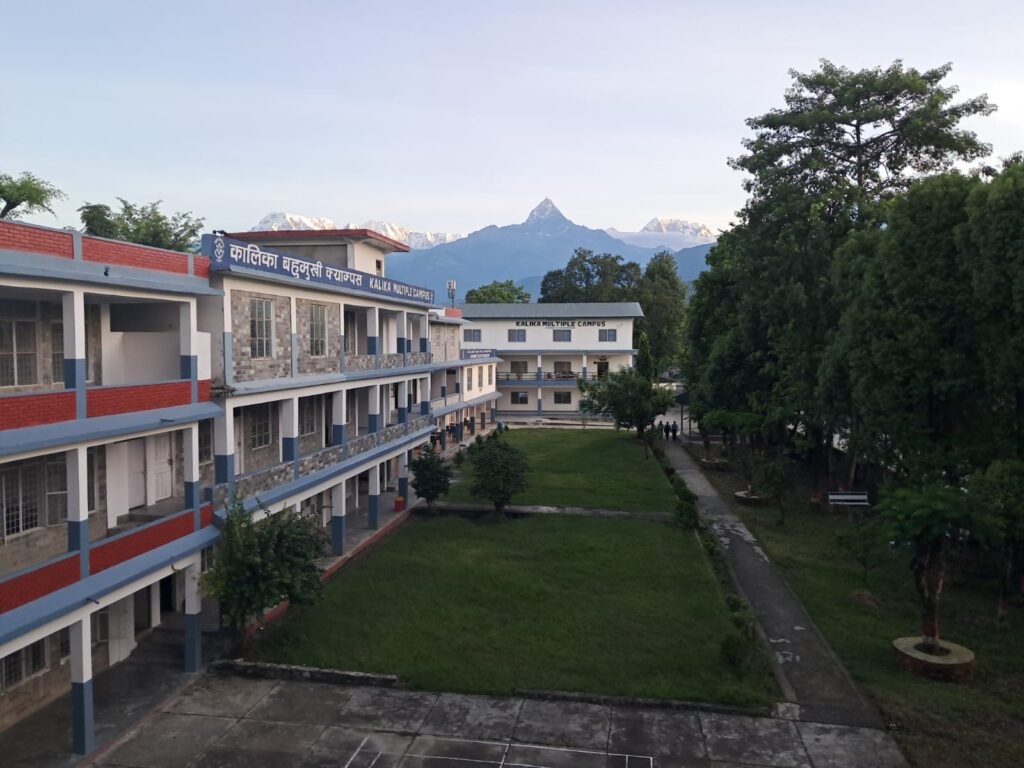
Kalika Multiple Campus Pokhara (कालिका बहुमुखी क्याम्पस, पाेखरा) was established to expand access to affordable higher education in Pokhara and its surrounding areas. Since its beginning, local participation has remained closely connected with the campus’s growth, management, and institutional direction.
KMC is a QAA-certified community campus recognized by the University Grants Commission (UGC), Nepal. It operates as a nonprofit autonomous campus affiliated with Tribhuvan University and conducts its academic programs according to TU’s teaching and learning standards.
The campus is identified as the first campus in Gandaki Province to offer the Master’s Degree in Rural Development Studies (MARDS) affiliated with TU. Its teaching approach includes class lectures, group discussions, field visits, practical exercises, laboratory work, and project work, supported by internet access and multimedia teaching aids.
KMC intends to be a prestigious community-based campus of higher education in Nepal dedicated to academic excellence. It will offer people access to educational opportunities in different branches of knowledge.
The mission of Kalika Multiple Campus Pokhara is to provide people in the country with affordable access to higher education in different disciplines. The campus aims to evolve into academic excellence and aspires to be an educational hub of the Western region through continued focus on academic autonomy, program extension in non-technical and soft tech disciplines, and continued certification as a QAA-certified institution.
Physical Infrastructure Development
Faculty Development
Academic Excellence
Program Extension
Institutional Capacity Development
Students' Welfare and Extra-Curricular Activities
Campus Community Linkage
Financial Resource Development and Management
The aspirant candidate applying for BBS, BA, and BE.d programs must:
Secure at least a passed second division in the +2, PCL, or equivalent program from any educational board or institution recognized by TU.
Comply with all the application procedures.
Applicants are required to take the campus examination. To qualify for enrollment, students must secure a minimum score of 40%. The examination follows standard testing patterns and includes verbal ability, logical reasoning, quantitative ability, and general awareness.
Candidates are interviewed and selected for admission. Shortlisting is based on the written test.
| Criteria | Scores |
|---|---|
| Examinations | 25 Equivalent |
| S.L.C./S.E.E. | 25 Equivalent |
| +2/PCL | 50 Equivalent |
| Total | 100 Marks |
Our teaching pedagogy includes class lectures, group discussions, field visits, practical exercises, laboratory work, and project work. The teaching faculty determines the methodology according to the course's needs.
KMC uses the Internet and multimedia projectors as teaching aids to facilitate the learning process. We also invite guest lecturers and speakers from the management and entrepreneurship fields.
KMC provides an up-to-date and well-furnished library to facilitate teaching and learning. It has many books, online libraries, periodicals, videos, and a growing collection of digital study materials.
Scholarships: Ten percent of the total number of students will be awarded scholarships, either fully or partially. (To be eligible for a scholarship, students must attend and pass internal and board exams.)
The premises of KMC have internet accessibility equipped with high-speed service providers.
Library
Wi-Fi
Connectivity
Classroom
Playground
Parking
Canteen
with fixed multimedia and projectors
Sanitary Napkin Vending Machine
Smart Living Technos
The BBS, BA, and BEd programs require four years to complete the course. The TU Examination Board conducts the final exams annually, and the campus also conducts regular examinations for internal evaluation. Only students who fill out the exam form will be eligible to study the following year.
Students must regularly attend lectures, practical classes, seminars, and presentations. To be eligible for the final examination, a candidate must have a minimum attendance of 80%.
A student can transfer to TU-recognized universities with the permission of the concerned Dean's office.
The uniform is compulsory for all students as prescribed by KMC:
Light sky blue white line shirt
Black pants/skirt
Black shoes
Dark black sweater/coat
Campus tie as provided by the campus administration
Discipline is the prime concern of KMC. The students of KMC must maintain a high degree of discipline in their classes and on the college premises. The KMC code of conduct specifies the following rules and guidelines:
All students must enter the college in proper campus uniform.
At least 80% attendance is a must to be eligible to sit for the final exam.
It is strictly prohibited to get involved in unethical activities.
Punctuality in all campus activities is highly emphasized.
Clustering and other group formation by students that disrupt smooth and peaceful educational activities will be strictly addressed.
Misconduct and malpractice during class and exams will lead to expulsion from the campus.
Students must pay for any damages caused to college and campus properties, which may lead to expulsion.
Students are discouraged from visiting public places such as cinemas, pool houses, restaurants, and discos in campus uniform.
Students must possess the identity card issued by the campus throughout the session while attending the campus.
Ten Plus Two (+2) Education - NEB Affiliated
Ten Plus Two (+2) Science - NEB Affiliated
Ten Plus Two (+2) Humanities - NEB Affiliated
Ten Plus Two (+2) Management - NEB Affiliated
Bachelor of Arts (BA) - TU Affiliated
Bachelor of Education (B.Ed) - TU Affiliated
Bachelor of Business Studies (BBS) - TU Affiliated
MA in Rural Development - TU Affiliated
Master of Business Studies (MBS) - TU Affiliated
Kalika Multiple Campus, Pokhara-14 Kajipokhari Rules and Regulations 2058 (Second Amendment 2076). As per rules 4-12, the campus chief will coordinate forming a five-member scholarship selection committee. The committee will include the Assistant Campus Chief, Department Heads, a Representative of the Professors' Association, and a Student Representative. Through this selection process, up to 5 to 10 percent of students can receive full and partial scholarships.
The basis for providing scholarships will be as follows:
1. Meritorious (Internal Examination)
25 points for scoring above 65%
22 points for scoring above 55%
18 points for scoring above 45%
2. +2 Transcript Basis
25 points for scoring above 70%
15 points for scoring above 50%
3. Economically Disadvantaged (Interview Basis)
Extremely Poor: 25 points
Poor: 20-25 points
General Poor: 15-20 points
Slightly Poor: 10-15 points
4. Indigenous People - 5 points
5. Remote Area
Extremely Remote: 10 points
Rural Area outside Kaski District: 7 points
Rural Area within Kaski District: 6 points
Urban Area: 4 points
6. Female Students - 5 points
7. Disabled Students - 10 points
8. Dalit Students - 10 points
Students who fail the internal examination will not be eligible to participate in the scholarship distribution.
Contact Kalika Multiple Campus Pokhara's administrative office for detailed information on the course, admissions, location, fees, scholarships, facilities, counseling, or eligibility.
Kalika Multiple Campus
Email Address: info@kmcpokhara.edu.np
Phone Number: +977-61-433385
Website: http://kmcpokhara.edu.np
Location: Kajipokhari, Pokhara-18, Nepal