Overview
Swati Sadan College (SS College) is a secondary and higher education institution located at Machhapokhari, Balaju-16, about 100 meters inside the Ring Road in Kathmandu. It was established in 2008 with a clear focus on providing accessible, practice-oriented education for students from school to bachelor level.
The college runs as Swati Sadan College & School, combining school education (PG to Grade 10), Ten Plus Two (+2) programs under the National Examination Board (NEB), and the Bachelor of Business Studies (BBS) program under Tribhuvan University (TU).
According to institutional information, around 900 students study at the +2 level, about 350 students study in BBS, and the total school–college community reaches nearly 1,800 learners supported by more than 100 academic and administrative staff.
Highlights
-
Location: Machhapokhari, Balaju-16, Kathmandu, about 100m from Ring Road
-
Establishment: 2008 (2065 B.S.) as Swati Sadan College & School
-
Affiliations:
-
Ten Plus Two (+2) in Science, Management, Humanities – National Examination Board (NEB)
-
Bachelor of Business Studies (BBS) – Tribhuvan University (TU)
-
-
Academic range: PG to Grade 10 (school) and Grade 11–12 and BBS (college)
-
Approximate strength: about 900 students in +2, 350 in BBS, and around 1,850 students overall
-
Class timing (college): Sunday–Friday, 6:00 AM – 9:40 AM
-
Key streams: Science, Management, Humanities, and BBS in Management
-
Noted strengths: practical teaching, subject-wise laboratories, scholarships for merit and need, and close coordination with families and local community stakeholders
Academic Programs Offered
Swati Sadan College positions itself as a multi-level institution where students can continue a consistent academic journey from school to bachelor level. Each program follows the curriculum and examination rules of NEB and Tribhuvan University.
Ten Plus Two (+2) Programs
The +2 wing runs Science, Management, and Humanities. Each stream follows NEB guidelines for curriculum, credit hours, and final examinations.
+2 Science
The Science program at Swati Sadan College targets learners who plan to move forward into engineering, medicine, information technology, or other technical and scientific fields.
Core subjects include Compulsory English, Compulsory Nepali, Mathematics, Physics, Chemistry, Biology and Computer Science. Laboratory work in Physics, Chemistry, and Biology is supported through dedicated labs where students handle experiments, prepare reports, and relate theory to observation.
The Science stream is suited to students who are comfortable with analytical thinking, numerical work, and sustained study habits. Many graduates later apply for engineering entrance, MBBS, BSc, pharmacy, agriculture, and IT-related degrees across Nepal and abroad.
+2 Management
The +2 Management program is one of the largest streams at Swati Sadan College, with a significant share of the college’s total enrollment.
Core subjects include Compulsory English, Compulsory Nepali, Social Studies, Accounting, Economics, and Business Studies, along with optional areas such as Computer Science, Hotel Management, Business Mathematics, or Marketing. Project work, basic accounting practice, banking exposure visits, and sessions on taxation and share market awareness are part of the learning experience.
This stream suits learners who wish to pursue BBS, BBA, hotel management, travel and tourism, banking, entrepreneurship, or public administration in their higher studies.
+2 Humanities
The Humanities program focuses on social science, language, and communication-related subjects. It is appropriate for students interested in media studies, sociology, development studies, social work, language and literature, or civil service in the future.
Subjects offered at +2 Humanities include Compulsory English, Compulsory Nepali, Social Studies, Rural Development, Optional English, Optional Nepali, and Sociology. At the college level there is also provision for Business Economics, Mass Communication, and options such as Computer Science, Major English, or Major Nepali.
Bachelor of Business Studies (BBS)
The BBS program at Swati Sadan College operates under Tribhuvan University and follows the four-year modular structure based on eight semesters. Students normally enter after completing +2 or equivalent, and complete the program within four to six academic years, as permitted by TU rules.
The curriculum covers core areas such as Business Economics, Business Statistics, Principles of Management, Accounting, Finance, Marketing, Human Resource Management, Business Law, and Research Methodology. Students also engage in project work, reports, and, where applicable, internship exposure related to banks, corporate offices, or development organizations.
This program prepares graduates for entry-level roles in business, NGOs, public sector offices, financial institutions, and also builds a base for further studies like MBS, MBA, and professional courses.
School Level (PG to Grade 10)
Alongside the college programs, Swati Sadan Secondary School runs Play Group to Grade 10. This makes Swati Sadan a continuous educational unit where many learners remain in the same institutional culture from early childhood up to bachelor level. The same management team and many of the same teachers contribute to consistent discipline, monitoring, and academic follow-up across levels.
Admission Process
Admission procedures at Swati Sadan College follow NEB and Tribhuvan University regulations for entry qualification and documentation. The college also uses its own internal criteria for subject selection, capacity management, and scholarship distribution.
Eligibility and Entry Criteria
-
+2 Programs (Science, Management, Humanities):
-
Completion of SEE or equivalent with a minimum GPA of 1.6
-
For Science: entrance test and subject-specific screening
-
For Management and Humanities: generally, no entrance test; merit and counseling-based placement
-
-
BBS Program (Tribhuvan University):
-
Completion of +2 or equivalent in Management, Science, or Humanities with prescribed minimum grade or percentage as per TU rules
-
For Humanities students, subjects such as Basic Mathematics or Economics at +2 level support entry for BBS
-
Applicants submit academic certificates, mark sheets, character certificates, passport-sized photographs, and citizenship or birth certificate copies as required. The college admission desk and counseling team guide students and guardians through subject selection, stream choice, and scholarship options.
Academic Calendar and Class Timing
College classes generally run from Sunday to Friday, 6:00 AM to 9:40 AM, which is especially convenient for students who work in the daytime or attend additional coaching. School classes run from 9:40 AM to 4:00 PM.
Teaching Faculty and Learning Methodology
Swati Sadan College maintains a subject-wise team of teachers with backgrounds in management, science, humanities, and school-level pedagogy. Many faculty members have long experience in NEB and TU syllabi, and have taught at the college for several years.
Key positions include the Chairperson, Campus Chief, Campus Coordinator, Principal, and Heads of Department for areas such as English, Economics, Accountancy, and Science. The College also appoints coordinators for research and project work, ECA, and student support.
Teaching methods combine classroom lectures, numerical problem-solving, lab work, project assignments, case-based discussions for BBS courses, and periodic class tests. Teachers also encourage students to participate in presentations, report writing, and small field-based tasks so they can relate their syllabus to practical settings such as banks, local markets, or community institutions.
Regular assessments, terminal examinations, and parent–teacher meetings help track students’ progress and adjust support where needed. The college uses multimedia teaching where appropriate and employs CCTV supervision and monitoring to maintain discipline and safety on campus.
Infrastructure and Learning Facilities
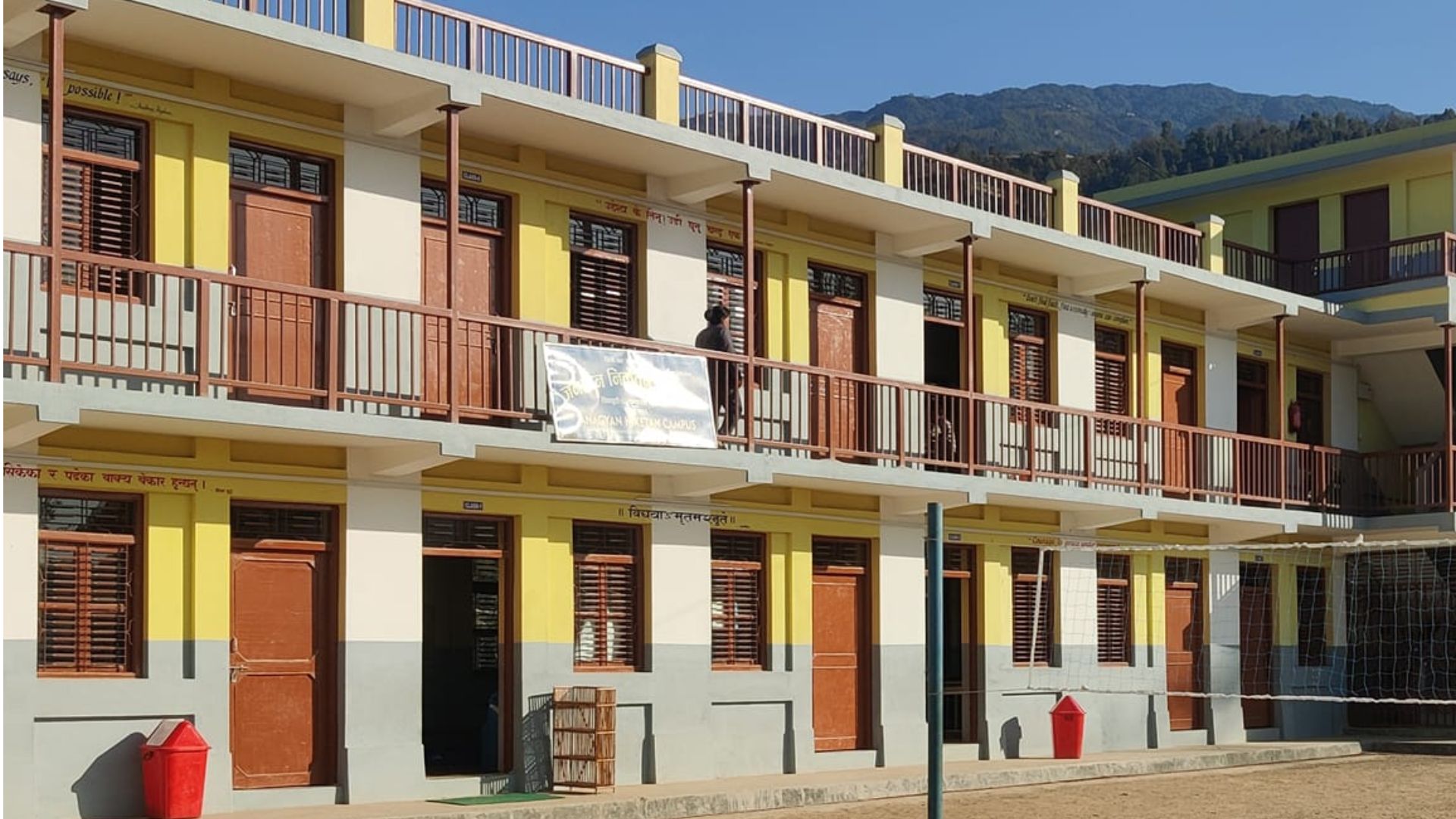
The Machhapokhari campus has a compact but functional layout suited to urban students who commute from different parts of Kathmandu.
Key facilities include:
-
Science laboratories for Physics, Chemistry, and Biology, equipped with instruments and materials for NEB practical work
-
Computer lab for +2 and BBS students, with internet connectivity and basic software needed for coursework
-
A separate hotel management lab for practical classes in hospitality-related subjects
-
Library with course textbooks, reference materials, and exam preparation resources
-
Classrooms with adequate lighting, furniture, whiteboards, and multimedia projection where required
-
Hygienic cafeteria for school and college students
-
Basic healthcare and first-aid support on campus
-
Transportation services covering selected routes in and around Balaju and neighboring areas
These facilities are aligned with NEB and TU expectations for science, management, and BBS programs and regularly support practical exams and internal assessments.
Student Life and College Experience
Student life at Swati Sadan College is shaped by early morning college hours, structured class routines, and continuous contact between teachers and students. A significant number of learners come from working or middle-income families in Balaju, Gongabu, Tokha, and nearby localities, which makes the college a neighborhood hub for higher studies.
Students experience:
-
Regular classroom engagement with attendance monitoring
-
Internal examinations and feedback sessions
-
Problem-solving classes for mathematics, accounting, and statistics
-
Interaction with school and college management during formal and informal forums
-
A shared campus with school students, which contributes to a family-like environment for younger siblings of college students
Guardians are invited for meetings during result distribution, academic counseling, and special orientations, helping maintain shared responsibility for academic progress and discipline.
Extracurricular Activities (ECA)
Swati Sadan College runs a variety of co-curricular and extracurricular activities under designated ECA teachers for art, dance, music, and handwriting.
Common ECA and CCA areas include:
-
Art, dance, music, and handwriting improvement classes
-
Quiz contests and speech competitions at school and college level
-
Sports events such as football, cricket, indoor games, and inter-class tournaments
-
Cultural programs around festivals, prize and medal distribution days, and annual functions
Scholarships and Financial Support
Scholarships at Swati Sadan College cover both merit-based and need-based categories across +2 and BBS programs. The schemes are guided by internal policy and national expectations on inclusion.
Merit-based scholarships
Examples of merit-linked support (exact percentages may change by academic year) include:
-
Full or partial waiver on admission and tuition fees for students securing A+ in multiple subjects in the SEE examination (for +2 Science and Management)
-
Partial waiver for students achieving high grades from government schools
-
Fee concessions for students who achieve the highest marks in entrance exams, terminal exams, or NEB/TU board examinations
Inclusive and need-based scholarships
The college also reserves concessions for:
-
Students from Dalit communities
-
Students from geographically remote or under-served districts such as Karnali, Manang, Mustang, Solukhumbu, and Taplejung
-
Students from historically marginalized castes and communities (for example, Chepang, Raute, Dhimal, and other listed groups)
-
Earthquake-affected students and those who show need during counseling
At BBS level, scholarships are available for students who have scored high marks at +2 and for those who perform strongly in internal and university examinations.
Institutional Milestones
Swati Sadan College measures its progress mainly through student performance in NEB and TU examinations, improvement in enrollment from local schools, and the number of graduates proceeding to higher studies or employment.
Key milestones and indicators include:
-
Stable operation of +2 programs in Science, Management, and Humanities since 2065 B.S. under the then Higher Secondary Education Board, now NEB
-
Operation of BBS under Tribhuvan University since 2066 B.S. with regular batches of graduates completing their studies from this Balaju campus
-
Continuous growth of total enrollment from school to college level, reaching around 1,850 learners
-
Regular organization of practical exams, internal evaluations, and medal or prize distribution programs for school and college level achievers
Why Choose Swati Sadan College?
Prospective students and guardians may consider Swati Sadan College for several practical reasons:
-
Location in Balaju, Kathmandu, within walking distance of the Ring Road and local transport routes
-
Combination of school, +2, and BBS programs on a single campus, which makes academic progression easier for many families
-
Affiliation with NEB and Tribhuvan University, ensuring national recognition of academic credentials
-
Focus on applied learning through labs, projects, hotel management practice, accounting and taxation training, and research assignments
-
Structured scholarship schemes for high achievers and for students from disadvantaged backgrounds
-
Close link between college administration and guardians through regular meetings, phone communication, and scheduled counseling sessions
Message from the Campus Chief
The message from Campus Chief Mr. Gyanendra Dawadi expresses the college’s belief that education must join knowledge with values and adaptability. He notes that Swati Sadan College views parents, guardians, and teachers as partners in building the future of students.
He highlights three central ideas:
-
Academic excellence through systematic teaching, assessment, and support
-
Character development and social responsibility, so that students grow as confident and considerate individuals
-
Collaboration with families and community, recognizing that lasting learning depends on trust between home and institution
The message also thanks parents and guardians for their continued trust and invites them to remain active participants in counseling, feedback, and school–college activities.
Management Team and Governance Structure
The management team of Swati Sadan College brings together academic leaders, administrators, and advisors who look after governance, planning, and day-to-day operation of the institution. The team works across school, +2, and bachelor levels, so decisions about policy, teaching quality, and student support stay consistent throughout the campus.
Board of Directors
The Board of Directors provides overall direction and institutional oversight. It sets long-term priorities, approves policies, and monitors how the college is progressing in academics, finance, and community engagement.
Key members include:
-
Chairperson: Mr. Prakash Ghimire
-
Campus Chief (BOD): Mr. Gyanendra Dawadi
-
School Principal (BOD): Mr. Rajendra Kumar Sharma
-
Members: Mr. Keshav Phuyal, Mr. Dileep Raj Lamichhane, Mr. Rajendra Dawadi, Mr. Megha Raj Subedi, Mr. Hari Dawadi, Mrs. Jyoti Neupane, Mr. Shambhu Nepal
-
Legal Advisor: Mr. Shambhu Nepal
This group meets regularly to review academic performance, approve annual plans, and ensure that the college follows the rules of NEB, Tribhuvan University, and national education authorities.
Academic and Administrative Leadership
Under the Board, academic and administrative leadership is handled by an experienced team:
-
Campus Chief: Mr. Gyanendra Dawadi
-
Campus Coordinator: Mr. Govinda Adhikari
-
Principal (School Section): Mr. Rajendra Kumar Sharma
-
Finance Director: Mr. Rajendra Dawadi
-
School Coordinator: Mr. Madhav Prasad Adhikari
This group manages class operation, examination schedules, teacher deployment, financial planning, and coordination between school and college sections. They also meet students and parents during counseling sessions, result discussions, and orientation programs.
Academic Advisors
Swati Sadan College receives guidance from a panel of advisors with long experience in higher education and public service. Advisors such as Dr. Kedar Nar Singh K.C., Dr. Madhusudan Pun, Dr. Tika Ram Bhattarai, Col. Hom Nath Dawadi, and Asso. Prof. Prem Chapagain contribute insights on academic standards, institutional development, and links with universities and professional sectors.
Their role is to review key academic decisions, support quality improvement, and guide the college in planning programs that match national needs in education, management, and public service.
Heads of Department and Faculty Coordination
Alongside the central leadership, each major subject area has coordinators or Heads of Department who supervise teaching plans and assessments. Examples include:
-
English Department: Mr. Rajendra Kumar Chapagain (HOD), with faculty such as Mr. Keshav Phuyal and Mrs. Chanda Dhital
-
Accountancy: Mr. Gyanendra Dawadi (HOD), with faculty including Mr. Rajendra Dawadi, Mr. Tirtha Raj Adhikari, Mr. Kiran Raj Adhikari, and Mr. Kailash Dhakal
-
Economics and Management: Mr. Govinda Adhikari (HOD) with colleagues in finance, taxation, and business law
-
Science: subject-wise teachers for Physics, Chemistry, and Biology such as Mr. Mahesh Chandra Adhikari, Mr. Uttam Lamichhane, Mrs. Menuka Gotame, and Mr. Prakash Pokhrel
-
Computer Science and Hotel Management: IT and hospitality instructors including Mr. Milan Budhathoki and the team from Sphere Institute of Technology
Heads of Department prepare annual teaching plans, coordinate internal examinations, and help newer teachers align with NEB and TU syllabi. They also support project work, research assignments, and subject counseling for +2 and BBS students.
Student Services and ECA Coordination
Student-facing services are supported by roles such as librarian and reception staff, including Ms. Urika Devkota and Mrs. Goma Pudasaini, who help with library use, basic information, and communication between students and administration.
Extracurricular activities are coordinated by ECA teachers such as Mr. Niraj Chitrakar (Art), Mrs. Prativa Chamling (Dance), Mr. Gopi Adhikari (Music), and Mr. Laxmi Gurung (Handwriting). They organize cultural events, competitions, and creative activities that add to classroom learning.
Conclusion
Swati Sadan College, Balaju, stands as a community-based institution that connects school, secondary, and bachelor-level education in one campus. With +2 programs in Science, Management, and Humanities under NEB and a BBS program under Tribhuvan University, it serves students who seek structured education at an affordable cost within Kathmandu city.
Frequently Asked Questions (FAQs)
1. Where is Swati Sadan College located?
Swati Sadan College is located at Machhapokhari, Balaju-16, about 100 meters inside the Ring Road in Kathmandu, Nepal.
2. Which boards and universities is the college affiliated with?
The +2 programs (Science, Management, Humanities) are affiliated with the National Examination Board (NEB), and the Bachelor of Business Studies (BBS) program is affiliated with Tribhuvan University.
3. What programs does Swati Sadan College offer?
The institution runs PG to Grade 10 at school level, +2 programs in Science, Management, and Humanities, and the BBS program in Management.
4. What are the basic admission requirements for +2 and BBS?
For +2, applicants must have completed SEE or equivalent with at least GPA 1.6, with an entrance test for Science and counseling for other streams. For BBS, applicants must have completed +2 or equivalent in a recognized stream and meet Tribhuvan University’s eligibility criteria.
5. Does Swati Sadan College provide scholarships?
Yes. The college provides merit-based and inclusive scholarships, including fee waivers for high achievers in SEE and +2, students from government schools, Dalit students, learners from remote districts, and those who top internal or board examinations. The exact scheme and percentages are announced each year.
6. What facilities are available on campus?
Facilities include science labs, computer lab, hotel management lab, library, cafeteria, transportation, multimedia-supported classrooms, healthcare support, and CCTV-monitored teaching spaces.
7. What is the usual class time for the college?
College-level classes run from Sunday to Friday, 6:00 AM to 9:40 AM. School-level classes run from 9:40 AM to 4:00 PM.
Contact Swati Sadan College's administrative office for detailed information on the course, admissions, location, fees, scholarships, facilities, counseling, or eligibility.
Contact Details
Swati Sadan College
Email Address: info@swatisadan.edu.np
Phone Number: +977-1-4950674, +977-1-4970019, 1618014970019 (noticeboard)
Website: https://swatisadan.edu.np
Location: 100m Away From Ring Road, Machhapokhari, Balaju-16, Kathmandu, Nepal